Dr. Gerald Bassleer explains discus pest and angelfish disease: what causes them, how to spot the symptoms, and how biosecurity and proper care prevent outbreaks in your tank.
Questions this video answers
Nearly 15 to 25 years.
About 32 degrees (Celsius) or more.
Chapters
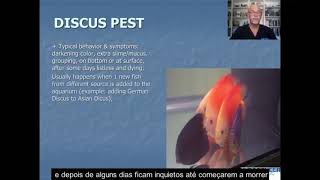
Foreign. Now we will discuss the fish disease. Case number five. About discus pest or angelfish disease. A problem quite often I receive in my office. Well, angelfish disease pest. Well, you can see the discus starting to behave very strange. People who have been keeping this curse for a long time know this problem is already existing for nearly 15 to 25 years. The fish are becoming dark, listless. You can see the extra mucus and slime appearing and whitish getting on the body. The fish have a difficult respiration. You see, the fish are suffering. Extra mucus is a particular reaction which we see quite often. And the discoloration. And afterwards some problems can be secondary, some bacteria can affect it. And the same we find in angelfish disease. It's the same kind of discus pest here on this large angelfish in this fish tank in the pet shop. And also here, the Severum red severum also. These kind of fish can have this kind of angelfish disease or discus pest. Getting dark, losing color, extra slime, laying on the bottom, getting listless. This similar kind of symptoms, same kind of problem. And I try to explain what could be this problem. The discus pest. Well, the typical first of all is the behavior like I showed you and the symptoms. The darkening color like you see here on these fish. Extra slimy mucus, the grouping on the bottom or at the surface. And after some days they are listless and even they start to die. Usually happens when one new fish from a different source is introduced to your aquarium. For example, adding German tank raised discus to Asian discus or wild discus. Mixing with tank race discus. Usually it also happens with a change of season and mostly by foggy weather. Usually it happens overnight. It goes very quickly. In the discus pest. If we examine the fish, we found there is a lack of immunity. There is an allergic reaction like you see here. Extra mucus is produced by the fish, like an allergy on the gills. And this is causing respiratory problems. But think about it, that it could be also a parasitic infection causing the fish to become sick. Something like gill flukes or spironucleus. I found in my experience also viral infection like iridovirus or secondary bacterial infection. So my conclusion is there is not only one clear factor. And unfortunately no good scientific study has been done so far. So what to do for the discus pest? Well, first of all, your prevention is avoid the mixing of different origins of fish, different angel origins, angelfish or discus from different breeders. Be careful when you start to mix. Avoid close contact of aquaria. I mean exchange of water and net from contaminated tank from one tank to the other. From a tank raised fish to a wild fish, keep the net separate, keep the water separate. So work biosecure so you can avoid the problem. You can also help to improve the resistance of the fish, the immunity by giving good immunostimulants to the fish food. If you have the problem, do big water changes many days after each other that already can help some people raise the temperature to 32 degrees and more. That can help the fish. Of course. Like I give you in my training, do an examination, use the microscope. Maybe there is a specific pathogen playing a role. And depending on your microscopic findings, you can add certain medications because it could be some specific disease you can treat. You need more information, you can go to my playlist on YouTube English so you might have more chance to learn more about diseases. Thank you.