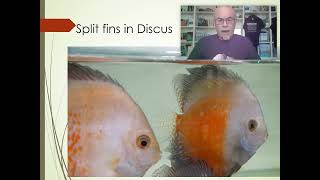
Gerald Bassleer examines why discus and scalare develop split or broken fins. Causes range from bacterial fin rot and iridovirus to poor nutrition and overcrowding. Most cases stem from internal disease or weak fish condition, not external rot, so diagnosis and water quality matter more than fin-trimming.
Chapters
Hello, dear aquarist that keeps discus fish or the discus hobbyist or the discus lover. Yes. Today a special video for you on split fins or broken fins. An issue that is discussed on social media amongst breeders and hobbyists. And I have seen this discussion going on. So I was thinking, well let me make a video about this topic and include some of my studies of my cases of fish diseases on discus which where I find also split fins. So watch my videos, watch me well my beautiful discus on this T shirt. Yes, those I have no split fins, but that's the way you should have your discus in this kind of color and no split fins. So follow my cases which I present here, my conclusions and my findings that might help you to prevent this kind of problem and solving the this problem of a split fin. Split fins are broken fins in discus or other fish. Select the subtitles. I I just for you the language because I corrected the language in English so the translation is more up to date for you in your specific language. Well, this is a snow leopard was showing those split fins. Look in the dorsal fin, look at the anal fin. Well, those fish were not looking very well. And the same for this kind of discus. Look here, the broken fin in this discus here. Well, that was not a good thing to see. Here we see it in another fish tank. Some have it very badly, some have it very little, some have nothing. And that can happen very strange. We see it, but it's typical that we see this kind of well happening that it's not a common problem. No, it's not very common. It's very rare to find in wild discus. It's typical for certain breeders. Here it's about you breeder. I bring you the cases and sometimes it's specific fish from the breeder. And this case is split fins developed after weeks, not from the beginning and not all the discus, but only few in our cases we could not find the fin rod. And interesting to notice below you see the link on a discussion we had on Facebook on this matter in June 2023 that might interest you to see that discussion where we evaluated the problem and I got some nice shares from my audience. Well, other cases with bad fins here it's real fin rot. On this discus you see the tails and the phenyl fin and the dorsal fin rotting away. Caused by a fish that is affected to a spiral nucleus and internal infection. Here that's a real tail rot here that's a broken finch or damaged fins here also necrotic fins here we see the broken fins here and here Here we see like a kind of tail rod and a fish that has fish tuberculosis or mycobacterium. Here we had another case. You see this split fin here in the dorsal and here in the anal fin. This fish we diagnosed with gill flukes fish tuberculosis. So many kind of diseases. And to give you an idea, as my doctor told me. Well, Gerald, look what mankind can have with their split nails called scientifically or nijorexis, which is due to different reasons, chemicals, physical injury, damage by lesions, temperature also can have an impact people working in cold water, organ failure and disease. Well, think about or discus old age, shortages of certain things in the food. Well, this is something happening with mankind. Just to compare. That's why we're not thinking about in this way about our fish. Why not thinking about the origin? That could be several or one origin. Yes, it can be. It can be disease, for instance, it can be a bacterial fin rot. Yes, but in most cases I found no fin rot. You can see all the cases I show you below. I hardly found any fin rot that was really causing it. It's possible, yes, there might be some cases like Andrew so said in his book and he has a lot of experience that he might have countered it. But the primary reason in my opinion is not the fin or tail rod for that split fin. A viral infection? Yes, could be. Could be like an iridovirus. Iridovirus, which is a virus common in our aquaria. It's not so much research, so hardly not much to say about it. Infected internal organs? Yes. If they're not functioning well, the organs, there can be a risk of poor blood supply, poor health of the fish like the thyroid axis, which is not working properly due to certain reasons. Or a mycobacterium fish tuberculosis infection or flagellates, internal parasites. I show you in my cases what we found. Could it be genetically origin? Because only specific species show those split fins. That's what we've seen from European breeders. And generally it's the poor health, poor blood supply causing the fin decay. This is what we found in our kind of cases. Also Andrew Soss published his findings and his suggestions. I will show you later on in the next video in the next part of my presentation. Could be also the origin or several one combined coming from environmental causes or food causes. The potential risk of temperature, drastic changes, too low temperature. Or could it be stress, Too small aquaria, too many fish together. Aggression, poor water flow or too heavy water flow, bad netting, poor transport. Could it be the water quality? Too large difference with the water that Came from the breeder. The fish were kept in for months and then they come to a complete different kind of water content. With too low alkalinity maybe, or too high or too high. Ammonia can have an impact when the filtration is not working properly. Or too low oxygen content. Those are all reasons that can cause the problem with bad fins. This is studied in aquaculture. It's not only coming from meat. It's generally. You can find that when you go on Google and look for the origin of fin decay or split fins. Food resources. Yes. Shortage of certain vegetable content because a lack of valuable content like iron, vitamin B minerals. This could be one part of problem in certain cases. Like split fins. Here in the angelfish. Yes. Look at the split tails, the broken tails of this and some of the dorsal fins of this black angelfish. See the link below. I give you the link of this study. Also of this discus fish with the split dorsal fin. See the study below. Or this snow leopard with the split dorsal fins and anal fin. I show you the study below. Well, Andrew so's book the Discus the Naked Roof. Many might have that book with you. Well, read that chapter on broken fins. Some nice information about with bacteria or without bacteria can be a problem. The treatment I can suggest. Well, the first of all, before you can do a treatment is do a good diagnosis to check for the possible pathogens. And then you can treat accordingly and the fish can repair its finch. When it is in good condition, a good care can prevent the problem. Know the recommended parameters from the breeder, the supplier and do more water changes. I always recommend keeping fish. Yes. In most cases. For most aquarium hobbyists, it's necessary to do regular water changes. Avoid overcrowding. Use a large aquarium. Use a functional fish food with a good variety of ingredients. Watch out for frozen or live fish food. I have specific videos on that. Because they can bring in pathogens, microbes, bacteria. Your fish don't need the cutting off the damaged parts. See Andrew saw his recommendations in his book. Cutting off is a possibility to start repair prevention. Yes. Avoid the purchase from a certain source. So check on that. Here is Andrew so's suggestion on cutting off the fins. You can see it in his book. He just put the link on Andrew so's the naked truth of discus. He explains it all in his book. Well, I hope this video explains you that your eyes are limited. You only see the broken or the split fins, but you don't see exactly what is causing it. It's usually in my opinion an internal disease problem. I explain a lot about that in my books. You can find it there. Subscribe to more videos, particularly on discus fish. I have a particular playlist which also bring the show you the link here below. Well discus people, try to keep your fish. Your discus is in the best condition so make you happy and avoid the split fins and follow my recommendations. Thank you for watching.