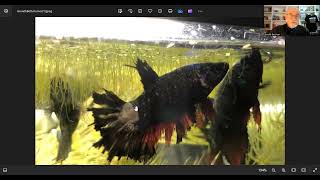
Gerald Bassleer reviews a recent scientific paper describing large skin nodules (iridophoromas / skin nodule syndrome) in Siamese fighting fish (Betta splendens). He summarizes the paper's histopathological and immunohistochemical findings: mycobacterial infection tests were generally negative, other bacteria were present, and authors suggest multifactorial causes including environmental factors and possible genetic predisposition from mass breeding in Thailand. He emphasizes that the syndrome may have multiple origins (infectious, environmental, genetic) and that careful diagnosis (microscopy/lab tests) and better broodstock selection are needed.
Chapters
Hello. Dear Agorist, dear fish keeper, today a special case of a fish disease that was studied in a scientific paper about betta fish. The betta fighting fish developing big nodules on the body, looks like big growths. And I had a case like that presented to me by a hobbyist who was dealing with this problem. And it seems to be an ongoing problem in the aquarium fish industry. So I show you the picture of the fish I got sent to me. And here you see this betta fish, you see this big growth here. This is something that is discussed in a scientific paper which I will show you because I found this article recently published at the same time that I had to consult this person dealing with, with this disease. So let me get you this paper here, which I show you. Well, here are the. The betta fish. Look the same kind of big ros. Here. And also here you see those big nodules here. And well, the article, the title is the Histopathological description of Iridophoromas Resembling Skin Nodule Syndrome in Siamese Fighting Fish Betta. Splendid. So this our big skin nodal syndrome, it is called and it seems to be a problem that is developing more and more in. In Bettas, particularly here about the betta fish which are raised in Thailand and they're becoming. Seems to be a problem. Well, due to different reasons. And that's why the article presents me the idea that we should look more at a holistic approach to this kind of nodule or skin nodule syndrome, as it has been called. And it was suggested that multiple bacterial infections were involved, also Mycobacterium. Different articles have been published on that. And also this article wanted to study did we found Mycobacterium, yes or no. So they were examining and here they describe the histopological, histopathological and immunohistochemical characteristics of the fighting fish. They, they examined and they found well, a mix of problems. The results show that they couldn't find particularly mycobacterial that was negative. And at the same time they found other kind of bacteria. But the interesting thing for me that they concluded that it could not only be a case of a bacterial infection, it could be also a cause that these fish might be having suffered from other reasons that maybe are not infectious, but maybe environmental reasons or maybe genetically. See, they concluded it resulted in a possible genetic origin because the Thai here, the Siamese fighting fish are breeded in. Bred in a large quantity and might be developing some genetic the risk of developing the nodules. And I'll show you in Short explain you with the pictures that can help us understand. Here are the big growths, the nodules inside, well, inside the cut of the fish. And here you could see those extra large growths developing all different forms. Some look like little nodules or granulomas look like this here. They did that study on that and they found out as a conclusion that. Well, the discussion is below here. You could read it all in the article below. But they should be done much more studies done on that because they say that these tumors, well, are typical for captive species, but they also found it in some wild species. So that might be something coming from nature because they think it might also be caused by environmental issues or chemical issues and well, things that need further examination instead of concluding, well, this nodal syndrome is typical bacterial and we should treat with antibiotics. Well, it doesn't work like that. It's not a parasite. It is not a typical one. Typical bacteria. And I would conclude that this kind of infection, like on this betta, I think it's different origin in different bettas, the nodules is a syndrome. And they said it clearly that it was a syndrome and it might be due to different origins. And that's why you have to do study clearly to use the tools of a microscope and the tools of a laboratory to do a detection of the pathogenic origin of this fish. Particularly important to understand if you're a breeder or if you are an exporter or import that you know the origin of the fish and that you're more careful where to buy the fish from. If this incident of these nodules are. Are bigger, how can I say are larger. So that's something we, we should concerned about that breeding of fish can also breed diseases and that you didn't make a good diagnosis. Like here this study look at in detail on the link below. They had different conclusions, different possibilities. They refer to different studies. Some said it was mycobacteriosis, you know, so the mycobacteria of fish tuberculosis, which I sometimes found also in those big growths, but not all the time. It is different, has a different origin and maybe a genetic origin so that the breeder should select better his brood stock. Okay, Okay. I hope this study explained you to understand this case of the nodal syndrome and the Beppas. Thank you for watching.