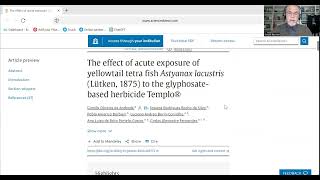
Gerald Bassleer reviews a Brazilian study on glyphosate's effects on Yellow-tailed tetra fish. Even at legally permitted concentrations, the herbicide caused chromosomal damage and mutations. He warns aquarium hobbyists and farmers to test their water for glyphosate contamination.
Chapters
Hello. Dear Al, interesting for you that you selected this video about the toxic effects of herbicides, a product commonly used in our aquaculture now in our agriculture industry. It's about glyphosate and what effect it can have on ornamental fish, particularly for those that are breeding fish or getting their water from nature or water supply, even groundwater or well water that can be polluted with herbicide and can have a serious impact on your fish. It's also concerned about human health that certain herbicide, particularly glyphosate, is known to be having a toxic effect and a hormonal effect on mankind. This study is done as an interesting study on a tetra ornamental, in fact an ornamental aquarium fish. And I want to share with you the findings of this study. I will not go in technical details, but still you will have the link below of this study. So you can see for yourself if you want to learn more about the well, the details on this scientific study. The title is the effect of acute exposure of Yellow tailed tetra and Astyanax lacustris to the glyphosate based herbicide Templo. Well, this herbicide has been used in Brazil and it's a study that is done by the Brazilian researchers to find out, well, what is the impact, what is the legalization, what is the risk you can have when you use water or products or anything that particularly in the water supply or that has a risk of having impact on your fish? And everybody knows glyphosate as Roundup. Roundup in this world is well known that it's not commonly available for the hobbyist, but only by the professionals. But still incredible. I can hardly believe it. It's still allowed to be used. Well, it's known to be a serious risk for mankind and here for the fish. The highlights of this study that glyphosate demonstrates acetyl to toxic and genotoxic effect in the Astiana extetra. The glyphosate induces chromosomal aberrations and micronucleated erythrocytes. That means it has an impact on the chromosomes, the genetics, the hormonal structure of the fish. The exposure to glyphosate also alters the cellular morphological erythrocytes, so making it a risk to become sick. And the concentrations that are permitted by the Brazilian legislation result in mutagenic effects. So these concentrations that by law are permitted to be used, it's not only in Brazil, but it's also in Europe that this amount of glyphosate is allowed to be used. I don't know who's behind it. I will not say any names. Who's pushing for the use of this terrible herbicide that is a serious impact on animals and on mankind, and that even the concentration that is permitted has a result in the mutagenic effect. And the abstract of this study Kirt says, well, if it of course the glyphosate efficiently eliminates weeds, but it's available in surface waters and it can have a risk for non targeted organisms like the fish that get water from rivers, from well waters, for aquaculture, for instance, or any livestock. And the main objective of this study was to investigate the cytotoxic and genotoxic effects also on the DNA and on the chromosomes, all the effects that it has. So the analysis were significant for all concentrations they tried out in the testing. That considering that intensive use of this commercial glyphosate formulation in crops like the herbicide Templo in Brazil, but like the same as Roundup in Europe or in America, represents a potential risk of of genotoxicity and cytotoxicity for aquatic organisms. That means it changes the cell structures, it changes the genetic material and it changes the hormonal balance of the fish. Might be a risk that your tetras become all non able to reproduce anymore because the hormonal balance has been disrupted. So you might think about when you are breeding fish and using water from a river or from a well and you have poor result in breeding, that you have to check your water supply anyway. When you're dealing with fish breeding outside with well water or live water, you have to check regularly the water supply. But in this case you have to check for glyphosate or Roundup. Anything that can be a herbicide can be toxic. But particularly this one has proven that the Environmental Protection against agency must be reviewed by regulations for glyphosate based herbicides in freshwater environments. And I hope this study also contributes that we have to get rid of using these kind of toxic products in our nature. I'm an eco modernist, you can follow me on Facebook. And I really hope we can protect our nature or animals and also mankind for these toxic products. And this study well go in detail, see the link below. But I want to show you that if you use water supply, you may be pretty sure you have to check your water supply, particularly when you're a farmer or a breeder, and that you are aware it can have a toxic effect on your fish. Just a prevention, just to make sure what you're doing in aquaculture. But I think even for people who are dealing with large volumes of water, even importer, exporter, pet shop, fish hobbyist, who using water from their water supply, think about it. It might be a risk with glyphosate that is well known and it's widely used still worldwide. Thank you for watching. Take care.