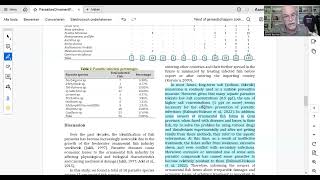
Gerald Bassleer summarizes a study of parasitic infections in ornamental fish farms in Qom (Qom) province, Iran. The research sampled 130 fish from 14 ornamental fish farms over seven months (November 2021–May 2022), covering 15 species, and examined them microscopically for internal and external parasites. Ninety-six of 130 fish were infected (~74%); the most frequently detected parasite was Capillaria (23 cases), while Lernaea ("Lardia" in the transcript) and Ichthyobodo (Kostia) were least common. Detected parasites included Trichodina, Lernaea (skin flukes/Gyrodactylus mentioned), Ichthyobodo/Kostia, Tetrahymena, Oodinium (velvet), Dactylogyrus, Ichthyophthirius (white spot), internal nematodes (Capillaria), and Spironucleus (Hexamita). The study’s conclusions stress improved diagnosis, targeted treatments, biosecurity (isolation of units, disinfection, extended quarantine), careful use of salt and antiparasitics, and use of probiotics/prebiotics in feed to reduce parasitic disease.
Questions this video answers
November 2021 to May 2022.
14 farms.
130 fish across 15 species.
96 infected out of 130 examined (≈74–75% prevalence).
Capillaria (capillary nematode) — 23 cases.
Chapters
Hello, Dear Aquarist, Today I'm hoping to get you some details on certain diseases that can appear in fish farms. And this study was done in Iran, where there is a lot of aquarium fish breeding going on. And it had a specific attention to the parasitic infections going on in ornamental fish farms in the Qom province in Iran. Iran has a lot of ornamental fish. It's the most preferred pet to be kept in Iran. And of course, therefore there is a lot of breeding and a lot of fish keeping going on. But I bring you to the attention to this study because it gives you a good idea of insight what parasites we can encounter in fish farms. And the purpose of this study, I will indicate here in yellow, was to investigate the parasitic infections in 14 Ornamental fish farms where diseases and death have been reported in different fish pieces. And this research was carried out for seven months from November 2021 until May 2022 on 15 different species of ornamental fish, including Ternettsi tetra, guppies, mollies, goldfish, Tetras eques, Pterophyllums galari, angelfish, Zebra Danio bettas, Tiger barbs, Hemigramus ocelopher, ancestry's catfish, Heros severus cichlid, the Rivulatus cichlid and the Koi carp and the rainbow Melanotania praecox. They were sampled for examination for internal and external parasitic infections with the use of a microscope like I use the best tool to find parasites within a couple of minutes research and in the results, which I will explain later on, more in detail. Following parasites were found Trichodina chirodactylus, skin flukes, Lernia Ichthyobodo or Kostia Tetrahymena Oodinium or velvet disease, Dactylogy or gel flukes, Ichthyophtheria white spot disease and also internal parasites like Nematodes capillaria, the Hexamita or now these days called Spironucleus parasites. They were detected and the highest prevalence of parasites was related to Capillaria nematodes and the lowest was Lardia and Ichthyobodo or used to be called Kostia. The study concluded that these findings can help to develop a program for the prevention and the treatment of parasitic diseases in freshwater aquarium fish in Iran, but also in other countries. It's a study that you can use in your country or you as a fish farmer to better develop a better program in preventing fish diseases. I will not go in detail on introduction about the aquarium industry, what it is all about, how Important it is and what we should do about fish health. The main thing I explained already that the study was done with a microscope and the results showed that out of the 130 examined fish, 96 of them had an infection with different parasites. So that means nearly 75% of the fish that were examined from those fish farms had parasites. I will show you later on in the table which parasites so it has a better overview. You see a few pictures here of the Lernia, the flukes, Tetrahymena, the white spots, all what they found. So the parasitic infection stages of the fish. Here we see on the left all the different fish pieces. And here on top we see all the different parasites, the ones they found during examination. And as you could see, 130 fish were examined and only 34 fish were free of parasites. That means nearly 75% had parasites. And the most found parasite was the capillary nematode in 23 cases. Then also hexameter was very common. The skin flukes were common. The Tetrahymena parasites were also common. And here we could see the percentage of parasites that were found. And here also the quantity of fish where it was found. Well, Capillaria is the highest and Hexametha, like I said, Tetrahymena and Gyrodactylus or skin flukes. So quite a lot of parasites. That means there is some problems in that farming going on. But not only in Iran. I can say it's happening in different parts of the world and one country has more problems than other countries. So in the discussion here I summarized or indicated a few things which I thought were important. You can read for yourself this article. The link is below. More detail if you want to learn more about it. But I will give you some things which I think were appropriate to explain to you. In most farms a long term salt immersion treatment is usually done. It's using sodium chloride as a preventative measure. Usually small quantities of salt do hardly anything. It looks like it controls, but it doesn't kill parasites. Maybe it controls the growth or the fast spreading of the parasite. Well, the aquatic parasites can tolerate sometimes high concentrations of salt. So you have to go pretty high in certain parasites to really use high quantities of salt. And you have to think about that. It depends on the parasite you found. So that is a something which is quite often used. Why? Because it's cheap and it's easy to use and it can be used as an effective prevention treatment. But you have to apply it correctly in a good dosage. In addition, some Owners of ornamental fish farms in the Com Province. When they are faced with diseases and losses in their fish, they try to solve the problem by using various drugs and disinfectants experimentally. That means they experiment, they don't research, they don't do a diagnosis, they just try something and after not getting the results like they would expect from their trials, then they go to the veterinarian. Well, you know, in many cases it's too late. Fish are too much damaged. And then the veterinarian, of course, has to try to solve and maybe save some fish or hopefully giving some directions to the fish farmer to be more aware about his treatments. So most of the time when there is the result of the ineffective treatments, the fish suffer from weakness, excessive stress and even a conflict with secondary infections. Well, we know when parasites are not controlled and are damaging the fish, there's a bigger risk that the fish gets secondary bacterial infections. I discuss that quite often in my fish disease cases. Moreover, the excessive and unwanted use of some antiparasitic compounds has caused some parasites to become relative resistant to them. That means apply the correct dosage, the correct time, and adapt it to the certain parasite, not just throw something in and hopefully it will work. Not knowing what parasite is, it's just creating a risk of more resistant strains. So you can go in detail and read about Trichodina, how they explain that, how it appears in Ichthyobodo and Tetrahymena, all the different parasites they explain. The main thing that explained, of course, Capillaria here is the most common one. It has a direct life cycle. It does not need an intermediate host. And in many cases I recommend when you have Capillaria siphoning the bottom of the aquarium or the pump to get rid of the eggs which they distribute and apply the correct medication. Also think about Capillaria. Because Capillaria is common, it's thinking about the fish food. I've seen cases where tubifex has the risk of introducing Capillaria to the fish, also other parasites. While considering the level of parasitic conflict in the ornamental fish farms in the Qom province in Iran, the need to observe the principles of biological security is strongly felt. Biosecurity important thing. What I discuss quite often, for example, dividing the farms into isolated units and separating them from each other. That means not connecting the farms, the ponds with each other. They should have separate water systems coming in, coming out, no connection. They should adopt specific hygienic protocols, which protocols for the transfer of the fish and also protocols for hygienic use of the equipment between different units. That means disinfecting the nets or keeping the net pond. Each net has one specific net. For instance, also extending the quarantine period when fish have been collected out of the pond into the aquarium or in the tub before sales that they are supervised. So you should try to provide more opportunities also to identify parasites and then to use the specific treatments. Also try to identify your water source if the water source is free of pathogenic pathogens. Also would say not only the water source but also the food source. Frozen food quite sometimes it also brings in bacteria. Here we talk about parasites, but it can also be with live foods. On the other hand, more use of immune stimulating compounds such as probiotics and prebiotics in feed formulation to strengthen the immune system of fish and the use of anti parasitic compounds with appropriate methods and concentrations can play an important role in preventing the occurrence of parasitic infections. Yes, as you know, Dr. Basler by fish food is loaded with probiotics and prebiotics. That's the main goal. It's helping in preventing fish diseases. So it's nothing new. This article just confirms the need of it. So they hope to develop a better program with these results of this research. You see more reference articles if you want, you can see the article here below. So this article tries to explain you diseases, parasites, particularly from a province where there's a lot of fish farming going on in Iran. But it teaches us lessons what can happen and where diseases can come from. Particularly how we can solve it, how we can prevent it. Good diagnosis, good biosecurity, probiotics in the food to help for immune simulation. Just a few things to mention. Thank you for watching and maybe you have questions. Please post your questions and I'm trying or willing to answer them. Bye bye.