What is the best food to give to our aquarium fish?
This YouTube interview (host Malik; guest Dr. Gerald Bassleer) explores optimal aquarium fish nutrition with emphasis on disease prevention through diet. Dr. Bassleer, a fish pathobiologist with decades of experience and a history running a large fish house, argues that fish adapt gut morphology to available diets in the wild and that providing a consistent, natural, balanced feed (his Basilier/BioFish formulation) — featuring Scandinavian wild marine fish, krill, algae, cereals, vegetables, vitamins, trace elements and minerals — supports health and reduces disease risk. The talk addresses Pleco/loricariid dietary questions, seasonal diet variation in wild fishes (guppies, discus), and practical feeding concerns (mixtures of species, longevity of food in water).
Chapters
What should I feed my fish? What's the best food for my fish and how much food should I give my fish? These are some of the questions that I have in my head all the time. It bothers me quite a bit because I want to feed my fish the best food and I want to have the best nutrition for my fish and I don't want to overfeed them, I don't want to underfeed them. I want my fish to be completely happy. This is a core goal for me. So I was blessed enough to have an interview with Dr. Gerald Basilier, who is an ichthyologist who specializes in fish diseases for the past 50 years and he works closely with fish farms in Europe. He's one of the main people they contact when they have a disease outbreak. So he's high up there with the expertise managing fish diseases. He's probably one of the most experienced people with this. And he also has a book and you can buy the book, his website, I'll put a link to it here. I'm not a paid advertisement or anything, but it does highlight all the fish diseases and all the causes and also what you can do, how to identify them, how to manage it and also how to prevent the disease, which is his main philosophy. He says let thy food be thy medicine. That's his core belief. And he thinks that by having a healthier animal who is properly nutritionist or properly well fed, you eliminate a lot of diseases just by simply feeding the animal the right food. So his entire approach is prevention before it even happens. So I really like the proactive approach. Instead of being a reactive person. I don't want to have a disease outbreak and then react to it with medication. I'd rather fulfill feed my fish a healthier diet ahead of time so that the disease outbreak does not happen. That's something I can definitely subscribe to, you know what I mean? Just like you guys have subscribed to my channel and if you haven't, you should do that right now. Right, Right now, Right now, right now, right now.
Yeah. Good.
And give this video a thumbs up.
Because this video is going to be.
Very informative for you guys. And I'm going to segment the hour long interview into small sections so it's not taking up a lot of time for each video. But if you want to watch the whole thing, you can on Dr. Gerald Basilier's YouTube channel. I'll put a link to it up here so you guys can check out his channel and the entire full length video. Now without further ado let's get into this video. Watch till the end because you do not want to miss out on all the valuable information he has to offer you guys. Through this live interview. Produced by Mali.
We're here with Dr. Gerald Basilier, the creator of Basilier Bio Fish Food. And this interview is. Hello doctor. And this interview is basically specifically for Pleco fish keepers, but also for other fish keepers on explaining on different types of foods and questions that we breeders and hobbyists have for Dr. Basileer as well. And so he's going to explain the different things that we've already the predetermined questions that we've asked. And if there is other questions that come to mind throughout the video, I will also ask them. But I will let Dr. Basilea take over now and continue with the interview.
Okay, thank you Malik for introducing me and I'm proud to be part of the Canadian area, Toronto. It's far away from Belgium.
We love you here.
Well, Canada is far away and not possible to fly these days. But anyway, luckily we have the Internet and I will try to answer the questions you posed me and I hope this will give some answers to your viewers and maybe afterwards questions come and in the next coming days I can try to reply to the questions because sometimes you give some information and then some issues remain unanswered off. Logically, I give so much info and maybe some people are still puzzled. Hey, I don't get the right answer, but thank you for the many questions and I will start showing my screen sharing. I will see how we manage here to get it all on the screen here.
Okay.
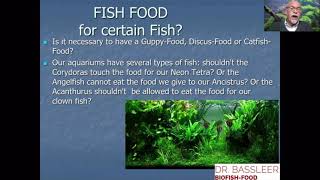
Well Malik, as I promised you, I was planning to give you some answers on your questions both by you and by your followers. So I will start showing my screen with the PowerPoint presentation and I hope this will help you to understand what I'm talking about and why you're sharing these ideas about fish and fish food for specific fish. Well, this is a subject many people ask me because do we need that? And I will try to explain in a few examples with my experience as a fish pathobiologist working with fish diseases and fish health. In more than 40 years I've been looking for solutions what kind of food I have to give. And I had a fish house with 1000 aquaria during 25 years feeding fish many kinds of fish. We had about 250 different varieties. And I was looking for a good food with good solutions for good health, good growth, but particularly for prevention of diseases and control of of diseases. Because the fish food should have some ingredients which helps the fish and avoiding the use of antibiotics or other kind of medications. So the questions you asked, you know, is why the best food? You know, why did I make it? What is better? And what should I give to the carnivore plecos and many other questions like the baby food, the nano food, is it dusty in a mix tank, how should we feed, you know, all different kind of fish and the wood eating plecos, what to do with that, you know, and the ancestors and the hip ancestries, they need more meat. What about the biofish food? What can they do? And if you have a mixture of three types of plicos, what should I recommend? So I will try to explain with my proper point the answers on these questions. And how can the food stay in the water for a long time? Is that possible? Well, I tried to answer, well, fish food for certain fish. Is there a question raised already? Many people do that because people selling fish food for guppies and people are selling discus food or catfish food, you know, like the discus bee people feeding a lot of mosquito larvae. Is that the best food? Well, to be honest, if I feed my fish tank, you know, and I'm feeding my fish tank and I'm feeding the angelfish, angel fish food, does it mean that the cardinals are not able to touch it? Or if I feed my Neon tetras and the corydoras are not able to eat on the food of the Neo Tetra? Or the ancestors cannot eat the food of the angelfish? Or the same for marine fish, if the ekaturis is not allowed to eat the food of the clownfish. Well, I tell you, in nature it's a survival of the fittest. And in nature they have to take what they can get. And I will give you examples of studies which have been done by people specialized in resourcing the sources of the fish food related to the health of certain fish in nature. And here is the guppy studied and Trinidad. What is original the guppies are coming from? And there is a comparison made between two rivers, the Narango river and the Tacariga River River. And they find out that these two rivers had different habitats, different kind of food sources. And because of different kind of food sources, the guppy had no chance then just to eat what was offered to them by the river. They had no chance to wait that somebody feed them or to change the habitat. They just had to explore that was available in the river. And in the river Narang, there was more invertebrates than there was in the Takariga river and less filamentous algae, more in the Takariga river there's more filamentous liver and unicellular algae and diatoms. So it is a different habitat. And what does that mean for the guppy, how the fish survived? Well, they survived but what was typical for the survival that those fish had a different gut system developed. If you see here the amount of invertebrates proportion in the diet, you see a large amount of invertebrates. And here is the length of the gut and the longer the gut is, the longer the gut is. Here on the left that means the fish has been eating many more algae food and less invertebrates. And if they have a lot of invertebrates, they have a much shorter gut length. That means the fish can adapt. The fish adapts during its lifespan and during, also during the dry or the wet season, the fish can adapt to a diet which is offered to them. So extra green food, a longer gut like you see with many ancestries. The Myelosoma, you know, it's called maybe in Canada also the kind of silver dollar type, you know, it's the red hook or the Melissome, many different kinds. And here they show that, that the food is changing depending on the season in the rivers. This is the nature, the nature controls what's available. And you see here, the left bar, you see that's the food that that's been been given. Well, let's go back here, that's been giving us as a plant material. The white bar and the black bar is the fruits and the seeds that I love to eat. And then the other bar here, this one, the big one here at when the low season is the bar where the fish can gather insects. So you can see that the insects, for instance, they eat a lot of insects in the low season and nothing in the rising or the high season. And in the rising and the high season you can see they eat more predominantly fruits and seeds. So you can see changing food depending on the season. So that's typical for many fish in the wild. The discus, I show you the same thing for discus, it adaptation depending on the high water or the low water season. In the yellow I show the high water season where you can see changes in eating vegetable waste products. You can see that the discus, most of the diet between 50 and 80% is flowers, fruits, seeds, leaves, vegetable products. Where are the mosquito larvae for these discus? Well, it's only small part, you know, they eat also algae depending on the season, more in the long season, low water season and they Eat more of aquatic invertebrates and worms in the in the low season and they eat more insects and crustacea. Here is the mosquito larvae. Only about 20% to eat of mosquito larvae in the high water season and hardly anything in the low water season. So this is the diet of the discus changing depending on the season. And it's really interesting for you guys, the people who having ancestors, Pterygoplictis lauricaridae. You see the study of the gut system of different situations where Pterygoplictis not Pyrigoplictis, I think it's the. You call it the mosaic pleco but you can see here the wild, that's the microvilli, the gut system which is different formed than when it's a wood eating system where it's living in or an algae diet where it's living in or a starvation system. And it's a large shortage of food. So you can see the adaptation of the gut to the food source which tells us lessons that the fish have an ability to adapt to the food. So our biofish food is mainly meant for you to be 100% natural because the nature provides the ingredients you have and the nature provides a balanced ingredients. It can be different low and high season. But in aquarium we don't have a high season or low water season or a wet season or dry seasons, hopefully not. But we can provide a balanced diet. And that balanced diet consistent are ingredients Scandinavian marine wild fish, krill, algae, cereals, vegetables, vitamins, trace elements and minerals and those are all very well digestible, particularly the wild fish. And the krill are very good amino acids, very good digested, so less waste and very good absorption by the gut system. Also because the marine wild fish have the best protein ingredients which are necessary for all fish, freshwater and Marine. We did 25 years of testing in the prevention and control of fish health here working in my fish house and we know that the food is suitable for freshwater and marine fish and suitable for all Loricaridae and ancestries.
Thank you so much for watching the video till the end and I hope you guys find value in the interview and hope I. And there's about four more sections that are going to come out in this that I segmented out from the video. I mean I'm just going to edit it out into smaller sections so that it's not so taxing for us to watch. You know, it's hard for average person to spend more than 10 minutes absorbing a lot of information. Even when you study, they tell you study for 10, 20 minutes, take a five minute break, go back to studying. I mean that's just how you kind of maximize your learning potential. So I believe that's why I don't want to put a whole hour long interview, you know, and then you guys don't get the entire length of it. But I will take out sections where I find value and I will put them into smaller videos like this so you guys can check those out and go watch the whole video on his YouTube channel, which I will put the link to in the description as well and should be like out here somewhere. Good in desktop. And hope you guys found this informative. And if you have any questions, comment below and I will be glad to.
Get back to you.
And also if you guys have questions for Dr. Gerald Bassinger, you can also comment here and I can ask him those on a follow up interview or you can also directly ask him those questions yourself on his YouTube channel. So there's so many options so we can learn what's best for our beautiful friends. And that's the question you want to keep your animals alive long term. These guys are about eight years now. Five to eight years. The one that passed away recently was eight plus. When I got him, he was eight. Big guy, you know. Congo tetras, you should live about three years. Dr. Basilir has fish that are 12 years that have an average lifespan of three. So he has cardinal tetras that are 12 years old. 12 years old, not one true, but a whole school of that still thrive and doing great. They don't look like they're 12 years old. They're probably going to make another few years. So these animals in nature even won't make it to five years. But he's keeping them alive three to four times as long as the average person. So he must be doing something like. That's one of the main things that my takeaway from the video is that his goals are pretty similar to my goals when it comes to his own fish. And also which is good for somebody like Bellance Farm, you know, who is the biggest zebra pleco breeder in the world. Then it's good for my fish. That's what I actually said in the interview. You probably see that at some point. So hope you like that and I'll see you on the next video. I love you all. God bless you. So I've been working on this for a little bit. I do have a few that's hatched. There's one right there. I don't know if you can see it. Right now in focus, but there's two that have hatched. There's one egg that had gone bad right here, so I had to remove it as much as possible. That's what I've been doing for the last, like, 15 minutes or so, trying to do that. So I figured I'm going to record this bit because I have been using the camera right on my iPad.
More from Gerald

Sick Dwarf Cichlid Apistogramma. See link complete video. #fishdisease #apistogramma #Cichlid


Fish disease case nr. 365 Tankraised Apistogramma borelli with bacterial infection and few tubercles

Corydoras catfish worm infection. See link complete video. #fishdisease #corydoras #catfish catf

Fish disese case nr. 364 Wild Corydoras concolor with Camallanus and other worm infections


Fish disease case nr. 363 Wild Cardinal tetra, Paracheirodon, with worm and bacterial infection

Fish disease case nr. 362 Sawbwa with gill flukes, Nematodes Capillaria and bacterial infection

Sick Golden Orf with Dropsy. See link complete video #fishdisease #GeraldBassleer

Fish disease case nr. 361 Golden Orfe with dropsy or ascites due to bacterial infection

Fish disease case nr. 360 Apistogramma with 3 different parasites and tubercles in the organs