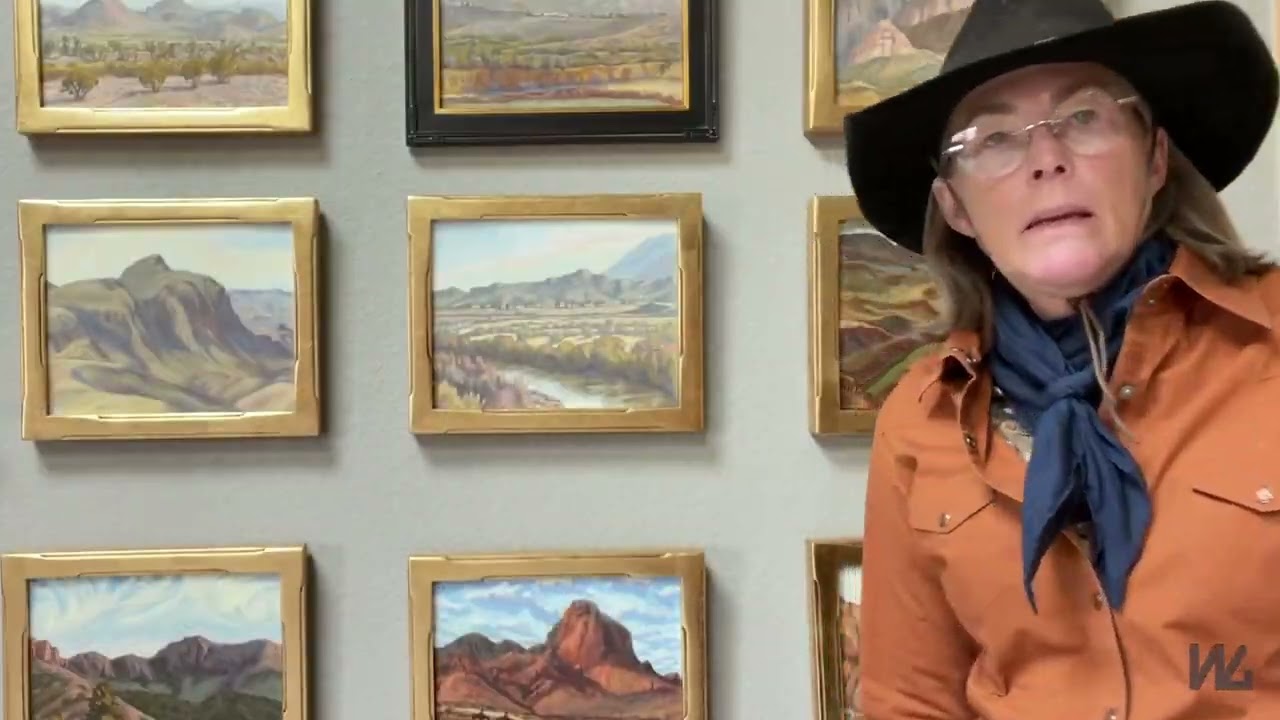
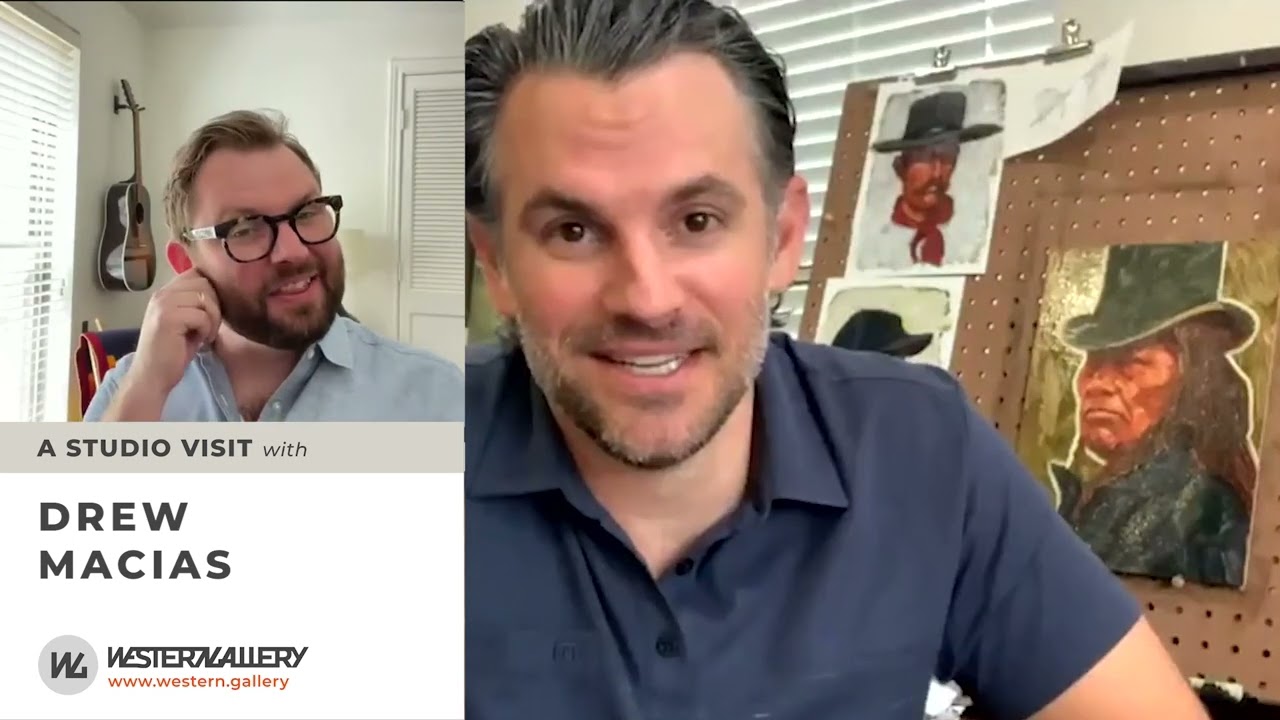
George Irwin visits artist Ally Morgan's studio to discuss her exhibition Neon West, running through July 12. Morgan draws from Red Dead Redemption and American Romanticism, painting coyotes, horses, and bulls in saturated neon colors. Four of ten pieces remain, with prints and a 6x6 original available.
Chapters
Nice to see you again. This is—
Good to see you too.
Yeah, this is like, for those of you, you know, who are not Alli or I, this is how we meet. She's in Maryland and I am in Austin, Texas. And so we just have been Zooming to get this exhibition going and sharing work virtually and getting things— we've been working on it for like almost a year now at this point, right?
Yeah, definitely. It's been crazy.
Yeah, it's been great though. Um, yeah, just some background, I guess. Uh, I don't know, Ali and I met on Instagram, I think, um, when I was like trolling through. I was searching Red Dead Redemption fan art. I was like, I bet you there's some great artists out there who just are like obsessed with Red Dead and draw and And there is a lot of fan art out there, but most of it is not what I would want to collect. But Ali's work stood out to me and I messaged her, and that was probably like 5 or 6 years ago or more. But she's been like developing as an artist, and I'm so excited that we get to like have this exhibition together now, 6 years later.
It's, it's crazy. I think back to that time, I call myself like I was a baby Western artist then. Yeah, just like dipping my toes into it and seeing if it was a good fit for me. And, you know, I saw so many other Western artists and was like, oh my gosh, their work is like so incredible. And what Red Dead gave me was that, I don't know, it's like this like kind of vastness and this kind of like mythological West that was kind of fantasy and a little like creepy and odd and I don't know, it just really resonated with me. And when, when you started following me, I went to my husband and I was like, oh my gosh, this guy started following me and they're Western art! Look at this!
That's so funny. I mean, I don't know, it's just like, I've sort of had this, and I've talked to you about this before, like, I would love to like talk to Rockstar Games, um, but I don't know anybody there and I haven't figured out how to get get an intro. So if anybody out there knows anybody at Rockstar, I would love to talk to them about putting together some kind of like collaboration, um, for whenever— maybe whenever their next Red Dead comes out. I think that'd be pretty amazing.
We better get another Red Dead. I know we're finally getting— what is it— the GTA 6. So I think— I mean, knock on wood, it better be next. Yeah, yeah.
So that would be— that would be really cool, I think. Um, And you know, there was a piece I saw written, I don't know, a few years ago that is talking about the landscape and scene design in Red Dead 2.
Yeah.
Being so heavily influenced by like early, you know, kind of Western, but you know, artists like, they're not Western, right? Because it's like, but maybe at the time it was sort of West, like the Hudson River school, right?
Right.
Like Albert Bierstadt. And there were like these like really, um, incredible artworks referenced when making the landscape in Red Dead Redemption. And, um, and just to see that, like, I don't know. So I think there's like a lot of good interplay that can happen there.
It has a very like romantic sensibility to it. I think of like early American Romanticism and Hudson River Valley. I mean, that's totally there. I think about, about like American regionalism too. Which obviously is still very prominent with Western art today. Yeah, I just— something about it, I think it was just really exciting. And at that time for me, I was kind of burned out with like the work I was making and I was like, I just want to do something fun and I don't want to be like thinking about all this like negative. I just want to make fun work. And Perk that was like really exciting and that like moved me in a way. And so when I look back today and I see all the work that I made now, I'm like, I'm so proud that I just took the leap and like went for it and kind of followed the dream, even though I took this kind of unconventional way to it. Yeah. Where do I think many Western artists who follow more, you know, like Maynard Dixon— I mean, I told you, you, you had some of Maynard Dixon. I was like, I didn't know who that was. Like, for like the longest time, I was like, I don't know who that is. Really? Yeah. Well, I mean, I always heard Western artists like talk about him, but I didn't really know any of his work, like off the top of my head. Yeah, and so, um, yeah, it's— I think it's a kind of a fun way to approach this genre, um, in, you know, kind of a different way, maybe that's a little bit more unexpected, maybe.
Yeah, yeah, definitely. Well, I mean, and that's, you know, I know, I know you're telling me you didn't know, like, really Maynard Dixon's work at first, and, you know, I think that I want— I would like people to understand this. You have like a master's in, in fine art and like studied in Phoenix.
I did, yeah. I went to ASU, so I got my master's.
Yeah. And it was, it was more like you studied more like very like the contemporary art world, right?
Yes, it was very much contemporary. Um, and at the time I was not doing Western art, um, at all. I was painting— I was much more, um, new contemporary figurative works. Uh, out of my undergrad, I was an oil painter, strictly oil painting. And, um, my professor like really taught us all about the details of painting human figure and almost like hyperrealism. So I was kind of the direction I thought I was gonna go in. And then when I got to ASU, the professors were like, no, change it up, do something completely different. And so I started doing animals, uh, in watercolor and started adding colored pencil to it. And I just, I didn't really have any interest in the West back then, except I started collecting Native American artwork when I was out in Arizona.
Right.
Specifically Woody Crumbo's pieces, like, totally resonated with me. And now when I look at my work, I'm like, I definitely see the inspiration from his pieces and kind of this, um, uh, he did a lot of like screen printing specifically is the work that I like to collect. And so there's a lot of like flat spaces with kind of these more stylized animals. And I definitely see kind of that pickup in there.
Yeah, definitely. Yeah, I can definitely see Crumbo's influence in your work along, you know, along with Maynard Smith we were talking about. And even like contemporary, like more contemporary artists like Logan Ajedge. And I don't know, I think that we, you know, we talked about a bunch of different influences of yours. Um, what was I gonna say? Okay, so anyway, we just kind of jumped in and started talking, so I didn't, I didn't even, yeah, say much about the show. Um, Neon West, I love, uh, that's your title, uh, 100% your title. And I mean, all the titles and everything, obviously this is all your work. Um, sometimes I help with it, uh, a show title, but this one was just like, you said it, and I was like, well, that's obviously it. And it's great. And it really, I think it's great because it highlights obviously kind of the bright outlines that are going through your paintings, but at the same time, it's kind of metaphorically like bringing the West to the contemporary space in a nice way. So yeah, Neon West on western.gallery if you haven't seen it. There's a link on your live thing somewhere. So check that out and stick around. You'll come back because we're going to be able to do kind of like a good announcement at the end of the program we'll share. And if you miss that, not to be so like, hello, I'm a salesman, but like, if you miss that, make sure you're on the Western Gallery guest list because we'll email more about that announcement as well. All right, so my notes. The show has done really well. 4 of 10 pieces are left. And the others were snapped up really quickly by very excited collectors. Multiple collectors wanted several of the pieces, which was— I mean, it just shows you that the interest is really there and your voice is really coming through in a good way. And I don't know, I just think that's apparent, but just wanted to point that out for anybody who hasn't seen seen the, um, the show itself yet.
Um, there's—
let's see, what should we talk about, Ali? Let me, let me think for this. Okay, no, you have, you have, um, what's the name of the piece that, the, like, the headline piece that is sold, I think? Yeah, And I Became the Ghost. You've got it there behind you.
Yeah, would you mind kind of like—
would you mind just like holding it and then we can talk about it a little bit?
Yeah, let me see here. I'm gonna see if I'm still in screen. Let's see.
Okay. Or you can bring it up to the chair and that— as long as— oh man, yeah, mind the glare.
I know, but it's shiny.
Oh, it's so beautiful.
Yes. Um, 16 by 20. Yeah, we got our 3 coyotes and of course our blue one. Love the blue coyote.
Can you tell me a little bit about the blue coyote that makes an appearance throughout your work a little bit? Yeah, sure. Feel free to sit down if you want.
Let me come back on screen. Hey, let me put this one down. So the blue coyote is kind of interesting. I love blue animals. I think there should be more of them. So the blue kind of goes back to like grad school days. And I was really inspired and I still really am inspired by medieval art, specifically medieval bestiaries, which are these encyclopedias of animals that were real and imaginary.
Like, like bestiaries, right?
Yes, yes. Bestiaries. Bestiaries. But yeah, there's— so in particular, I was doing a lot of paintings of dogs in my undergrad work. My undergrad work revolved around gender. I was painting actually a lot of self-portraits and then a lot of portraits with dogs. And so it dealt with like this sort of feminine, masculine energy as well as animal and like tamed and domestic, wild versus domestic, I should say. And so I was painting a lot of dogs back then. And so when I was looking at these bestiaries, blue dogs came up kind of often and, and I was like, oh, that's really interesting, as well as seeing other kind of blue animals and And one of my classes, one of my professors, we were talking about the importance of different colors. We were talking about blue in particular. And he brought up that when people often think about— and I don't know what study he used for this, but he said when people often think about space, instead of talking about black, people often talk about the color blue, a really dark blue. And that blue is kind of the color of everything and nothing, kind of this emptiness and this vastness all at the same time.
And then— Kind of get back to Christian too, right?
Exactly. Yeah, yeah, yeah, yeah. And so I think there's something very like universal about the color blue. I'm a big like religious history buff too. And so I think back to, you know, Mary's shawl in Christianity, in Islam with Muhammad, Prophet Muhammad, when he did his famous night kind of adventure, I should say, the prophetic night adventure. And he went to heaven and he saw these large pools of water and they were filled with these arabesque blue tiles. And I don't know, it all just really stuck with me, this importance of the color blue. And so with regards to the, to the Western work, I was like, I really want to bring the blue back. And so I, for me, coyotes made the most sense. When I lived in Arizona, I used to love, well, I used to love catching the coyotes early in the morning and listening to them like they're like little creepy yelping. That was so pretty and sad. And I always felt like it was this kind of like a party going on that humans weren't really invited to, but like all the night animals were a part of.
Oh, that's cool. Yeah.
And I was like, it's such a privilege to hear them. And so when I think about the blue coyotes, I wanted them to be this kind of transcendent sort of being where they were in between kind of the physical, the metaphysical, almost like this little ghost spiritual being. And then, um, and so I had my first, my sleeping coyote, which again sold quickly. I love that piece. I'm so happy that one found a good home. I love it. Um, and then I was like, well, let's add some more, you know, the brown tone coyotes. How does that change the conversation? We have a blue one and then we have the brown ones. So, um, yeah, it was just, it was really exciting and, and I'm excited to push that further and to see where else these sort of blue animals can go. I'm envisioning blue deer, blue horses, blue bears, you know, just kind of exploring animals, spirituality, um, and, and again, this kind of magical nature. And, and with regards to the West, yeah, right.
Well, I mean, there's so much like, um, mystique in the West, and like the idea of Well, I mean, like, there's like the whole like idea of like the coyote as like the gentle trickster, and maybe like, you know, seeing like the coyote— well, even in that, this particular piece, you've got both, both brown coyotes and a blue coyote, which kind of shows— I mean, maybe they're both on the same plane but coming from different places or something. I don't know, it's really interesting. And I love how there are other like you know, the other, like the coyote continues to appear in different pieces. Like there's one that's just kind of like the one, the lone coyote sitting down and looking at you. And that one is, that one's really interesting to me too.
Yeah, I like the idea of the animal looking at us. There's a kind of this confrontation that happens.
Mm-hmm.
This again, this kind of all-knowing creature looking back at us, having this sort of silent communication. I think it's really powerful. And I hope it's something that the audience also relates to and finds interesting. And with coyotes, they're so similar, or at least to me, they're so similar to dogs. And I think about my dog and, you know, our relationships with them. Again, kind of all going back to this idea of like humanity and nature and animal life. And yeah, well, I mean, and then like just like total nonverbal communication.
You know, I mean, I guess, you know, we talk to our dogs, but they don't talk back.
Right, right.
Or at least not in a way we can understand. Um, well, that's, that's really great and interesting. So how— what made you— I know that you are, um, you love color, and there's a ton of like bright colors in this Neon West that you painted. How did you get to be painting with such I don't know, such bright, saturated, awesome color.
Yeah. So color is like my favorite thing. It's— to me, it really pushes the work, especially these days. My work is really about color, color harmonies, this kind of color conversation going on. And I've always just kind of seen color like really vivid and bright. When I was— when I was doing figure painting early on in my career, I was adding a lot of like neon greens and yellows. My professor was kind of like, what are you— What are you doing over here? Like, and, you know, he showed me ways to tone it down, but I was like, that's not what I'm seeing though. I'm seeing brighter tones. Like, it's just more fun, you know? And that's part of it too. I'm like, at this point in my career, I've done a lot of the kind of— I don't want to say quote unquote kind of more serious work, but I want to do work that's fun and that is kind of pushing the edge for me a little bit more and work that I'm really enjoying. Yeah, and in a way, like, I like when the work feels kind of spiritual, I guess. And I think going with the brighter colors kind of helps with that. And it takes the world out of this realism, which, when I think about a lot of Western art, there's a lot of realism and, you know, trying to capture everything super correct. And I love that, but for me, it's about something more than that. And so I really The more I can push color and form and shape and stylizing kind of these images, like the more I get excited about the work and the more I want to see like, where is it going to go next?
Yeah, totally. I think, yeah, I mean, it's like obviously a huge role in it and making— in balancing, I think, the impact of your work because there, you know, you've been talking about spirituality and And I know like a lot of the themes and the way your titles relate to your work and the subject of the pieces are not necessarily like super light, you know, but they are important.
Yeah.
And framing them like this just makes it like, I don't know, it's like a real pleasure to like go deep into it, I think. I want to acknowledge a couple of comments that we're getting too, like Ian McElvoy, who's a great emerging artist that I've talked to before, he said that, you know, there's a whimsy about your work that comes through with the colors and the movement of these animals. Like, these jumping bulls are amazing. And then let's see. Oh yeah, Neil Myers. Hi, Neil. Was saying that, yeah, when one of his Native American— or no, a Native American tribe said when The end of the time comes, there will only be the earth and the coyote. Yeah, so both of those—
I mean, that feels so real. I love it. I love that. Obviously, I don't hope it's the end of the world anytime soon, but you know, right, right.
Um, well, so we talked a lot about the coyote. Um, tell me about, I guess, kind of like how— I know, and you were saying before, like, you had, uh You started off kind of painting animals, and I think, and you put yourself in the work as well. And now you've kind of like branched out into doing, you know, horses, which you used to ride, and bulls and other sort of like Western animals, as well as the coyote. And see, what else do we have in here that I'm forgetting about? Like, there might be something else, but that's okay. Maybe not. Can you tell me a little bit about like how, like, how you relate to, I guess, the subjects in your pieces that are not coyotes?
Yeah, I guess I would start with horses first because I did. I grew up loving horses. I was a horse girl, but I couldn't afford a horse, so I rode a little bit. But then I was doing English riding, so it was a lot of jumping and things, and it always scared me when we would start to go really fast. So eventually I just realized I just like being around the horses, and I just wanted to like pet them and groom them. And like, that's really what I loved. And I remember one point my instructor said that horses are mirrors, they're mirrors of us. And so I always kind of took that to heart, thinking about these horses as just being kind of stand-ins for us. So in many ways my paintings are animals, but they're also kind of stand-ins for me and, and how I see the world. And they're almost like little self-portraits, I would say. Um, and then the bulls— the bulls are fun because, um, I'm a Taurus, so I was like, I had to do some bulls. And then once I started painting them, honestly, I almost enjoy them the most these days. I love the movement of them. I love their kind of like really muscly bodies. Like, they're really, they're really like chonky, which is like really fun to paint. And they have such fun colorings and patterns. And I go— we have a local rodeo in Maryland, which I didn't even know we had up until like a year ago. So I go to the rodeo and that's where I get the majority of my source material, especially the bulls, because I don't know where I would get that otherwise. And it's, it's just so I don't know, there's something— there's a lot of like gender questions I have around kind of the rodeo and with the bulls in particular and the bull riding that's, you know, very masculine. I— and this is where I'm kind of speaking where I don't know a ton about rodeo. So maybe there are female bull riders, but the ones I've been to, I've only seen male bull riders. So I always— I think about that. I'm like, well, the bulls are so male, like dominate. I was like, how can I approach it as a woman painting the bulls? And I like to think that when I paint them, there's a softness to them that maybe is a little different. Kind of this nuanced sort of approach to painting them. I like to think that I add to the work. Definitely. Yeah, yeah, yeah.
I mean, it's great to see. Yeah, it's great to see these bulls like just kind of like, you know, flying through the air in joy.
Yes, you know, 100%. I hope that's coming across because that is really one thing I was pushing with this work is that for a while I thought my work was very serious and I used my painting a lot to deal with grief over the past couple years and Most recently, I've been able to kind of step away from that sadness, and I hope when people look at the paintings that they see joy in them and that they see energy and life and vitality and movement. Um, and I think the bulls in particular really show that. And in a way, I'm almost most proud of the bulls because I feel like they're just so joyful, um, and it makes me happy to look at them. So I hope it makes other people happy to look at them too.
Oh, I think it certainly does. And, you know, I was also going to like say this, that Starwolf 2016, I don't think we know each other, but thanks for tuning in. Yeah, he said like you capture emotions so vividly for the viewer and, you know, talking about joy as well. So that's like, that's some great, um, what's the right word, like, you know, representation of what we're talking about, I guess. Yeah, yeah, confirmation of what we're saying. Yeah, that's what I was trying to do. All right, um, wow, so time is flying. We're almost— we've almost kind of like run out of time here. And, um, let's talk about— let's talk about the big surprise. Um, so one of the things that I've been wanting to get going for a long time and I've just kind of been dipping my toes into with Western Gallery over the last couple exhibitions have been prints and making a more accessible way for our collectors and, you know, the fans of your work to collect a piece. And so that's what we're going to do, is we're going to offer a print or maybe two from the exhibition. And sorry if you wanted to say that, I just said it. Anyway, so we haven't decided what the images are going to be yet, which pieces, so if you have preferences, please let us know, message us, and/or send us an email. Whatever. And then the other very exciting thing is that anybody who is a collector of Ali's work from Western Gallery will be entered to win an original. It's a 6x6. Do you have it there, Ali?
I do. And we should say too, if you like, purchasing a print also is an entry. You don't have to buy one of the originals.
Yeah, that's right. That's where I was going. Yeah, purchasing a— whether it's an original or a print, you get an entry to win this little cutie.
So we're a little shiny again, a little shiny here, so mind the glare.
We have a nice little red "Do you want to marry her?" Yeah, I mean, I remember, you know, as soon as you showed me that, I was like, well, I want that. How do I win it? So, wow, can you guys hear that? My printer has just decided to print something. Thanks, printer. Oh yeah, it's my notes. I was going to print them out before we did this. Took half an hour for it to process, I guess. Um, yeah, so we're going to be doing prints, a print or two, and then you'll have the ability to win this wonderful little, little horsey. This is— does this guy have a name yet?
No, but I'll come up with a fun one.
Okay, cool.
Little fun one. But, um, yeah, so I believe what we're going to do is The show goes through July 12th, I think, officially. And so you can buy the prints and originals through then, specifically with the intention to be in the running for this little guy. And then anyone who buys the original or print will have their name in a hat, and then you might be able to take this one home for free.
I love a giveaway. I mean, and that's like a— that's a really, really nice, you know, giveaway.
Yeah, it's super cute. And yeah, squash, all varnished, perfect, ready to be home and be framed.
Yeah, totally. Um, let's see, we're not going to give away a frame though.
No, it's framing, it's very stressful.
Um, I was going to ask you about the other one that you got there, the, um, I can never remember the names on, um, anyway, is that, is that a silver leaf?
The frame.
Yeah. Yes.
Yeah, it's silver leaf. It is a wooden carved frame. And here I can— yeah, quick. I just making sure because like the silver leaf, um, like a thick heavy duty frame.
I mean, oh yeah, they're very nice. Very nice.
Yeah, but um, these are silver except for the one piece that got a gold one.
But okay, so there was just one that was gold. I couldn't— I wasn't quite sure if they were— if there were a couple that That were gold. Okay, so they're all silver except for the Desert Shadows, which— and that one's unavailable anyway. So they're all silver now.
It's all silver. Cool.
All right. Well, Ali, thank you so much for doing this Instagram Live. Thank you so much for painting this body of work and sharing it with everybody. It's always, you know, I think that a lot of people feel like when you have a full, like, presentation of work that it, um, they don't think about how kind of like vulnerable it is to put forth, you know, like this much work together, you know. It's vulnerable enough when somebody makes something and shares it on Instagram, right? But when you put together a whole show and you put it out for the world in a professional way, there's a whole nother, a whole different level of vulnerability. And I just want to thank you for, like, trusting me to help you to put this out there. And I want to thank all of you viewers, collectors, art lovers, press, etc., for embracing Ali's work because it's— I mean, as you can tell, it's wonderful and it deserves it. But yeah, it's just— it's important. As well. So thank you.
Well, thank you, George, and thank you everybody listening and who is seeing this in the future. Thank you everybody for all the support. Um, as George said, this, you know, it's really been a labor of love, and we've been working on this together for almost a year now. Um, the pieces, uh, they mean so much to me, and it's such an honor and a privilege to get to share them with everybody, and Um, and again, just the comments, the feedback, all that, it really, it means so much to me. So thank you everyone, and thank you George.
Yeah, thank you, Allie. Thank you everybody. And, um, remember to check out the show at western.gal and, um, sign up for the guest list so that you know about the print situation. We'll send out a poll, um, I don't know about today because Friday afternoon doesn't get much attention, but we'll send out a poll soon that you can weigh in with what your preference is.
Sounds good.
All right, Allie, thank you. We'll talk to you later, and thank you everybody for tuning in. Adios. Thank you.
Bye-bye.
More from George

Leslie De Leon discusses her Lotería series, her painting practice and inspiration with WG