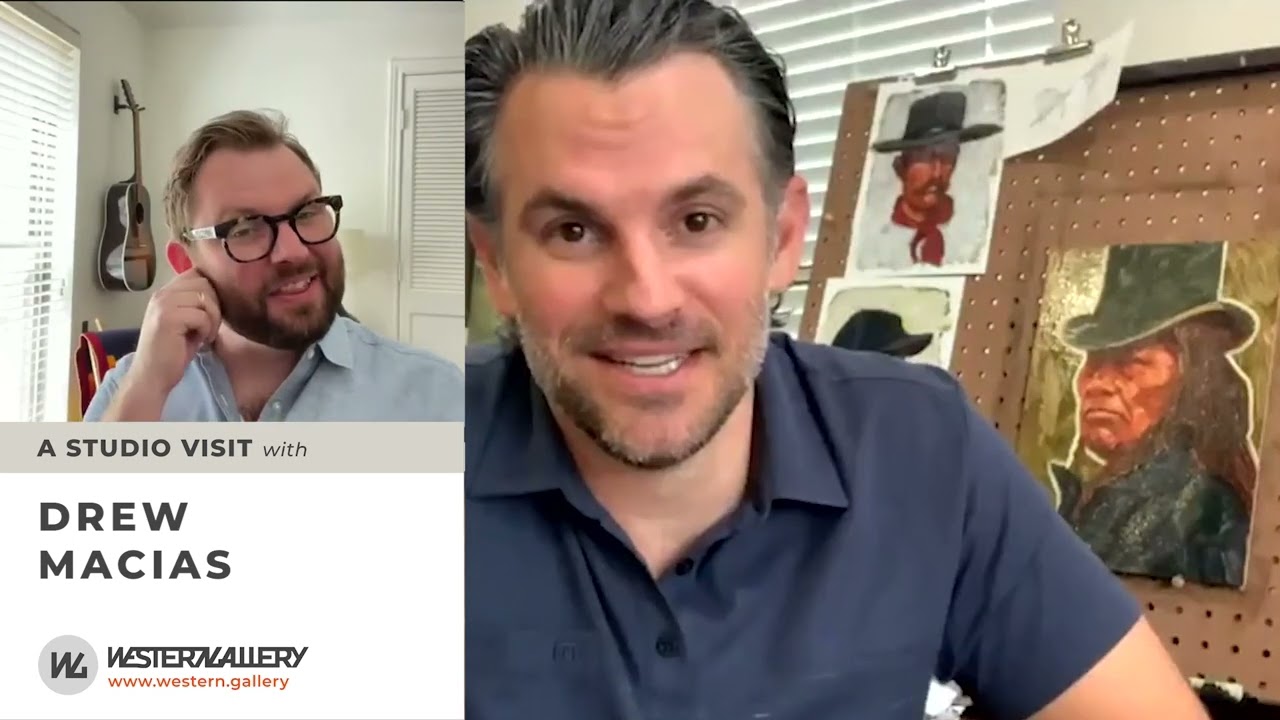
This content was created by George Irwin. This content was uploaded by George Irwin. This is a YouTube video titled "Artist Studio Visit with Drew Macias" (posted June 16, 2022) featuring a casual studio-visit interview hosted by George Irwin of Western Gallery with artist Drew Macias. The conversation covers Drew's shift from baseball and acting into fine art, his studio setup, portrait-focused practice and techniques (brushwork, underpainting, color choices), mentors and influences, and his participation in the New Western Talent show. The excerpt is an informal, live-stream style interview/studio tour with viewer comments referenced.
Chapters
All right, take 2. George Irwin here with Western Gallery. We're going to be talking to Drew Macias today, um, hopefully if I can get my technology to work. Let's see, I think people are gonna be tuning in here. Thanks for, thanks for coming back, y'all. Uh, we're gonna give this another shot, and I don't know if Drew's on here yet. There he is. All right, I'm waving at him. Maybe that will help us with the, uh I don't know, the Instagram gods. All right, haha, yeah, the phone works. I don't know why the other thing doesn't work. Hey Drew, how's it going?
That iPad of yours, man, you got updated or something.
Yeah, no kidding.
I think maybe that's the issue though.
I think, I think it did update and now it's like giving me trouble. I used to do this on that frequently, but that's okay. Good to see you. Am I pronouncing your last name correctly, by the way?
Yeah, Macias. I've heard a lot of things throughout the years.
Yeah, cool. Did the baseball announcers get it right?
You know what, that, that I, I, uh, have a funny story where actually I remember going into spring training one year and I get to the big league clubhouse and, um, my jersey was spelled wrong. They put Marcias, they added an R to it.
Nice.
But yeah, for sure, a lot of, a lot of different marks for some reason. A lot, a lot of Marcias, Messias, Marcias. Micaiah's, yeah.
Okay, well, Maceas it is though.
Yeah.
All right, Drew, well, cool. This is, it's cool to see you've got like some other portraits behind you and this is a studio tour, I guess. So do you, yeah, do you wanna show us around first and then we can start to chat a little bit about—
Yeah, sure. So basically I got a great understanding girlfriend who let me turn our kitchen into my little studio. So over here, it used to actually be our dinner table. It's just me and her.
Oh, wow.
Never used it. And so at first I took over the dinner table and then I was like, I need more space, I need more storage. And so I went out and bought this cool drafting table and, uh, threw it right in the middle of our kitchen. So yeah, I just took it over.
You know, whatever works. You know, that's, that's, uh, one of the things is like, you know, if you anywhere you can find a spot, if you love to do it, then you'll find the spot.
Yeah, awesome. No, it definitely gets the job done. I, I enjoy it. Cool.
Then actually, so Drew, I was mentioning my first attempt. Oh, sorry. I think we're having like a little bit of a connection delay. Delay?
Yeah, that's all right.
Maybe we can— yeah, let's try and be aware of that, I guess. So I was talking like, I think the first time I tried to do this live a minute ago on the iPad, I was saying that you were, you know, relatively dove back into doing fine art or started for the first time. I'm not sure which. Can you tell us a little bit about your— I know professionally you were playing baseball and then you were with the Padres for a little bit and then you were acting for a little bit and then you found your way into being more serious about drawing and painting. And I'm wondering if you can tell us a little bit about if you've always had the fine art kind of pull or if it's just something you discovered.
Well, I definitely always drawn. Growing up, it was more— I did a lot of cartoons, you know, throughout baseball. I'd always like characterize teammates and teachers and different things like that. I definitely always been attracted to art. For some, there's just certain things that just, you know, I'd see certain paintings and I just sit and look at it. And, you know, for the longest time, especially even growing up, I remember just almost like knowing how much time it took for that artist to do that. It kind of was, it was a little daunting. And I thought, you know, I would love to be able to do that. I just don't know if I could do that. And then I think the best thing that, that was probably the best part of the pandemic was I all of a sudden had a bunch of time, and, um, that's kind of when it was like I started really getting more into like, I don't want to draw cartoons anymore, I want to, you know, kind of move this direction. And then it's just kind of got— I just got kind of obsessed with it, and it's just like a daily thing. And it's really been, you know, it's been— it's just, that's been the fun part, just watching it grow from like what I originally posted what I was so proud of in the beginning to what I'm doing now.
So that's awesome. Yeah, I mean, it's— I feel like, uh, you've, you've shown like that you have like a kind of an innate talent and understanding for it, and then you've really developed that over the years. Um, I think you're a great example, uh, of somebody who entered New Western Talent last year, I think even, with some drawings and the jury didn't jury you in for whatever reason. But this year it was, you know, you got juried right in with your 3 portraits. So that's exciting to not only kind of like see that progression, but then also to see, you know, some kind of payoff of it, I guess, or recognition is a better way to say it. So that's cool that that's kind of what happened. So nice work. I know that also, like, you have been— did you kind of find some mentors through Instagram or elsewhere that you've been studying with?
Yeah, so originally, I remember one of the first artists I came across, he's up in Northern Cal or the middle part of Northern Cal. His name was Kenny Keys. And, uh, he— it was like one of the first kind of Western— yeah. And, and I remember I just reached out to him, and— or maybe he commented or something. I remember maybe he was like the first kind of other artist who started following me after stuff that I was drawing. And so I remember I just got in contact with him, started asking about, you know, painting and what I would need. And he was just a cool dude, and he, he, he kind of gave me a whole list. I have a whole, you know, of what you need, do this, that, that. And so, you know, we kind of kept in touch. We still keep in touch now. So that was great. And that kind of just pushed me along. And then I was lucky enough that when I'm not painting, I actually teach kids to hit. And one of my lessons, who's a stud, he's now playing at UCLA, his uncle is Michael Cassidy. So it just was like the most perfect. Yeah, it was like the most perfect because it's like exactly where, you know, I kind of saw myself, kind of the art that I'm drawn to. And so throughout, you know, once Kathleen, his sister, Jack's mom, once she started understanding like, oh, you like to draw, you like to draw cowboys. And then she's like, my brother does that. It just so happened it was Mike Cassidy. And so, you know, I reached out to him and it just started off as like kind of like a slow little thing. And, you know, now even looking back, I'm embarrassed. But again, I mean, just the drawings that I would originally send in, you know what I mean? And he was cool enough to just kind of give me techniques. Hey, go get this book, check out this different way, techniques of drawing. And then probably about August of last year, he invited me up to his place and I stayed there for like 4 days and he just gave me a crash course on painting. And that was it. And then he released me into the wild.
That's so cool. That's so cool, Drew. I mean, I think that being able to connect with other artists and learn from them is, that's like the age-old way of learning to do fine art and artisanal crafts and everything, like the apprenticeship almost. But, and I'm not saying that that you were like apprentice, you know, but to get those kind of like tips from someone who knows what they're doing, not only just like the, you know, the knowledge and technical stuff that you pick up, but even just seeing somebody doing it in a more established way, it can be like inspiring in a great way and give you kind of the vision for what you wanna do too. That's really awesome.
Yeah, it was to watch him move around. And I'm a visual learner. Like, I want to— like, if you can show me, just show me a couple of times, and then my brain kind of processes that. So it was really cool to just see. And again, him and I are so much alike, just in and outside, like just the way he is. It's not— it was so gritty and just— let's just get this work done. And it was, it was, it was amazing. It was, it was really cool thing to watch.
Very cool.
Cool.
So you have kind of gravitated right to doing portraits. Is that— do you think that that came out of just doing like caricatures of your, your teammates and stuff, or what, what draws you to doing portraits of these, all these characters?
Yeah, I think so. I mean, obviously everybody's like, hey, draw me, or, you know, so it's always— you always have to obviously start with their face. Um, so, um, and I think I, I don't like— I, I don't want to just like get locked in. I feel like that's just where I'm at right now. Like, I, I want to understand the face, and I'm slowly going to move down here, and then, you know, eventually I want to go up to— I'm going to go back up to Bend and, and do more like landscape stuff and kind of learn that, what— how, you know just kind of how he sees things. But, you know, right now I'm just having a good time doing that. Like, just, I see a face, I see an interesting face, and I want to see— especially now, like, these new paintings. Like, in the beginning I was really sketching a lot, and now I'm trying to get more of, like, I just want to draw only with my brush and, like, not give myself so much, just like kind of challenge myself with that. Um, so it's just, I'm, I just still learning, I think, on the face. And I just, I, I mean, obviously I got years to go to get down to the chest and arms, but I've done a few, I've done a few little, uh, little paintings. Yeah, with where I'm slowly— I haven't even done a horse yet, man. I'm like, I have not even, I haven't even tried to do a horse. Um, yeah, so I'll get there eventually, man. I'll eventually That's wild.
I hadn't thought about that. Like, maybe like that's just like kind of like what you feel comfortable doing at the moment, but that's really, that's so cool. I mean, it's kind of like if you get like the portrait thing down, and I feel like you got a good, like, you've got a great head start.
I was about to say, hey, nice.
Yeah, so, but, um, that's— I mean, that's such a challenge for so many painters, I think, to get a, you know, like a convincing face that a lot of people shy away from it. And I think that that's really, um, that's admirable that you are getting that, you know, getting that down as like a foundation. That's really cool.
Yeah, no, yeah. Appreciate it.
Um, so Drew, have you— I don't know if you've had— have you shown anywhere else before, or is this kind of like the first foray into the world?
Instagram, just Instagram.
Yep, that's how you found me, man. This is it. I know, I know. Yeah, it's, it's awesome. But, um, yeah, that's cool. That's really exciting that you're starting to, uh to get it, get your work out there though. That's, that's cool.
Um, yeah, that's it.
So for now, is it just— I didn't mean it. Yeah. Um, yeah. So for now, is it just kind of like focusing on portraits and then maybe expanding into, um, I don't know, like you were saying, like, like the rest of the figure and then landscapes and stuff as well, but Is it— do you see things like you're just kind of like doing the work and finding your voice and everything at the moment? Or do you have like a vision for kind of like what you want to do?
I think I'm definitely just, you know, one of the other artists that I talk to a lot and he's just been amazing of giving me pointers is Greg Newbold. And, um, he's got a lot of great work that I love to look at. And he, you know, so, you know, we talk about that too, of like, just, I don't know, I am, I'm looking for exactly what I want to do, um, in like my style. And, you know, what he says is basically just you got to keep putting in the work and eventually it will come out. So it's like, I'm not trying to do anything like crazy experimental or anything crazy like that. And every now and then I'll kind of, for, for what I think is pushing 'Oh, I'm gonna do a pink background,' you know what I mean? Like, I, I, I, uh, yeah, to me, I, I'm still— I'm definitely looking for— right now I'm just trying to put out things that I think look right, you know what I mean? Like, this face is very interesting. I love the shadows. I love the shapes. And I'm working on different brush strokes and different way to lay down the paint. So I guess it's just, it is, it's kind of like, hey, let's just see where this goes. I'm having fun. I don't really, you know, I don't really put too much pressure on myself to do that. It's just, let's just see what happens. Yeah, I kind of think that's how I've always been.
That's really cool. I think that's, I mean, it seems like, you know, you're in a good spot for this. Is, I don't know if this is worth saying, but you're in a good spot for where you are, or you're doing the right thing, I think, for like, uh the point that you are in your practice, and that's really exciting. I think one of the things that is exciting, and maybe, you know, you're still working at it, but I think that, yeah, I think that you're starting to develop a little bit of a personal style, and maybe that's just because, like, of the artists that inspire you and what you're trying to emulate is not necessarily the same combination of, or like maybe not the most common like combination of influences for artists who are starting out. So in any case, it's starting to, I feel like there's like a little bit of Drew starting to come through with these pieces, which is really cool to see. Jose, you've been doing, you've been making some good comments, Jose Quintero Art, while we've been talking. He said he's noticed some improvement.
Yeah, that's my boy too.
Evolve. Yeah, cool. Yeah, so awesome, Drew. So I guess, you know, most artists have like a few different directions in their career before they find their you know, their calling to fine art. Do you think, do you have any ideas about how like your previous experiences as a ballplayer and as an actor maybe have helped to shape like the way that you're approaching this?
Definitely. I, you know, There's just— obviously, I feel like even when it came to acting, like, you know, I feel like everybody probably has a certain, you know, we have this creativity that we're trying to, you know, let out. Um, and I think not everybody does it, you know what I mean?
Maybe— and it could be anything.
It could be, it could be, you know, making a pot or, or blowing glass or, you know, anything, anything that, that I can just— I want to, I want to say that I made that. Some people You know, like for instance, my brother's amazing at like, he can build whole cabinets in a kitchen and he can build, that's his, you know, that's his art. I, on the other hand, I'm not handy when it comes to like, I can't sit and, you know, crank a wrench and fix my car. You know, being a Southern California cat. So it's like, that's my, this is my, you know, the way I get my creativity out, you know. And for a while, for a while I was doing acting. I did that for like 5 or 6 years. And, um, you definitely in that business, you know, you can definitely get into a place where you just feel like you're spinning your wheels. And, you know, things would happen here and there, and, and, and then, uh, obviously COVID happened. Then I just got into art, and it's just been, it's, it's been a great stress relief. It's just been a good, you know, I mean, it's like, again, it's just like you got to find something to, you know, put your mental energy in and your— and be creative. And, and if people like it, great. If not, you know, I've been lucky enough to get to have people, you know, reach out and, and comment. And, you know, I mean, I think as an artist, that's what, you know, you— that's definitely a good feeling, you know what I mean? It's like you're doing it. And it was the same thing when I did acting, you know what I mean? It's like You know, people always, you know, make fun of the Academy Awards and different— all these are— but it's such a hard business. Even, even this, it's such a hard business that every now and then you do need a pat on the back. You know what I mean?
Oh, yeah. Yeah. Definitely. Yeah. I mean, I think that that, that's such a huge part of— yes, like you're saying, like any kind of artistic thing is like making that connection with people. And getting the feedback from, you know, whether it's like the audience or the, the viewer or whatever. Um, one of the things that I think is really cool about, um, visual art as— who— hey, who we got there?
That's Dutch. She's my art buddy. She always hangs out and watches me. Dutchess.
Oh, hey Dutch.
She's a lover. She's a good girl.
Yeah. Cool, cool. I love a good studio cat. Right? Anyway, so what— yeah, one of the things I was thinking that, you know, it's— we definitely like— or like one of the things that's wonderful about the arts is making that connection between the artist and their kind of perceptions and the viewer audience. But one of the things that I think is really cool about visual art and like tangible like paintings, for example, is that what it's— there's like a solid— yeah, so the word tangible, there's a solid tangible thing that is evidence of what you have put your work into that you can then revisit and see that like, oh yeah, this is, this is what I made.. And it's a little bit different than when you are, you know, acting or whatever. You're like, it's hard to like feel that when you, you know, you think like, well, I think I acted really well then. And then, you know, maybe if I go back and watch this part of the commercial or the TV show or something that I was in, and it's kind of different because there's like a background in it that wasn't there before. And I don't know, it's not, I feel like there's like a little bit more of like a concrete sense of accomplishment that you can get as a visual artist making like real life stuff.
Yeah, 100%. And you know, it's funny, I feel like, you know, when you say that even now, 'cause it's like where I'm at in my art journey is like, I'll finish a painting and I'll look at it and sometimes I'm like, I don't even remember exactly how I did that. I, I look at it, I'm like, oh my gosh, am I gonna be able to do that again? Because like I get into a zone where I've just got some music on and I'm just start— strokes start coming out. I see this and I'm just so looking back and forth at my reference and what I got to do that all of a sudden I'll, you know, and there's every now and then I'll come back and I'll, oh gosh, this is terrible. But then there's sometimes where I'm like— and that's what I just love about like I'll go look at different— I remember I went early on when I first started getting in to art. I went— I got lucky enough to go see a Brett Allen Johnson, um, at a gallery out in LA. And to just sit and get up close to his paintings and look at every stroke and, you know, the color of his blues. I don't know if you've ever seen his in real life, but it's like there's a— yeah, his blues just hit. I don't know what he does. I, um, and, and so it's just— yeah, it's that. It's, it's just a different It's just different.
Yeah, Gina has a good comment about this, about how it's like, I guess you have— painting is something you have more control over as a TV commercial is out of your hands once your bit is done. Like, I guess it is, it's more of like an independent product instead of like a piece of a puzzle of a big team of people working on something. As far as like fine art is concerned, you know. That's interesting. That's a good point, Gina. I like that. Cool. Well, Drew, can you tell us a little bit about the guys you got behind you there?
Oh yeah, so this is— let me get Dutchess out of here. These are just a couple things that I like. I started this guy the other day. Uh, so I got a little bit more to do on him. I've actually done a small version of him, and so this is the first time I'm going to a 9x12 with him. Um, this is my first attempt over here. This is my first attempt, um, to just kind of quickly do a cowboy, uh, actual figure and legs.
You can see—
well, yeah, and I, and I, I didn't really plan it well. I, I didn't, I didn't leave enough room for his boots. So I was a little mad about that. When I started the head, I was like, oh yeah, this is plenty of room. And, uh, no, I didn't. And then we got a couple cool, uh, just these are little fun, uh, things that I work, um, you know, I'll be watching TV and I'll just start throwing paint down.
Um, cool.
I'll find a cool head and then, uh, yeah, every now and then I'll start doing some old baseball, some old baseball guys.
Awesome. So who's, who's that? Yeah.
This is Honus Wagner. He's got, he's got one of my favorite baseball quotes. One of his quotes is, uh, there ain't much to being a ball player if you're a ball player. So that might, that might go with me, that might go with painting too. I feel like that's how, you know, I feel like that you can probably switch that over, uh, to painting. I'm not there yet, but I guess, yeah, yeah.
When you, I mean, when you get into like the, um, especially when you're talking about being in that flow state and you're not sure how it happened. It just, just did.
Exactly. And some people like, can you show me how to do that? And I'm like, maybe I might.
Yeah, yeah, yeah. I mean, it's interesting because you can teach— I think there are a lot of things that you can teach, um, but the, the way that you apply all those things together is, is something that each individual has to figure out. That's That's cool. Um, so your three— yeah, I think I saw one of the, one of the portraits from New Western Talent over there on the, the right.
Right here.
Give us another look at that for a scale. And I don't really know how big these are.
Yeah, these are nice.
All three.
Let me grab these things for you. Yeah, they're all right here.
Cool.
Um, 9 by 12. Um, again, this is one of those faces that I saw one time and I'm like, I gotta paint this. Yeah, so yeah, it's kind of good. It's— yeah, exactly, with the, with the frame.
Um, so is that like from when you say like, this is like a face that I saw that I have to paint, is that, um, like a reference photo that you've just sort of come across, or, or where does that start for you? Right now?
I, yeah, I definitely, I spend a lot of time, um, just saving pictures. I've been going now, I've been kind of going through trying to, you know, get into different archives, um, um, and, and just, you know, doing that, like trying to do the library and different things where I'm just, I just sit and scour Pinterest and, and I'm just trying to find, um, interesting. And a lot, like, a lot of these guys were pretty close to This is old Joe Gillian. He was a famous Texas Ranger, and I've seen quite a few photos of him, so I just kind of zoomed in. And yeah, and this one, I, you know, this is especially when I was like at this point where I'm just really working on, you know, really kind of trying to simplify as much as possible. So it's like the thing that I love too about my paintings is like the farther away you get, it looks, you know, like just a picture. And then the closer you get, which is one of the things I love about art, that's just my style, like I want you to get close and kind of, uh, then you see all the brush strokes. And then it doesn't really make too much sense this close, but from, you know, from farther away, then it's like, oh, that's cool. Yeah, so there's the other one. And then let me get the other guy.
Cool. Drew, when you're, when you're painting those, um, are you, are you at like all different sort of distances from the surface or are you pretty much kind of like up close or? Right here.
So I, I have this little tabletop easel um, the little board, and I just kind of set it right here on these little, uh, nubs, right? Like this thing just— I just come right here, set this thing right here, and I have my palette right here, and I just breathe in all that dangerous fumes for 5 hours. I just kind of hang out right here, and then I'll go walk around the sink because I'm in the kitchen And then I'll kind of look at it from far, then I'll go watch TV for a little bit, kind of get my eyes off it, and then I'll come back and be like, oh, holy cow, why would you do that? Then I'll fix it, and, uh, and it slowly but surely comes out. And yeah, then every now and then I'll just get the paper towels, I'll wipe it all away and start over.
Yeah, very cool. Cool. Um, are you When you're doing these portraits, I know you said you were trying to do more like drawing with the brush. Are you just starting right with a brush on the surface, or are you doing like any underpainting or anything like that?
So like this guy, I just put my undercoat on, this green, you know, olive green color. And then what I'll do is I'll just get— I'll just sit and look at the picture, and I'll just start drawing, like, with no paint. Like, I'll just be moving— like, I don't know if you can see this, but like, in the beginning, I'm just kind of like moving this and kind of like— see how that kind of just like wipes away the undercoat?
And I just kind of— like a negative drawing. Yeah.
And, and that's what I've been doing lately. In the past, I would draw, you know, like a— you know, I would draw the outline of the face. Maybe it, it just depends. Like I just— that's kind of like been what Mike's been pushing me to do is to just draw more with the brush and just, you know, he's, you know, talks about like it just, it comes to life a little bit more, um, instead of it being just like this stagnant, you know, block in. And, you know, it's almost like just letting it flow a little bit better. It's definitely challenging, um, and especially so, so all my— I might mark a couple of things like I know I'll get my, you know, scale tool, and I'll be like, I know, you know, this picture to this picture, this has to be, you know, 7 inches down where the nose is going to be. So it might just be like a mark here, a mark there, mark there, and then work around that. Um, but it's just kind of— I'm just winging. I'm just, I'm just, I'm just having fun winging it. And, you know, sometimes I get lucky and they come out the way they want, and if not, I just start over. Yeah, cool.
Um, yeah, I think one of the things that you are doing really well with is your color choices. Is that something that you are also just kind of winging, or is that something that you are paying attention to, kind of like working out a palette, I don't know, beforehand, or kind of paying a lot of attention to during, during the—
My next, my next purchase is I am going to be getting a desktop computer and, you know, Photoshop or whatever, and Elements. And I'm gonna— I am gonna start, you know, trying to get better at, um, planning. Like, right now I'm just looking at a black and white picture and I'm just making up colors. Um, oh wow, like this one was a black one. This one actually I did was like the first one that I ever used. I went to my brother's and he— we kind of colorized it in a certain way. And, uh, so I want to get my own thing where I want to start putting more time in doing that because there is certain times, like, I'm trying to think, like, for instance, this one, which it actually— I got lucky and it came out pretty cool. Like, the background is just a nice color, right? Like, it fits. The original background was— I was like, oh, you know, yellow is a complement— complementary color. I'm gonna go yellow and it's gonna pop. And I started doing the whole entire thing yellow. I'm like— and I'm like, oh my God, I messed it up.
I screwed up the painting.
And so then I just got, I just wiped it all out very carefully and then just started like, screw it, I'm gonna do it. I'm just gonna go white. And then it came out to a color that I actually really like. I really like that background color.
Yeah.
And I even kept a little bit of the original, which actually I stuff like that. Like I even kept a little bit of the original yellow right there just to kind of, and it came out, I liked it. So it's just kind of that thing where sometimes you'll do something, your eyes are like, no, And then other times you'll do something and it's like, wow, I, I, that's, that swipe, I gotta leave that there and not touch it. It's just, yeah, I'm just, that's, I think that's what I like about it because there's just certain little things that happen that I wasn't necessarily trying to do that I end up loving. So, yep.
Yeah, yeah. Well, and that's, I mean, one of the things I remember talking to, um, Eric Bowman about before was like, you know, he, he talks about like So much of his process ends up getting like, you know, covered up or obscured or like different things are, you know, added and removed. And then all of that goes into like the final character of the painting. And even like, you know, you said you added the white around him and it turned out like some of the yellows in there, some of the like background, you know, painting in there, like kind of on the edges. All that looks really cool together and it's kind of an accident, but at the same time, it's also like evidence of the process he went through to make it. And that's really awesome. Cool.
Eric Bowman, man, that guy's one of my favorites.
Yeah, yeah, he knows what he's doing, I think, most of the time. Oh yeah. Well, cool, Drew. What are you up to this weekend?
I think actually my cousin's gonna come over and we're probably gonna do some painting. Um, for a little bit. Maybe go, maybe go hit up the golf course, place, place, play 18. Uh, it's my sister-in-law's birthday, so we're gonna go to brunch tomorrow. Church, brunch. It's a great weekend.
Nice, sounds good. Well, excellent. Yeah, awesome. It's been, um, it's been really nice to talk to you and to, uh, to see some of this stuff and kind of learn a little bit about what, what you're doing. And, um, I appreciate your time this morning, and thanks for, thanks for continuing to enter New Western Talent. I'm glad that you were juried in this year and that we're showing pieces. Y'all who have tuned in, thank you guys for watching, and be sure if you haven't, go check out Drew's work on the new Western Talent Show at western.gallery. You can zoom in and there's like some different angled pictures and I think videos even of the pieces in that show specifically, so you can check it out up close. And I guess, yeah, that's good. Keep me up to date, and all of us up to date, I guess, on what's going on and Well, look forward to following what you're up to.
Thanks, George. Appreciate you.
All right, cool, Drew. Adios. Bye, everybody.
Bye.
More from George


Leslie De Leon discusses her Lotería series, her painting practice and inspiration with WG