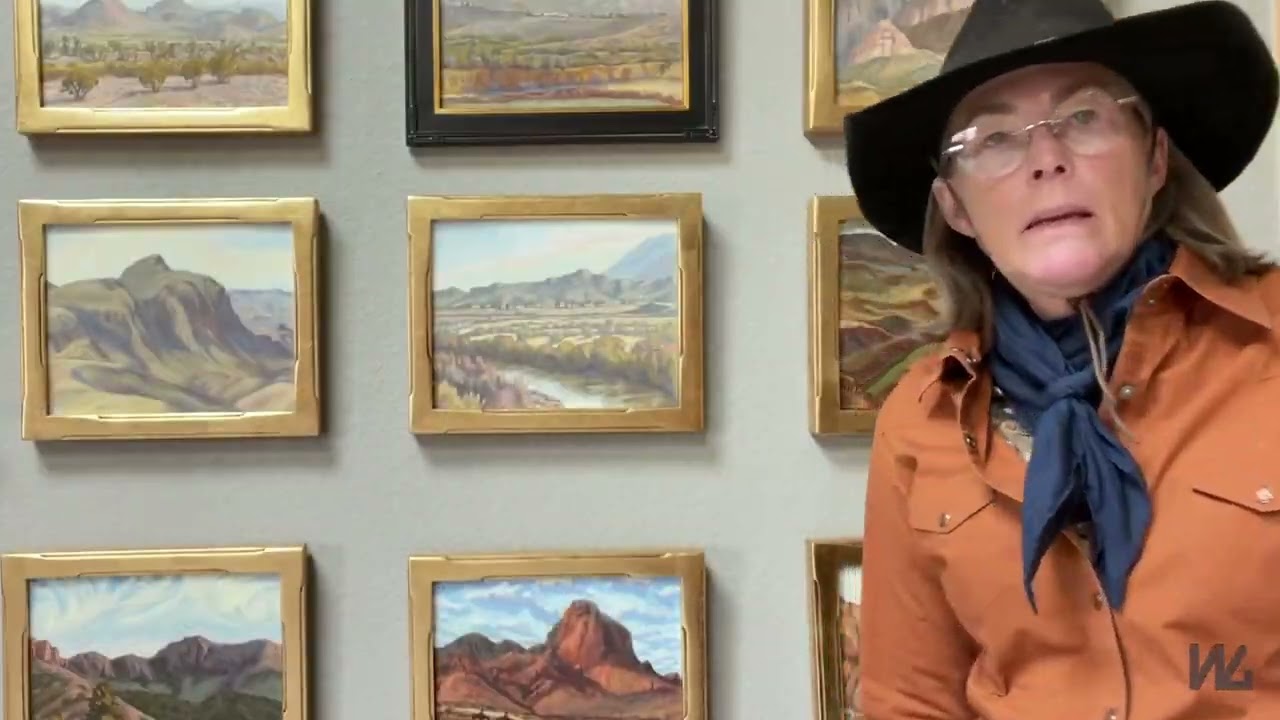
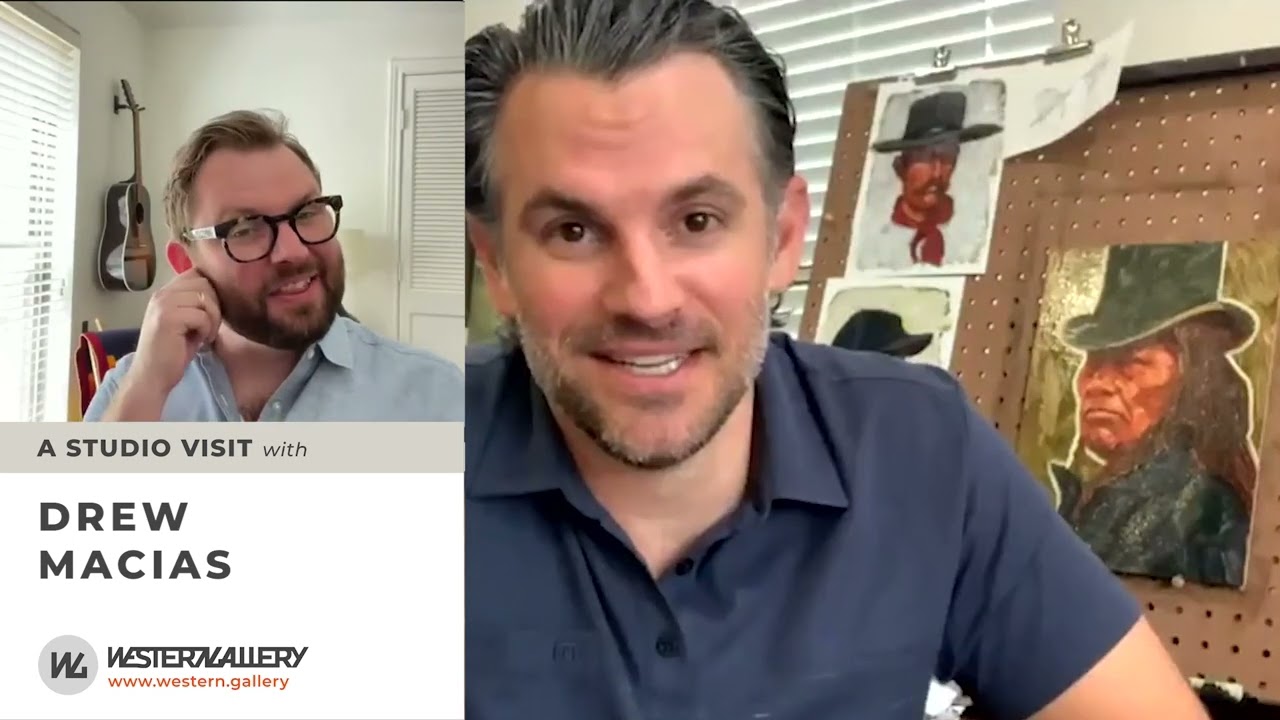
George Irwin visits Andy Barker's Boulder studio to see his ink and watercolor work on wood panels. Barker talks through specific pieces including cranes, a hawk, and a Pride-themed work called Spectrum, and walks through his process from sketch to final layering with metallic watercolors.
Chapters
Um, so hooray, surprise me, I'm live. And today I'm going to be visiting Andy Barker, Andrew Barker, in his studio in Boulder, Colorado. And, um, Andrew is our featured artist at the moment in the Impermanent Collection here on Western Gallery at western.gallery in your browser. If you're not familiar with his work, we've got several pieces of it on the Instagram and Additionally, his collection that's available right now is up on western.gallery in the Impermanent Collection. That may have been redundant, but everybody's getting on here still, so I'm just kind of talking. I hope that's all right with you. I think that Andy is on here, so I'm going to invite him to join me and we can get started. Hey, there he is. Hey, George. Hey, Andy, how you doing?
Good, how are you?
Pretty good. How are things up in Colorado?
Uh, not too bad. It's really beautiful out today. It's like 50 degrees and sunny, so that's awesome.
Yeah, all the, uh, I keep thinking about, um, keep thinking about all the fires that were there a few weeks ago and, uh, you know, wondering how that affected things or if you were aware—
I mean, I'm sure you were aware of that, or what—
how it changed, uh, your day-to-day for a minute.
Uh, myself, not too much. Um, and I actually don't know anybody directly affected, although, you know, with 1,000 homes being, you know, being destroyed, you can't really avoid that. Um, but, uh, yeah, it was, uh, it was a pretty weird day. Like, uh, Like, the fires were probably about 5 miles from me, but I could see them from my deck. Um, yeah, it was just like, you know, heartbreaking loss and devastation.
So yeah, yeah. Well, I'm glad that, uh, I'm glad that it snowed and they, you know, they got put out, uh, yeah, you know, before it got— before it got worse. So And I'm glad that, you know, you were not really affected and were able to kind of keep going with your thing. I was just about to say, I think before you came on, that you just moved into this studio not too long ago, correctly? Correct?
Correctly? Yeah, I kind of joined last beginning of December and kind of had just been moving in slowly. It's a It's a collective where we actually have a gallery in the front and it's in the Arts District. So there's a lot of like events here. It's cool. Specifically like First Fridays are like a big thing here. Like, you know, stages in the parking lot. Yeah, it's kind of a big party. So yeah, it's a pretty good location to be in. I'm looking forward to, you know, being here for the year and you know, just being like in an artist community.
Awesome. What is that like working in like a more community kind of setting as opposed to your apartment these days? You have your own space in there, so I mean, I'm sure you have like the solitude you need, but—
Yeah, I would, I would, you know, put some quotes around my own space. It is kind of like a shared environment. I have a corner here, which is fantastic. I have like a space mate over here, and she does amazing work.
Oh, cool.
Actually, and like this time of year, it seems like pretty quiet. And since I come in mostly in the evenings and the weekends, I don't see too many people.
Gotcha.
So it is just like a great place to come and like, you know, put on my headphones and work for hours on end. So that's awesome.
Yeah, cool. Um, well, so I guess one question I would have is, well, I guess, you know, the studio, you know, we do like a studio tour. Do you want to show us like any more than we've seen sort of of the corner, or— Yeah, sure. I know like in your intro video you gave us a little you know, overview of how you start your sketchbook, which I think was really cool, by the way. Start your sketchbook and then move it to the larger paper, tracing paper and whatnot. But I'm curious about how your studio functions and how that works with your process. Oh, sure.
Let me attach that. Awesome. So This is basically the space that you saw in my intro video, and I have actually worked on that piece more.
Oh, cool.
That's right here. So I have inked it, and I am starting to add some watercolor to it. This was the original sketch that I did before transferring it to the watercolor paper. Nice. So yeah, this is a— oops, that was kind of like the initial sketch for this particular one. And then this is the sketch for Dusk, which is, uh, right over there if you can see through the, the glare. Yeah, I can see your fluorescence. Yeah.
Um, so Yeah, I love that one you're working on. It's so active.
Yeah, you know, I, I think, uh, I think what I really gravitated towards this one after, uh, this Dusk one, because just because this one is like so like ordered and balanced, and I just really wanted to change to something like more, um, more organic and just like a lot of movement. This is cool.
I think Amy, I think you might be covering up the microphone on your phone there because it's muffled.
Oh, can you hear me now?
Yes, that's better.
Okay, I was saying that this one's just going to be like super hyper detailed and a lot more organic and a lot more movement to it. So cool.
Can I ask another question about this one in process here?
Oh, absolutely.
Um, so you've started kind of putting on the watercolor. Are these going to be layered? Like, are these layers of watercolor, or are these pieces right here more or less done and you're going to be just continuing on like the rest of the other sections?
Oh, absolutely layered. Um, uh, basically what I do on the first pass is just kind of get, uh, the values done, and that's in the particular queue that I'm going to be working with. And that way, that way I can really just kind of like map out like, uh, um, you know, what's going to be in front, what's going to be in back, like, uh, where my like, uh, you know, conflicts as far as contrast go. Because, uh, with watercolor, of course, you can't ever go lighter, at least not easily, or make it look nice and do that. So, um, yeah, it's a, it's a layering process. And so Yeah, like, even though this is like, I think it's a Davy's Gray, which is like this greenish color, and then the purplish gray is just called like a neutral tone. So I, like I said, I just want to kind of get the values in there before I start adding more pigment.
Gotcha.
So, yeah, very cool.
All right, so I didn't mean to cut you off there, but what else you got going on around there?
Oh, okay. So, uh, just, uh, storage and all my media for, um, for the year probably. I kind of splurged this winter, um, so I got paper and wood panels and everything. And, uh, then I kind of have like, um, a little bit of a display, uh, just for like You know, people come in here all the time for, you know, commissions with other artists and stuff, so just want to make sure that they know who's working here. And then this is my space mate's workspace. Her name is Kristen Ross and she does like amazing landscapes, so I'm going to give like a quick shout out to her.
Nice.
And she's been here a long time, so she's like, she's very like, her space is very organized compared to mine. It feels like But you've got—
then you've got your easel and your work table and just like your supplies and you're set to go.
Yeah, pretty much. I imagine I'll probably add more stuff to it kind of as I, as I grow into it. Um, and then this is basically just like— yeah, it's a, it's a warehouse setup. So, uh, There's, uh, 6 or 7 artists along there. That's me back in the corner again. And then, um, the owner of the collective, uh, Tiffany, her space is back there. And I think she does a lot of like encaustics, um, so she has some crazy equipment. And then, uh, we have a kiln because we do have a ceramicist here.
Oh, that's great.
And, um, There's a private studio upstairs, and then—
What's, what's the name of the collective where you are again?
Uh, it's called the Crowd Collective.
Crowd Collective, and it's in Boulder?
Yeah, in the—
you said the Rhino Arts District, so it's, uh, North Boulder Arts District. North Boulder. Oh, Rhino's in—
yeah, yeah, in Denver. Um, North Kitchen Narwhal. Oh, gotcha. Cool. And then, uh, we have private studios as well. Um, and then this is our gallery walls. We had a, uh, like a, um, a miniature show for the holidays, and this is basically what, uh, what's still up. Cool. And then the front door and garage door goes out to the parking lot.
So awesome, that's a great— what a great space.
Yeah, it's really fun.
So this reminds me, I just— I went and toured, uh, what are they called, Contra Common outside of Austin, and that was an— it's another kind of collective Gallery studio space, um, and it just was— it was inspiring to see how well that one was run. And it's— I'm glad to see that this one is, uh, is doing good things in your neck of the woods too.
Yeah, yeah, cool, cool.
Um, so Andy, I know that, that you have been, I guess, what, for like the past 5 years you've been much more serious about your work. I don't know if you can hear that, my children are screaming in the other room. And so in this, in what we're showing right now in the Impermanent Collection, you've got works from, I guess, like probably spanning across several years. You've got some from like as far back as 2019, maybe 2018, I'm not sure, and then some, several that you've made very recently. And there is definitely a cohesive style, but I'm curious if you can— if you've had any realizations about how your style might have evolved over those years and between those pieces.
You know, it's funny. I tend to try something new in almost every piece that I do. Even if it's not perceptible, there's something that I'm doing differently, um, just to kind of test it out. But I think like the most— the biggest changes for me have been, um, the speed with which I work. Like I can, I can, uh, get like base— the compositions down a lot quicker and get the line work down a lot quicker, which is like a huge help.
Sure.
But, uh, there's actually— there's I'll look back at some of those pieces that I did 4 or 5 years ago, and there's some techniques and stuff that I've kind of abandoned that I'd like to come back to because there was kind of like a, um, like my approach was naive, but there's something about them that really works.
So, uh, yeah, I try to like, you know, look at my older pieces and just take mental notes and, yeah, recapture some of that, those ideas and figure out a way to do that that works for you, knowing what you know now, I guess.
Exactly.
Cool. I mean, yeah, because it— I mean, they all feel very cohesive to me. Um, but yeah, I was surprised when I kind of like was looking at— I guess in your signature you usually date them, and so I noticed like some older dates and I thought, huh, I didn't even know that that was the case, but with, you know, that these were made a year or two ago, one or two of them, and yeah, just think that like Stag, for example, I think was made a while back, and I was wondering if like maybe you had moved away from like such a hard stylization, or like if that was something that you used to do more of, or if that was just kind of like you know, like a little bit of an outlier.
I think that piece is a little bit of an outlier, um, and that actually, like, that, that, like, geometric nature of that one is something that I would like to go back to and explore more of at some point.
Um, that's a cool piece.
Yeah, thanks. Yeah, it's, uh, it's actually been my, uh, my best-selling print over all these years, and nobody's been on the original yet, so Interesting. Yeah, it's one of those pieces that I always like when I do shows, like I hang that up in the most prominent spot because it is like really eye-catching and it does stop people. So yeah, even if it hasn't sold, that's been helpful, right?
Well, and I think that your work in particular lends itself really well to producing prints. You know, being in that ink and watercolor, it's like, it's a flat on white paper kind of naturally immediate, you know, it feels at home like that. So it makes a lot of sense that people would, you know, want prints of this. But these originals are still very special.
Yeah.
Yeah.
Cool.
Do you have any, like, do you have any favorites from your, from this? I don't know how many there are, like 9 in this, this collection?
Oh my goodness, favorites.
10, I guess. Yeah. Oh, you don't have to pick a favorite, but I just didn't know if there were some you were really, uh, stoked about. Huh.
I'm pretty stoked about like, and I've sent you a couple close-up videos of the pieces that some metallic watercolors on. Yeah, like I had this piece in the new Western Talent Show, and I don't know, my camera probably isn't going to catch it, but there's like some, you know, some metallic highlights in the wings and trying to avoid the reflections.
Um, yeah, yeah.
And then these cranes as well have that kind of— okay, their wingtips and a little bit in their red crowns on their heads. So that's been really fun. I'd like to, uh, you know, play with that more. Um, and, uh, someday I'll learn how to actually do like gold leafing.
Yeah, well, I mean, these metallic inks on here look really great. I didn't realize the Crayons had one that's had some metallic in it.
That's really cool.
Yeah. Um, can you tell me— when— so when I visited you last summer, uh, we talked a little bit about Spectrum and kind of the story behind that. Would you mind telling me a little bit about where that one came from again?
Oh sure, so I was involved with the crew that was putting on the Boulder TEDx events and basically doing artwork before COVID kind of closed those down. And the theme of one of their series was Pride and Prejudice. And so that particular piece, what I wanted to do was recreate, um, the pride flag with the birds that you can find here in the Front Range that represent each of the colors and the pride flag. So—
oh, gotcha. Yeah, very cool.
I wish I had it here so I could show it and people would know what I'm talking about, but—
oh yeah, is that one— that was still your place? Yeah, yeah, that one's— that one's such a cool piece. I love— I don't know, I just really love how each of those— I don't know, each of the birds like really kind of like makes it flow from one, one section to another. And I mean, as you know, I love, I love a good rainbow painting, so, um, so that checks that box for sure. Awesome. Um, so you have, you have, uh, a couple pieces that you've done on wood in this group of works. What can you tell me about like what it's like to work on like the wood panel like that? I know that you mentioned again in your intro video, if you guys haven't seen it go check it out, you like how the medium can come or the medium will allow the surface to come through a little bit.
Yeah.
But there's something, there's something really cool about drawing or painting like these natural scenes, I feel like, on such a natural surface. Did you just, you know, get a wood panel one day and thought you'd just go direct on it instead of priming it, or—
You know, I saw some other artists working on wood, and not too many actually used watercolor. So I just did a little research on how it was done, and I think I did try one without priming or treating it first, but what I learned was that you want to cover the wood with what's called watercolor ground, and that basically allows the surface to act like watercolor paper and keeps the paint from really being absorb too much into the wood. But yeah, it really produces some nice textures, and like each, you know, ribbon or strand of grain in the wood will sometimes like interact with the paint differently, and it's always just kind of an adventure. And I really just like being able to see like, you know, the wood grains through through the pigment. So yeah, cool, very cool.
Um, looking at this one, uh, Thistle, and thinking about, you know, we've talked in the past a little bit about how, uh, I think, you know, you try and capture sort of the, um, like the spectrum of life and and death, I guess, in your work. Is that something that you're still considering when you're making new pieces, or was that more of a stylistic choice previously?
Oh, I think I do kind of incorporate that. It's just not not necessarily consciously. So I was just actually thinking about that in terms of this hawk piece that I'm working on and, you know, why I have like the three different stages of the sunflower, kind of like the initial bud and then, you know, the pretty phase, I guess, and then kind of like the gnarled older phase. And I didn't really like I didn't plan that. Like, I just had like these images from my garden and I was like, whoa, this is kind of like, you know, a metaphor for life. Your, you know, your youth, your adulthood, and then your old age. And I actually decided to draw this particular kind of hawk. It's a sharp-shinned hawk because I found one that had just hit a window and had died, of course. And then I buried it and I thought I covered it well enough with rocks that like no scavengers or anything would get to it. But I came back 6 months later and a fox had dug under the side of it. And there was like a trail of feathers coming out. And I was just like, well, I tried, but at least now I can honor her in a painting.
Oh man. Yeah, well, that's cool. That's a cool way to, uh, I don't know, to revisit that experience. And then I like how you've, uh, you know, really freed the hawk in this painting.
Yeah, yeah. So I really wanted to— this one, this one to have like a real kind of like celebratory like, uh, feel to it. Yeah, yeah, awesome.
Yeah, um, Are there any kind of like other backstories as inspiration for any of these other pieces that you can think of?
Yeah, so I spent a lot of time in the mountains and like this particular one, actually I'm gonna see if this will work. Sort of. But every time I would see a golden eagle, I would watch it for a while and eventually like ravens would start pestering him or her. And that happened like several times over like the course of a year. And I was just like, oh well, I feel like painting an eagle, might as well paint them how I see them.
Interesting.
And then this grizzly bear was actually inspired by a trip I took up to the Tetons in 2019. And I watched a couple of grizzly bears like chase elk around a meadow. For, I don't know, 20 minutes or so. And I had always like kind of wanted to capture that, but never really could like get my mind around like how I would. So I just decided to do a grizzly bear in tall grass. So yeah, that was the impetus for that. And then my family actually has a cabin in the Uinta Mountains, and so I go there quite a bit, and it's a crane like a stopover spot on their migration. And so I see cranes there a lot, and I've actually like identified a few different spots where they return to. I think it's like the same individual or pairs. So when I'm there in like the spring or the fall, when they're, you know, in the middle of their migration, I'll go to these spots and like, you know, I will always see like the same cranes there. So yeah, that was kind of the inspiration behind this piece. And the first time that I ever saw cranes, I did see them dance, and that was the only time that I've seen them since. So yeah, I just kind of wanted to capture that. That's really cool. Yeah, I think those are the pieces that have real kind of like real life inspiration behind them. Mm-hmm. So very cool.
Is this like Aquila and, and your— are these Latin names?
Uh, some are Latin, some are Nordic. Uh, I just, I like one-word titles for some reason, and, um, typically, uh, animal names are prettier in other languages than English, so Gotcha. It gives them a little bit of flavor, you know.
So, oh yeah, definitely. I mean, it's, it's way more interesting to say, you know, to see something titled like "Service" rather than "Deer." Well, I have "Stag" already, so— right, that's true. But that's more— that's even more, you know, descriptive than "Deer." Um, very cool. Well, Andrew, I know that you have a lot happening this year and you've got some events and stuff coming up. What's your next event that you're gonna go show at or take part in?
So there's a few coming up that haven't gone through like the application process, so I can't confirm them, but My next one on the books will be, um, June, uh, I want to say the 17th, uh, which is going to be the Rhino Showcase. And oh cool, down in Denver. And that'll just be a single day event at, uh, Number 38, um, which is a food hall music venue.
Um, okay.
And then, uh, I'm likely going to be at an art music festival up in near the Tetons called Fire in the Mountains in July. The 22nd through 24th, and those are my only two confirmed at the moment. Um, but, uh, yeah, I'm going pretty crazy and like applying for a lot of the, um, the big art festivals in the Front Range, uh, so I'll likely be at those. I just can't like say for sure yet. So yeah, well, cool.
Yeah, well, um, yeah, is there anything else that you'd like to mention before we Say I do, or, um, uh, I guess it would be good for us to mention your Instagram is @pdx_barker, which I suppose if any— if anybody's seeing this, they know that. I don't know why I do that every time. And then you have a website where you show a lot of your design work.
Um, yeah, actually, yeah, I did redo it recently, um, to make it more art-focused. Cool. So yeah, that's a great place to go to see my work as well.
That's ovo-works, ovo-works.com.
Cool.
And I guess that's, that's about it. Thank you so much for showing your work in the permanent collection, and I, I'm a big fan, so Thank you, I appreciate it. I appreciate it. Yeah, thanks for showing us around today and for talking as well.
Yeah, definitely, and thanks for everybody who watched and shared nice comments in the chat.
So, yeah, thank you all for tuning in, and we'll catch you next time. Cool. All right, talk to you later, Andy. Thanks, George. All right, adiós.
More from George


Leslie De Leon discusses her Lotería series, her painting practice and inspiration with WG