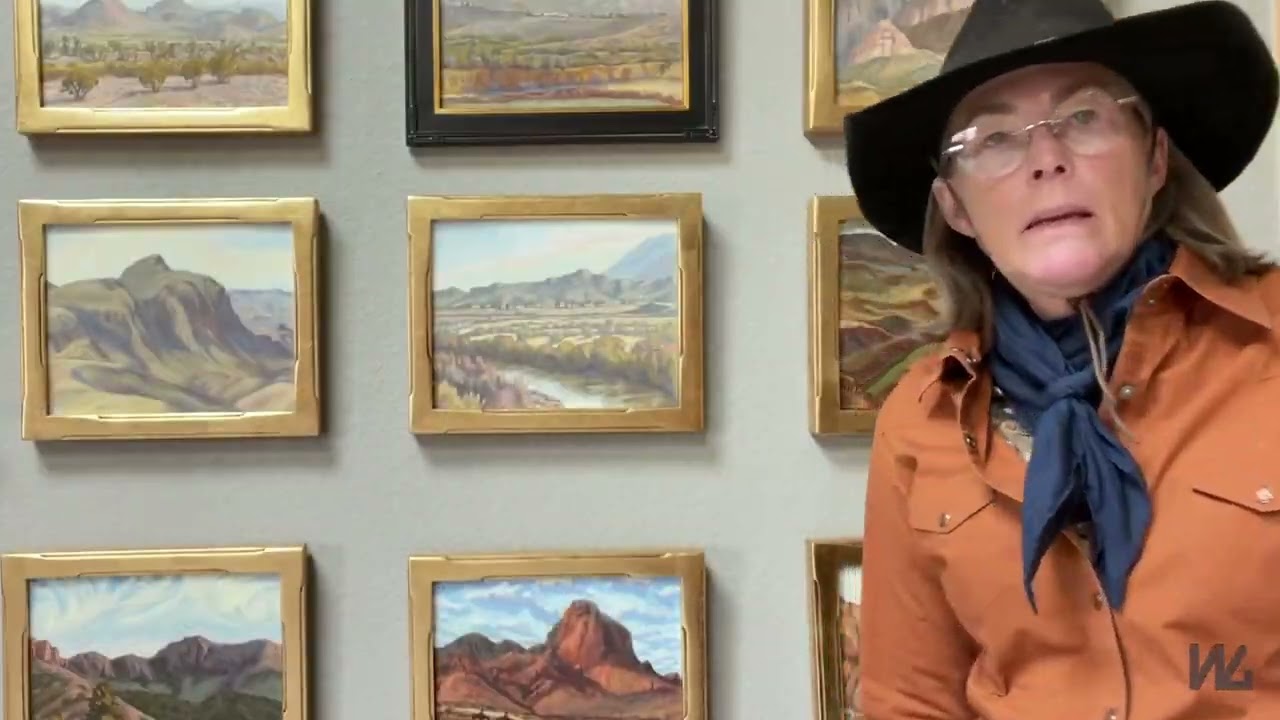
Leslie De Leon discusses her Lotería series, her painting practice and inspiration with WG

This content was created by George Irwin. This content was uploaded by George Irwin. This is a YouTube video titled "Leslie De Leon discusses her Lotería series, her painting practice and inspiration with WG" (Instagram Live republished) recorded Oct 19, 2025. It is an artist interview / live studio tour and Q&A: George Irwin hosts and interviews painter Leslie De Leon about her Lotería series, inspirations (Western and Latino influences), travel-based photo references, studio practice, sketches, selected works (e.g., La Dama, Bandera, El Borracho), prints/hand-embellished editions, and exhibition availability. The stream includes live viewer questions (e.g., Emily Christine, Brittany Sepulveda) and brief mentions of her partner/model Danny.
Chapters
I think I'm here.
Aha, there you go. Awesome.
I'm doing an Instagram Live. Some technical difficulties, sorry about that.
Yeah, did you say this is your first time to do one?
Yeah, actually.
Oh well, um, congratulations, you're now a part of the Instagram Live club.
Thank you, thank you.
Um, well cool, you've got your— the Lotería behind you, uh, some of them. I guess there have been a few that— well, maybe The ones that have sold are framed down there, but yeah, it's interesting. Everything's kind of flipped, so all the words and numbers are backwards.
Is there something I can do about that?
No, I don't think so. I think we're just— we're just— it's just like that.
Roll with it.
Yeah, but that's all right. So, okay, let me just jump into things, I guess. Folks who are new to Lotería as a thing, would you mind kind of like explaining what it is to them?
Yeah, absolutely. Let's jump into it. Okay, so some people call it Mexican bingo. What it is is you have a player deck and there's 16 images on that deck. There's 52 cards in total, so each deck is completely randomized, right? And then you have a caller who flips out a card say like La Bandera, for example. So if you have Bandera on your player deck, you would mark it with a penny or a bean. Sometimes we do beans. When you get 4 in a line or diagonally, you win.
Aha, that's cool.
That's the concept of the game.
Yeah, very much like, uh, kind of like bingo.
Um, yeah.
And what I like also about this is that you made 16 pieces, so it's almost like a a full card on the, like, on the poster or on the wall.
So the first time I did it, I had that in mind. I wanted to be like a player deck, and now this is like the second iteration of the second deck.
Yeah, it's really cool. Um, yeah, and for those of you who weren't aware, uh, Leslie did this series— this is the second iteration of the Loteria series. She did one in— was it 2023?
2023, that's right.
Yeah, in 2023, um, she did her first version of the series, and that was really great. Got— definitely got my attention and a lot of other people as well. And, um, and so we're excited to show this, the second iteration, and it's fun to see how it's, uh, kind of progressing and taking shape. Um, yeah, in the second iteration also.
I think so too. And I'm— maybe in 2 years again it'll be a different series and it'll look a little bit different, but the spirit will be there.
Yeah, well, I mean, you've still got a lot of cards that you can do, so that's— yeah, that's fun.
So there's 52 in total. That's kind of a big, um, challenge. But if we take it 16 at a time, I think we'll get there.
Yeah, I mean, that's like you're already like almost halfway or more than halfway, I guess. Yeah, or exactly halfway. I'm not sure.
Well, here's the thing, that would be 26, so you're more than halfway. Yeah, the thing is that sometimes because it's been 2 years, I think like, oh, this would have been so good for that card and I could do it again. So maybe it'll take a little bit longer because there might be repeats, you know, like maybe I have another idea for La Bota and I want to do another painting for that. Definitely.
Yeah, I think there might— are there— was there— did you do a La Dama last time also?
Yeah. So very different as far as it looks, but I love that card so much. Can't let it go.
Very cool. Cool. So, um, What inspired you? I mean, you know, we've covered some of this, but I think that, you know, maybe other people who are tuning in may not be fully versed in what's going on behind with the series. What inspired you to paint this Loteria series the way that you're doing it?
Yeah, so I've been really into Western art for a couple of years now, and also borderline art or art with a Latino influence. So this is a really good way to combine those two concepts because it is Western in its subject matter. We have landscapes, um, animals, cowboys even. So very Western in that sense, but I wanted to fuse that Latino culture with something very iconic like this super popular card game. So bringing those two together, I think got that point across really, really well.
Oh, definitely. Yeah, and I mean, it's something especially like, um, you know, the, the Western art, uh, world is so vast, you know. It's like it ranges from like upper end, like in Canada, all the way down to, you know, down into, into Mexico, I guess. Um, but what we normally think of is like sort of that like I guess southwestern thing is like New Mexico, Colorado, and Arizona. But yeah, there's so much like in the Western art world, I think, especially like in Texas and in southern Arizona and in southern New Mexico, especially like where there is like that borderland culture.
Yeah.
And it's fun to see that really represented well. Mm-hmm.
Because like Latino culture was always in Western art. Some of the first cowboys were Mexican. So it's always been there. It's just really loudly here.
Yeah, definitely. Yeah, and I love seeing that come more into, I don't know, like the overall like subject of Western art. Like, I know, like, you know, there have been like some, some really famous ones in the past, like Remington painted some vaqueros, and now it's fun, Sean S.C. Chavez has been painting vaqueros out of Albuquerque and Santa Fe, and those are really, those are fantastic paintings and represent his that subject really well as well.
Um, well, cool.
Well, you know, so this— one of the things that I also thought was, uh, really nice about working with you, um, we— I showed a couple of your pieces in a group show. I think it was After the Gold Rush, a couple of years ago. Um, and that was— that went well. And so when we started talking about doing the Lotería, I was really impressed with your professionalism and like your dedication to your work. Can you talk a little bit about like how you approach your art and sort of like your work style, your process? Like what— how do you like come up with this like concept and work toward it steadily and make things happen for yourself?
Yeah. So you and I started talking about this series A long time ago. I am a big planner. I like to have lists, sketches, rough drafts. So I'm really meticulous about the details and planning before I actually jump into the paintings. But it started off with, um, talking to you, getting my little ideas in a notebook, and then, uh, sketches, which I can show you if I can flip this around.
Yeah, let's do that. I love how you made, uh, sketches and studies for each of these pieces.
So we started off with some sketches. This is really, really fun, but also very time consuming. So if you're in a maybe a time crunch, don't do this. Yeah.
Well, so I think you probably— you made lists of the cards you wanted to represent.
Exactly.
And then you took them to— some of them are pencil sketches. And then what medium are these?
Are these acrylic? Okay, little painting sketches. Cool, because I also wanted to play with color a little bit more this time around. I like this one a lot. Color was crazy. Yeah, but yeah, so we started off with the sketches, and then once everything was finalized, I showed them to you. Then we jumped into the canvases. Yeah, that one's really good. Cool.
And it's— they turned out very like You know, sometimes there's a little interpretation that happens between the sketch and the canvas. And I think that did happen a little bit, obviously. But like, yeah, it's pretty like on the money for you. That's how they turned out. That's awesome.
I think so too. I didn't want to spend too much time on the sketches because ultimately they're just sketches there to get my idea on paper, but not look as good as the original, I guess, as the finished product. Don't want to waste too much time on a sketch. Yeah.
We have a question from Emily Christine, 12:30. What pieces from your life made it into your pieces? Or what, maybe what, like, aspects of your life made it into your pieces? I see some familiar landscapes, she says. Yeah.
So I travel so, so, so much, and all of these photos are references that I took myself. That's really important to me to get my own pictures. So, um, we have Colorado landscapes because I lived in Colorado for a year, a lot of South Texas landscapes because I'm from South Texas. So I have thousands of pictures of all my adventures, and they eventually make their way into the paintings. Even, um, like animals, deer that lives behind my backyard, or models, people that I know in my life posing for the paintings.
That's awesome.
Yeah, it's really great. Thanks for the question, Emily.
Yeah, I mean, it's—
I—
that's something that I think is really important and really helps to give, um, to help an artist like determine their point of view is to, you know, obviously work, create and work from your own reference.
Yeah, I mean, to each their own, but for me it makes me feel maybe more confident and a little bit more legitimacy in my own head that I've been there and I know what I'm painting. I've lived in that moment. So I think that's important to me personally, but to each their own.
Yeah, definitely. I mean, there are certainly, um, good cases for working from like other reference or whatever, but, um, I think, yeah, just like it— I think it helps to develop like a point of view for the artist.
Yeah. And you can borrow things here and there, but I mean, most of my paintings are like 4 or 5 pictures in one badly photoshopped reference photo and then making its way to the canvas. Yeah.
Um, let's— I mean, we've got another question, so let's just stick with this for a minute. Um, Brittany Sepulveda says, what was your hardest painting and which one is your favorite?
Oh, okay. I don't think I have a favorite because after each one I was like, oh, that's so good.
It's always the last one.
Yeah. That's the one that I finished.
Every, every artist's, uh, favorite painting is the one they just completed.
Yeah, so true. But to me, the one that I keep on going back to a lot is La Dama and Bandera. Those two are iconic for me for this iteration. They are like the centerpieces of the entire series. Um, I can't say I have a favorite, but those two— you know that you can't say I have a favorite child, you can't say it— but those two are up there for me a lot. Um, I think the represent everything I was trying to say with the series so clearly.
Very cool. I wonder, do you think it's because they are, um, human subjects and they are impressive human subjects?
Maybe. And maybe just because they represent the card well also.
Okay.
Bandera being the Texas flag, like my home state flag. But with like a rider, you know. I don't know, something iconic about that one for sure.
Yeah, very cool. Um, yeah, drop your favorite in the, in the comments if you're, if you're on here. That would be fun to see. A couple of you are doing that, like I see an El Borracho and El Venado, so that's, that's fun. Um, yeah, there have been like, I think, you know, you're mentioning some of the ones that you like, like the, um Like Bandera was definitely— is a popular one. Um, uh, Maceta is a popular, a really popular print. Really?
Oh, I'm so glad to hear that.
I think it might be the highest, uh, the largest series that we, that we end up making.
Oh wow. Could I ask you? I'll flip it over to you and ask you which one's your favorite.
Oh, that's a good question. Um, I like El Mundo a lot.
Oh, I love the concept of that one.
It makes— it twists my brain what's going on. I mean, not only is it really cool because like, it's like— I mean, when I first looked at it, my initial thought was like, oh, that is so cool how that— how the cowboy is like trying to lasso the moon. And I'm like, wait a minute, that's Earth. Yeah, and where is the cowboy? Yeah, so it's like, it's like some kind of weird inception happening there that I think is really fun.
So the bottom portion of that painting, um, in Colorado there's a Rocky Mountain National Park and there's this road called the Trail Ridge Road. The further you go up it, the less it looks like Earth. So that is the very tippity top of Rocky Mountain National Park. It's just Rocky Mountain craziness. Um, so that's that. And I remember being there thinking like, I don't even— I feel like I'm on another planet. So that's that portion.
That's awesome.
I love that, man.
That's so cool. Um, okay, so let's see, let's, let's go in a different direction here a little bit, I guess. Well, no, maybe not a different direction. You're talking about like being in the field, like being on location and being inspired. Do you, do you make sketches or take photos or gather reference like on location, or is that something— I mean, I know you said you work from your original photos, so I'm guessing some of that happens, but how do you gather reference from location and then bring it back to the studio?
Yeah, so I travel a lot with my partner. We go hiking, camping. We've been to 26 national parks at this point.
Awesome.
Yeah, it's amazing. It's so cool. But I hike a lot, so not much time to sit around, pull up your sketchbook and draw. I have thousands of pictures. I have painted on site before in Colorado. That was a crazy story. It was June here in Texas. In June, it's 100 million bajillion degrees, right?
Yeah. Don't plan to go to an area in Texas in June. Yeah.
But over there I set up my oil painting and working and all that. It starts snowing on me, so I had to quickly pack everything up. But, um, so that's an issue you could run into in Colorado. But no, I don't draw a lot or paint a lot on site. I do like to journal now to capture all the memories while I'm there. Um, but yeah, mostly just taking the photos, a million photos.
Yeah, that's really cool to think of, like, um, you know, visual artists journaling and processing what they're experiencing verbally, you know, like in journaling, as well as, you know, gathering all the reference photos. Yeah, bringing that back.
It's a new process for me, journaling, because, um, I've been traveling for maybe 5 years now, and that's really, really great, but I have only the photos to show for it. Not so much the memories. And now I want to remember, like, when we went camping, I burnt the Spam on the campfire, you know, little things like that. Um, twisted my ankle on the hike, or just part of the story. I want to remember the memories also, not just whatever the photos piece together in my foggy memory.
Oh, that's very cool. And I'm sure it like kind of like helps to add depth when you start, um, assembling works, you know, that are, that are inspired by a place.
Absolutely. That's cool.
Um, would you mind showing us, like, I know things are flipped backwards right now, but— oh, maybe if you flip the camera around. Yeah, can we do like kind of like some zoom-ins? I want to see a little bit of like the brushwork and impasto kind of—
absolutely—
uh, surface of the, of the pieces, if you don't mind.
Absolutely. Maybe we do a brief little studio tour.
Yeah, that'd be great.
Okay, so hey MTV, welcome to my crib.
Love it.
All right, so this is my new apron. Doesn't look so new. Here we have the remaining available paintings.
Okay, yeah, so there's— yeah, we've got 8 left.
Uh-huh.
So that's half, you know.
Also here in Colorado. Brushwork on this one was so Yeah, I love La Palma. That one is so good.
Um, yeah, so the— I guess La Palma, is that like some, some valley inspiration?
It is, yeah. Um, so there's a local park in Laredo, Texas, where I'm from That sits right on the river, the Rio Grande. That's the natural borderline between U.S. and Mexico, and this is a scene from there. Cool. Yeah, those palms are all over South Texas.
And then we also, you know, the timing of this show was, was meant to coincide with National Hispanic Heritage Month, which it does, but also we realized that it's going through Halloween, so we wanted you to do— we thought about doing a spooky painting. You want to show us that one?
Yeah, so this is araña, the spider, in a spooky forest. George has an aversion to spiders.
I tried to talk her out of doing a spider because I don't like them, but It turned out to be a really cool painting, I think.
Yeah, I like it.
Yeah, what was the inspiration for that one other than just doing a spooky painting?
Um, so I do travel a lot, and I can confidently say I hate traveling into forests because I always feel like it's so creepy, especially going camping. I'd much rather camp in like a barren desert than in a forest because I always feel like there's gonna be like a witch living in there, something creepy out to get me at night. Um, so that just combines like the spider with like a creepy spooky aspect of the forest.
Gotcha, that's cool. And you know, like, con— you know, I don't know if it's like contrary, but like sort of in opposition to that, like, um, alacran is a creepy crawly, but I think that painting is so beautiful, like from like just say like it's really pretty, you know?
Yeah, I guess it has to go again with the colors, the background. I mean, yeah, exactly what you said, maybe the background, the setting.
So, well, and something maybe about the scorpion and it's like sort of natural camouflage with the, um, the prickly pear, you know, like sort of all go together and it just feels more like a landscape. It doesn't feel to me like really creepy. It just feels— yeah, pretty like really nice.
Yeah.
Um, potentially deadly, I suppose, but potentially—
I mean, maybe spiders also, who knows.
Yeah. Um, all right, so tell me about El Borracho. Okay, I mean, I know, I know what he represents. I, I may resemble that, uh, or have resembled that at some point in my life, but, um, Tell me about your inspiration there.
Yeah, um, something I thought was so funny the first time around when I was, uh, posting online about the first series, sharing my paintings, probably the most requested card by far was people saying that they wanted a painting of El Borracho. People were saying, paint me. So, um, keeping in with a Western subject matter, maybe like a look with the series. I wanted, you know, like a cowboy drinking, right? But, um, I don't have many of my own personal reference photos of people drinking, uh, so I had my partner Danny pose. I was like, I need to do this card, please just pose for me.
That's awesome. I was wondering if that was Danny. Yeah, as a, as a model.
Uh-huh. He's a good sport about it. And, um, He likes to help me whenever I need, so he posed real quick and then we made a good painting.
Very cool.
Yeah, that was really fun, and I think it's just funny that that was the most requested card.
I love it. Um, well, so going back to how you are a pretty organized person, would you mind showing us your, um, your paint board?
My palette?
You're not— you're not your palette, but the— I mean, you can show us your palette, but your, um your, your hanging wall where you have all your, all your paints organized?
Oh yes, okay, yeah. So I have this pegboard, it's a little bit backlit now, but, um, helps with organization a lot and just like visualizing the paintings— or sorry, the paints— seeing what I need. Um, stocked up on some more Gamblin. Yeah, and I also have that paint squeezing contraption machine thing. This right here.
Oh, nice. Yeah, you can get all the—
squeeze every last drop out.
Very cool. Well, can you show us a couple of the, of the framed pieces there that you've got ready that we're about to get shipped or delivered?
This is El Pescado, the fish.
I love this one. This one turned out so cool.
Let's see if I can grab it into the light to see it better. This one has some crazy texture that was so much fun to play with and color. Maybe we could even show how it transforms from the sketch to the painting.
Oh man, that was like a— that was fantastic. That was like a Mr. Rogers or Reading Rainbow moment. Do that again.
Cool.
I love seeing how the light, um, you know, plays on the actual pieces.
That's really cool.
Bandetta, it's gonna ride off, uh, into this— into the sunset. I don't know, the clouds.
Soon into the storm. Yeah. And then my girl, Obama.
Yeah. Very cool. Um, all right, Leslie. Well, is there anything else? I guess, yeah, what is your— show us your workstation real quick, because I know there's artists out there that love to see this kind of thing.
Yeah, so this is a cart just from a good old-fashioned thrift store. I have my palette here. Bunch of brushes that are in desperate need of cleaning.
That sounds about right.
Yeah, but it's just a pool cart situation, does the job.
Cool.
Um, on this shelf we have more paintbrushes and the original cards that I like to look at for reference.
Very cool. Um, phone stand, because you do, you do a a pretty good amount of, um, kind of like, uh, content creation for Instagram and TikTok and stuff. So you've got your, your phone thing on there.
Absolutely. Yeah. In the year 2025, you got to be both an artist and a social media manager.
Yep. It's the truth. Well, very cool. Um, all right. So let's see. What would you say, I don't know, I mean, I don't, this is not so much a question just like as something I was thinking about that I love how we're doing prints and they're, you know, they're all limited edition based on the time of the exhibition through October. And so that's a, you know, kind of the first time I guess we've had a really accessible, like at Western Gallery, we've had a really accessible price point for work, like original works that are translated into, I guess, limited edition prints directly. So I think that's really cool. I know that they've been, they've been really popular with a lot of people. So if you haven't gotten a print, make sure you check them out. If you do want one of the originals, those are available also until the end of October. And there's, what, 8 left? So you saw a bunch of them just now. Let's see, and as far as like, and we're also doing a few, I think there's a few available, 3 maximum, of like hand-embellished prints. So Leslie's gonna add some painted flair to the hand-embellished ones if that's something, you know, if you want something a little bit more special than the limited edition sign print, but don't quite feel like going for an original, that's a good middle ground.
Yeah, somewhere in the middle of those two. Yeah.
All right, let's do some rapid-fire questions for you real quick, and then we'll finish up. But when you're working, and I know this is maybe— okay, this first question is silly, so how about Big brush or little brush?
Little brush. Okay, for the details.
Um, morning paint session or night?
Uh, night. I'm not a morning person.
Cool. Underpainting, yes or no?
Hmm, sometimes. I'm gonna— I do know an answer. Yes.
Okay, cool. And then, um, Do you have one color that you're maybe overusing and loving?
Right now I really— I'm trying to push pink a lot to bring out the warmth of life in it. So pink.
Very cool. Awesome. Leslie, this was so much fun. Thank you for doing the Instagram Live. Thank you for showing us your lovely studio and the works in it and how you're working. Thanks for hanging out and telling us about Lotería. The rest of you guys, make sure you explore western.gallery. We've got the whole exhibition up through the month. The prints and everything's available there. Oh, and also, I forgot to mention, other than in the beginning, we were talking about like the lotería card, we've got the exhibition poster available as well, and that's a pretty accessible item if you like the exhibition. Um, and yeah, links in Western Gallery bio, western.gallery in your browser. And Leslie, what's your, your URL for if people want to go right to your site?
Yeah, it's just lesliedeleonart.com.
Okay, awesome. Well, uh, thank you again, Leslie, and thank you everybody for tuning in. We will see you next time and, um, talk to you then.
Thanks, George. Had fun. Thank you. Bye. Thank you. Bye.