Artist vs Entrepreneur Paths -- Basic Ikigai Venn Diagram for Authentic Business
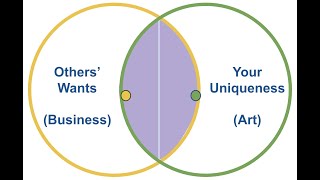
George Kao maps authentic business as the overlap between your unique creative self and what people will pay for. Artists risk staying a hobby; entrepreneurs risk selling out. He took three years experimenting before his business grew in 2016.
Chapters
If you have been interested in finding purposeful work or creating what I call your authentic business, you probably have come across various kinds of Venn diagrams online. It's been popularized recently with this concept of ikigai I k I g A I. You can look it up and, and see the various colorful types of Venn diagrams which basically represent. They try to communicate this, this intersection between, let's say, your strengths and your passions and what the world wants to hire you for, what you're good at, that kind of thing, those, those intersections. Well, I have my own version of that kind of Venn diagram. And I was somehow. I somehow stumbled upon an old diagram that I created back in 2014. I think I may have even started. Started sharing something even years before that. But 2014, for sure. I presented this diagram that I'm about to show you. So let's take a look and let me know if this is helpful. So this is. Let me just give you a bit of context before I share my screen. I make it simple by having just two. Two circles to begin with. Your artist self on the one hand and your entrepreneurial self on the other. So my, my view about it is that each of us, because you're watching this video, you have some interest in creating and growing your authentic business, a business that really fulfills your authentic expression and your kind of your soul's calling. It feels to you that way because you have that impulse. I think you have within you two archetypes, two aspects of you. You have kind of an artist self. And by artist, I don't mean you literally paint or sing or create music. By artist I mean that you have a, a creative self, you might say, that wants to express something that's more fulfilling for you. Okay? So you have an artist side of you, and then you also have an entrepreneurial side of you, which is the, the person, the. The part of you that wants to make money, that wants to be able to sell something that people buy. So these two sides of you, when they're integrated and they play well together, I call that an authentic business. So let me go ahead and show you my screen now and tell me if this is helpful. Here we go. So let's begin with this green circle, basically representing your artist archetype, that part of you, and I call it your uniqueness, the experiences you've had in your life, the peak experiences, the, you know, all the books you've read, the trainings you've gotten, the conversations you've had, the, the skills you've developed, the vision and dream you have for the world. And maybe sometimes you might even want to say this. This is your energy signature. So sort of like your uniqueness, your. Your presence and your values in. In the world. So that's. Let's start with this circle. Okay? That's one part of you. And then you have another circle. Let's go to the next one, which is. So the green circle is your uniqueness, and then here, the gold circle is your entrepreneurial side, the side of you that understands, okay, if I want to make money, it depends on meeting other people's needs. Right? Meeting other people's needs. And I want to get clear on this because I've made this in 2014. I would say at this. You know, I would say now to clarify it, it's really meeting other people's wants, meeting people where they're at, because you might think they need something, but they. If they don't agree with you that they need something, then they're not going to buy anything from you. So they have to want something. You know, you have to understand what their wants are. And if you can understand it, then you are much more likely to have a business. All right, so then let's put these two circles together. Here we go. All right, so your niche or your authentic business is the intersection between your understanding of other people's wants. And I really should just go ahead and update this. Others wants and your uniqueness, your art, your peak experience, the thing you love talking about, the thing you love doing. So that intersection between the two, the thing you love and what others love and others want is your authentic business. Or in the past, I call it your niche. Now I call it your authentic business. Now, this seems pretty simple, but I want to take it one step further because you might say, well, yeah, George, obviously I want to find the intersection. Because if it's just. If it's. If I'm just in the. If I'm just in the green circle, there's. There's no intersection with the gold circle, then it's just my hobby. That's true. Right. Because if you're just talking about things you love and then nobody wants to buy anything from you, well, you've got a great hobby. Wonderful. Congratulations. But if you could find the intersection with what others want enough to buy something, well, then you. You have an authentic business. But. So this is pretty simple, but let's take it to the next level and find some nuance here. So let's. Let me show you this. Check it out. What's the difference? I Have just added a green dot. The green dot. Notice where it's located. It's closer to the center of your uniqueness. The green dot right there in the middle is closer to the center of your uniqueness. And yet it's at the edge of other people's wants. And this is where a lot of artists start, right? Because the artist says, I don't really care what other. Well, the pure artist self says, I don't really care what other people want. I know what I want. I know what looks beautiful to me. I know what is makes me come alive. And I'm going to focus on that. And if you're lucky, you're still somewhere within the circle of other people's wants, right? So you have a little bit of business, but a lot of artists as well. It's the common trope, you know, the starving artist, right? The, the artists are able to sell a little bit because they're able to sell a little bit because it's on the edge of what other people want, but it's closer to what they love. And so they're only able to sell a little bit. So this is the artist path with the common way to think about the artist path. Right, well, let's continue on. There is the other side. Okay, so let's go to this graphic here where now you see a gold, little gold dot. Notice where the gold dot is. The gold dot is closer to the center of other people's wants. Again, I would change that if I could, but I'm not going to change that right now. It's closer to the center of the market desires. You know what the market wants. And, and generally, I'll just give you a shortcut. What the. Like in any era, right? In any time in history. The what, what. How do you know what the market wants? Well, you basically notice what they're spending money on. You look at your friends, you ask your friends, you ask your clients if you have any. You ask your friends, you ask your colleagues, you, you, you, you, you look at your, the spending of the people around you. What are they spending money on? And then you have gotten in touch with the, the market. You know what other people's wants are. And generally speaking, it's things that unfortunately give instant gratification. The more something gives instant gratification, the more likely people want to spend money on it or the more that it solves a painful problem, a painful, urgent problem, the more likely they want to spend money on it or something that brings them, brings them great convenience or pleasure or something. Again, either it gives them an instant pleasurable experience, or it solves and solves a painful, urgent problem. It's like generally one of those two and some mix of that is what people want to spend money on, right? Notice, look around you. What are people spending money on? And you just become aware of that, right? So the gold dot yojo notice is closer to the center of the market, and yet it's also. It's still on the edge of your art, meaning you still don't mind doing it. Like, if it was out, if the gold dot was completely outside your uniqueness slash art, then you would feel resentful or it would be a job. It would be a job that you don't love. You don't love at all. You're just doing it because you have to make money, right? But here, they're still kind of on the edge. It still has. Has some sense of, yeah, I could enjoy this. It could. It still includes my energy signature, you know, and so this is usually where entrepreneurs start. When you need to make money, you need to get closer to the center. You need to get closer to what other people want. They're willing to spend money on it. And that's you generally. But the. But, but let's. Let's keep going here, right? Okay, so let's continue understanding the nuance of this. So the artist path, as you can see, the artist started closer to the center of their passion and art naturally, what they love, right? And they understand over time, if they want a business, they have to go closer and closer to the center of what other people want. That might not be directly related to what they want. It's other people. Other people want stuff. Have you noticed? Just because you want something doesn't mean other people are willing to pay for it, right? So you just have to be aware, become aware, get outside. It gets outside of your own head. So really, the artist path, as you can see, I've written a few notes on the screen here. The danger is self absorption, right? The artist goes, I don't understand why people don't love my art. I love my art, and my art is amazing. You know, it's like, well, it's because you spend so much time in your own head, right? You spend so much time in your own head, in your own creation, in your own world. And other people don't get it. Because other people haven't had the journey you've had. Because why? Because you have. Obviously you've lived your own life, you've had your own experiences, and other people haven't lived the same life you have. They haven't seen the same things you have. So it's like, it's like the job of a marketer. The job of marketing is to bring other people along your path, help them understand your journey enough so that finally they go, oh, I love what you love too. I see the beauty where you see beauty also. Right. So, so the artist path is, the danger is hobby status. Hobby status. It always, it always stays a hobby. You could always stay on the green dot, you know, you never move towards the gold dot. You always stay in the center of your passion. It's usually at the edge of the market. So you only sell a few things here and there, whether it's paintings or music or poaching or healing or retreats or books. Like, you only always sell a little bit because you haven't been willing to expand your mind and your heart towards other people's wants. Yeah, it's actually, if I may say so, and I'm going to stop the screen share for a moment what I think the universe is calling forth to the artist, what life is calling for to the artist. Life is basically saying to the artist, you can either enjoy your hobby and don't worry about making money, just enjoy your hobby, fully go into your uniqueness, fully go into your world, create art, share it with the world. But just know that most, the vast majority of people who see it aren't going to engage with it, aren't going to feel anything from it. Maybe get a few people, and maybe you even get a few people who want to buy something from you, but fully enjoy that path. You can either choose the hobby path or if you want a business life and the market is whispering to you, expand your heart and your mind enough to encompass more people. Yeah, it's really coming out of self absorption and being willing to open your heart to the wants of other people and say, okay, I'm not going to just be in my own little world now. I'm going to expand and say, well, what do you want? Let me, let me try creating what you want. I, I don't think it's as pretty. I don't think it's as meaningful, but maybe I can stretch my mind and expand my heart to income, compassion, to encompass what you want. Because maybe I will find the, the path of service to be meaningful. It could be that. It could be that. So that, I think, is what life is calling to the artist. If they want a business, if they want to make money, if they want a livelihood, they don't have to. It could be in the hobby. But if they want a livelihood, they have to expand their heart and their mind toward the green dot or, sorry, toward the gold dot. So that's closer to what other people want right? Now, on the other hand, what is life telling the entrepreneur? Right? The danger of the entrepreneur, as you can see, is that they, they usually, I want to make money. I want to have sales. I want to influence people. I want to persuade people. I want to, you know, I enjoy seeing people buy from me. So they, they basically, they tend to start at the gold dot, the center of other people's wants. They get real sensitive and they bend over backward. They contort themselves into a shape of what other people want them to be so that they'll get sales, right? They learn how to persuade. They learn how to. They learn psychology so that they can shape, you know, shape shift right into. Oh, I'm going to say these things to get you to buy, to get you. And that's what the entrepreneur does, right? And it's the center of other people's wants. They understand other people's wants better than the artist does. But the danger is losing meaning and ethics by staying with the gold dot. You see what I mean? The entrepreneur is in danger of selling their soul, selling their, Selling, selling out. It's like you're not, yeah, you're. You care so much about what other people want that you've forgotten about a path that's you deeply meaningful because it's unique to your own life's experiences. So what. The universe is, I believe what is calling forth to the heart of the entrepreneur is to say, why don't you move? And let's look at this diagram. Why don't you move a little bit closer to your own heart, to your own uniqueness? Maybe you don't. Maybe you don't have to try so hard to make all this money, but let's, let's try moving closer to your own, your own heart. And yeah, it might sometimes it might at first be, you know, out closer to the edge of the market, meaning maybe you'll make less money at first, but let me show you what happens. Okay, let me. I'll stop the screen share for now. This is, this was actually my path. My. I actually started on the entrepreneur's path because when I began, I'm like, I didn't. I don't have a job. Back in 2008, I quit my job because it wasn't meaningful to me. And I said, I just want to do my own thing. But because I had to still support myself, I said, well, I got to make money, so let me figure out how to be an entrepreneur. So I learned how to do that and I started a business and I sold things that other people want and I made money doing it. But then I felt like I lost my soulfulness to it. And so those of you who have watched my videos probably know that I had this journey of spiritual breakdown and breakthrough. So that I said, you know what? I can't, I can't be doing the persuading psychology stuff anymore. I can't be doing the funnel stuff. The things that just like, are so to me now these days, I see it as manipulative of other people because that's what tends to happen when you learn marketing from the mainstream guys and gals, is that you learn how to shape shift, contort your, your ethics so that you use certain words and certain techniques to get people to buy, get people to act. You're like seeing other people as like a. Something to manipulate, like, oh, I manipulate their psychology. So I, I learned all that stuff and I'm like, no, I don't want to do that anymore. So I really stopped my business in basically between 2012, that's when it started, and 2014, I basically wound down my. The way I was doing things so I could restart from the artist path. So really in 2014, I restarted and I said, I'm just gonna go with my heart and I'm going to do what is truly authentic to me. And I had to learn really in the, you know, I wound down my business a lot so that in 2014, I kind of started my business over with, with much less income because I was just wanting to try my heart of service. What does that mean? Authentic fulfillment? What does that mean? I did all the. So I experimented a lot. 2014, I experimented. 2015, I experimented. It really wasn't until that I really started to figure out and, and build an audience from 2014 to 2016. Then 2016, my business started taking off again because I finally figured out this intersection of authentic business. Now. So let me just share with you. If you start at the artist path, like most of you watching this, can't bear to start at the entrepreneur path. It would be too painful to you. It wouldn't. It would. The lack of meaning and the lack of soul, for most of you, watching would be too painful. You couldn't do it. So you have to be patient and go, fine, I'm going to start at the, the, you know, I'm going to start at the green dot. Let me go ahead and share my screen again. I'm going to start at the green dot. Okay. Whoops. Yeah, I'm going to start at the green dot because I can't bear to start at the gold dot. It's too painful. It's too meaningless or too manipulative feeling for me. So I'm going to start at the green dot. You can start at the green dot, but just have to be patient. That is not going to make as much money. First, you have to be patiently building your audience. That's what I've been trying to teach you to do because I know most of you will tend toward the artist path. It's okay. You give yourself two years, three years to not make so much money, to make very little money, but to build an audience for two to three years, start at the green dot. You build an audience with your uniqueness, with your unique voice, exploring what that even means. And by doing so, you make your energy signature stronger because you practice what it means to express authentically. You make your energy. It takes two to three years, right, to make your energy signature, to make your authentic confidence come out publicly, to have visibility for that to be okay, being visible authentically. And then as you keep doing that, you build an audience that's willing to go into your heart as well. And therefore, you'll be able to make money. Right? You, like, take the audience. You basically expand the circle. You're starting here, and you're expanding the circle so that the circle becomes more and more. I'm not going to connect. Yeah, the circle becomes more and more. You're moving the market over closer and closer to your own heart as well. But it takes a couple of years. For some of you, it might take two to three years. Some. Let's let me. For some of you, it might take, I don't know, five to 10 years. So if you're willing to be. Not make as much money, then it's. It's. It's doable. But if you have to make money sooner, you have to honestly bear the pain of expanding your heart and mind to reach other people's wants. And it can be meaningful because you're. You're going into compassion at that point. So I hope that this is helpful and maybe enlightening to where you are at. I look forward to seeing your comments below, and thank you so much for joining me.









