Concentric Circles Business Model -- a wholesome alternative to sales funnels or customer journeys
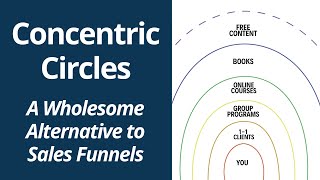
George Kao presents the "Concentric Circles" business model for coaches/consultants/healers that centers the individual ("you") and radiates outward to increasingly scalable offerings: one-on-one clients, group programs, online courses, books, and free content. He emphasizes "joyful productivity" (consistent, gentle discipline) as the source of value, explains trade-offs across tiers (access vs. scalability and pricing), gives concrete examples from his business (group size, pricing, attendance trends, book royalties), and stresses a non-pressure, non-funnel ethic allowing people to move between tiers voluntarily.
Chapters
All right, I'm going to share with you a simple business model strategy that I use myself and recommend to all of my clients. This is a model that is ideal for those of you who want to build a right livelihood, a true livelihood that is based on your own experiences, learnings, knowledge, wisdom, presence. So you would be doing this through either coaching, counseling, consulting, healing, facilitation, mentoring, that kind of thing. So I'm going to go ahead and share a graphic with you on the screen. Some of you are probably listening to this as a podcast episode, and if that's the case, you can look in the podcast notes for the link to the video that will show you. But for those of you who are watching this on the screen, Here we go. Let me go ahead and share my screen with you. I call it the Concentric Circles business model. And here it is. You hopefully see it on the screen. And I have essentially been using this model since 2009 in different ways, but more earnestly since 2015, since 2014 when I started my business over again. And it's been growing ever since then. And this model has really stayed, stayed true and very helpful for me. So let me go ahead and explain this to you step by step here on the screen. So, as you can see, these are concentric circles. The outer one encompasses the inner ones and the the inner one right in the center of the model is the word you. Okay, You. Why? Because, well, the model begins with you as the source of your all the value that you give into the world. You. The value you give to your clients, group programs, courses, books, free content, etc. And so this center circle is most effective. Like you are most able to radiate value when you pay attention to your joyful productivity. So let me just stop the screen share for a moment. I'll just go back and forth so we can look each other in the eyes. So at the center of the model, you, if you practice your the, the skills of joyful productivity, meaning being able to show up consistently with gentle discipline and joyful work on a consistent basis, then you're, then you're able to really develop the skillfulness to radiate the most value out into the world, versus if you are more haphazard in how you show up for work, you're not consistent with putting content out there, for example, or creating offers and announcing your offers, then the, your signal will be relatively unstable and kind of weak. But those of you who have been following me for a while now, some of you have been kind of watching my content or, you know, taking my courses for years, you know, that I am so darn consistent. You know, I was just talking with a colleague of mine today who has also quite a successful business and he says, george, I don't know anyone who launches, offers and creates content as consistently as you. And well, it's because I have dedicated myself to the practices of joyful productivity and it really has changed my business, changed my life. It's made me so much more stable and consistently growing over the years. And I haven't been this balanced and joyful in my work than ever before. So I highly recommend whether you want to, you know, read my blog posts or watch my videos about joyful productivity, I also have a whole online course that goes through the 20 skills of joyful productivity. Want to study that stuff? It's up to you. But yes, I have blog posts, videos about it. If you just want to kind of start, start with all the free content that you know that, that you, that you need. So let me go ahead and go to the next level of the model, which is one on one clients. So first of all, you notice that each level gets larger, but also farther away from you. So one on one clients is the closest to you, you know, to the center circle. And then group programs is farther away from you, but it's larger. Online courses is larger, farther away from you. So what does this mean? It means as the circles get larger, it means the more people, the more numbers of individual human beings you are able to make a positive impact for. So for example, one on one clients, you can't hold as many serve as many one on one clients as you could having people in your group programs. You can't serve as many group program members as you could people who buy your online courses. Right? It's more do it yourself kind of thing. And then if you had books, you probably, you could technically have, you know, millions of people buy your books. And it really doesn't affect your workload very much. I mean, people might email you more, you might get more opportunities, but not, you can't serve, you know, millions of people in your group programs or even online courses or something like that. Right? And free content is the outermost level, which is farthest away from from you, but you can serve the most number of people. And you'll notice that the free content circle is porous. On the edge is porous, meaning it really is completely scalable. In other words, you make a YouTube video or you make an Instagram post, or you write a blog post or something like that. Or you record a podcast episode, it could be consumed by millions or tens of millions of people or thousands of people. And you're adding, you're, you're putting all this value out into the world. People are getting benefit from it. But, but it's porous, meaning as many people, I mean it doesn't cost you more money when people view your YouTube videos, right? Or, or read your blog post. Now you might, YouTube video certainly doesn't cost you money. In fact, you'll make money when more people view YouTube videos because YouTube, you can turn on the ads on YouTube and start making money when YouTube shows your show ads on your videos, um, on your blog posts. If literally millions of people read a blog post, you might, depending on your website hosting company, they might charge you a bit more for, but not, not that much more. So in other words, free content is really porous and scalable. Whereas, and back to the, to the closest to you. One on one clients is not scalable, however, because your one on one clients are closest in the closest to you at the center where you're radiating the value and you're living your life. You're kind of sharing experience from your lived, from your, from your life, from your lived experience. Your one on one clients get the most access to you. And at the same time they pay you more for per person that they pay you more than let's say a group member, a group program member would. You see how this model is starting to work? So the closer into you, the fewer people you can serve, but the higher that they're paying you per person, right? So you're each one on one client. Maybe, maybe they might pay you 500amonth, let's say, okay, something like that, whatever. You know, some of you charge, I don't know, 150amonth to 500amonth. Some of you charge $1,000 a month for one of my clients or more. I've seen, definitely I've seen more. Whereas, however, group programs are where, you know, I have two group programs right now and it's where I facilitate group calls every week for my program members. So they get to kind of interact with me within a group, within a contained group. It's not hundreds of people on a call. In fact, my group program live calls are usually about, you know, 10 to 30 people at the most on a group program call. Online course calls are larger than that. But group program calls I usually have, even though I have. So this is interesting and, and this is helpful for those of you who are interested in this model, I have 80 people in one of my group programs, 80 people paying between 111 and 222 dollars a month. So there's different tiers, but 80 people pay, you know, somewhere one to 200amonth. And out of the 80 people, only 10 to 20 people show up on every Q A call. So it's only 1/8 or 1/4 of the people show up live on calls consistently. And actually this is, right now, I'm recording this at the beginning of the year and beginning of the year there was, there was 23 people on, on the call that had the best time zone for most, most of the members. 23 people out of 80 showed up live in the beginning of the year. And then throughout the year it's going to be less and less until you know, by, let's say March or April, it's going to be like 12 people on the call. And then by, by the end of the year it's going to be like five people out of 80 people. It's always, it's always like this. So your group program members don't get as much access to you because they're interacting with you in a group on, on zoom calls and also in private online forums where you respond to them. And, but even though they don't get as much access to you, you can't have unlimited group program members because you're charging them, you know, you're charging them a certain amount that they expect some interaction with you. I don't know. But I, you know, I have, I have personally been part of group programs that were like four or five hundred people in a program and I felt lost and I felt like nobody cared whether I was there or not and whether I engaged or not. Whereas in my group programs I always assign each member a helper. So I, I pay a little bit to some of my, you know, long time members and I pay them a little bit or, or I give them some other benefit to lightly support like four to eight other members, depending on which group program. And so in my group programs, that's why I have to charge a certain amount so that I'm able to kind of provide those, those benefits. So, so let me go back to the diagram here and I'll show you. And in case you're wondering, those of you watching, that's my cat crawling around. Okay, so let's go back to the diagram. So the group program has less access but still more access to you than the higher levels there. They have some access to you. They pay less per month. Than a one on one client. So let's say, let's say a one on one client pays you 500amonth, then a group program member might pay you $200 a month or 100amonth or depending on your group program and what's included. Right. They pay less, but that means they have less access. And there is additional benefit actually in a group program they get to interact with each other. So some people really appreciate that. And that is not available usually to your one on one clients. Although of course you could create a community for your one on one clients as well. But then you're kind of, if you create a community for one on clients, you're basically going into the group program model at that point and you can have, you can have people at all these levels. By the way. You don't have to just say, well, I'm a one on one only. No, what I'm trying to show you here is that over time you probably want to, it's, it's, I think it's a good idea to create offers in each of these tiers, in each of these levels because that way you have a more diverse stream of income, you can test the market more to see which ones that your audience wants to sign up for. And you also get to test what way of delivering value you actually enjoy the most. If you only ever stick with one on one clients or only group programs, you won't ever have that experience. And so even at this point when I have a relatively, you know, good sized business, I still do some one on one client work because I still want to experience that kind of interaction. I don't do, I do very little of it because most of my offers is really group programs and online courses. But I still do, I still do everything on every level, at least a little bit to touch in on what it's like to deliver value anyway. So that's one on one clients, that's group programs. And then next level up where you can serve even more people is online courses. By the way, when I say online courses, you could of course teach things in person, but when you're teaching in person, it's, it's almost more like a group program because you can't have that many people in person. Whereas with online courses you could have hundreds of people buy every course or thousands of people over the years buy your courses. And it doesn't, you don't have to get a bigger room. It's just they're, they're, they're at getting access to some digital Content, right. And maybe some online calls. So online courses are wonderful, especially for you to test different topics. What I mean is you have so many topics within you that you could teach the world. I mean, look at all of the life experience you've lived, look at all the things you've learned, all of the courses you've taken yourself, all the videos you've watched, all the things you thought about, you have talked to friends and clients about. There are so many topics. And so online courses, to create online courses allows you to really test the market to say, will you buy this topic from me? Okay, no. Will you buy that topic from me? Oh, yes. Okay, great. Well, I'll do even more on that topic. So, so I, I really encourage all of you to consider creating online courses on a regular basis. To, to. It helps you to organize your knowledge. Because once you, once you announce a course and that you're going to teach it and people start signing up, you get this kind of motivation, natural motivation to organize your knowledge in that in, and then deliver it in a very or in, in a very step by step way for your students. And so you benefit from organizing your knowledge. Your students benefit from having the shortcut of all of your years of experience, you know, given to them in a step by step way. And your business benefits because, well, now you have an additional passive income stream because people can buy your online courses anytime during the year as long as you have it listed on your website. So online courses, very scalable compared to group programs where again you can only have, you can only serve a couple dozen or maybe low hundreds. Well, where people feel cared for. But in online courses you can have thousands of people buy it and people don't expect that you're going to like answer their, their detailed questions one on one because they're buying an online course, they're like, okay, you'll probably respond in a comment when you can. Or maybe you have certain, like for example, for my online course students, I have a monthly Q A where I'm like, you know, listen, I don't answer questions via email and I barely like to answer questions by commenting on, on stuff under lessons. So come to my Q and A call, I will answer as many questions I can. There that's really. Now, you know, my audience is big enough where I can do that. But when your audience is so small, your online courses are relatively small and you can serve them, you can, you have more time to answer each person and so your customer support is probably better than mine. But as you're. Because that that's actually, this is the natural sort of dynamic over, over the years, as your audience grows, your customer service necessarily decreases. But I think that's okay because that gives more opportunity to people who are just starting out. Right? Like your audience. The most of you watching this, your audience is smaller than mine probably. So you can have better customer service. Your, your business will, will stand out with better customer service than compared to mine. I can' customer service as I used to be able to. So. And of course I try to compensate by that by starting to hire some part time team members to help out things like that. But that's the reality of a business growth. It's like the, the person in the center of the circle. Right Again, back to the, back to the diagram. Person in the center of the circle only has limited capacity and presence and the one on one clients. You know, as you, as your business grows, as your audience grows, you're probably going to charge more for one. You're going to charge more for each level as your business and pres. And ability to deliver value grows. Right. So online courses anyway, more scalable than group programs. And then above that, books are even more scalable. Like you can reach tens of thousands of people can buy and read your book and the book readers aren't going to expect that you're going to answer their email, right? Like when was the last time you bought a book and go let me look up this author's email address and make sure they answer all my qu. No, you don't expect that. You know, you just, you know, if you, you'll feel lucky as a reader if they even get back to you with a, oh, I'm so glad you read the book. Right. So books are. People have less. So, so I should mention with each level, okay, that gets larger, people have less expectation or I should say you should set expectations properly. So for example, so let me, let me finish with the books. Books obviously will give you a bit of passive income. It's not as good of a pass. It's for each level that's closest to you. It's more likely that you'll make enough money to live on. So if you want to make enough money, start with one on one clients and then go to group programs to build on top of that and then go to online courses and then go to books, etc. Right. You don't, don't think you can write books and make a living? It's extremely, extremely rare. I don't at this time in this recording I make somewhere between just shy of 200amonth I get for book royalties. And I have five books, two of those five books have second editions. So books are really just like, for people to discover you, new people to discover you. It's a cheap way to get into your world, right? And finally, free content people will not expect and should not expect that you will answer their emails or answer their, even their comments and things like that because you're busy, you're dealing with all these other things, serving all these, all these other people, especially one on one clients and group programs. And so each level closer to you means they have more access to you. And you also have more responsibility for what you do with them. Right? Because you have more, they have more access to you. You have, you're able to customize your advice more as the levels are closer to you. And the farther out the levels are, the less you can customize your advice to them because they have less access to you. And you should finally keep these as solid boundaries so that you don't burn yourself out. And one more thing I'll say before I end is that part of the authentic part of this model is that I allow people to come in and out of any circle without feeling the pressure that. So for example, some people, which I don't really like, like, I don't like the funnel model. This is different than the funnel model because funnel models, like, they check out your free content and then they might get pressure to either buy a book or buy an online course. And after they buy an online course, you're going to pressure them to join a group program or one on one client or whatever. That's a funnel model. And I really don't like that. I think people, I think you should be able to watch my free content all you want with no pressure to go further. Now, of course I still make invitations. I still, but I do it gently. I try to do it gently. I try to just, you know, but you don't have to, right? You can read my books without doing anything else. You can join my online courses and not join my group program and still get a ton out of it and, and et cetera, et cetera. So allow people to come in and out of each level without pressure. And that's what makes it truly wholesome and authentic. So I, I hope this diagram is interesting. I hope you'll study this diagram some more. Read, read what's on, read what's on the page here. Those of you who are able to watch the video, those of you who are listening to the podcast look at the podcast notes to get the link to be able to watch the video and see the diagram. So I hope this helps. Thank you for joining me. I look forward to any questions and comments below, knowing that of course, this is free content, so I won't be able to address your question in depth. I'll try to as I can, so thank you so much for watching.









