🧘🏻♀️ Developing Consistency and Discipline, and the importance of moving through resistance 🙏🏼
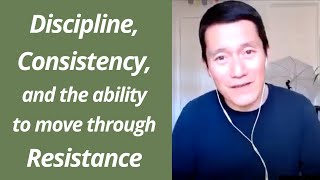
George Kao breaks down how consistency builds skill and predictable results. Real change takes years of practice, not 21-day myths. His three-part approach: calendar your work, move through early resistance to find flow, and release work sooner to stay sustainable.
Chapters
One of the core issues for many of us heart based business owners or just more intuitive workers is consistency. I've heard this over and over and over so many years. And I myself, most of my life I struggled with being consistent, with doing the important things. I don't know if you can relate to that. I can certainly relate to that. And really because of implementing joyful productivity over the past now, I'd say I've been implementing it diligently for about 15 years. I would say probably about five to seven years into it. Well, even, even less than that, three to five years into implementing it diligently, I began to see that I'm like becoming a different person, which is really both beautiful and surprising to me because I'm like, I didn't realize, well, I didn't realize I could change so much. And I want to tell you I really believe that each of us can change dramatically. Dramatically. Really can the human mind and the spirit. The human spirit is neuroplastic, is very pliable. We are able to activate potentials way beyond what we currently are living. It's because of practice, practice again and again and again and again and again and continuing to practice that changes us and integrates that change more and more deeply over the years. It takes years. It really does. Not just three weeks, right? Some people say, oh, building habit, three weeks. That might be true for certain habits. Or you know, maybe you've heard, you've read the James Clear, you know, research. 67 days is the, you know, average time based on all the studies that build a habit. I no longer believe that. I mean, yes, that's probably true for like certain tiny habits, yeah, sure. But for changing ourselves at such a core level, to become consistent in doing uncomfortable things takes years of practice. It's not surprising that there's the old 10,000 hour rule. Now 10,000 hours is, there's no, it's not really imagining that. It sounds good. But the idea is 10 years of full time practice, right? I don't think it takes 10 years necessarily, but I'm going to say it takes a couple of years of consistent practice. It takes years of practicing or flailing and practicing consistency before we become more and more consistent and, and then it becomes something that's just part of us, whatever, we will become consistent with discipline. I tell you, I've been so growing up, I was so frustrated because I realized at one point in my later youth, I guess my early adulthood, I would say I realized I'm the one. In my own way, I have all these Dreams. I have all these desires, goals, vision. And the reason I can't do it is because of my lack of discipline. Like, I realized that in my early adulthood. Like, and I got so discouraged when I realized it because I thought that was unchangeable. And I will tell you, I'm a different person today than five years ago, for sure, and very different than 10 years ago because of discipline and consistency. So why, how, how come we're not consistent? How come we're not disciplined? Well, let me just say I wanted to. I have. I'm seeing my notes here. Consistency leads to skillfulness, and skillfulness leads to results. And oftentimes we even beat ourselves up when we do something. We don't get the results. Of course you're not going to get the results. Of course you're not going to do something well, or do something excellently if you don't do it consistently. Because if you don't do it consistently, you can't have the skillfulness. And without the skillfulness, the results are either take a great deal of willpower or they're haphazard. But when you are skillful, then the results come easily. Easily. So, I mean, today, I mean, one more thing. I'll say. I used to be. Growing up, I was extremely shy and I stuttered. I had a stutter growing up. I don't know if you knew. A lot of people didn't know that I used to have a stutter and I used to be freaked out when I got in front of a room. In part because we immigrated to the US From Taiwan when I was just learning how to know, to communicate, you know, as, as a, as a young adult. And so it's like I got. I freaked out because I, you know, so I couldn't speak in front of people. So now I'm a completely different person. You can't stop me from giving. Give me a crowd. I love to speak. What happened? Consistency of practice led to skillfulness, and skillfulness made me a different person, which leads to results. So me being able to extempore. I'm not reading notes right now. Extemporaneous speaking is so easy for me because. Because of so much practice. Right. Consistency. Being on video is not something that. Those of you who know my story about being on video, my God, I avoided it like, like I talked it down for four years. My first video, 2009, I couldn't stand how I looked at how I viewed myself. I couldn't stand how I looked and how I sounded. So I swore off video for the rest of my life. It was with. With a lot of encouragement and love from colleagues like Tad Hargrave, marketing for hippies.com check out his his work that encouraged me to show up again, try again, try again, try again. And now can't stop me from being on video. It's very natural for me now, but I'm a different person and same thing. And you too. I invite you to chat below. In what area of your life are you a different person than 10 years ago? In what area of your life? Because of consistency of practice? Now, you might not have intended to practice. Some of you were forced into practice, like practice being a parent, you know, very different person now than you were before you had kids or whatever, or practice being a caretaker, practice being doing some particular skill that you had to. Many of us had to practice using social media because kind of forced into this new world, right? So, all right, consistency leads to skillfulness, lead to results. Now, consistency being a problem. Now, how does consistency therefore take place? It takes place by kind of three major moves, right? Three major phases or three major areas to work on. One is calendaring and setting boundaries, which we talked about earlier in this webinar series. Calendaring Setting Boundaries. So you got to plan well to be able to be. Because, for example, I always use the example of writing. If you want to write consistently, you have to experiment and figure out what time of day is best for you to write so that you can plan more skillfully to say, oh, I got to write in the morning, oh, I got to write in the evening, or I got to write in the middle of the day, whatever for you. So calendaring and then setting boundaries, like closing the door when you're writing or when you're doing the thing that you want to be consistent with, close the door, tell everybody you're not available for an hour because you have an appointment on FocusMate. FocusMate is another secret to my consistency. I use FocusMate several hours a day. If I'm not on a call or I'm teaching, I'm on focus main. So calendaring, setting boundaries, first part of consistency, or that's the first aspect of it. Second aspect of it is normalizing the discomfort of getting into the work. And let me talk about this, right? And let me just give the big picture. So calendaring and setting boundaries, normalizing the discomfort of getting into the work or basically generating flow and inspiration instead of waiting for it. Okay, so that's the second part. And the third part is working lightly is generally how I like to say it, which is basically letting your products go sooner than you probably would have liked because you see the bigger picture and you're working more lightly, you're working with less intensity, working more sustainably personally. Right? So which I'll talk about in the upcoming segment. But let me, let me talk about this middle part of normalizing the discomfort of getting into it. Boredom, right? Anxiety, resistance. Did you know that that is normal for expert creators? Did you think that if you felt any kind of resistance towards a task that somehow your spirit guide is telling you not to do it? Could be right. Some of you are much more spiritually attuned than I am. Could be your spirit guide telling you not to do it. Could be the stars not being aligned for you to do it. But I don't know, right? You have to determine that. You have to, you know, understand spirit well enough to know what, what spirit and what's your monkey mind? Do you know the difference? It's hard to tell sometimes it's hard to tell what I know. What I know for many, many years is maybe I've trained my spirit guide, I don't know what it is, or maybe I've trained the stars. I can move stars by saying I don't feel like doing it. Screw it, I'm doing it anyway. Watch me. Of resistance. Yeah. Okay, you want to write because you're going to write crappy right now. Watch me, watch me. So I kind of rebelled against my resistance and my anxiety. It's one way of doing it. It's one way of doing it. And maybe because I have a lot of internal critics which you could say it's the anti spirit guides trying to bring you down. So boredom, anxiety, resistance is normal. Bar B A R Boredom, anxiety and resistance is normal for many of the expert creators out there. It is. It's not necessarily true that because you feel boredom, anxiety or resistance that your spirit or somehow it's not, it's not within flow, it's not Taoist, it's not in flow for you to do that thing at the time. Could be, like I said, could be, you know, the stars or the spirits or whatever. But what I know is having practiced rebelling against my resistance, I kind of like, maybe I, I kind of practice the principle of the universe gives way. The universe gives way when you set an intention and you move through the resistance and you become a creator, you become the creator of your life. Universe gives way. So. Or you might say it's the monkey mind that is becoming tamed, right? To the monkey mind is being tamed. To your higher mind to say, no, no, it's time to create. No, no, it's time to do this thing because it's on my calendar. And if I, if I still feel a lot of resistance toward doing it, then maybe I can ask myself, is there a better time of the day or better time of the week that I should be scheduling this thing in the future? Because right now it's a ton of resistance. Okay, fine. I'm still going to move through it right now for this hour and publish something crappy. It's fine, it's fine. But next time maybe I should schedule at 9am or 9pm instead of 2pm, you know, so. So you learn over time, but still is to understand that there is an illusion for us hippies or for us heart based people, that flow is supposed to happen on its own or that if work is done right, it's supposed to be light and fun at the beginning. So that's the big mistake. The big mistake is work is supposed to be light and fun at the beginning. No one ever told us, no, no, no, no, no, no, no. Work is not supposed to be light and fun at the beginning. It's supposed to be light and fun. After you move through the initial resistance and you learn to generate the flow, then you're having fun. So it takes me sometimes half an hour of writing, frustrated before I find my way through the resistance. And now I'm having fun. I'm like, oh, I'm seeing something come together now. I'm using writing as an example. You could talk about using, you know, doing marketing as an example, learning technology or doing your bookkeeping or doing your taxes or whatever. Existence. It's supposed to be hard at the beginning. What is not hard at the beginning? You know, and sure, you could say tiny habits, sure, that's fine. But designing the tiny habit may be hard, right? Designing it. Right. But the key is to understand. There's my cat there, baby girl. In the other webinar segments, you see Buddy there. But when baby girl wants the bed, she gets the bed. There is no resist. She moves through the resistance. Buddy says, all right, sorry, you get the Buddy. My dog always gives way to her, so. And she's much smaller too. So. So she practices moving through the resistance. So you have to just understand that we don't somehow, I mean, sometimes we're lucky and we do experience lightness and flow, you know, inspired moment of creativity. And if you have that and if your schedule allows it, you can move things around, you're inspired, right? Now go ahead and create. Go ahead and do the thing you're inspired to do right now. Just as long as you move your schedule around. Can you move whatever you were going to do at 9am to do something else to another time of the day or another day of the week? It's fine. I do that all the time. But then you have to notice I'm always inspired at 9am or I'm always inspired at 9pm Then maybe you should plan that in the future rather than just always be haphazard to just be inspired at random times. Then you're not planning, you're not using your brilliant mind. You know, you got to marry the left and the right brain, right? Marry mind and heart, right? So whether or not you have inspired, I'm usually not inspired. Honestly, I do. All of my, most of my creative work is done not inspired in the beginning, not inspired. But I understand the principle, like baby girl of moving through the resistance. And so I just basically rebel against my resistance. I go, hey, I know you're resistant, but I'm going to do it anyway. Sorry. You know, I don't have to be angry or mean to that part of myself. I simply say, oh, got it. I understand you're resistant. Setting you aside for now, I'm just going to play with this and I'm going to publish something crappy. Right? And so how, so how do we find our way into the flow? How do we generate lightness and fun and creativity? Right? That's something you've got to discover on your own. I have a process. I do the energy reboot. If you don't know it, just Google energy reboot and you find my process. But my process is not for everybody. It's simply the fact that there is a process of generating flow is what I want you to develop. Some of you may need to dance. Some of you may need to, you know, I don't know, do some light a candle or something like that. You know, some of you may need a journal for a little bit, but the idea is to find your way into the flow. You do something quick. Don't, don't say, well, I got, I have to walk for three hours in the woods before I'm creative. That's not, that's not good. That's fine. You should still walk three hours in the woods, but you can't let, you can't have that as a crutch every time before you write. You got to walk three hours in the woods. I mean, unless you can plan that into your daily Life. Fine. Great. Wonderful. You have that privilege of doing that. Great. Most of us don't. Can't do that. You know, first you got to even find the woods wherever you live, right? And then commute there and then walk for three hours and then come back and then write. Okay. Or whatever you do. So. So my energy reboot takes me not 3 hours, 20 seconds. If you can find a flow generating activity now, just after 20 seconds doesn't mean I'm suddenly brilliant. No, no. Like I said, After 20 seconds, I still struggle for the next five minutes before I do another energy reboot for 20 seconds. And then I struggle a little bit less for another five minutes. Energy reboot. Yeah. Sometimes I do my energy every five minutes and then I struggle a bit less each time. And then by the half hour mark, I moved it, I moved through it, I moved through it. The dog has moved out of the way and now the cat's in the bed, you know, and now I'm like, ooh, now I'm in flow. My God, it took me half hour. But same thing with my videos. Have you noticed? I mean, from the beginning of the segment till now, now I'm much more energized. I moved through the resistance. I'm much more alive. But it took me. How long did it take me? 10 minutes. Right? Same thing with any of my watch any of my videos. You notice beginning is not the same energy as when I'm middle to the end. I'm much more energized, moving. I generate flow while I'm in it. Right? So that's how we do it. And so I want to just invite you again to join the community of creators which is around the world. All of us, we're moving through resistance every day. We're normalizing discomfort in the beginning of our creative process every single day, every moment, every however often we create. You are in that community of creators around the world. You could literally be in a community. You want to be part of my focusmate group? By the way, I don't get paid if you join my focusmate group. It's just a convenience for you to be paired up with me and other people in my group more often. And I'm just going to chat below the link to join my focus mate group again. You can pay for focus mate. You pay them if you want to have unlimited sessions, it's like $5 a month or whenever you're watching this, it might be 10 or 15amonth by that point. Still a great deal. But basically the key is again, let's step back out a little bit to a bigger picture and say, you know, instead of delayed gratification, you know, which. Which is true, we get gratified the more we work on our skillfulness. But when you are willing to join the community of creators around the world and join this adventure of moving through resistance at the beginning of any creative endeavor, anything that's important, anything that adds value, has resistance in the first, you know, five to 30 minutes, sometimes 45 minutes, right? The faster, the more you practice, the less time it takes to go through resistance for any task or any project, any skill. When you join us on this adventure, you know, be part of this movement, worldwide movement, and moving through the resistance, then what happens is you find the reward in every hour of creating. You no longer have to delay gratification. Because I feel so proud every time I finish writing something, because I couldn't have imagined writing something in the beginning of the hour. It was a blank page. Blank page. Maybe I have a topic. I'm like, how the hell am I supposed to write more than five words on this topic? I don't know what I'm going to say. Blank page. But then by the end of the hour, something's there. It's such a miracle. It's such a reward. So I invite you to normalize creative discomfort. All right, so let me go ahead and pause and see if you have any questions, and then we can move on from there.









