"George, talk about how your spiritual awakening relates to your business..."
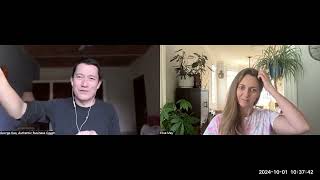
In this candid interview, George Kao reflects on his 2012 spiritual awakening sparked by a haunting question about having only six months to live. He describes how the teachings of Peace Pilgrim, the spiritual movement Spiritism, and Michael Singer’s The Surrender Experiment shaped his belief that the universe provides for him and that deep trust can coexist with entrepreneurial work. Initially, he tried giving all his content away for free, discovering that generosity without perceived value led to low engagement. He then pivoted to a small‑group, paid model ($125/month for 20 participants) and introduced the concept of a “minimum resentment rate” to balance service with fair compensation. Kao outlines his core business values—surrender/trust, diligence, and lightness—and explains his daily “energy reboot” practice, a 20‑second grounding exercise he repeats throughout the day to stay aligned with those values. He also addresses how both religious and non‑religious people can find security by anchoring themselves in timeless, deeply held values and community, rather than external guarantees. The conversation offers practical guidance for entrepreneurs seeking to integrate spirituality, value‑based pricing, and daily mindfulness into their work.
Chapters
Elise, thanks for letting me record this and asking a question that I love to answer because it is about sort of the deeper aspects of authentic business. So you are, you have a yearning to be of service to humanity. I love that. That's how I really, that's how I first began business because I needed a job. That's how I started in 2009. And then like after a couple of years of like just doing business, I'm like, oh, I want something more meaningful. I want something more aligned with my conscience, with my values. And then that's where I started diving in deep. And you said you noticed some anxiety and self-protection around money. Join the club, you know, welcome to humanity, right? And there's a sense of wanting to make sure I'm being compensated for my work. And it brings a level of transactionality that I would like to shift. I wish more people asked this question, right? I believe, um, oh, you, you mentioned that you heard about my spiritual awakening around 2012, uh, where I, uh, saw that, uh, you know, we are all provided for and there's a deep trust in this. And I believe you said, I believe this on a mind level, but of course the parts of your body and, and your life doesn't yet trust it. Um, so what was, what was, you asked me about my journey in getting to this place. What were some challenges of stepping into the work? Coming from a place of serving humanity and having a full trust that you're being provided for. Yeah, I thank you for asking. And it's, and it's, we have the rest of the day, right? Like you don't have anything else scheduled, right?
Great.
This is such a deep question. Yeah, it's an important question. So I'll briefly share and you know what, I'm going to share a couple of links below. Because Yeah, I will share some links below to, I have a video where I actually recorded, uh, it was like 15 minutes where I talked about like my spiritual journey and, and I think that one might be interesting for you, but I will briefly, um, and I also have a playlist I'll share with you, the best of George Kao spiritual videos, which I kind of laugh because everyone wants me to talk about business. Stop talking about spirituality, George, just talk about business. Thank you very much. But I do have a playlist where I indulge myself sometimes and talk about that stuff. And most of my spiritual videos nobody cares about, but a few of them people found interesting. So I will put those, I put those into a playlist, so I will be sure to share that. And I'll just briefly say that there was a question that came to me in 2012 that wouldn't leave me alone. And the question was, George, what if you only had 6 months left to live? Okay. It was a scary question. It wasn't because I was diagnosed with anything. I don't think so. I don't know if maybe I saw people dying in my life or something like that. I don't remember there was a particular death. It just, it was a question that wouldn't leave me alone. And I said, well, if that were true, I would just give it my all. And I have to say, first of all, that I had a very innocent and I would say unwise response to that question for a while, where I, you know, it's kind of like the person who goes, oh my goodness, I'm gonna go and live like Peace Pilgrim did. And I should mention, have you heard of Peace Pilgrim before? Okay.
No.
All right. This is good. I also discovered Peace Pilgrim around that time, and it changed my life because this is a, this was a woman who came to this in her young adulthood. She was walking in the forest and like got sick of all the worldly pursuits. She started having a job and she's like, oh, I hate this stuff. And walked in the forest and came to this realization, you know, I just want to live I, I just want to live with God. I just want to live and serve everybody. And so she did. She literally said, I, I renounce taking money, receiving money, using money at all. Now, this is an extreme case, right? This is why it's not for everybody. Most of us are called to live a householder life, not a monk or nun type of life. So, but this is what Peace Pilgrim did. She literally gave everything away and then walked the earth. She walked— she's a— she was an American, so she walked from one end of America to the other end of America, literally. And she took no money. She did not beg. She didn't ask anybody for anything. So literally, most nights she slept on the highway, like on the highway, the side of the highway, most nights. Sometimes someone saw her and gave pity on her and invited her, please stay in my home for the night. And then if someone invited her, she did, she went and stayed in someone's home. But many nights it was like in the forest, on the highway floor, in some abandoned warehouse or whatever. And then food, same thing with food. She never begged, she never asked. She just waited until someone noticed her and go, can I give you some food? Can I give you some money? No, I don't take money. Can I give you some food? Yes, sure. If you want. So, and of course she, she wrote, she wore a cloak. Eventually she wore a cloak that says walking for peace or whatever. And anyway, so she just went from one end of the country and just helping. She like saw someone needed help and she helped them until they no longer needed help. And then she would keep walking and help somebody else. And she did that for not 3 months experimentation, 30 years. Okay. And she hasn't— there was an audiobook that changed my life. It was called— it's called the Peace Pilgrim audio. If you Google it, Peace Pilgrim audiobook SoundCloud, it's for free on SoundCloud. The entire thing can be streamed. It's not her voice, it's a friend of hers who recorded it. Her friend's voice is much nicer than Peace Pilgrim's voice actually was, but it's Peace Pilgrim's words. Anyway, that book changed my life, and I was like, I want to live like that. but I know I'm not called to that. So I thankfully, I was wise enough not to become homeless. Okay. To say that's not my life. Cause there's, there's been stories of people who have literally tried that and like went home crying 3 days later to their parents. I'm sorry I ever gave up everything. That's not for me. Right? Like most, most of us aren't living anyway, but the, the depth of trust in God was what really touched me. And I'm saying, okay, I'm not going to become homeless, but can I trust God? And, and at the same time, I was also being influenced by, um, a spiritual movement called Spiritism. And I, I'm— whenever I mention a spiritual philosophy, it doesn't matter what religion we are, I don't think. It doesn't matter. Like, someone could be a-religious completely and still have this deep trust. But that particular spiritual movement was the one that did it for me. And then near the same time, I also happened to read Michael Singer's The Surrender Experiment. I don't know if it was around the same time or later, but it all added to the same picture. The Surrender Experiment, Michael Singer, is kind of like a Peace Pilgrim, modern Peace Pilgrim experience. But as a business person, this is why it's particularly good, good read. Um, so Spiritism, Peace Pilgrim, The Surrender Experiment, all kind of convened on me. Plus the question of what if you only had 6 months to live? I'm like, I'm gonna— so this was the unwise part. The unwise part is I'm going to give away all my content now for free. No one should, should charge for content. There should be no paid courses on the planet Earth. There should— everything should be given away for free, and you should only charge for one-to-one services. That's the only thing that is worthy of being charged for, right? Everything else should be given for free. And so I started giving away my content for free, including like in-depth course content from 2012 to 2014. In 2 years, I was trying it, trying, trying, trying. And I noticed something interesting in that most people didn't care. Like most people go, oh, that's nice. It's very generous of you. But they wouldn't study it. They, they, you know, um, they didn't value it. And so I started wising up and go, okay, so people really— I mean, sure, if my audience were big enough, I'm sure, like, if I had a million-person following, probably there will be a thousand dedicated students from my free content. But thank you, changed my life. But I don't have a big following, so it was like very discouraging, like I put out my heart, right? It's the old thing, put your pearls before swine quote. It's like you put out your heart, and that's not wise either. You put out your heart to make it feel like it's being stomped on isn't wise, isn't wisdom either. So I had to come to a middle way, which is like, okay, what I'm going to do is I'm going to start a small group of people, 20 people, who are studying closely some piece of some framework, and I'm gonna charge very reasonably for that 20-person group. Back then, I charged $125 a month for a 20-person group that also met with me one-to-one, same, same amount of money. It's like, yeah. And, and that's how I started, and it felt really right. And so, Elise, I think, I think that's where you're gonna have to look at your business model. And say, what parts of my business model doesn't quite feel right right now? There's something calling to you to say, let's try an experiment and see if we can adjust the business model so I feel more like I am serving and receiving compensation that feels worthwhile to me. It's an experiment. And after I did, ran that group, I was very tired. I made some money. I was quite tired and like, I think I probably need to charge more for this because I don't want to become resentful either of my, of my clients. And so I always call it, what is your minimum resentment rate? What's the rate where if you went below that, you would feel resentful, but you're, you're kind of on the verge of like, at this rate, I feel deeply in service to them. But if I charge less, I would feel resentful. So play with that rate, and over time, as you serve them more and as you develop more case studies and you go, oh my gosh, this thing is helping so many people, this helping people deeply, and then you're, you're getting more inquiries than you can handle, that's when the rate keeps going up because it— you deserve to be paid more. The market says, please, Elise, charge more because you're, you have a waiting list, or you're getting tired, you know. And so one last thing I'll say, and I'd love to hear your thoughts on this, is for the person who is a-religious, like, let's say you're an atheist, right? How do you have the deep security? Because if you're religious, the deep security comes from your religion, right? Like, okay, I trust God, right? I trust that God will take care of me, or the afterlife. Is where we have all the abundance. So I'm a religious person, right? So I believe, oh, the afterlife is where we have all the abundance. Here, we're here in the Soul Gym. We're supposed to freaking work out and be, um, be uncomfortable sometimes, you know. And but it's all— it's okay. Even the suffering or pain is worthwhile. Like, it trains us, it develops us, and we're going to have all the eternity abundance. So let's be delayed gratification. So that's the religious perspective. The a-religious perspective is our security is found in a couple things. Essentially, it's found in aligning with our core values. And even religious people can find security there. But like, let's say someone says, okay, what if I don't believe in an afterlife or God? Where do we— I'm gonna die. So how is my security now going to fuel the service to humanity? Well, then it's like, well, what values do you admire so deeply it almost brings you to tears. Could be values such as service. And are there heroes that embody those values? People like Gandhi or Martin Luther King or whoever, modern-day heroes who embody those values that like, I, more people should be like this. Well, guess what? I should be like that. And if you can align your actions and your lifestyle and your business to those deep values, There's a lot, because then those values are not, are not man-made. They are eternal values. Even if it's not— if there's no afterlife, eternal value. It's like those values will always be here, and you can always trust in those values. You can always align your life, and your life is worthwhile. And but when you align yourself with those values, you probably will come across a community of people, other people who like align with those values, and that community also is part of your security. You know, like, they— that you build an audience when you communicate your values. You build an audience of people who, who love those values, and that audience is part of your security too, you know.
Thank you.
You're welcome. Sorry for such a long response, but it's a long conversation.
Um, yeah, one thing that comes up is just curiosity around what those core values are for you.
Yeah, for me, the core values are— I think surrender is one of them. I think surrender and trust are connected. And diligence or discipline is another core value. And I would say lightness. Yeah. There you go. The cat, the cat knows.
Can I ask one more?
Yeah, yeah, please.
How, like, how did you overcome challenges around this for yourself? Was it just an act of— was it like being in the practice of what is it like to come to my business and to my clients from a place of surrender and trust and Was it just like a muscle that you, you know, exercise?
Oh my gosh. I, yeah, I mean, you're right on. It is a muscle. I mean, it starts with, you know, some framework, you know, like values or religion or some framework that you can say, okay, I really believe this, the set of ideas. But then what does that mean for daily practice? And so I developed what I now call my energy reboot. Practice. And that energy reboot practice takes me 20 seconds every time I do it. And so it's such a short amount of time that I, that I can do it throughout the day. So like, if someone, like, whenever I'm working with people, like on Focusmate or on a work retreat, like, they often see me go for like 20 seconds, like, you know, 3 to 5 times an hour. And that's, that's the practice that keeps reminding me grounding me back to those core values and that deep security. And so if you Google Energy Reboot, you know, George Kao, it has my, like, I have 3 versions now. The first version is what I did in the first couple of years, which is really about security. And that's, I think that's a great one to start with, really about security. And then the second version kind of went beyond that, but it's still core values, core values. Yeah.
Yeah, okay, thank you. That gives me something to chew on.
Yeah, thanks for so much for asking, and looking forward to seeing if you have any follow-up later. I do. Yeah, thank you. Thank you.









