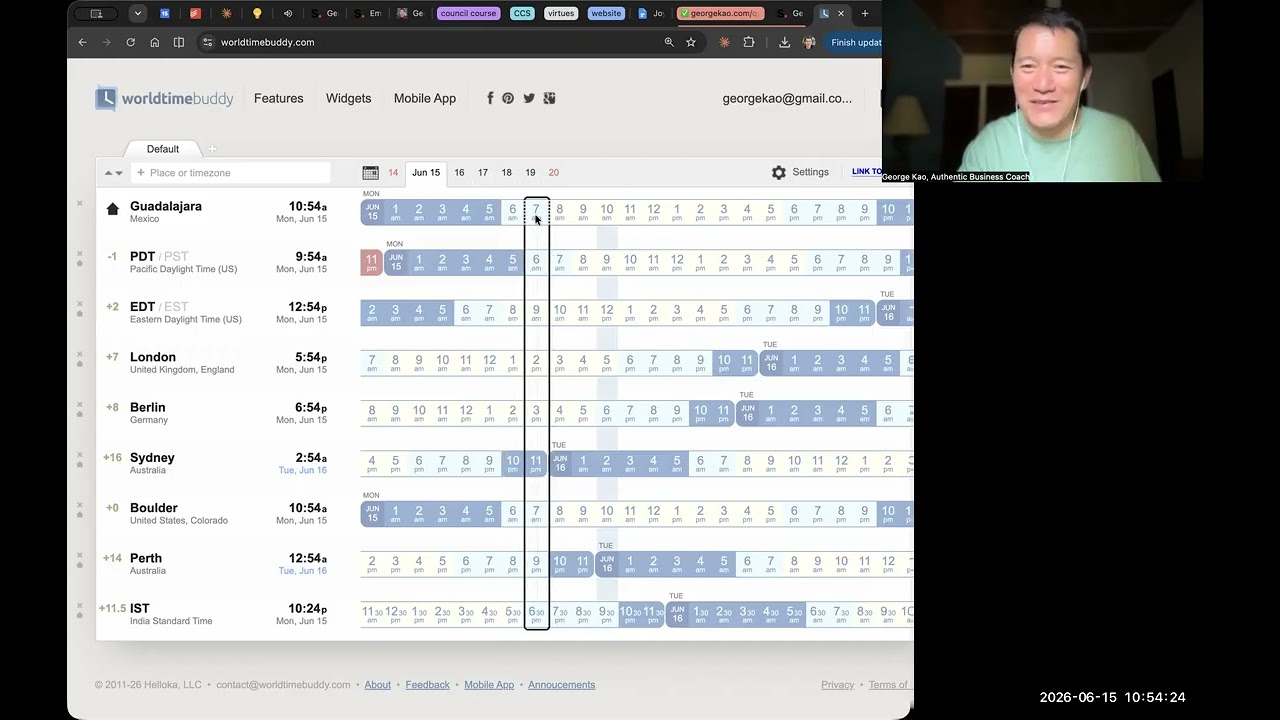
In this instructional video George Kao explains how to schedule public or group calls for a worldwide audience by adopting a simple two‑zone approach: an “EU‑friendly” time slot and an “AU‑friendly” time slot. He argues that covering Europe (and by extension North and South America) with one slot and covering Australia/Asia (and India, Africa) with another slot allows virtually anyone to attend without excessive inconvenience. Kao demonstrates the free online tool World Time Buddy, showing how its colour‑coded working‑hour bands (yellow for typical corporate hours, light‑blue for extended hours, dark‑blue for undesirable times) help pinpoint overlapping windows. He provides concrete examples: a 10 AM call in his Guadalajara time zone translates to 5 PM in London and 6 PM in Berlin (EU‑friendly), while a monthly 8 PM call in his local time works for Sydney, Perth, India, and other Asia‑Pacific locations (AU‑friendly). Kao discusses trade‑offs: larger audiences or high‑demand events can tolerate a single inconvenient slot, but solopreneurs with smaller followings benefit from offering two regular calls. He also notes personal factors—whether one is actively working, semi‑retired, or fully retired—affect how many slots one can sustainably host. The video blends practical tool usage, time‑zone calculations, and strategic advice on balancing audience needs with personal capacity.
Chapters
Great question about how I set the times of my public calls, my group calls, uh, when they're— when I have people from North America, South America, Europe, um, Asia, Australia, New Zealand, you know, um, Middle East sometimes, Africa sometimes. So all over the world. Anyway, um, I'm— no one from Antarctica and or the poles yet. Maybe there were, I don't know. Anyway, so how do I set the times? How do I decide what, what times to do? And also, do I do calls for both. Uh, so essentially, I'll make it really, real simple for everybody here who, who does group calls and, and, and wants, want to accommodate everyone. You essentially have two major time zones in the world, okay? I call them the EU-friendly time zone, and the other one is the AU-friendly time zone. Easy to remember. So one time zone you need to be concerned with is for Europe. Okay. And the why, why not North America? Well, even though most of my people are, are actually in US, Canada, that's most of my audience. Why don't I even, because North America is convenient in that if you are friendly with the time zone for Europe, you will be talking to the North Americans in the, during the daytime, like morning-ish. Okay. Morning or early afternoon. If you set an AU Australia friendly, time, then you'll be working with the North Americans and the South Americans during the afternoon or evening. So North South America is very lucky in that way. Um, so essentially, if you want to address everyone in the world, set a call that's EU-friendly and then set another call that's AU-friendly, and then you'll address everybody in the world, essentially. Okay, I know, I know, with, with India or Africa or some places, they may need to come a little earlier in the morning And then some places may need to come a little later in the evening, but it still works if you do those two time zones. Now, of course you could say, well, what do you mean those two time zones? Because there's all day. I mean, when we talk about European friendly, do you mean morning in Europe or afternoon in Europe? Okay. AU friendly, does that mean morning in, uh, uh, AU or afternoon? So let me go and show you a tool that I use to figure this out. All right, so let me go and share my screen right now. It is the wonderful tool of World Time Buddy. And I love this tool so much. I've been using it for years and it's always been free. And I, I just, I'm amazed that they, they allow this for free. So the great thing about this is that you can add whatever you want. Let's say you address people in India. So if India is important, then add India. So look, when I type India, it gives me all the time zones in India, which are all the same. So as far as I know, India has one time zone. I don't know if it changes throughout the year, but Anyway, when you type it in, you get to select, you get to click on whichever one you're talking about. So I'm gonna click on the standard. Okay, so that's India right there. Okay, so I'm in the Guadalajara time zone, which is basically Mex— Mexico City, Guadalajara, most of Mexico. Did you know most of Mexico has the same time zone that does not change? The only places that change are Baja California. Anyway, so I am always looking at whatever time works for me, and particularly in the yellow. So it's very convenient that World Time Buddy colors in sort of like working, typical working, corporate working hours is yellow. And then the, the light blue is like, yeah, like hardcore people might work during the light blue hours. And then the darker blue is like, no, you probably shouldn't set a time in that, in that, in the darker blue zones. Okay. So I work from, I'm able to do calls from 9 to 5. So that's— I really look, look at those. So you, you kind of have to first think about obviously your own, what you are willing to do yourself, right? And then make it friendly for EU and then for AU. Now here's the thing, you don't have to, you don't have to set two, two calls if you don't want to, you know. You— someone could just say, listen, I'm just going to do whatever works for me and let people attend even if it's middle of night. My wife recently did a 3-day training that was from 9:00 PM our time to 1:00 AM our time. And for the East Coast, they had to attend from 11:00 PM to 3:00 AM. It's because that training was done in the AU-friendly time zone. They didn't care about North America, South America, okay? So yeah, you could do it. You could just decide, hey, I'm gonna do whatever I want and let people show up at 2:00 AM their time if they really wanna show up. Now that typically works if, if the event is like desperately attended by people, like people really, really wanna be there. For many of us solopreneurs who are, who have a small audience, who, if you have a small audience and you're just trying to get people to your thing, it's really better to have more time zones that are friendly for them. Like you'd rather do 2 calls per week, one at EU, one at AU, than, than, than only whatever you want. Okay? You don't have the luxury yet to do whatever you want if you don't have a big audience yet or an event that people desperately want to attend. So I look at 9 9 to 5, and then I look at something that works for London. London and Berlin are typically where my people are coming. I mean, those time zones are— anyway, if you just do— if you just type in London, it'll, it'll, it'll work for most of, most of Europe. Okay. So anyway, if I say, well, I wanna do a call between 9 and 5, what would be a time that could work in the, you know, yellow, maybe, maybe light blue areas? Well, you could see that I basically can do anything from 1:00 PM my time all the way until, you know, 9:00 AM is when I'm willing to work. So I basically have my calls at 10:00 AM my time. London works at 5:00 PM, Berlin 6:00 PM. It's not too bad, right? I'm willing to— that's what I'm willing to do. So that's, that's when my calls are for EU. For AU though, that's a lot trickier. You can see Sydney— I'm gonna take out Boulder actually, sorry about that. Sydney and Perth are the two extremes of the Australia and Asia time time zones. And that's tough because look, for Sydney, 8 AM, right? It's Perth 6 AM, and that's my 4 PM. So if I do a 5 PM call my time, okay, that's from 5 to 6 PM though. I'm not willing to work after 5. Um, so if I do a 5 PM call, that, that could work for both Sydney and Perth. But you know what I'm willing to do? I'm willing to do a once a month, I'm willing to do an 8 PM call my time. And I was like, once a month I'm willing to be unselfish and say, all right, I'm gonna, I'm gonna, it's typically time to get ready for bed or whatever for me. I'm gonna do 8:00 PM once a month. And that works for the Australia, Asia contingent cuz that's about noon, 10:00 AM for them. And for India, that's 7:30 AM, which, you know, is a little early, but it's still doable. You see what I mean? So anyway, that's how I, that's how I, I used to be a lot more hardworking and I used to do a weekly call. In the Australia time zone. Actually, 2 weekly calls for Australia time zone. I used to do, I used to do 5 PM, 8 PM, 5 PM, 8 PM, um, and now I'm retired, so I'm only able, I'm only willing to be unselfish one time a month and do the 8 PM. So you have to decide if you're still working, making money, willing, wanting to get people onto your calls, you should be more aware of, um, of these time zones. And if you are more semi-retired, retired, you don't care, then you do whatever you want and set the time, right? Then really you get to be selfish, quote unquote, or rather sustainable, rather, at whatever pace works for you. So I hope that's— that helps.