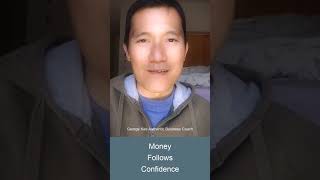
George Kao argues that genuine confidence, built through practice and service, attracts money more reliably than fake polish. He shares how being unpolished publicly, doing free work early to see real impact, and letting go of self-blame help confidence grow.
Chapters
Money follows confidence. So if you want to make more money, become more confident. Now, how do we become more confident? Most of the marketing that's out there, I find, teaches us a lot of fake confidence, doesn't it? Fake it till you make it. You know, use hype to get sales and then, you know, figure out how to serve them at that level later. It's not. Eventually, you'll burn out from that kind of fake confidence, whether you make money or not. A lot of fake confidence doesn't make money, so whether you do that or not, you're gonna burn out. And it's not a very fulfilling business to use fake confidence. And, oh, by the way, I'm in the bedroom today because my wife is using the office. So just gonna make this a short video. I'm holding this video, holding this phone by hand. So it's gonna be a short video. So let's talk about how to generate authentic confidence. I feel like this is really what I take a stand for, that I really am trying to help. All of you do. For example, I don't look like the typical Instagram influencer or YouTube influencer. Look at me. I'm dressed in this sweatshirt, is, you know, if I look in the mirror, kind of looks like crap. Got this at goodwill for maybe $10. I, you know, wear really cheap shirts. I think I'm. I'm almost trying to. Well, this is comfortable. That's why I wear it. And I don't really care how I look because I have found that even if I turn people off by how I look, okay, let's say I turn Joe off by how I look. And Joe says, oh, I looked at George's website. Doesn't look that great. I looked at his videos. He doesn't look very polished to put. So Joe leaves. So Joe says, yeah, I checked out George, and I don't, like. I don't think I can learn marketing from this guy who doesn't look so polished. But then, you know, Sarah, who might feel some energy signature with me, like, there's. Yeah, George doesn't look polished, but there's something about his stuff that makes me want to keep on watching or keep on reading. And Sarah reads, you know, my stuff and, like, oh, my gosh, gets a lot of benefit from it, continues to follow me. She meets Joe and says, joe, you got to take another look at George. I know you looked at it before. It didn't look impressive to you, but please take another look. And then Joe is also going to hear about me from, you know, from Mary and from Mike and from Susan and from Bill. You know, Joe's going to hear about me from all these different people and Joe is finally going to take another look and a third look and a fifth look. And that's when Joe says, okay, I get it now. I can overlook the non polished, I can overlook the website that looks like crap and I can get the benefit and finally become a true fan. I have found that to be true for the last five years, ever since I switched my marketing from polish and looking persuasive and professional and all that stuff. Five years ago I made a dramatic shift and I said, you know what, it's exhausting to pretend. And so I'm just going to be myself. I'm going to dress, you know, whatever is comfortable, some people might call this PJs or whatever. I'm going to dress myself, be comfortable and I'm going to win people over because I have good skills, because I have good things to offer them aside from the polish. And even for a marketing teacher to purposely not be polished is like, is like, it's kind of dramatic. But I find that, you know, I'm trying to prove the point that if even a marketing expert, if even me, a marketing expert, can make more than $100,000 a year consistently, right? I still do. I built my business once. I restarted my business five years ago, I had a big drop, but I've made it now. I make over 100 grand a year. But like, if even a marketing person in such a competitive industry where everyone else looks polished can look like this and make so much money and do so well, God, then in a less polished industry, if you're a life coach or a spiritual teacher or anything else that's not marketing related, you can certainly make it being yourself without having to dress up and put makeup. If you like dressing up and putting makeup on, wonderful. Then you have an advantage over other people. But if you don't like dressing up or putting makeup on or whatever, you don't have to. If you don't have a great looking website, you don't have to, okay? You can win people over because of your authentic confidence. And how do we develop authentic confidence? We practice. We practice our skills and we serve as many people. Whoever wants to be served by us. In the beginning, it may be volunteer for other people, okay? But we serve people, practice our skills until our skills get so good that we can clearly see the impact we're making on other people. And that generates authentic confidence. This is why it's important when you're first starting out. Don't get hung up that you have to charge certain rates. You would rather be doing the work for free than to because you want to generate authentic confidence and notice the impact you're making on other people. And the more confidence you have, the more you will be happy to speak. A high rate with confidence because you know how damn good you are. Okay. And the other thing about authentic confidence is some kind of spiritual practice that helps you to ease up on your self blame. Because especially spiritual people blame themselves more than just about any other people. Oh, I should, I should know better by now. Oh, I should have gotten all this together by now. How many years have I been working on this and I'm still like this so much self blame. And self blame is not actually spiritual, right? What God wants for us or what source wants for us. Pick the term you want. What the universe wants for us is to use mistakes as lessons that we can. You know, when you next time you sense your self blame, you have one of two reactions I recommend. Either you rebel against yourself blame. Use anger to say F you self blame. You know, I'm not going to care about you. You are no good for me. So I'm not going to blame myself. And instead I'm just going to calmly say what's the lesson I can learn here? Or the other. The other reaction, which I've honed over the years is like just ignoring self blame. If I sense self blame coming on, I just ignore it because I know it's not good for me. And I just say, hey, what's the lesson I can learn from this? Okay. So that I can practice, hopefully practice a little bit better next time. Even if I don't practice better next time, it's okay. What can I learn? I might have to learn the same lesson 5,000 times until I practice again. It's okay. How many I also think of to myself, I have the rest of my life to practice. I have the rest of eternity to practice. So there's no rush. There's no rush. You can make as many mistakes as you want. You'll always be taken care of. And what I mean when I say that, I don't mean you have to have a trust fund. I don't have a trust fund. I have to make all the money to survive, pay off my debts, live my. All the money I live with, I have to make myself. But so most of us don't have a trust fund. If you do, congratulations. But if you don't, just know that you will be taken care of by spirit. No matter what. You're here to practice. And with practice comes authentic confidence. No need for self blame at all. Just keep practicing. I hope this is helpful. My arm is getting tired so I'll let you go for today. But I wish for you authentic confidence. Take care of.