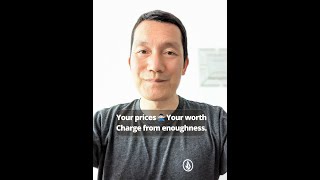
George Kao argues against tying your worth to your fees. Instead, charge what sustains a fulfilling life, then give back through higher affiliate payouts and profit sharing. He moved to Mexico to lower costs and now launches fewer products to focus on making them better.
Chapters
Let's talk a little bit about pricing and the common teaching to charge what you're worth, to stand up for your value. Now, what does this do to us when we connect our pricing, our fees, to our worth? So does someone who charge more, are they worth more than us? You could say, sure, their bank account's worth more than our bank account. That might be true. But always try to disconnect how much you are receiving money for how much you're worth as a person, because you are worth infinity. You cannot put a value, not even on your time. I don't like to even say, well, my time is worth this. No, no. The simplest healthy way of looking at it is to charge the market rate, to look at other people who to do the similar kind of work that you do for the same kinds of people, same kinds of clients and customers. Okay. And with a similar background that you have a similar level of skill, let's say, and to charge about the same that they do within a range. You know, there is a market range, but even so, I want to give you a different way of thinking about it. This is the way I've thought about pricing for years. I tried to charge based on enoughness and compassion. It's different than what you usually hear out there, which is to charge what the market will bear or charge what your service is worth, not by your hourly rate or something like that. I don't like any of those things. I have a longer blog post around charge what you're worth that you can read. But let me just tell you what I mean by charge based on enoughness and compassion. So what we don't usually do enough when we think about pricing is to look at our own lifestyle and say, what are the most fulfilling aspects of my lifestyle that I want to keep? That if there's a more creative and lower cost way of achieving those, fulfilling those needs, maybe we should do that. But it's like the more we can look at what is enough for us, the less we're able to charge. And the wonderful thing about that is the less we're able to charge, the more people we can serve and probably the more happily we can serve because there's less financial pressure of, oh, I, I took all this money from them and now I have to give them this much value or something like that. So it's actually a happy thing to be able to charge less money, not more now. So charge based on enoughness on the one hand and compassion on the other hand. Compassion for our clients and customers. Like I try to have that compassion when I set my rates. Most of you who know about my industry know that I charge a lot less than most people in my field for my services, for my online courses based on the credibility that I have, the experience. It's. Anyway, it doesn't matter. I charge based on enoughness, my enoughness, and based on compassion. Now it also. Compassion also means to charge with compassion for yourself to make sure that you do have enough, and not just enough, that you have a bit more than enough, at least so that you can invest for your retirement. But what I disagree with, though, is all the people who are teaching us to, you know, retire early, make as much money as fast as you possibly can. Well, what does that really mean? That means to take a lot of money from other people. Because where does money come from? Money just doesn't fall out of the sky. Money comes from other people deciding to spend money, their precious money with us so to make lots of money and then retire quickly so that we can then live the life of our dreams. That's bs. It's bs. Why? Because the making tons of money quickly turns us into sharks. It does. That's what happens. It turns us into sharks. And you don't realize how susceptible you are to becoming a shark. The more people you learn from who have those kinds of values, the more that's normal. It just becomes normal. And then you don't even know that you're becoming a shark. But instead, like I said, come back to charging based on enough and compassion. And see. So I'll tell you what I'm trying to do. I'm not trying to make as much money as I can so I can retire early and then be of service to others by volunteering. No, it's also B.S. in my opinion, I think the most true way of doing living our calling, is by taking money for our services. I can argue with you all day long about this. Volunteering is beautiful. Yes, of course. But our calling is the intersection of our skills and interests with the market's needs and wants. What cannot be found for free, and what people are paying for is the market. Okay, what can be found for free? Beautiful. Wonderful. People are volunteering here and there. I love it. Do that. And yet, there are many things that cannot be found for free. And that's what the market is. And your calling. And my calling in terms of work is to find the intersection between our skills and our interests and what the market is happy to pay for. So what I'm not trying to do is to retire quickly and Retire early. Not. No, I want to work until the day I die or at least until the day I'm not mentally competent to work anymore. Fine. Okay. Or physically competent. And so what I'm trying to do is while I'm working in my working life, hopefully for the next 30, 40 years, who knows, is to lessen my lifestyle when I can. So for example, I just moved to Mexico from San Francisco, California, one of the most expensive cities. So what that means is I moved to a very much lower cost country and area. So in the next year, you're going to see two things happen in my business. I'm going to launch less so I can focus more. I'm going to take less money essentially, and I'm going to focus more on improving my existing offerings so that it's even better for you. It's even more impactful, more effective. Okay, Number one. Number two is I'm going to pay more. My affiliates, even more. Who are my affiliates? It's people like you. Did you know you can join my affiliate program. Anybody can join. And basically when you, when you join my affiliate, it's free. It's free to join. And then you, when you enroll in one of my courses, you get 25% back at least, plus profit sharing. So I pay 25% plus profit sharing. And now that I'm in Mexico, I can share more profit. Yeah, I could share more profit because my business model hasn't changed. Not yet anyway. It hasn't changed. I'm still taking the same amount of money, but I'm just going to be paying you more than I did before. So that's what I'm doing. I'm going to be launching less next year anyway because right now I'm still, I just moved. I'm still getting settled and there's costs to getting settled here. But, but in the coming year, okay, next, after the next few months, I'm going to be using my new enoughness to give you more back. That's my joy and my aim. So anyway, it's just a different way of thinking about it. That's what you came here for, right? A different way of thinking about business and marketing and pricing and money. So I hope this is helpful and gives you some food for thought and thank you so much for being here.