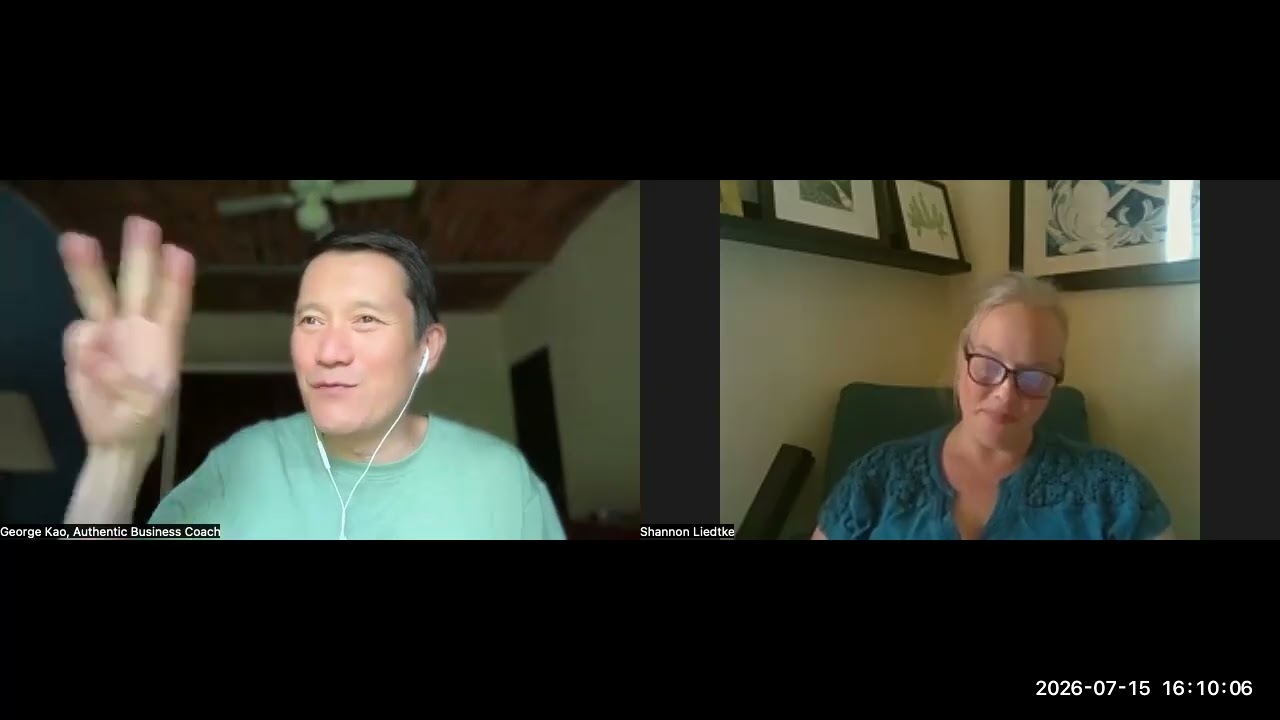
George Kao advises Shannon, a healthcare coach with two different client types, to keep one website with separate pages for each audience rather than maintain two sites. AI tools make this easy to manage. She worries her direct style and criticism of the medical system will alienate corporate clients, but George suggests reframing critique tactfully while keeping her authentic voice.
Chapters
Shannon, thank you for letting me record this. And before we started recording, you were just giving some background about how you do coaching for healthcare professionals or helping professions, and you integrate things like forest bathing and life coaching, and you have experience with raising an autistic child, various modalities that you bring into it. And you have like your, your audience is, you know, you're, you're happy to serve people who are one-to-one. Professionals, like, you know, like nurses or therapists, etc., but you also am— you're open to doing workshops for companies, essentially, right? Healthcare-type companies. And so your question was, should they be two separate websites or one website? And I think that's a great question. You know, these days, it's, it's not, it's not hard anymore to have website management if you are willing to use the modern tools, especially AI. If you're open to doing that, AI can manage a lot of the stuff for you. These days, AI manages my website completely. I just completely redid my whole website with a new look, and it looks much, much more professional now, all done by Claude. So, so that's, that's, so I'll just kind of get that objection out of the way actually, is that it's become easier. And even if you don't use AI, whatever website, you know, creation tool these days, they probably use AI in the back anyway. But, but it's, it's easier. However, having one website builds more kind of credibility all in one place and also gives people your audience the opportunity to look at the different offerings in one place. So the question for the different websites and same question in terms of social media profiles, should you have different social media profiles for each of these? The question is really, is one audience going to be somehow turned off by the content that you post to the other audience? So that's the, that's your answer. Like, I, in my opinion, like if, if the answer is yes, likely my postings to this audience may be at least misunderstood or, you know, degrade credibility because they don't understand it or whatever, then it should be two separate websites, two separate social media profiles. You now, you have two sites and then if you do three social media account accounts, you have six social media profiles now, right?. But that's the case for, for some people, you know, they have a particular corporate site and corporate presence. And then, but for most of us, the answer is not really, not really. I mean, the ideal client for a corporate workshop is probably open enough to your individual work too, so that, you know, they— it doesn't— you can just keep it all in one single presence. Um, the, of course, each page, well, each audience should have its own page. And I, so I always like to say, uh, you don't ever have to niche yourself, but please niche your offers as much as possible.
Yeah. Okay. That makes sense.
I, yeah, I, for example, go, go to my Substack profile, substack.com/@georgekao. And you'll see I have like 8 different links, like these several different newsletters for my different interests. I have a spirituality newsletter, I have a business newsletter, I have a, you know, money newsletter. I just different interests. And that's fine because people subscribe to the one niche that they're interested in. So don't, you don't have to niche yourself, but please niche your offers. So your corporate workshops will of course have probably a more quote-unquote professional-looking page, and your one-on-one work will have a more personalized feel or more warm or casual feel or whatever. But let me just pause there and see what your thoughts are on all this.
Well, that does bring me to a question because I feel like with my one-on-one work, a big part of what I'm trying to do is be really deeply authentic. And so sometimes authenticity— I mean, I don't have to swear, but the authentic me does drop quite a few F-bombs.
Yeah, I get it.
I'm a nurse, you know, we're crusty, we're salty, we're cranky, we've been abused.
Oh, gosh, yeah, totally.
So yeah, I have been riding that line between professionalism and if I criticize the medical system, is that going to be taken as something that would mean that, you know, stakeholders don't want to hire me?
That's a really good question. I mean, I don't think the cursing is as much of a big deal because You know, there are plenty of, you know, fiery corporate speakers who swear up and down in their content and their videos or whatever. So I think that's not a problem, but I think the criticizing of the industry, I would say needs to be done. I mean, even if you had separate sites, corporate stakeholders are gonna research you.
Yeah.
So it's, it's not like, I mean, you could do everything in private to talk and, and criticize all you want in private, but if it's public information, it's public information.
Now, I usually communicate pretty respectfully, so I think— yeah, I think I can continue to ride that line.
There we go. Yeah, I think it's good food for thought.
Thank you.
Yeah, exactly. I mean, you know, it's like, again, if you, you know, for those who use AI or just your own rewriting of things, you can have it rewritten so that it's tactfully critical. I mean, plenty of corporate leaders critique their own industries, right? So you can kind of take that line and I think people will find it like, oh, that's a thoughtful criticism, that's true, and that is something we're trying to improve or whatever, you know, and that's why we need to bring you in, you know, it might be something like that.