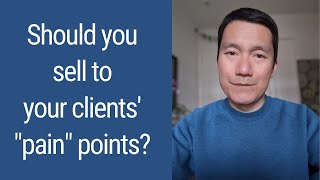
George Kao (YouTube video) critiques the common marketing 'hook, story, close' approach that emphasizes clients' pain points and fear to drive conversions. He argues this "mercenary" pain-focused marketing harms audiences and society by amplifying fear, and proposes an alternative: market to joy, relief, gratitude, and trust—while being transparent about what your product/service is designed to do and avoiding promises of guaranteed results. He also notes a limited, ethical role for gently diagnosing pain points (doctor analogy) to ensure appropriate solutions.
Chapters
The hook, story and close model of selling your services, your products, doing your marketing. This is what's commonly taught out there these days. You hook them in with a problem, a pain that they're experiencing, so you get their attention by saying, hey, aren't you struggling in this way? Aren't you feeling bad about this or about that? Aren't you afraid of this, this might happen, or that might happen? Have you been up at night, can't sleep because of this issue or that issue? And then you go into a story about how you experienced that too, and then what you did to solve that problem, or how you've helped so many people solve the problem, or whatever the story is that captivates them. And then you close them by saying, well, if you don't buy this, you're going to regret it or buy it now, it's such a good deal. Blah, blah, blah, blah, blah. Okay, so one of my subscribers, my newsletter subscribers emailed me this question of, okay, this is what's taught out there. And you know what? In fact, what's taught out there is to make the pain points of the clients so obvious in your marketing that they feel like, oh my God, if I don't buy this, I'm going to die. If I don't buy this, if I don't do what you say, my life is going to be so much worse. So that's typically the way that marketing is taught out there. I call this mercenary marketing advice. It's mercenary. It's basically like I don't really care about the feelings of the audience member, the potential client. Well, all I care about in terms of their feelings is whether or not they end up feeling like buying from me. That's all I care about. I don't care of all the people, because here's the truth of the matter, is that for every one client you get, there are probably 10, 50, 100 others who saw your marketing message. Right. It's actually more likely to be somewhere closer to 50 to 100 other people who saw your marketing message. And one person signed up. You know, 1 to 5% conversion rate, maybe up to 10% conversion rate is not unusual conversion rate meaning how many people who saw the marketing message signed up. That's called a conversion. It's very unfortunate language as well, in my opinion. So all these people are seeing your marketing message and don't sign up, and the one person who signs up is all that you care about? Right. That's how we were usually taught in marketing. Just care about that one person who signs up that those 10 people, those a hundred people who sign up. Who cares about all the other people who didn't sign up? Really? Well, what kind of difference are you making in their life by putting a marketing message out there that makes them feel even worse? The ripple effects to their lives, the ripple effects to your karma, the ripple effects in society. I mean, this is why marketing is demonized by. Rightly so, because much of marketing is about making us feel incomplete. Not enough feeling bad, feeling urgent if we don't buy this thing. So is there an alternative to selling to the people's pain points? Yes, there is. Yes, there is the alternative. Why can't we, instead of selling to their pain points, why don't we sell to their joy points? Why can't we sell to their relief points? Why can't we sell to their gratitude points? Meaning what is possible when they use our service or product that might bring them joy? How might this service or product give them a sense of relief, a sense of gratitude, a sense of empowerment, a sense of, you know, well, a sense of value, essentially, for having experienced your product. A sense of, this was worth it. This was so worth it. Now what we're not doing is promising results. Nobody can do that with integrity. You can't promise results, right? Because how do you know how they're going to use your service or product? You can't promise results in your marketing. What you can promise, though, is that you care if you do. What you can promise is that the product or service was designed to solve a certain problem. That's what you can promise. That it was intended to relieve them of certain issues or to bring them to a certain transformation. That's what you can promise. You can also be transparent about your background. How does your background, how, what makes you qualified to provide this service or product? That's what we can talk about. Now, is it always wrong to talk about pain points? Not necessarily. When you go to a doctor and she gently taps on that part of the body that's bothering you to say, oh, is that the part. Oh, okay. That is the part that hurts. Okay, good. Okay, what we need to do then is we need to blah, blah, blah. She gives you a therapy, she gives you a solution, a medicine to solve that particular pain. Now if she taps on that part of the body, no, that doesn't hurt at all. Oh, okay. So that's not what I was thinking, that you had this problem, but maybe it's something different. Let me try a different tap. Let me try a different diagnosis. So if we are Gently mentioning the pain points in order to diagnose the issue of the, the client. Right. In order to understand what is the cause of their frustration or why they're approaching you today, we need to understand that because if we don't understand that, we might give them the wrong therapy or the wrong solution, the wrong kind of mentoring, coaching, whatever, healing, whatever it is, the wrong kind of product. But if we understand, if we gently tap on the pain point only to understand that yes, we are on the same page with the client, that that is a problem, that's why they came to us, then we can give them the right solution. So it's not that we never talk about pain points, but it's the intention of, are we talking about it in a way to make them buy from us? You know, are we talking about in a way where we're like, oh my God, if we don't make it so dramatic, they're going to leave this webpage, they're going to leave our marketing message. So essentially the type of the mainstream marketing that's being taught is very fear driven, fear based. It's all about fear, right? Oh, I'm afraid that if I'm not interesting enough to you, you're going to leave this video. Oh, I better, I better keep myself, you know, being interesting enough talking about the pain points of a. Right. I don't mind being boring. You know, you can leave if you want. You'll be back. If you trust me, you'll be back. Right? But this is the thing, like I operate from a base of I trust myself and I trust that the right people will benefit from this message. And I trust also that when the time is right, you will decide to enroll in one of my online courses. If it's the right thing for you. I don't know, you can take a look at the page yourself and see if it's the right thing for you. I have written it in such a way where I'm writing it to set the correct expectations and if it's the right fit, you'll do it at your own time. So that's, that's what I hope to communicate through all my trainings and all my content. That's what I aim for, authentic marketing. That, you know, that's really the basis of it, is it coming from trust rather than fear? Oh, I'm so afraid that if I don't, you know, if I, if I don't make them feel something so strongly that they're not going to buy this product. And so out of that fear comes a lot of the negative marketing that we see. The pain point stuff, the driving home the frustration and the struggles that they're having and the scarcity and all the other things that are basically fear based. It's fear based from the marketer, the business owner standpoint and it therefore is also creating more fear in the potential client. Oh, if I don't get this, then I'm going to continue suffering because I've just been reminded of how much suffering I'm in. Do we want to re traumatize our potential clients? Remember, of every one client that signs up with you or everyone buyer of your product, there's another 10 to 100 people who saw that marketing message. What kind of ripple effect are we creating in the world with our marketing? So I hope that this is helpful and gives you a better sense of how you can manage that teaching about pain points that you're going to see out there. I'm pretty sure I'm going to take a look to see if there are any comments on this Facebook Live video. I'm always grateful when I see your comments and any questions that you have. Feel free to ask as well. I see. Thank you to Tim and Jonah for joining me for this. And there's no questions right now, but feel free to post your questions or comments below. But until the next video, those of you who don't know me, I'm George Kao, by the way. I love talking about how do we create a business that really feels good to us and that feels good to the people who, whether or not they buy from us, they feel good from seeing our marketing and our content. Because if they feel good, they're probably going to have a good impression regardless. They're going to have a better day. And some of the people who have a good impression of you, of course are going to keep coming back. They're going to consume more of your content and when the timing is right, they will sign up for your services or your products. And of course you should also occasionally mention your services and products otherwise they won't know about it. So that's an important part of it too. But we don't have to press on the pain points of our clients. Let's try instead to touch on the joy points more often, the gratitude points, the relief points, things like that. Okay, I wish you well and see you in the next video. Take care.