the opposite of #hustle -- joyful calm productivity
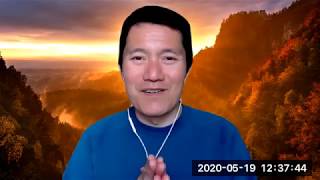
George Kao (speaker) presents a short YouTube talk arguing for “joyful” or “calm” productivity — a disciplined, long-term way of working that emphasizes showing up, deliberate practice, and non-attachment to outcomes. He frames the approach with a Shaolin/martial-arts metaphor, contrasts it with hustle/strain, and supports it with a quoted Alan Watts lecture (on relaxed attention) and a verse from the Bhagavad Gita (act without attachment to fruits). He gives practical signposts: planning his day in half-hour blocks, treating launches and sales as practice rather than identity, and trusting that needs will be met even in hardship (references pandemic stimulus as an example).
Chapters
So I want you to imagine a martial arts master high up in the mountains, maybe in the Shaolin temple. So the master has done a lot of meditation and has done a lot of martial arts, maybe trains other people. And when that master is fighting an opponent, right, maybe there's a, some kind of invasion or some kind of break in at the temple and he's fighting an opponent. The master, we might imagine is doing it with such grace and calm while fighting an opponent. Even though there's a lot of precision and flexibility and power, it's still sort of this calm, you know, putting the foe at bay and ultimately defeating the foe. So this is the way that I've learned to work on my business as well. I'm not a martial arts master, not that I know of, but I've learned to apply that kind of Shaolin master sort of attitude to the work that I do, which is creating content, which is something I think we all, it's all part of our work, creating content, training people on entrepreneurship and marketing, writing books. And in fact, one of my clients had asked me when I was finishing my first book, she said, you know, you're about to finish your first book. That's amazing. Like, how do you, how are you feeling at this time? Like you're, you're about to let go of this, this baby, this project that you've been working so hard at and so long at. And I thought it was a great question because I looked at myself and I said, huh? I don't think, I don't have this huge emotional charge that, oh my God, this thing better work. And this is such a high risk endeavor. My first book launch. Instead, I was already planning my second book at that stage, and I was doing it. My first book launch, I was just taking off the checklist, trying to do it in a calm and joyful way. And so even with such a giant milestone of life like your very first book launch, I have been so practiced at this sort of way of working that even then I didn't find it to be a very big deal. And I want to share this with you because I think the way that I have practiced working makes it possible for me to work like this for a long time, many, many years. Whereas I look at some of the colleagues that I started with back in 2009 and 2010, like people I met at that time in the first couple years of my business who were also, you know, at some point, they were quite successful, and many of them are no longer doing the work that they were doing. Maybe they're doing a totally different kind of business now, or they're in a job, or maybe they're retired. Even though, of course, as we all know, you don't ever have to retire. You can keep doing the things you love to do, doing work that feels purposeful to you. And I'm still here compared to a lot of the colleagues I started with. So I think the difference is this practice of what I call joyful productivity, or what someone has recently who read my book said, you know, George, actually it's more like calm productivity. I said, yeah, yeah, you can call it that, too. So I want to read you a quote from Alan Watts, the famous, you know, philosopher from the, what, 1950s, 60s, something like that. And this quote is from a. From a lecture he gave. And I always liked this quite a bit. So here's the quote. What do you do if I say to you, take a hard look at me? Take a real hard look. Now, what are you doing? What's the difference between a hard, hard look and a soft look? Well, with your hard look, you are straining the muscles around your eyes and you're starting to stare. If you stare at a distant image that's far away from you, you'll make it look fuzzy. If you want to see it clearly, you must close your eyes. Imagine black for a while, and then lazily and easily open your eyes and you'll see the image. The light will come to you. I love that idea. Let the light let the world come to you, rather than straining so hard to grasp it. Right? That's essentially what Alan is speaking. So let me continue with this quote. And what do you do if I say, now listen carefully, listen very carefully to what I'm saying. You'll find that you're beginning to strain yourself around the ears. Supposing somebody said, okay, now you've got to use your will. You've got to exercise. Strong will. That's the ego, isn't it? What do you do when you exercise your will? You grit your teeth, you clench your fists. If you want to stop wayward emotions, you go uptight, you pull your stomach in, you hold your breath, you contract your rectal muscles. But all these activities have absolutely nothing to do with the efficient functioning of your nervous system. Just as staring at images makes them fuzzy, listening hard with all this muscular tension distracts you from what you're actually hearing. Gritting your teeth has nothing to do with courage. All of this is a total distraction. And yet we do it all the time. We have a chronic sensation of muscular strain, the object of which is an attempt to make our nervous system, our brains, our sensitivity, function properly. And it doesn't work. From the moment when we were little children, teachers in class screamed at us, pay attention to see or hear more clearly, to concentrate or to will something which is supposed to be difficult to do and that constitutes a habitual tension over the whole body. That feeling of unnecessary tension is, as it were, the material on which we fashion this concept of I. We hang it onto that feeling. That concept is not us. The feeling of tension is completely phony. It has nothing to do with success or seeing or hearing or acting. So that's, I guess, another way of saying what I'm talking about, which is when we are doing the things that are in front of us, we don't have to stress about the results, but instead we can bring a calm, curiosity, exploration, practice, a feeling of practice to whatever it is right there. Now, to not will so hard doesn't mean I don't plan. Those of you who know how I work, I plan my day to the half hour mark. You look at my schedule, it is completely filled for every single half hour. Now I'm doing this, now I'm doing that. Now I'm doing that. Some things take me one hour, but usually it's half hour chunks. So I plan a whole lot. I'm very regimented. I'm like a, you know, drill sergeant, except more like the Shaolin monk type of drill sergeant. Right. I'm very, very structured, and I simply show up to whatever I said I was going to do because I don't have. I don't care about the results. See, that might be the difference between me and the people who couldn't make it in the same niche. I don't care about the results. I don't care if you like this video or not. I prefer it. I have a preference. But what I care more about is that I show up for it. That I am here to explore my thoughts, that I'm here to serve you the best that I can. Just the practice of service, not the. Did I. Did you. Did I get enough likes or did I get enough comments, therefore I served you? No, no, I don't care about that. I care if I show. If I show up, if I'm practicing the exploration of my thoughts and the practice of serving you the best that I can with a smile, you know, with gentleness, with grace. It's just all practices. So I'll just give you one more quote and I'll end this video. Quote is from thousands of years ago from the Bhagavad Gita. And it says, to action alone hast thou a right, and never at all to its fruits. Let not the fruits of action be thy motive, neither let there be in thou any attachment to inaction. So don't be lazy. In other words, therefore, without being attached to the fruits of activities, one should act as a matter of duty. It's just a practice right. For by working without attachment, one attains the supreme. So I don't care if my courses sell, I prefer that they sell. But what's more important is that did I show up for the launch? And yes, if I do a pre launch, there were no sales. And I'll switch the topic again just because that's part of my process. But then whether it sells a lot or a little, well, you know, I'll observe afterwards, I'll observe, oh, that one didn't sell as well. Well, next time, as part of my process, I probably won't sell that one. I probably won't launch that one again, didn't sell so well. Okay, let me try something else. But it's all just a series of, you know, practices. That's all it is. And I think I can do that because magic. I really believe that magically we are all taken care of in some mysterious way. Even if you can't pay the rent, even if you can't pay the rent, something will emerge in the last minute. It's really weird. Notice it, right? For those of you who can't pay the rent right now, something will happen at the last minute to take care of you. It's the strangest thing. Now remember, don't be attached to laziness, don't be in despair and don't do anything. You got to do things, but just do things. From whatever smart smart you have, from whatever wisdom you have, you just do things, but without attaching to, oh my God, is that gonna help me pay the rent? You just do things as smartly as you can and something always happens to take care of you. The government will send you a stimulus check, for example, these days with the pandemic, or somehow you'll hear about this grant that you can apply for. Or somehow a family member says, hey, you know, I've got some extra money this month, I'll send it to you. I don't know. Or somehow you'll have some magical idea happen last minute to sell something that you own, that you don't really use anymore, and then generate some money. I don't know. But you will figure it out. I promise you. Either you will figure it out at the last minute or before the last minute, but definitely by the last minute. You'll figure it out, or you'll figure or someone will come to your aid. Something always happens. It's so strange. Notice that you're still here. Now, if you, for whatever reason, if it's meant for you to live in your car or to live with somebody else, that will happen too, and that would be part of your journey. That's okay. Why are you attached to living with your own rented house or apartment or whatever? Why do you have to live there? You see what I mean? Like. Like everything happens as part of your journey and you just work as smartly as you can each day without attachment to, oh, I better make this happen. Because something will always take care of you. No matter what happens, as long as you're alive, something will take care of you. And it's when it's time to die, you'll die. You know, not a big deal, right? Don't make it a big deal. And it won't be a big deal. I hope this is helpful. It's just a perspective on how to perceive all of life as just a journey that somehow we are always learning something from. And as long as we just work as smartly as we know how to at the moment, we're going to learn to be smarter over time. But whatever smarts you have now, just do that. Work with no attachment. Because you'll always, always be taken care of. All right? I wish you well. And those who don't know me, I'm George Kao. I love talking about building business from a more authentic, maybe spiritual values way of doing it. If you enjoyed this video, you'll probably like my other ones and I always look forward to seeing what you thought about this one in the comments below. I wish you well. Take care.









