The trouble with cold calls and emails... and the 3 warm outreach alternatives
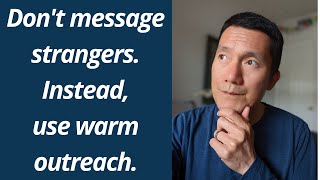
George Kao explains why cold calls and emails backfire: they attract low-quality clients who won't refer you. Instead, create helpful content to draw people in, do regular genuine check-ins with communities, or ask mutual connections for introductions.
Chapters
None of us like spam, right? And yet so many of the sales and marketing trainings out there are. Some of them are essentially asking us to make spam and become a bit of a spammer. So. And, and you probably have received a lot of people reaching out to you. They seem like they, they really want to help or something, like you never heard of them. And maybe they're even inviting you to a free Facebook group. But if you've done that kind of thing before, you join the group and you realize, oh, okay, this person is basically using this group to, to sell their stuff. Sure, they're building community as well, but they're also selling their stuff. I'm not saying there's anything wrong with free Facebook groups, but I am. What I'm saying is there's no need to do cold outreach. Cold email, cold calls basically come across to most of the people that are being reached as spam and annoying. But the reason why it still happens is because it works a small amount of the time. And so if it works a small amount of the time, you reach out to 100 people cold, and maybe you'll hear back from, you know, five of them or 10 of them, and out of those 10, maybe two of them will become your clients or something. Oh, let's go ahead. And how many people can we, can we cold outreach to? So, so first let me describe. Explain what cold outreach is. It's when you see someone on social media or you find a website and they seem like, oh, they might be interested in my services based on who they are, what they say on their social media profile or on their website, they might be interested. So then you reach out to them, you know, in, in a service oriented mindset, you know, saying that, oh, I provide the service and maybe you're interested. You know, a, a silly example that happens to me all the time is people contacting me about cleaning my office, my business office. They're like, we are, you know, business office cleaning company in your area and we'd like to. And it's like, I work at home. Are you going to come and clean my home? I mean, thanks, but we don't have that big of a home and we can clean it ourselves, and we do. So. But. And another example that I recently received that was quite shocking, the subject line was, you have a problem. That was the entire subject line, do you have a problem? And then I open the email. You know, most email, you know, you kind of know, you know, they're selling, you know, Viagra or something like that. But some emails, you don't know what it's about. It might be a real, you know, thing. And so you open it. Oh, it's spam. So when I opened the you have a problem email, it basically said, you have a problem. I've been to your website and I see some things that could be improved. Please contact me about my copywriting services or my branding or my marketing funnel services or whatever it is. And it's, you know, it's like I, okay, there's even some savvy spam where someone actually go, you know, records a screencast, going to my website and, and saying, hey, or, or they watch one of my videos. Records a screencast. Hey, you can improve in this way and that way. And maybe it's only like a three to five minute video. And that took them a lot of time to create that spam because I didn't ask them for it, right. And they don't even know. Maybe I would be offended, you know, because have you ever had someone give you advice without your consent? You know how that feels? You're like, I think I'm, I feel I'm doing fine in that area, but thanks for your concern, I guess. And so this is what a lot of desperate people do and teach other people is to reach out. And they, again, they, they try to dress it up as a authentic selling by saying, this is a service oriented. You're providing services to others by, you know, for example, copywriters or marketers going to the website, recording a screencast about what can be improved and subscribing to their email newsletter and, and giving them some tips on what can be improved. And it's like, first of all, the person you know that's receiving it might not, might not want feedback. They might, you know, feel like it's an imposition on them. But secondly, that is so much damn time that could have been gone, that could been, that could have been spent in the alternatives to cold outreach. Okay, so I'm going to talk about that next. But I, I want to end this segment about cold outreach by saying this. Even if someone is successful in getting clients by doing cold outreach, okay, here's the problem. The client who says yes to being spammed and saying, oh, I don't, I have no idea who the, who the f. This person is. And they reached out to me and a stranger who gave me advice and all right, I'm going to go ahead and give their services a try. Think about what just happened. Somebody is sitting around and actually says, you know, I don't know what the mindset is. Maybe, maybe they're so desperate for that service that they would say yes to a stranger pitching them on it. But here's the problem. If you get a client like that, that person is also susceptible to the thousand other people that are going to cold pitch them. Do you see what I mean? The kind of client you get by cold pitching is, has not it kind of. You start that relationship by just selling to them, they're going to be easily sold at the stage in their life by other people like you. So, so, so this is probably why, I mean I, I get, like I said, a lot of copywriters spam me in sometimes very clever ways, like I said, in ways that seem like they're very friendly and very service oriented. But I'm like, gosh, if, if your service was that effective, and this is the other thing, if your service was that effective, why are you still cold emailing and cold calling? If your service was that good, you'd have tons and tons of word of mouth by now, especially how much you spam people. You must spam tons of people and get enough clients. And then those people, if you're happy about your service, probably tell, tell other people about it. But again, like I said, the kinds of clients and relationships you build from cold calling, cold emailing don't tend to be very sustainable and they don't tend to generate word of mouth. And so you have to just keep cold calling, cold emailing for the rest of your life and experience that kind of very unpleasant marketing activities. Right, so let me, let's now go into what is the alternative to cold outreach? All right, I'll give you three alternatives. Number one, you may recognize this, because I love doing this myself, is to create and distribute good content so that people reach out to you rather than you spamming other people about who don't know you about your services. So create and distribute good content as widely as you can. I mean, you see how I do this. I'm recording this right now on Facebook Live and then later I'm going to upload this to YouTube. And if this does, if, you know, if this was a helpful, particularly helpful video, I might upload it to Instagram at some point. And along with this video, I've written a blog post that will go on my website, It'll go on medium.com and it'll go on LinkedIn and the website. The blog post will be shortened eventually into a carousel post for Instagram and a text only post for Facebook. Anyway, so it's like you create content that serves your ideal clients, your potential clients, and those who may never sign up for your services but will benefit from your, from your content. Anyway, I always talk about this marketing. Authentic marketing is ministry or is a cause. If you don't like the word ministries, say cause, meaning if your marketing is to be successful, you're going to be reaching and impacting way more people than who sign up to work with you, right? Think about it. If you're, if you put out a video or an article that people really found helpful, it gets shared and shared and shared and 100,000 people see it. Do you expect a hundred thousand people to work with you? No. You don't even expect 10% to work with you. You know, 10,000, maybe you expect 500 more leads or something like that. That's amazing. 500 more inquiries compared to an article that only reached, you know, 500 people. And you know, you got, you know, three inquiries or something like that, or five inquiries or 10 inquiries. So when your marketing is successful, it reaches and impacts a lot more people than who eventually work with you. Just statistics, right? So the higher, the higher your marketing impact, the lower your conversion rate. It's supposed to be like that. That's actually a good sign that you're, you're creating more impact. So therefore, that is why, and this is why I always am always urging you to create content in the service of your ideal audience, whether or not they ever spend a dollar with you, knowing that if it's successful, your content, most of them won't spend, ever spend a dollar with you, but there will be enough of them that you'll be plenty full with clients forevermore if you keep, you know, if you create and distribute good content. And of course I also always say that that's. The one side of good, authentic content is it serves the world with your passion, your expertise, your presence. And on the other side of, you know, this Venn diagram of authentic content is it serves you by continually sharpening your creativity and deepening your understanding of your field and also expanding the power of your authentic voice. You can't. It's. It's a, it's creativity, fitness, it is a fitness project. It is a, it is a, it is a ongoing muscle that you either develop or let it atrophy, right? If you, if you rest on your laurels because you wrote some 10 good articles or something like that, well, your writing and creative capabilities are going to attribute, attribute, attribute until you again stretch and create and try again to create some Additional value from the deep and broad experiences of your life and all the things that you've studied and read and watched lately, et cetera. So content serves deeply and powerfully, serves at least two purposes. You, your own growth and the service in service to your audience's growth as well. And so creating distributed content, guess what? That's a very good alternative to cold outreach. Because people, it's like again, you have a limited amount of time. Do you want to be spending it spamming people or do you want to be spending it growing yourself in service to the world? And therefore people reach out to you. Okay, so that's number one alternative. Second alternative is net caring, and you may have heard me talk about this as well. Net caring is the process of connecting individually with others and also in groups in a way that you genuinely enjoy, in service to your, you know, your enjoyment and in service to, to, to, to their growth as well. It's different from content in that net caring, you're really responding to others. You're responding, responding, responding, but also you're reaching out sometimes to see how people are checking in on people, to see how they're doing in a way that's really genuine because you enjoy that person, you really care about that person, and you're just doing it in a more structured way because guess what? Most heart based solopreneurs and most intuitive and visionary people are not, are not structured or are not organized enough to, to keep in touch with the people they care about on a regular basis. They care about these people, but they're so scattered and overwhelmed or, you know, they're, they're, yeah, they just aren't organized enough to keep. So you can be one of the few people who is both heart based and visionary and intuitive and go with the flow. And you're organized and structured enough to keep in touch every six months, every 12 months, whatever rhythm you want with the colleagues, the clients, the friends, the acquaintances that you care about that you genuinely enjoy. And if you do that, guess what's going to happen. You, you keep in touch with them genuinely because you're curious what they're up to and what they're working on. How if there's something that they need and want right now in their professional life or personal life that you might be able to support and be a connecting point to. Right? You're doing that out of genuine care and enjoyment. Not surprisingly, some of them are going to ask, what are you up to? What's going on? And not surprisingly, some of them will, you know, connect again. With you on social media, they'll come back to your social media profile or whatever it is, and they'll see what you're up to, even if they don't ask. So net caring, if you either do it individually or you do it in groups, right, in, in Facebook groups or any other online community you're part of, you go there and you comment on people's posts in a very caring and genuine way. You know, in service to them. You're not creating, well, essentially you're creating content as well. I mean, you could take some of those comments and turn them into content, but you're doing it in response in service to these people and these groups that you, that you enjoy, that you care about. By doing so, people naturally look at your profile and, and if, if you've been posting occasionally on your profile, the things that you offer, you know, and your own content, they're, they're going to start following that and they're going to reach out to you. Some people, some of them will refer people to you. So that's the second alternative to warm, to cold outreaches, this kind of warm outreach of net caring. And then the third alternative, okay, is let's say you do find somebody on, you know, on their website, Facebook, LinkedIn, Instagram or wherever that you're like, oh, this person could be a client or this person could be a referral source like you, you do want to connect with this person. Well, instead of spamming them in cold outreach, a much better way of doing is see if there is a mutual contact, see if there's a mutual friend, mutual connection. And how do you do that? Well, if you go on Instagram, you go to their profile and if you're able to see who they're following, you could see who you both follow and maybe contact. If you, if you actually are friends with the person they're following, then you could, you could do it that way on LinkedIn, or you look them up, look them up on LinkedIn, look them up on Facebook. Both of these places have mutual connections that you could see, oh, I can get to this person through that other person. And if that's, and that if that middle person, you know, you're able to get their attention and support and introducing you, then that's a much better way to get to that end party instead of you randomly reaching out cold. Now, there are a few exceptions where cold outreach I think is okay. And this is where, and by the way, I do this sometimes. This is the exception. You want to interview someone, somebody you know for your podcast or for your newsletter or for your blog or, or you want to introduce them to your clients or to your customers or students. That is a welcome cold outreach. When someone says, hey, George, I'd like to interview you for my podcast now, I don't always say yes. It depends on how large the podcast is and how relevant it is for how relevant the audience is. I don't always say yes, but I certainly appreciate it when people invite me, you know, if I can at least decline politely if, if that, if it wasn't the right fit. And you know, now I kind of know that person a little bit. Right? So that's the, that's one exception to cold outreach is when you are clearly giving them a benefit and not trying to sell them something. You're just, you're, you're trying to, you know, for free. For free. You are bringing them to a larger, to, to people that they wouldn't have otherwise reached, meaning your, your network, your friends, colleagues, students, customers, clients, etc. So I think that's where the cold outreach could work. Another exception maybe is, you know, if you and that person have a similar sized audience, you know, you both have several hundred Instagram followers or several thousand YouTube subscribers or something, and you could clearly see how you can collab how you could either interview each other or find some other way to collaborate. Then you could gently reach out and test that idea, say, hey, I. And because you're genuine about it, you actually say, hey, I like your content. Because you talk about this to these types of people. Guess what? I do the same kind of thing. I wonder if there's a way for us to collaborate. If you're open to that, you know, let's let me know and we can brainstorm. Otherwise, I just want to tell you I support your stuff and I really like it. Keep going with this. And that type of content I so rarely receive. Like I said, spam is usually quite generic, right? Like, you know that the person that emails you like that message could have been sent to 500 other people and probably was right? And maybe they'll customize the first line, which is done by mail merge, to say, I liked your art, your recent article about blah, blah, blah, and like the title of the article and also, but, but yet my favorite article of yours is blah, blah, blah, and I received those too. And I think that's a very clever, you know, mail merge because they basically, they have some bot, you know, taking the titles from my blog or titles from my videos and basically mail merging them and sending that out to 10,000 people. And some people go, whoa, this person watched my videos or read my blog post and I should respond, no, it's a mail merge. No, it's not real. But when you send someone a message, you know, with longer than that, like genuine praise for their content and for something they said recently and what you thought about it and have more of a connection there then then that might work. But I hope overall that you will use the these alternatives to to cold outreach. And there's my cat doing some warm outreach to say open this door, please. Anyway, I hope this is helpful and I look forward to, as always, your comments and your questions below. Thanks so much for watching.









