Why does growing your audience feel like paddling upstream?
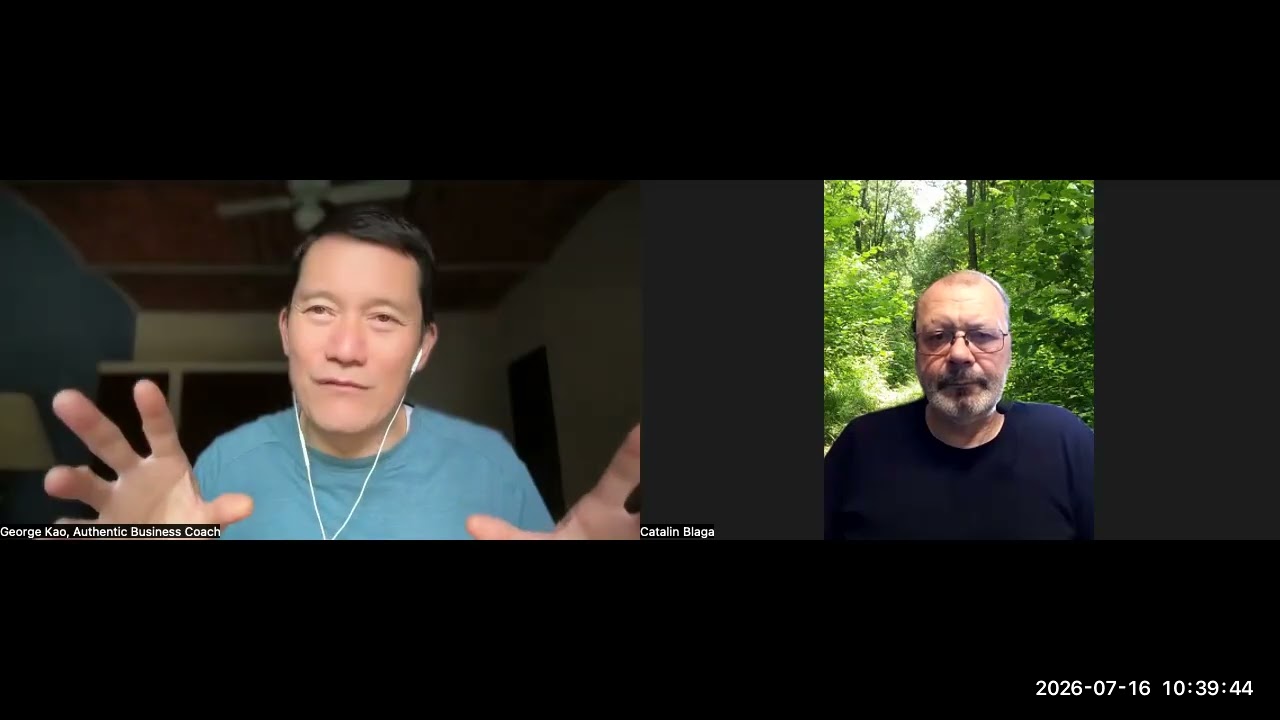
George Kao coaches Catalin, a mindfulness teacher, on why audience growth feels hard: he's fighting the current instead of reading it. The fix is monitoring market trends, running free monthly webinars to funnel people into paid programs, and using cheap Facebook ads with keyword research to catch where attention actually flows.
Chapters
All right, Catalin, thank you for letting me record this. You're teaching mindfulness and stress reduction, and you're doing it in Romanian.
Mostly in Romanian. I've had English-speaking clients, but not very many.
So, and then you've got some free guides and content out there, and you're wondering how do you get more traction, because sometimes you feel like you're paddling upstream. And I really like that you brought that metaphor in here because— and oh, I forgot to ask, what is your hope or goal for this work? You— I mean, I'm assuming you want to reach a lot more people and you want to create products or you already have some products or services to sell?
Yes, I have the mindfulness program and I have the stress compartmentalization program. I work in cohorts, very little one-on-one, mostly in cohorts. And I have a goal, a business goal in mind, which is quite modest, but I'm not there yet. And I was wondering where and what should I do differently if this is the case to bring it all together?
I see. Good.
Okay.
So back to the paddling upstream. This reminds me of, I like to talk about, and maybe you have seen this if you've been reading my blog posts for a while, I write about the, the, you know, the river, right? And if you don't know what I'm talking about, go to my website and search river, and you'll find the blog post. Everyone, you know, I encourage everyone to read it. Basically, to get traction, to get interest from people, and to make money, you have to understand the river of energy. Okay. Now, I'm not talking about something woo-woo, like there's some vibrational river that we have to be intuitive to tap into. There probably is that too, but I'm talking about business. And when it comes to business and audience building, the river is very obvious. Thankfully, it's not— you don't have to be psychic to, to sense the river. You— all you have to do is, well, you have to be more like a scientist. Okay, actually, you have to look at the data. All right, and I know, Kathleen, you have some scientific background, so maybe you will appreciate this too. And you have to look at trends. The river is the, is the collection of energy from people, their attention, particularly their attention and their engagement. And we solopreneurs, right, soulful entrepreneurs, we tend to ignore the river that's outside, which is the data, the trends, the attention, the engagement that people are giving. And we only look at the river inside. We are very much inside-out people. And yes, that's— it's very authentic. It's very fulfilling, right, to be inside out. I just care about my river of energy. Where is my river of energy flowing? And that's what I'm gonna do. But then, if we don't care about the outside river, then the outside doesn't care about us. We have inner fulfillment, but we have no outer fulfillment. And so, and the reason I'm saying that is because I don't have to be an expert in your niche. You are the expert in your niche. And so it is your job. I'm not talking to just Catalina. I'm talking to everybody who's watching this. It is your job, everybody, to be an expert in your field and to be an expert in where is the energy flowing in your field. So here's another blog post I want to encourage all of you to look up on my site: Client Doorways. Doorways. Okay, sorry to mix metaphors. I'm not very good at this. Um, but basically, people come to you like you have— your business is a beautiful, magnificent castle with giant gardens all around, the different types of gardens. People are attracted to your business castle, to your work, from different directions. They come into different doorways. They come through different doorways. You have to start noticing what doorways people come through. What do they request of you? Okay, but you also need to notice the river, which is the, the outside Data. And how do you notice the river? Well, a couple ways. You probably notice just from surfing social media what your audience tends to be most interested in. So, for example, these days, you know, tai chi is very popular, right, on social media. You're like, I watch a lot of little short videos, and I know, oh, tai chi, another tai chi video about this or about that. You know, more recently ADHD has been very popular, but it's starting to peak out. Mindfulness was popular about 10 to 20 years ago. It's no longer popular. It's no longer part of the river. That's why you're having a hard time. Stress reduction was popular 20 years ago, 10 years ago, maybe. No longer popular. It's no longer part of the river. So you're literally paddling upstream because everyone wants You know, whatever, tai chi, ADHD, you know, trauma healing. Everyone wants those kinds of things. And then you're not saying anything like about that. That's why it's hard. Now, I'm not saying you can't do it. It's just that the audience is so small now. But it's not only the audience is so small because mindfulness used to be popular. There are many, many, many, many, many providers of mindfulness content and programs and stress reduction, mindfulness. So many competitors you have, so many niche mates you have that are doing Most of them are not doing well, but some of them are doing really, really well, and they have all the audience, they have all the attention for whatever attention is left. Not much is left, right? So how do you know? You notice by just, just observing whatever you're seeing on social media, number one. But number two, keyword research. Keyword research. And now, of course, these days, whatever you want to learn, if you are willing to use AI, AI can teach you everything. Ask AI, how do I do keyword research? What's the free way? Because plenty of free keyword research tools. Tell me the free way of doing keyword research. Teach me step by step. And, you know, and you can, you could even maybe ask AI, hey, what's trending these days? I teach mindfulness, I teach stress reduction. I understand that it's no longer popular, but what's trending these days that I could reframe my work I could reframe mindfulness in terms of trauma healing. I could reframe mindfulness in terms of ADHD. I could reframe mindfulness even in terms of chi, because tai chi is popular, right? Like, what, what's popular now? What's trending now, dear AI? And help me reframe my thing, my skill, whatever your skill is. Some of you do life coaching. Some of you do, um, you know, leadership development. Some of you do music production, whatever you do, teach me to reframe this for whatever's popular right now. That— and I should be clear, popular of course is always audience-centric, you know. And, and Catalin, tell me about your, your ideal audience.
Um, from what I noticed, asked, been answered, and researched, my, uh, my, uh, client persona as probably someone over 40 who has already tried several tools ranging from spiritual to mechanical, has been disappointed with the result, and is looking for a science-guided way to rewire the parts of their brain that are giving them pain.
Okay.
I also noticed that My unique sales proposition seems to be my presence, my energy, as you call it. There are repeat students who just want to be in, in the virtual room because I teach over Zoom, in the virtual room with me because of my presence. Oh, that's wonderful. So these are the, these are the things I know right now about My audience.
Okay, good. Very good. What you said about, you know, their, their age range, what they have tried, what they're interested in, those are very helpful. And you can ask AI to say, here's my— here's what I understand about my audience. Teach me how to use keyword research tools to find what is likely to be popular right now to that audience. Now, if you ask AI directly, hey, what's popular to this particular audience? It's probably going to hallucinate. The AI is very good at sounding right, but it's not a keyword research tool. It'll give you some, maybe some ideas to look into, but it's better to ask AI to teach you how to use proper keyword research tools that have the actual data, but teach you how to find the right keywords for this particular audience that you've named. Very helpful that you You have an audience in mind. Okay. Now the other thing you said about they, that my audience likes my presence, you can't do marketing like that. The, I mean, the only marketing you can do like that is to do free webinars and free virtual experiences. Catalin, you should do one a month at least. Do you do that currently?
I did until last autumn. I had hired us and the next free webinar is planned for the end of July, the end of this month. Okay, good.
Everyone here watching this, if you are a solopreneur, you should be doing one free group experience per month. If you're not, I don't know why you're not. And by the group experience, it could be teaching-based, it could be just webinar teaching, lecture training, or it could be a group facilitated, some kind of group experience. Because whenever you show up as a leader of a group, even if the group is a group of 3, okay, if it's a group of 2, group of 3, doesn't matter, okay? You instantly have more credibility. And just by promoting that you have a free group experience, you instantly have more credibility. And it doesn't have to be long. It could be 1 hour, it could be 30 minutes. But this is once a month. It's very good for your continual market. And that's how people can experience your presence, right, Kathleen? So they go, oh, I like this. I want more of it. And at the end of the group experience, you can then talk about your mindfulness program, your stress reduction program, etc. So anyway, I think I'll pause there. Is that helpful?
Yeah, right now the funnel seems to be Facebook because Romanians are big with Facebook. Ah, right, right. From Facebook to my free webinars and some of those who came to 3, 4 webinars finally arrived into one of my cohorts. So this seems to be a consistent theme that I observe.
Well, guess what? Then I liked hearing that because Facebook ads is so cheap. It's for, you know, $3 to $10, you could reach 1,000 targeted Facebook users between $3 to $10, sometimes even lower. Anyway, again, AI can teach you how to run Facebook ads. So I would recommend that if you, if Facebook and Instagram are part of your is part of your client journey towards you, then maybe spending a little bit of money every month to start on Facebook and/or Instagram ads would be useful too. So, yeah. All right.
Okay.
Thanks. Thanks, Katalin. I hope this helps.
It sure does. Thank you very much, George.
Thank you.









