In this video Dr. Ashley Frazee, a direct primary‑care physician, provides a concise, non‑medical‑advice overview of peptide use. She defines peptides as short chains of amino acids that act as cellular messengers, outlines the wide range of claimed benefits (muscle gain, fat loss, sleep, inflammation, brain health, etc.), and discusses their legal status (often prescription‑only, but many are sold as research chemicals). She emphasizes safety considerations, noting that peptides differ from steroids, have short half‑lives, and may be safe in the right hands but can pose risks if misused. The doctor reviews evidence levels (human trials for some peptides like SS31 and tesamorelin versus animal or anecdotal Reddit data), recommends basic blood work before use, and explains dosing and dilution calculations. She covers stability after reconstitution (≈30 days refrigerated for most), routes of administration (injectable, oral, nasal, topical) and their limitations, and the realistic timeline for visible results. Stacking and mixing are addressed, with cautions about synergistic vs. antagonistic combinations and the unreliability of blended products. Potential side effects and theoretical cancer risk are mentioned, along with how to assess source legitimacy (COA fraud, market unregulated). Finally, she explains why most doctors don’t prescribe peptides and shares her personal favorite—mitochondrial peptides like MOTS‑c—while urging viewers to stay safe and not view peptides as a magic solution.
Chapters
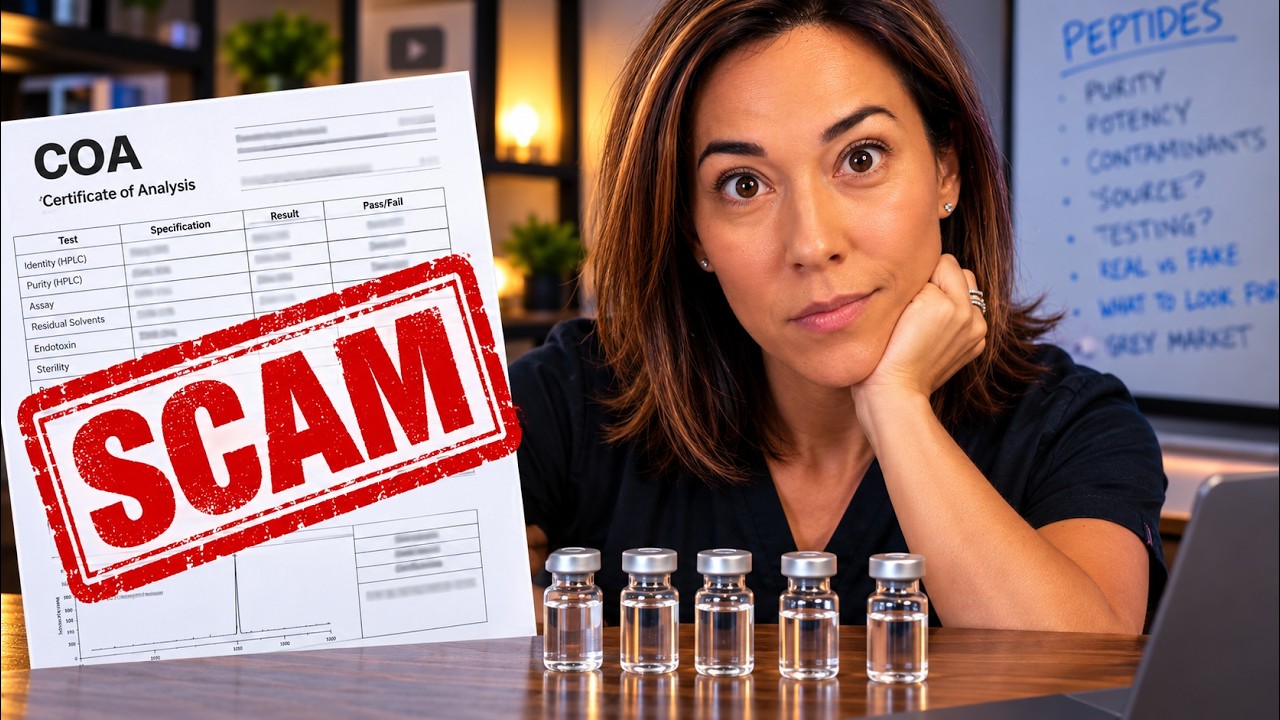
I'm a primary care doctor and I work directly for my patients, meaning that I don't involve insurance because we like it better that way. I get a lot of questions on peptides and it's because I do a lot of research on them. If people are buying random compounds off the internet and injecting themselves with it, shouldn't I know more about these things than my patients do? Because if I don't and I know you're doing it anyway, I feel like that's a disservice. Today I pulled together some of the most common questions I get about peptides. So you at least can understand what these things are and all the implications of using them. And for the record, this isn't medical advice. I am not encouraging you to buy random things off the internet and put them into your body. I just know that you do it anyway. Okay, buckle up because this isn't a deep dive, this is a joyride. All right, let's start with the basics. What are peptides? Peptides are literally just chains of amino acids, the same thing that proteins are built out of. When put into a living body, they hit receptors. You can think of them like short, powerful text messages between cells. They provide messages such as repair this, build that, turn this on, turn this off, that kind of thing. And so what do peptides actually help with? Well, there are peptides for basically everything— muscle gain, fat loss, brain health, energy, sleeping, inflammation— basically all the things that you could ever want, right? Moving on. Are peptides legal? Sort of. Sometimes. Some of them with a prescription. But right now, most of them I can't prescribe. Are they safe? Well, it depends on which ones you're talking about and what they're being researched for. See, in the right hands, in the right environment, under the right circumstances, peptides can be very safe. In the wrong hands, not so much. You see, research should always start with a measurable goal. That's how we learn what's safe. Where do you get peptides? I mean, I can't really tell you that, guys. I'm a licensed physician and I can't sit here and point you towards buying research compounds. But oh my gosh, please be careful. I have heard of and witnessed some really weird things. Are peptides safe? Are peptides steroids? The short answer to that is no. Peptides are just chains of amino acids. After they do their job in a cell, they basically break down and they don't last very long. They're like little engine tuners. Steroids are more like hormone takeovers. They get in the driver's seat and say, move over, I'm taking charge. Are peptides safe long-term? Some peptides are very gentle and some are not. It depends on the peptide. But there is a reason also that some peptides are kind of cycled on and then taken a break from. Sometimes you don't want to potentiate a receptor constantly, and There's reasons for that. Have peptides been tested in humans? Some of them, yes. There's really good data on things like SS31, the mitochondrial stabilizer peptide, and tesamorelin, one of the growth hormone-releasing hormone peptides. Now, some peptides only have animal data and Reddit data. Just know the difference. Should blood work be checked before using peptides? First, I'm not telling you to take peptides, but if I was going to take them, yeah, I'd probably want to know things like my kidney function, my liver function, my hormones, my IGF-1 levels, but it wouldn't be like a comprehensive NASA flight panel. It's just some pretty basic stuff. How do you dose peptides? Okay, first of all, you need to be good at dilutions and math. For example, if you take a vial with 6 milligrams of redotrutide in it, you put 3 mL of bacteriostatic water in it. If you can't figure out that that equals 2 milligrams per milliliter and understand the dosing that needs to be used after that, maybe you shouldn't be doing it. And a better answer to that is that every peptide has different trial dosing and milligrams per vial, etc. That's kind of the end of the story there. How long do peptides last after they've been mixed? The general rule of thumb here is after mixing a peptide with something like bacteriostatic water, it's usually stable for about 30 days in the refrigerator. Some are drama queens and fall apart earlier than others, but most last generally a few weeks before going bunk. How long are peptides taken before you see results? Well, peptides generally act really fast, like the same day that they're put into a system. But here's the real answer to that question. See, visible results take time. Injury recovery, Muscle gain, fat loss, all of these take time and consistency. They also take exercise and good habits. You can't expect peptides to just be a magical answer for everything. They enhance the work, they don't replace it. Can you take peptides by mouth or do you have to inject them? Some you can take orally, and yes, they still work. There's actually really good research on BPC-157 in animals showing oral activity, but most peptides are injectable. Now, some come as nasal sprays, but the people buying TB-500 in a nasal spray, they need to know that that physically will not work. It can't absorb through the nasal mucosa. It's too big. Some peptides are topical. GHK copper, for example, works very well as a topical peptide. What's the best peptide stack for beginners? I am not recommending stacks here. That's not the purpose of this video. I do have some videos on common stacks of peptides that I've seen, and I have a couple more coming. But the short answer to this is not all 9 peptides that you bought on Black Friday. It's really just best to keep things simple. Do peptides work better together? Some do, like the growth hormone-releasing hormone peptides mixed with the growth hormone-releasing peptides, you know, like CJC-1295 and ipamorelin. Classic stack. Find a bro on YouTube talking about it. Big old muscles. Now, some absolutely do not. I mean, imagine taking all of the weight loss peptides together and completely stopping eating. You would waste away and probably break a bone. You laugh, but I've seen people do this. Can you mix peptides together? There are many blends and synergistic stacks of peptides, and you'll You'll see people taking stacks of vials and just literally injecting one of each. You know, like BPC-157, TB-500, Rediger-Tide, and KPV. Classic. Are they going to interact with each other? Theoretically, probably not. And then there are blends too, like this one. This is a Glow Blend. It's got BPC-157, TB-500, GHK-Copper, all mixed in the same vial. People stack without blending. People use something like that. And listen, GHK-Copper does not degrade when it's put in a vial with 2 other popular peptides. You can fight me on that, but look into the research before you do. GHK copper has been mixed with things like vitamin C in serums and creams, and that will degrade it, but these globulins are fine. Okay, I'm off topic. Do peptides have side effects? Yes, they can, and here's your breakdown. BPC-157 and TB-500, probably no side effects. Melanotan 2, you might get really tan, but you might also regret the new moles that have permanently implanted themselves on your body. Then there's things like tesamorelin, which lasts a long time in the body. You cannot be on this forever. I have a video on peptides and cancer if you want to know the science on why. And to answer that question, do peptides cause cancer? Theoretically, some of them could if used for a very long time and inappropriately. Now, I haven't seen any proof on that, but it shouldn't be giving people free rides to act recklessly. How do I know if a source of peptides is legit? Okay, most peptide websites are showing something called a certificate of analysis next to the product. It's like a PDF that you can pop open and see a bunch of peaks and valleys on the purity of a peptide, claiming that that peptide, if purchased, would be 99% pure. But let me be clear with you, COAs can and have been faked, and a PDF on a website does not guarantee purity. The truth of it is that the peptide market is largely unregulated, purity varies wildly, and plenty of companies actually do fake or fudge these certificates. And this is half the reason that I'm not encouraging you to go out there and just buy anything. But again, I know what you're doing. This brings me to talk about my next question: if peptides are so great, then why aren't doctors prescribing them? Well, I hope I just answered that in my previous question, but there's also more to it. I mean, doctors are busy and they don't really have a lot of time to learn about them, let alone read all the research. Like, all of this has been exhausting, guys. I'm not gonna lie. I just really love it. And I'll end on this one. A lot of people ask me, well, what's your favorite peptide and why? And I'm gonna have to go with the mitochondrial peptides, things like this one, MOTS-c. There's a couple more, but really everything begins and ends in cellular energy. And the more we unlock about that, I think the healthier we'll be. I'm Dr. Ashley Frazee. I run a direct primary care clinic in Mesa, Arizona. If you like this video, please hit like for me, subscribe to my channel, and I'll keep talking about things like this. Just remember this: I am just a doctor with a camera on the internet. Be safe, guys, and have a great day. Bye.