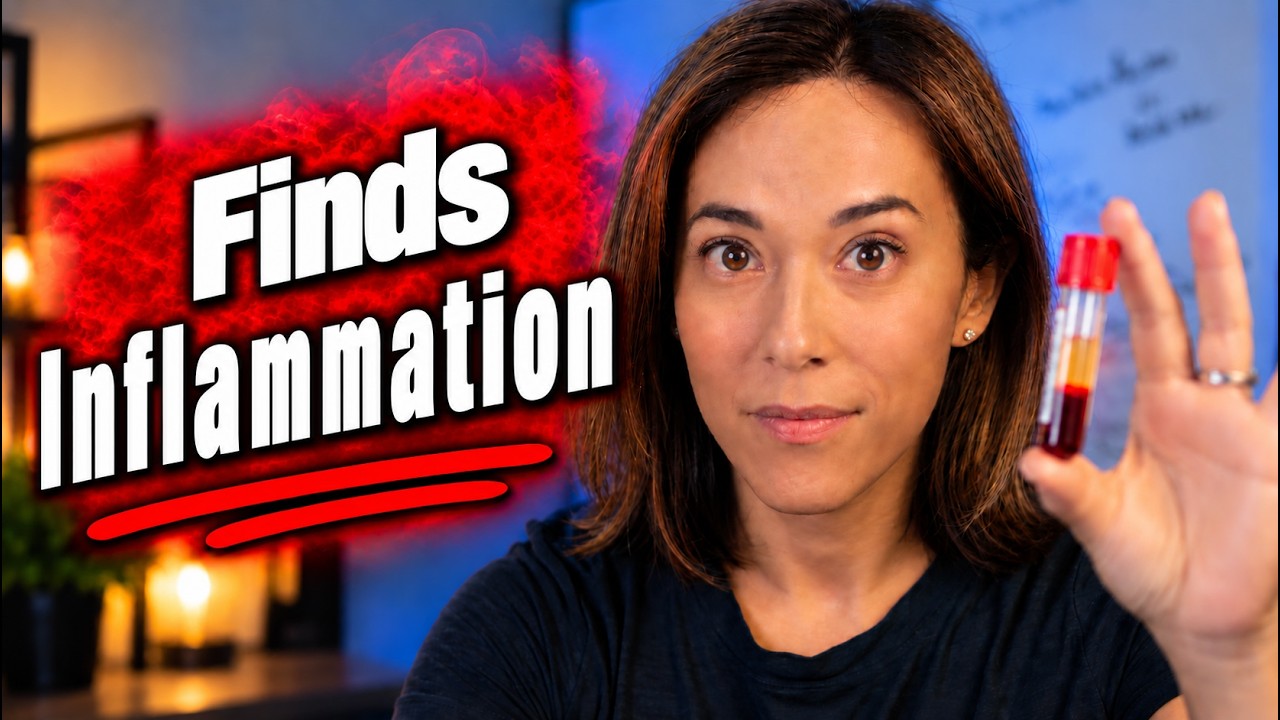
In this video Dr. Ashley Frazee explains the high‑sensitivity C‑reactive protein (hs‑CRP) blood test, positioning it as a "biological smoke detector" for chronic low‑grade inflammation that can precede serious diseases. She contrasts standard CRP with hs‑CRP, describing why the latter is needed to detect tiny protein levels that signal subtle, ongoing inflammation. The video details the molecular transition of pentameric CRP (pCRP) to monomeric CRP (mCRP) in acidic, oxidative microenvironments, and how mCRP triggers localized immune attacks in tissues such as arteries, brain, joints, and visceral fat. Frazee outlines common lifestyle sources of this silent inflammation—poor diet, fragmented sleep, chronic stress, oral health issues, excess visceral fat, and over‑training—explaining the physiological pathways linking each to elevated hs‑CRP. She then interprets hs‑CRP ranges (≤1 mg/L low, 1‑3 mg/L moderate, >3 mg/L concerning, >10 mg/L acute) and discusses guideline positions (ACC/AHA use as a cardiovascular risk enhancer; USPSTF finds insufficient evidence for routine screening). The presenter shares her own result (0.2 mg/L) and reviews evidence‑based strategies that can lower hs‑CRP, including modest visceral fat loss, regular resistance exercise, treatment of gum disease, sleep apnea therapy, and anti‑inflammatory supplements like curcumin and high‑dose omega‑3s. She emphasizes that while the test cannot pinpoint the exact tissue source of inflammation, it can flag the presence of systemic “smoke,” prompting proactive lifestyle or medical interventions. The video includes a brief sponsorship for Knobs fluoride‑free toothpaste tablets and a disclaimer that she is not the viewer’s personal physician.
Chapters
And if I could only order one blood test to tell me something about my long-term risk of dying early, this might be it. Which is weird, because a CRP level doesn't even tell me what's wrong with you. And yet today, the test is popping up on more and more of the blood panels you're being told you should be getting. But you need to understand why. Because unlike what most doctors will tell you, this isn't just about getting ahead of heart disease. When you get your annual blood work, the order is designed to look for specific problems. Blood sugar, cholesterol, anemia, kidney or liver issues. But unlike an hs-CRP, these tests don't always capture silent, everyday friction that might be wearing down your body years before a diagnosis ever shows up. And that's where this test gets fascinating. If I order a CRP level, I'm not looking for specific issues. I'm looking for the smoke that hasn't set off the alarm yet. The burn in the background. And that background burn is where this story gets much bigger than just heart disease. Because we're starting to learn that persistent low-grade inflammation has been associated with some of the biggest things we're trying to avoid as we age. So in this video, we're going to investigate this biological smoke detector, what creates it, what it means, and how to lower it before you catch on fire. And while we're doing all of that, I'm going to find out how much smoke is currently building up inside my own blood. Just a couple of years ago, before I could use AI tools to give me a summary of 40 peer-reviewed papers in 10 seconds, a patient showed me a printout with this exact marker flagged in red. And to be completely honest with you, even with medical school under my belt, I didn't know what it meant. I had to open up PubMed and UpToDate and spend hours tumbling down research and biology rabbit holes. Because I already knew what a standard CRP level was, at least as much as I was taught. It was a marker of inflammation. A high CRP level meant infection, inflammation, or disease. But hs-CRP is not exactly the same thing. And don't get me wrong, CRP and hs-CRP are not the same test, but they are measuring the same protein in your blood. And I'll explain this, but I need to address why most doctors aren't ordering this test in your annual checkups first. When you look up why hs-CRP matters in our medical guidelines, almost everything leads you back to cardiovascular disease. And to be fair, there's a good reason for that. The original research on the test proved that persistent low-grade inflammation signaled by elevated hs-CRP predicted heart attacks and strokes, even in patients with normal cholesterol levels. So the American College of Cardiology and the American Heart Association cholesterol guidelines actually use a persistently elevated hs-CRP level of 2 or higher as a cardiovascular risk enhancer that can influence how aggressively we should lower someone's LDL cholesterol to prevent heart disease. But here's where it gets confusing. The US Preventive Services Task Force, the USPSTF, which is a guiding body that guides us on when to get things like colonoscopies and mammograms and DEXA scans, well, they still say that there's insufficient evidence to recommend adding hs-CRP for routine screening of asymptomatic people. Basically, they're saying don't bother. But the test is still popping up on comprehensive wellness advice and AI deep dives on the tests that you need to be getting, and not just for heart disease. So why is that? Well, it's because of this. Your liver makes CRP, or C-reactive protein, in response to something somewhere causing inflammation. It doesn't just make this protein in response to clogged or inflamed arteries. The exact same signal that lights the match in an artery is what your body uses to signal problems across your entire body, which is how it moves from heart disease decision helper to investigative smoke detector. And next, I want to show you how this works because it's fascinating. But first, I want to thank Knobs for sponsoring this video. Listen, I've been dying to partner with a brand that gets oral health, and this one made me turn my head and have to try it. Knobs makes fluoride-free toothpaste without the paste. These are tablets that you chew. You can also brush after chewing it, and it foams up like regular toothpaste, which my kids think is really fun. The tablets are made of just 13 carefully thought-out ingredients that all have a purpose. They use 5% nano hydroxyapatite that remineralizes your enamel and cleans your teeth without any of the harsh stuff that regular toothpaste has. You can even just chew a tablet in the middle of the day to clean your teeth and freshen your breath. Knobs actually tested their formula in a peer-reviewed study, which I love, and it found that brushing with Knobs tablets was as effective as standard fluoride toothpaste at preventing demineralization. And my husband is a diehard anti-fan of fluoride. So this is the product that he feels most comfortable using with our family. If you want to support your oral microbiome and simplify your routine, click the link in my description and use my code DRASHLEY10 to get 10% off to try it out. Okay. Remember when I said a standard CRP test is not the same as an hs-CRP test? Well, that's true. It's just a matter of the way the lab tests The blood. One test is designed to measure CRP across the higher ranges we see with more obvious inflammation, while the high sensitivity tests can accurately measure much smaller amounts. So why did we need to develop an entire new test just to detect tiny amounts of this protein floating around in our blood? Standard CRP tests were built for acute, high-volume inflammation like infections or major tissue damage. Usually measuring above 3 to 10 milligrams per liter. But the everyday low-grade inflammation that comes from things like sleep deprivation, visceral fat accumulation, or even oral health inflammation produces tiny chronic elevations, usually under 3 milligrams per liter, that fly completely under the radar of standard tests. You need high sensitivity because you're measuring a slow burn, not an active fire. So let me show you how this works because it's actually pretty cool. Normally, your liver produces this beautiful 5-sided protein called pentameric CRP or pCRP. And you can think of this as like a biological cleanup tag. It has a simple job of patrolling your bloodstream to spot dead or dying cells. And when it sees these, it locks onto them, tagging them for your immune system to come and swallow them up. It's calm, harmless, and essential until the environment changes. So whenever a tissue gets overworked, starved of oxygen, or inflamed, whether from infection, disease, poor lifestyle habits, chronic stress, or even an intense workout, 2 things happen: oxidative stress spikes and the local tissue environment turns slightly acidic. And that acidic drop in pH is like a tripwire. The acidity strips the CRP of calcium ions that are needed to hold the 5-sided ring together, and this weakens the protein. And pentameric CRP has a high affinity to damaged cell membranes. Once it finds and binds to a damaged membrane, already weakened, it snaps, and the peaceful 5-ring structure bursts into 5 aggressive single units we call monomeric CRP. Monomeric, or mCRP, is hydrophobic, meaning it doesn't like water. So the moment it breaks into single units, it plunges headfirst deep into the cell membrane to hide from the bloodstream. It lodges itself in there. And what was once a pentameric CRP passive cleanup tag has now transformed into an anchored SOS beacon. beacon, serving as a go switch for your immune system. This process recruits a massive swarm of white blood cells to the location of the MCRP. But these recruited white blood cells don't just quietly clean up the damaged cells. They end up attacking the cell, creating a destructive inflammatory loop. So by permanently lodging into the tissue, MCRP hijacks the body's normal waste disposal system and turns it into a targeted, localized attack of the tissue. Now, the test itself isn't measuring the mCRP. What happens is a destructive loop causes more pCRP to get pumped out of the liver in response, and that's what we're measuring. Now, we have quite a bit of research connecting this process to plaque formation in blood vessels leading to heart disease and strokes, but like I said, this doesn't just happen in your blood vessels. The whole process doesn't just care about blood vessels and cholesterol. It can occur wherever CRP encounters the altered membranes of activated, damaged, or dying cells. And we find it in some of the most fascinating places that I think you'll want to know about. Take the brain. Researchers have actually found mCRP deposited in damaged and inflamed brain tissue, including around blood vessels, neurons, Neurons are high maintenance, making up 2% of your body weight, but consuming 20% of your energy. When you're trapped in chronic stress or you have sleep apnea or ADHD, those neurons run out of energy quickly and they drop in local pH. So the PCRP passing by unloads right inside of your brain tissue, signaling the brain's immune cells to aggressively prune and eat healthy synaptic connections. And this, as you can imagine, can drive things like brain fog and accelerated cognitive decline. Researchers have also found higher levels of mCRP in people with osteoarthritis, with higher levels associated with more advanced arthritis. Inflamed joint fluid creates the exact acidic microenvironment that causes pCRP to come by and shatter. And once MCRP burrows into synovial tissue, it turns mild joint irritation into an active immune attack on cartilage, which is literally how osteoarthritis accelerates. Isn't that interesting? And then there's visceral fat. The thing about visceral fat is that the fat cells can grow so fast that they outgrow their oxygen supply and blood supply, which stresses them out, and they end up recruiting white blood cells and releasing inflammatory signals like IL-6, which travels to the liver and triggers CRP production. It's wild. So now let's zoom out a bit and talk about what causes these problems to occur, because sometimes the answer is infection and disease, but sometimes it's simply an accumulation of ordinary issues. The first thing is food, and this is where I trip up. Just know that the food that we all know is bad for us, like refined seed oils, preservatives, alcohol, and excess sugar can degrade your intestinal mucosal barrier. Your gut lining is just one single layer thick, and when this gets irritated, things like bacterial fragments can leak into the bloodstream, which can quickly set off the CRP cascade. And chronic exposure to damaging substances keeps the cycle on repeat. Then there's poor or fragmented sleep. The mechanism here is fascinating because sleep loss disrupts both your autonomic nervous system and your cortisol rhythm. Normally nighttime sleep quiets sympathetic activity in the nervous system and helps suppress inflammatory signaling. But when sleep is repeatedly fragmented, that break doesn't work as well. Sympathetic activity stays elevated. Inflammatory pathways remain more active. And signals like IL-6 can rise and tell the liver to make more CRP. And cortisol makes this even stranger. Cortisol is supposed to suppress inflammation, but chronic sleep disruption can keep the HPA axis activated at the wrong times while immune cells become less responsive to cortisol's anti-inflammatory signals. So you can have more stress hormone signaling and less effective inflammatory And don't even get me started about chronic stress. This overlaps with sleep because cortisol is normally one of your immune system's brakes. And when you encounter a threat, your sympathetic nervous system and HPA axis, which releases cortisol, turns on. So cortisol rises, and initially cortisol helps keep the inflammatory response under control. But when stress becomes chronic, your immune cells can become less sensitive. Sensitive to cortisol's anti-inflammatory signal, something called glucocorticoid resistance. So now your body keeps sending out the stress signal while becoming worse at hearing the signal that's supposed to shut down inflammation. It's like if you've got your foot on the gas and the brakes at the same time, but eventually the brakes stop working. And that can leave you with persistent low-grade inflammatory signaling that ultimately reaches your liver. And this is something we tend to forget about. Hidden oral infections ties to our toothpaste friends. You can do everything right, but if you skip oral hygiene, you can still have little pockets of chronic inflammation sitting around teeth or underneath your gums. So periodontal disease creates this constant interaction between oral bacteria and your immune system, and even everyday things like chewing or brushing can allow bacterial products to enter the circulation when the gums are inflamed. And then there's heavy lifting and unrecovered muscle damage. I'm going to throw this one out there because this is the one that I suspected might get me in trouble. I have a problem where I use exercise as a stress reliever, and sometimes I just don't like resting, so I'm pretty sore all the time. But every time you do a hard workout, especially like heavy eccentric exercise, you're creating microscopic muscle damage, and your immune system sends new Neutrophils and other immune cells into that tissue, and inflammatory signals like IL-6 rise as part of the repair process. I mean, exercise doesn't necessarily create problems. It's just when you overdo it and don't give your body the chance to rest and recover is when you run into problems. All right, so I got my results back and I'll pull them up for you. I'll show them on the screen for you right here. Look at that, 0.2. Well, I guess I'm fine continuing my ways. But now let's talk about the ranges that you might see if you get this test. Under 1 to 3 milligrams per liter is typically a green zone. That's a very low level of circulating CRP, and assuming you're pretty healthy and not worried about something specific, it suggests that there's not much inflammation showing up in your bloodstream at that moment. Over 3 milligrams per liter is where you need to pay attention. It doesn't always mean disease, but there may be some background friction worth investigating in your body. Poor sleep, visceral fat, stress, oral inflammation, bad diet, or undetected heart or vascular disease, or even something else nudging inflammatory signaling upward is worth talking to your doctor about. Anything over 10, well, that's a value that's much more likely to reflect an acute inflammatory event. Different than the smoldering smoke that we're trying to measure. So if that's you, take that to your doctor and make sure something big isn't going on. Oh, and if I haven't told you already, I am a doctor on YouTube, and in no way am I your doctor. So please talk to your own before making any decisions. So let's just say that my number came back at 5.6 or something like that. I've seen it many times, and I can say things like get your diet right and start exercising, but It helps to know what evidence we actually have on things that can reduce the number. Because sometimes in a regular doctor visit, you might just get handed a statin and not understand why. Or on an algorithm or a telehealth app, you get told to take a handful of supplements. But we actually do have several studies and clinical trials to show that lowering hs-CRP isn't just guesswork. It responds directly to removing the underlying friction. So we've got studies showing that losing just 5 to 10% of your visceral fat can significantly reduce IL-6 stimulation from the liver, leading to a direct drop in circulating hs-CRP. We've got studies showing that regular exercise and resistance training drives systemic anti-inflammatory adaptation, which also drops hs-CRP up to 30%. We even have studies showing treatment of gum disease and periodontal disease reducing hs-CRP by up to a full point, and that treating sleep apnea can lower it. And we even have some studies showing that if necessary, anti-inflammatory supplements can lower hs-CRP. And these are things like curcumin or high-dose omega-3s. So if you do get this test and your level is high, don't panic. Talk to your doctor, come up with a strategy, and watch it go down. I've seen levels as high as 9 drop over time to less than 4 in just 6 months with targeted interventions. So after all of that, even if my hs-CRP level was high, the test wasn't going to tell me whether I have inflammation in my arteries, my brain, my gums, or my muscles. The test can't tell you where the fire is, but it can tell you whether there's smoke. And that's why I find this test so valuable. Healthcare is getting better at being more proactive, finding issues before they're bigger issues, which I think we can all agree is worth getting on board with. I'm Dr. Ashley Frazee. If you like this video, please hit like for me and subscribe to my channel, and I hope you have the best day.