In this video Dr. Ashley Frazee explores the rapid rise of peptide use among the general public, describing how short chains of amino acids—peptides—have moved from a niche bio‑hacker subculture to a mainstream wellness obsession. She begins with a personal anecdote about trying CJC‑1295, noting the immediate physiological sensations and subsequent strength gains that sparked her curiosity. Frazee then outlines the main categories of popular peptides and the four primary benefits they promise: enhanced physical recovery, improved sleep, muscle gain, and fat loss, largely through stimulating the pituitary to release more growth hormone (e.g., Sermorelin, CJC‑1295, Tesamorelin). She explains the mechanisms of GHK‑Copper for collagen remodeling and skin health, and BPC‑157 for accelerated tissue repair, emphasizing that most supporting data come from animal or cellular studies, with limited human trials. The video highlights the tension between enthusiastic real‑world user stories—pain relief, gut healing, chronic fatigue improvement—and the medical community’s caution due to insufficient long‑term safety data and potential cancer risks. Frazee details the gray‑market ecosystem where peptides are sold as “research‑only” chemicals, the prevalence of counterfeit certificates of analysis, and the lack of regulatory oversight. She discusses ongoing FDA debates about allowing custom‑compounded peptide prescriptions, the role of telehealth companies, and the high cost and time required for formal drug approval. Throughout, she underscores a broader societal demand for therapies that deliver repair, recovery, and vitality beyond what conventional medicine currently offers, driving a “peptide revolution.” The video concludes with a sponsor plug for Superpower blood‑testing services, an invitation to her paid peptide education course, and a call for viewers to like, subscribe, and stay informed.
Something very strange is happening in medicine right now.
Peptides.
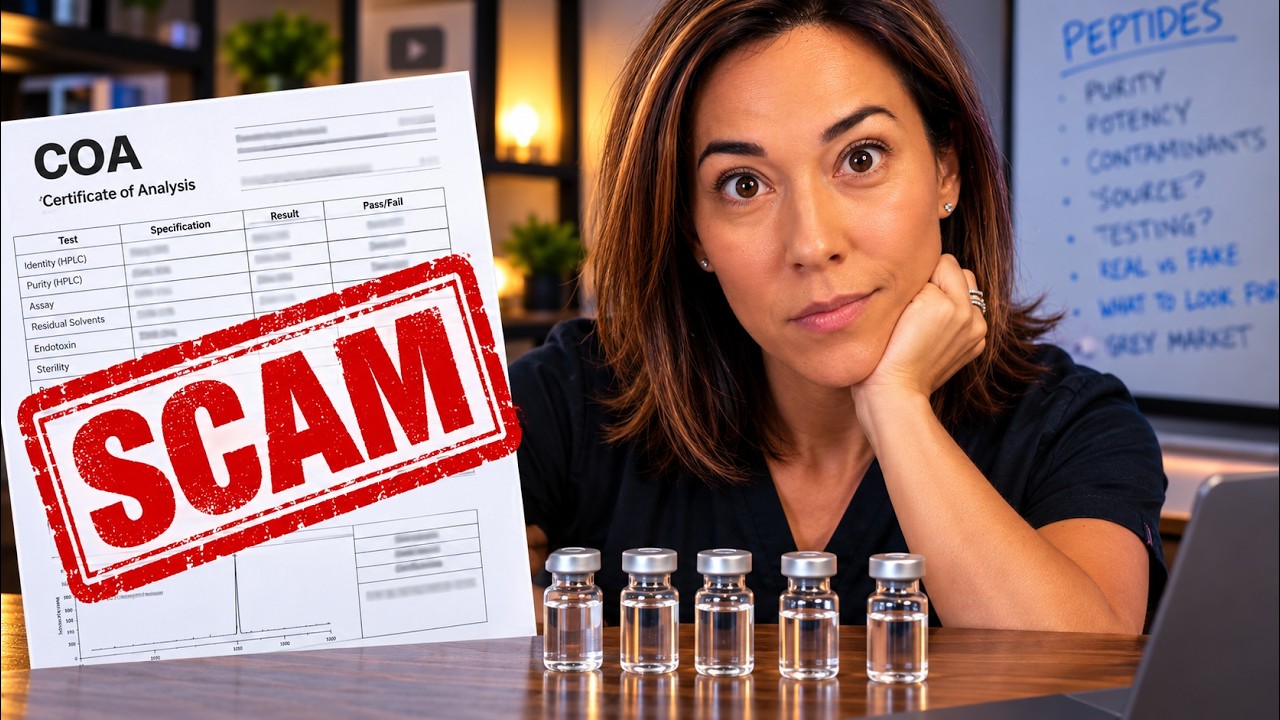
Millions of people are experimenting on themselves with compounds their doctors often won't prescribe. And despite medicine trying to kill the movement, it's becoming mainstream. An obsession. It's about peptides. Short biological messages made of amino acids. Tiny instructions capable of telling your cells what to do. But why are people so obsessed with them? Because if you ask your regular doctor about them, you might get an eye roll or a warning that these are unregulated and dangerous. So today, let's investigate how peptides have escaped the underground bro culture to become a massive universal wellness obsession. What is it about these little things that's got people so excited? Well, let me tell you about my own personal journey learning about peptides. See, when I first started hearing about peptides, the general consensus was that people like bodybuilders and fitness enthusiasts use them for gaining strength and muscle mass. And it just so happens that I'm part of a community of CrossFitters. Many of my own friends and patients come from my gym. So naturally, people started coming to me asking questions about peptides, and this made me curious. So I bought some vials off of Peptide Sciences and tried some CJC-1295. And what felt like 10 seconds went by, and then I felt like I had taken like 3 shots of vodka at a bar. My face was flushed, my head felt fuzzy, and I didn't know if I should sit down. And then, even with very inconsistent use of the peptide, I started getting stronger. And that's how I got more curious on peptides. But I ran into a major problem. Peptides weren't prescribable at the time that I was experimenting with them. And I was embarrassed because I was dabbling in what felt like dark medicine. So here's where I faced the same issue that would eventually become a nationwide cultural tension. Peptides weren't prescribable, but they were changing lives, and they didn't seem to have a lot of downsides. At least compared to some of the medications that I've been taught to prescribe to people. Which leads us to where we are now, in the midst of a peptide revolution. Peptides haven't exploded because of marketing algorithms or biohacker fads. They've exploded because people discovered that there are peptides capable of unlocking longevity, better sleep, improved body composition, brain function, and healing. I mean, who doesn't want all of that? And once people believed that these compounds were actually delivering results, and not just for young, fit bodybuilders, but for anyone struggling to feel better, well, that's when the movement took off. And like I mentioned, not too long ago, modern medicine refused to acknowledge peptides as safe. They kind of still do, and there are reasons for that, but that hasn't stopped millions of people from trying them anyway. So after trying some more peptides and studying them myself, started to know just enough to be dangerous, and I started studying them more and more and more. And eventually I was hooked on the possibilities and also on what I had seen people get out of them, all while peptides are being heavily scrutinized by the medical community for not having enough human data. So let me share with you some of what I've learned, because the science behind it all can be pretty incredible. And what I'm about to share with you is some of the scientific backbone to why millions of people buy risky internet injectables. There are There are so many peptides that I could share the science on with you. But for the sake of our time, I'll just demonstrate some of the more popular ones. We have a group of very popular peptides that people take for mainly 4 reasons that all tie together: physical recovery, improved sleep, muscle gain, and fat loss, or basically improved body composition. These are the peptides that tell your pituitary, the little gland that lives at the base of your brain, to release more growth hormone. These are peptides like Sermorelin, CJC-1295, and Tesamorelin. Structurally, they look like and mimic a hormone called growth hormone-releasing hormone, which basically walks up to the pituitary and tells it to be a little louder with growth hormone. They tell it to crank up the music so it releases more growth hormone than it already would have. Nothing supra-physiologic, it's just that the pituitary seems to get tired the older we get. And these peptides give it a little nudge to wake up. The result is improved deep sleep, increased natural pulses of growth hormone from the pituitary, and increased levels of a hormone called IGF-1 from the liver. Deep sleep improves energy levels, brain function, and gives your body that shutdown period that allows us to recover while we sleep. And the IGF-1 helps our body actually improve body composition. We also have a peptide that improves collagen remodeling and influences our DNA, which translates into plumper skin. Healthier hair follicles, downregulation of inflammatory signals, and DNA repair. It's called GHK-Copper. We naturally have this peptide in our bloodstream. It's just that by the time we're 60, we have less than half the amount we did in our 20s, which contributes to poorer healing and several physical signs of aging. Part of the reason we have less circulating GHK-Copper as we get older is that GHK, The 3-amino acid peptide backbone of the complex is harder to access. Enzymes, which are like chemical scissors, are supposed to come along and snip up collagen that needs to be remodeled, releasing GHK into circulation as a result. But our collagen gets thicker and stickier over time, and the enzymes have trouble doing their job. It's like when you try to cut through a thicker, stickier stack of paper, like a magazine. But when GHK is released, it binds tightly to copper ions, forming the GHK-copper complex that can then deliver copper where it's needed. It can also direct healthy collagen remodeling and dial up reparative genes. So the thought is that by supplementing with the peptide complex GHK-Copper, we give our bodies more of what it needs to do all of this rebuilding and influencing. We also have a group of peptides that improve healing, or so at least we think, because most of the good research we have on these peptides is based on animal studies. But if they do what we think they do, well, here's what happens. Imagine having an injury like a torn tendon, and for some reason the injury just won't heal. What if all it needs is more help from the body to heal? For example, if you crash your car on a back road that's hard to get to and help is 50 miles away, that's rough. But if you send up a flare or your car has that nice SOS button that can alert somebody that you need help, They come a little faster, and they can even bring construction crews to clear out better paths to get to you. Well, that's kind of what we think the healing peptide BPC-157 does. We believe that it has the ability to upregulate growth factor receptors and stimulate nitric oxide synthesis, effectively making injured tissue more receptive to repair signals that the body is already capable of sending. That's why we think the studies we have on animals have shown accelerated healing in tendons, ligaments, organs, and the gut lining. But here's the reality you have to know, and what brings us to the issue on peptide use. Like I said, the majority of the documented healing data for BPC-157 comes from animal and cellular studies alone. Well-done human studies are much harder to come by. And yet tens of thousands of people with joint pain and other issues swear the peptide completely resolved injuries that years of standard treatments couldn't touch. And this is where the peptide story Splits in 2. This video is sponsored by Superpower. If you're looking to get a comprehensive picture of your health through blood work, but your doctor's office maybe doesn't offer it, or the price is too high, well, the Superpower membership gets you blood work that measures more than 150 blood markers from one blood draw. And you don't have to go to a lab. They actually send the phlebotomist to you. It takes just 15 minutes in your house, and 5 to 10 days later, you get a full panel showing your blood counts, your liver and kidney function, cholesterol, heart markers, blood sugar, thyroid, iron, sex hormones, vitamin D, inflammation, and more. And you don't just get one blood draw, you get 2— a baseline test now and a retest later— so you can see that if something that you're trying changed things. I tried Superpower and I was actually pretty impressed. The thing I like about Superpower is that it uses all of your results along with your goals, health history, and lifestyle to build an action plan for you. You also have access to an on-demand care team when you need help understanding what could come next. If you want a much broader view of what's happening inside of your body, I'll put the link to Superpower below. See, the real reason people are obsessed about peptides is because real-world human use and accounts have completely outpaced institutional science, and the stories are just incredible. I'm talking about people who spent years dealing with pain, people told their only option left was surgery or just dealing with the pain. Who after just weeks of using peptides were then pain-free. Or people who report that taking oral BPC-157 or a peptide called KPV completely fixed their gut issues. People with chronic fatigue magically finding their energy again. And again, I'm not making any claims here. These are just stories that you can find all over the place. I mean, honestly, I don't even have to tell you more. I have a feeling people will put their experiences in the comments of this video. Good and bad. And I won't ignore that there are bad experiences and side effects with most peptides. But, and this is a big but, some of the reason we have a lot of negative experiences with peptides might not be coming from the peptide use itself. There's a whole world of underground peptide sales that I need to address in this video because it's driven where we're going with peptides next. Let's talk about the gray market. When peptides started booming, most regular doctors didn't have access to them. Or training on them. But that didn't stop people. We all just turned to online peptide sellers using not for human consumption stickers to sell peptides as research use only chemicals, which comes with a lot of risk. I mean, sadly, there's no regulation over gray market peptides. And just when you think you can trust a company, they go out of business, or the CEO goes to jail for being shady, like for faking certificates of analysis. Which are supposed to tell you that you can believe that what's supposed to be in this vial actually is. And sadly, there's been a lot of scams with this, like a lot more than you would probably want to believe. So I think naturally we're all asking ourselves, why don't we just study these peptides properly and get them FDA approved, or at least dispel the claims that they do more than can be proven? Well, that sounds easy, but it's really not. The way we currently get new drugs onto the market is very, very expensive, and it takes a really long time. Like years. And sometimes clinical trials fail. And most of the time when something gets FDA approved and branded as a drug, the price is just astronomical. Imagine waiting for all 30 of the popular peptides to go through this process. So all of this is why we're currently having heated discussions in FDA meeting rooms to try and bring peptides back into the hands of prescribers as custom-made compounded medications for people to use. And the people involved are a mix of doctors and patients passionate about the benefits of peptides. There are telehealth enterprises saying that they're passionate as well, but also conveniently poised to make a lot of money when peptides are prescribable. And there are those who are skeptical and not ready for the FDA to approve things that haven't been put through clinical trials. And truthfully, there are a lot of unknowns about long-term risks using most peptides. When you stimulate growth factors like with BPC-157, or you pulse cellular proliferation signals like with the growth hormone peptides, we don't know what happens if someone has an undiagnosed cancer, for example. We don't have 20-year retrospective studies yet to answer that. These are legitimate criticisms. Modern medicine isn't necessarily wrong to urge caution around it. But given all of this, people are still really passionate about peptides. The bottom line is that the pressure is too immense to ignore because the sheer volume of public demand and the risks involved with letting people continue to buy peptides from shady internet sites has broken through the dam. And for the first time in our nation's history, we might see the FDA cave on allowing unproven molecules to become prescribable medications just based on animal studies and millions of real-world stories of people seeing improvements. Like lives being changed. And I'm not saying that peptide obsession is proof that every peptide works and is undeniably safe. What it is proving is that people are desperate for medicine that promises something beyond what we're already providing. We want repair, recovery, better sleep, more energy, more capable years inside of our own bodies. And when conventional medicine has no satisfying answer, people don't patiently wait. They experiment. And that is the peptide revolution. Not a handful of miraculous molecules, but a massive collision between human desperation, biologic possibility, and a medical system that just hasn't kept pace. I've been on a mission not only to learn as much as I can myself, but to then translate it and help people understand how our own biology works, how it can be influenced, and how that applies to life as we know it. The more we know, The less guessing we have to do, and that's powerful. If you also have a need or desire to learn as much about the research on peptides and how they can apply to human biology, especially if you're a prescriber needing to figure out the world of peptides, I have a full course for that where I break everything down and share it in a helpful way. And I'll link that in the description for you. I'm Dr. Ashley Frazee. If you like this video, please hit like for me and subscribe to my channel. In the meantime, I'll be working on making these videos better for you. And I hope you have the best day.