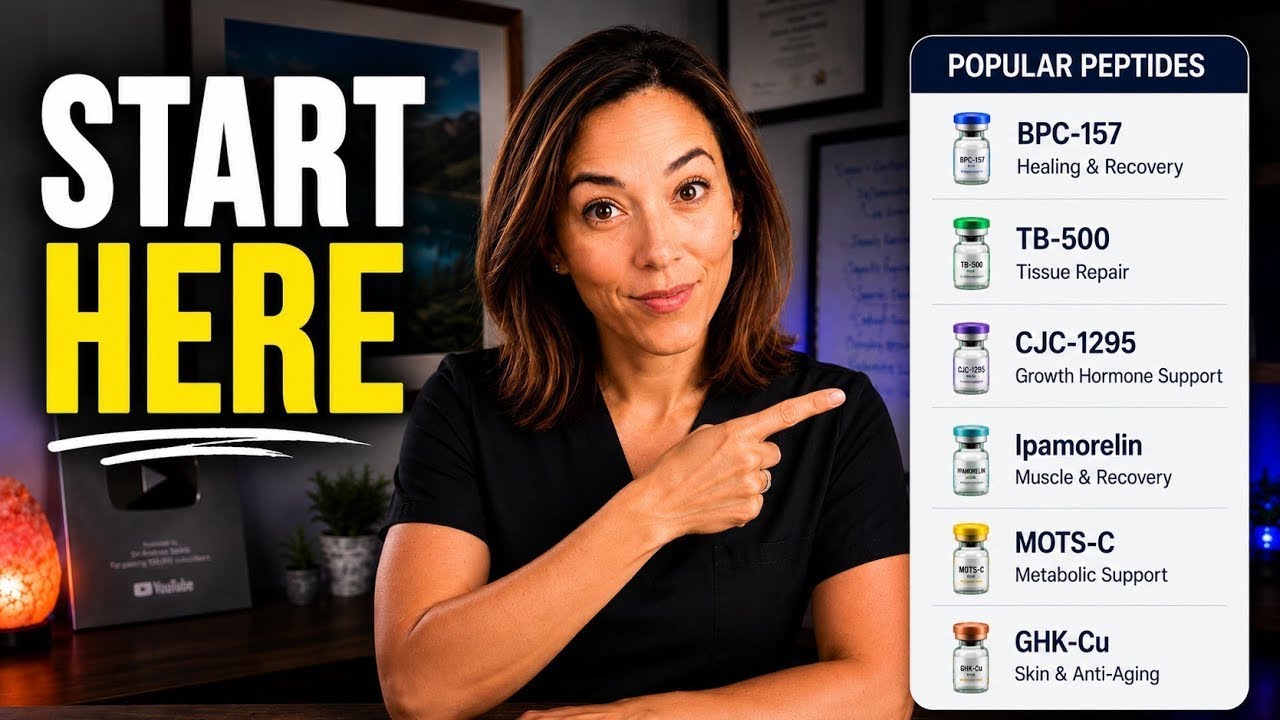
In this seven‑minute educational video Dr. Ashley Frazee gives a rapid, clinician‑level primer on peptide therapeutics for a lay audience. She begins by warning that most peptides are sold as research chemicals and stresses the importance of informed, safety‑first use, offering a deeper paid course for those who want more detail. After a brief 60‑second refresher on cellular biology, DNA, mitochondria, and the endocrine systems that coordinate growth, stress, and metabolism, she categorizes peptides by the primary physiological goal they address. For inflammation she highlights GHK‑Cu, KPV, and thymosin α‑1; for injury repair she explains BPC‑157 and TB‑500; for mitochondrial energy she covers SS31 and MOTS‑c. She then moves to growth‑hormone signaling (sermorelin, CJC‑1295, ipamorelin, tesamorelin, IGF‑1 LR3) and to metabolic/weight‑loss agents (semaglutide, tirzepatide, retatrutide, AOD‑9604, tesamorelin). Cognitive and focus enhancers (Semax, dihexa) are discussed, followed by anxiolytic‑type peptides (Selinc) and sleep/circadian regulators (Epithelin, Pinealon, delta‑sleep‑inducing peptide). Throughout she notes safety concerns, the predominance of animal/cellular data, and the need for clinical guidance. The video ends with a call to action to like, subscribe, and explore her full Peptide Mastery course.
Chapters
So I was giving my staff a peptide crash course the other day, and I realized you might want one too, especially right now because there's all this talk about certain peptides becoming more accessible again through compounding pharmacies. But here's the problem: most people now are getting peptides from websites selling them as research chemicals not intended for human use. And knowing that people were doing this, as a doctor, I had to make a decision. If you're going to be using peptides with or without medical guidance, I'd rather you feel comfortable talking about it. I'd rather be a resource, not a barrier. So I've taken the time to really understand peptides, like a lot. And honestly, the more I've learned, the more excited and fascinated I've become. I've actually put everything I know into a full guide on peptide mastery for people who want to go deeper, and I'll link that in the description. But in this video, I just want to simplify things because you can't just walk up to your doctor or your friend in the gym or the guy that looks all muscly and just say, What peptides should I be taking? It's best to have some goals in mind because there's dozens of peptides. But once you know what you're aiming for, the tools are there for you. Now, before we talk peptides, we need about 60 seconds of biology. Nothing crazy, but here we go. Your body is made up of billions of cells, and inside those cells is your DNA, which holds your genes, your instructions, and also your mitochondria. These produce all of your energy, and how well your mitochondria work can literally determine how you feel. Your energy, your focus, your recovery. But over time, with stress, inflammation, poor sleep, things stop working as well. Signals don't land the same, and your energy drops. Now let's zoom out a little. You have systems in your body that coordinate everything. Your pituitary gland lives at the base of your brain, and you can think of that like a project manager. It signals growth hormone, which tells your body to repair, recover, and rebuild. It guides your reproductive system, which can get suppressed when stress is too high. And speaking of— your adrenal system. This senses stress and pumps out things like cortisol. And then come in things like chronic inflammation and insulin resistance. These are a big deal. They can mess with things and act like shrapnel in your system, damaging the receptors that your cells use to hear signals. So your body might be doing everything right, sending out the right signals, But your cells just aren't listening. All right, enough physiology and anatomy. Let's talk peptides. Well, speaking of inflammation, let's start with that. These are some of the most talked about peptides: GHK copper, KPV, thymosin alpha-1, all studied for calming inflammatory pathways. GHK copper is way more interesting than that, and I'm sure you know that, but I'll make another video on it. And then of course there's BPC-157 and TB-500. Probably the most well-known for injury recovery. BPC-157 is a stable gastric peptide fragment that helps tissues become more sensitive to your natural repair signals. And then TB-500 can act kind of like a GPS to help cells crawl or migrate to the site of an injury. There are supplements that contain BPC and KPV orally like this one, and I'll put a link in the description if you want that one specifically. But what if the issue isn't just inflammation? What if it's energy? Well, that's where mitochondrial peptides come in. SS31 and MOTS-c. Well, these are studied for how they can improve mitochondrial function and the biogenesis of making more mitochondria, ones that work better than your tired old frayed ones. Now let's say your energy and your mitochondria are fine, but you're not progressing physically. Well, this is where growth hormone signaling can come in. Sermorelin, CJC-1295, ipamorelin, tesamorelin— these signal to the body to pump out more growth hormone for recovery. And then there's IGF-LR3, which is a synthetic version of the hormone IGF-1. And IGF-1 is the actual hormone that does most of the recovery that growth hormone takes all the glory for. But maybe your goal isn't growth and recovery, maybe it's fat loss. That's where semaglutide and tirzepatide come in. Originally for diabetes and weight loss, but we're seeing far more benefits out of those peptides than just for those things. People's lives have improved dramatically with those peptides. And coming out of the woodworks is retatrutide, a new and improved version of the GLP agonists, which effectively blunts the appetite, improves fat burning, and improves your metabolic rate while you lose weight, which was unheard of until now. And then there's AOD-9604. The peptide fragment of growth hormone that mobilizes fatty acids for fuel. And don't forget about Tessa Morelin, our growth hormone friend that's been proven to reduce visceral fat, the kind that's really inflammatory and can actually increase your risk of mortality or death. And then there's peptides for focus like Semax, proven to improve focus and alertness by increasing brain-derived neurotrophic factor, something your brain uses to improve plasticity and make new neural connections for learning. There's also dihexa, an oral peptide that's been shown to be up to 10 million times more potent than actual brain-derived neurotrophic factor. Fascinating, right? And just a note here, there are safety concerns with dihexa, so don't rush out to buy it. And there are safety concerns with all of the peptides, and I think that's my job to know and explain to you. So you can see a lot of that in my more in-depth discussions on peptides. And for overthinkers, those with anxiety, Let's look into Selinc. It's been studied on humans to have been shown to have properties like medications like Xanax and Ativan without the sedating or addictive properties that those meds give people. It's also been shown to modulate overactive cortisol responses. Speaking of, what if you're someone who tends to lie awake at night? Well, there's some interesting peptides that have been researched for sleep. Epithelin and pinealon have been shown to reset circadian rhythms and improve melatonin production. Epithelin has also been shown to lengthen telomeres. It's a big longevity peptide. And delta sleep-inducing peptide shown to improve delta wave sleep, which is associated with deep sleep, the kind where your brain and your body physically recover each night. I know that was a lot, and that really wasn't every peptide, but this is my point. Peptides are fascinating, and they can be biological enhancements. If your system isn't working well and your signals aren't landing the way that they should, They might be something to look into. Now, a lot of what we know about peptides comes from cellular and animal research, not necessarily human, but we've also learned a lot from seeing people using them in the real world. And personally, I wouldn't be this interested in them if I was seeing more harm than benefit. And if you want to go deeper into this, and I mean a lot deeper, I've built a full course called Peptide Mastery where I break these peptides and more down individually and help you actually understand How to think about them, what the research shows— animal, cellular, or human— and why the world of peptides can be so powerful. I'm Dr. Ashley Frazee. I really hope you liked this video. If you did, please hit like for me, subscribe to my channel, and I'll keep making videos to help you feel fascinated and informed. And have the best day.