In this video Dr. Ashley Frazee provides a comprehensive overview of retatrutide, a triple‑agonist peptide (GLP‑1, GIP, and glucagon receptor agonist) that she argues is the most advanced weight‑loss therapy currently in development. She contrasts it with earlier GLP‑1‑only drugs (semaglutide) and the dual GLP‑1/GIP agent tirzepatide, explaining how each molecule’s receptor profile influences appetite suppression, insulin sensitivity, and metabolic rate. Retatrutide’s added glucagon activity is described as a “metabolic cheat code” that drives mitochondrial uncoupling, increased brown‑fat oxygen consumption, and a futile calcium cycle, thereby raising resting energy expenditure even during caloric deficit. Clinical trial data are summarized, showing 20‑25% average weight loss and highlighting that up to 40% of that loss can be lean mass. Safety considerations are detailed: potential muscle loss, modest resting heart‑rate increases (5‑10 bpm), allodynia in ~20% of high‑dose participants, low‑incidence pancreatitis (<0.5%), and gallstone risk from rapid weight loss. Dosing in trials ranged from 2 mg to 12 mg with 4‑week titration steps; the video discusses micro‑dosing concepts and theoretical receptor desensitization. Dr. Frazee also promotes a home‑use body composition scale (Hume Health BodyPod) for tracking lean mass. The video ends with a disclaimer that retatrutide is not yet approved for human use, a call to like and subscribe, and a reminder that acquiring the drug outside clinical trials is not advised.
Chapters
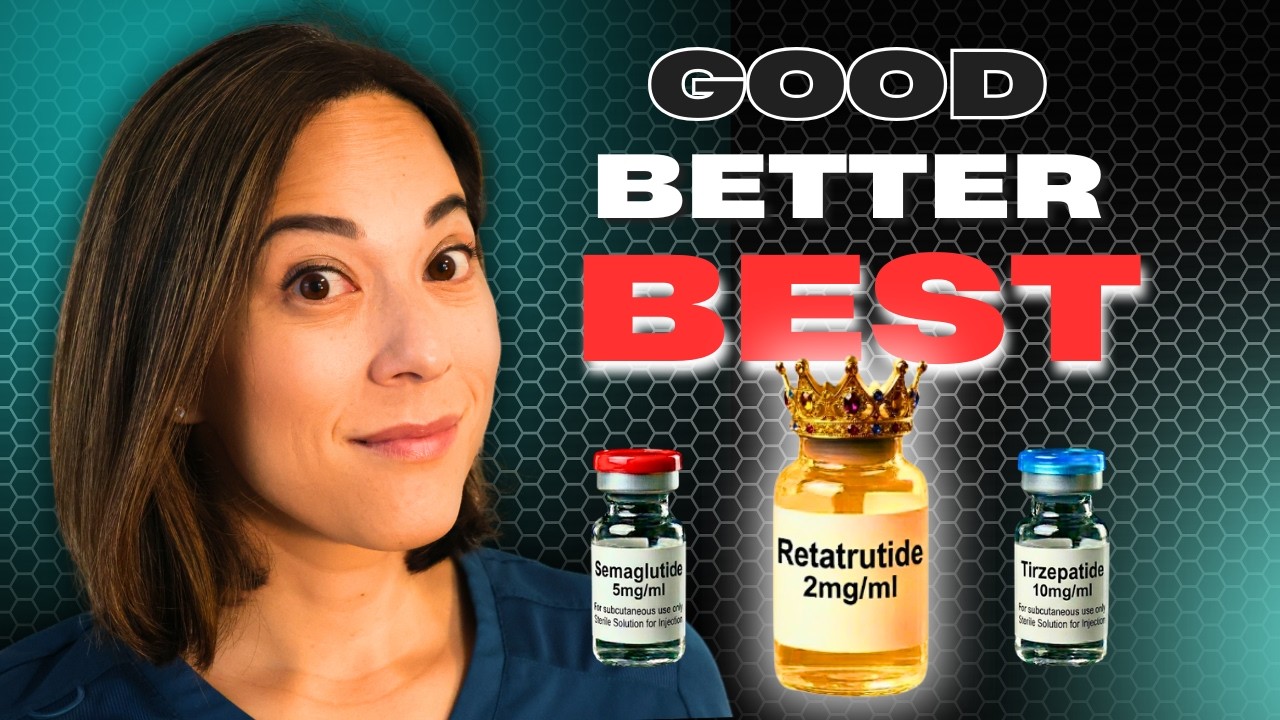
You want the scoop on retatrutide. Why it's everywhere. Why your friend is on it. Where did they get it from? Should you try it? Should you switch from tirzepatide? Can you do just a little and come off of it later? Will you lose muscle if you use it? Well, today I've got all the answers to those questions and more. So there's no room for confusion, no holding back. And just as a quick disclaimer, this is not medical advice from me to you. I am just a doctor on the internet. I am not your doctor. So first, just for clarity's sake, you need to know the difference between the GLP injectables and why retatrutide has become the king. The long and short of it is that we now have good, better, best versions of a weight loss peptide blend that not only blunts your appetite and decreases inflammation and insulin resistance, but now increases your metabolism. It's a trifecta, and the so-called best version is retatrutide. But why? Well, have you ever been told that the more weight you lose, the lower your metabolism will be? Well, not with retatrutide. It effectively boosts your metabolic rate while you lose fat in a caloric deficit. Here's how it works. It's a peptide blend of GLP-1, GIP, and glucagon receptor agonism. In a nutshell, GLP-1 drugs hit GLP-1 receptors all over your body, heavily in the brain and the gut. This dumbs down your appetite and slows down your digestion. Semaglutide is pure GLP-1 receptor agonism, a peptide designed to put the brakes on hunger while constipating you and making you nauseated. Then came tirzepatide, a combination of GLP-1 and GIP agonism— glucose-dependent insulinotropic polypeptide. GIP is complex, but it essentially turns your fat from being stubborn and inflamed into a healthy, accessible fuel. It lowers inflammation in fat, allowing you to become more insulin-sensitive and able to mobilize fatty acids better. So why is tirzepatide so much better than semaglutide? Because there are fewer side effects and more weight loss with that drug. And this is because research suggests that GIP receptors in the brain antagonize or dampen the nausea signals triggered by pure GLP-1 agonism. Essentially, tirzepatide hits that stop eating button while simultaneously pushing a don't throw up button. Tirzepatide is amazing because it has less GLP-1 in it than GIP agonism. See, GIP is doing most of the heavy lifting. Something we don't talk about enough that's really cool is that hitting your GIP receptors with using tirzepatide causes a transient increase in energy expenditure for no good reason at all. We call it a futile calcium cycle, meaning a calcium pump in your cells gets activated and starts moving calcium back and forth across the membranes for no functional reason other than just to consume energy. It's like revving your engine while you're in neutral. It also increases oxygen consumption in brown fat, which also increases your resting metabolic rate. So using tirzepatide, at least for the first few months, increases your metabolism despite a starvation effect due to less calories. GIP receptor agonism also increases blood flow to fat tissue, making it more sensitive and open to breaking down. With GLP-1, we went from 15% average weight loss in the studies to 20 to 25% weight loss in the studies on tirzepatide, or GLP-1 plus GIP. More weight loss Less nausea, and a revved-up metabolism. But let's shake things up even more. Enter retatrutide. The scientist who formulated this drug deserves a prize, and he probably got one. See, we really learned a lot with this GIP to GLP-1 ratio, and retatrutide still leans heavily on GIP receptor agonism, but it adds a glucagon receptor peptide to the mix. You can think of glucagon as like a fat vacuum. In a normal functioning human, glucagon is a fasting hormone. It tells your liver to release sugar when you're hungry, basically to keep you from passing out. But in retatrutide, because it's paired with GLP-1 and GIP pushing insulin and sugar into cells, the glucagon receptor is then tricked or diverted into doing its secondary jobs, which are lipolysis or fat burning and thermogenesis. Basically, it increases your metabolic idle or your resting energy expenditure. And this is cool. Glucagon does this through a process called mitochondrial uncoupling, essentially leaking protons through the electron transport chain, the factory assembly line we use to make ATP or energy. So instead of making ATP, you get energy released purely as heat. The body literally starts wasting calories as heat. And this is basically just a metabolic cheat code. While GLP-1 and GIP are handling hunger and insulin sensitivity, glucagon handles metabolic output. It forces the body to stop being stingy with its own fat stores. See, normally when someone loses weight, they can hit a point of starvation mode where the body starts to fight weight loss, lowering your metabolism in order to match the lower caloric intake. But if you have a glucagon signal, you prevent the metabolic adaptation that usually stalls weight loss. It tricks the body into thinking it's in a high state of energy demand and it commands the body to waste energy. It's kind of one of the coolest and safest exercise-in-a-bottle versions we've ever seen. Obviously it can't replace actual exercise. But speaking of safety, in a controlled clinical setting, it's been proven to be safe, but safe doesn't mean side effect free. And because I know people are getting their hands on this stuff, even though it's not approved for human use yet and just using it however they please, Let me just go over what's been noted so far as side effects. So the catches with retatrutide come down to 3 areas. Number one, muscle loss. What we've seen in the clinical trials so far is that up to 40% of weight lost on these GLP agonist peptide blends can be lean mass or muscle. 40%. That is 40% of your metabolic capacity. And if you're like me and you care about muscle sticking around, and I know you do, eat a minimum of 1 gram per pound of lean body mass that you have in protein. Track your muscle mass and let it be a driver of your weight loss. Losing weight fast is cool and all, but if you lose 100 pounds and 40 of it is muscle tissue, are you gonna feel good about that? So here's where I'm gonna plug a product for you guys. I'm a massive muscle nerd because how much muscle you have is directly tied to how long you'll live, barring any freak accidents. So I wanted to see if I could find a product that you could use at home to track your muscle mass. So about 3 weeks ago, I went and did a full DEXA scan and my results showed that I have 20% body fat and 96 pounds of lean tissue. I was actually pretty proud of it. And then I got a Hume Health BodyPod scale. It's like an InBody scale that you can do from home. It took about 5 days for the measurements to learn my body, but the Hume BodyPod literally shows me at 20% body fat and 96 pounds of lean tissue. I kid you not. It is the same as the DEXA scan. So I got Hume Health to sponsor this video. Thank you, Hume Health. And I got a discount code for you to use. You can click on the link in my description if you want to track your muscle and fat mass from home, especially if you're on a fat loss or muscle gaining journey. And you can use an HSA or FSA for Hume BodyPod if you want. Be patient with fat loss. It is not worth the muscle loss, but you don't have to do it blind either. Other things you need to be aware of should you try retatrutide, when it's approved for human use, of course, heart rate. There's a natural pacemaker in your heart that has glucagon receptors on it. And so research is showing an increase of 5 to 10 beats per minute in resting heart rates. Now that could be meaningful for someone with any sort of risk of arrhythmia or tachycardia. Allodynia. About 20% of the participants in the studies on high doses, meaning 12 milligrams of retatrutide, reported a side effect of allodynia where their skin felt like it had been sunburned. It's likely due to sensory neuron sensitization. There are glucagon receptors on sensory neurons, and the theory is that overloading these can cause a lowered threshold for firing sensory neurons. It may be only a temporary thing, however, meaning that it goes away with slow titration of dosing. And just like with semaglutide and tirzepatide, the risk for pancreatitis Still exists, but in the clinical trials, the incidence was less than 0.5%. And gallstones— the thing with gallbladder issues is that rapid weight loss is one of the top, if not the top, trigger for gallstones. So beware of that. Now again, a lot of people are getting their hands on retatrutide. Please don't ask me how to do that. I'm not really allowed to say that on YouTube, but I still see a ton of questions around dosing and microdosing GLPs. For retatrutide, in the trials, the doses were 2 milligrams, 4 milligrams, 6, 9, and 12 milligrams spaced out in 4-week intervals, meaning you have to be on one dose for 4 weeks before you can increase. And so you can suppose that that's what's going to be the recommended dosing. But microdosing, I think people are doing this to level out peaks of the medication in their system, meaning if you get really nauseous, if you take a GLP, maybe you could microdose it more frequently throughout the week. Sounds solid to me. But I will say there's a theoretical risk of receptor desensitization because incretin receptors like GLP-1 and GIP are meant to be pulsed by food naturally. Some scientists would argue that the dip at the end of a 7-day cycle is actually a good thing. It might allow your receptors a brief period of breathing room to recycle back to the cell surface. By microdosing and keeping those receptors under 24/7 high-level tension, you might actually accelerate tolerance, meaning you'd need higher and higher doses sooner to get the same effect. I don't know. This is not fact. It's just a theory I have. But the life cycle of these receptors does prove that you can go on one of these GLP peptide mixes for a certain period of time and then come off of them. It's just that if your metabolism is shot at the end of it, you're gonna gain weight pretty quickly. A big question a lot of people still have is, why can't I get this? And the answer is that retatrutide is still in clinical trials. And why people have it anyway? Well, they're not supposed to. Everyone's using peptides that are meant for research purposes only. It is what it is. Retatrutide will be approved for human use soon. We don't know when exactly, but it's happening. I hope you liked this video. If you did, please hit like for me and subscribe to my channel. I'm Dr. Ashley Frazee. Have the best day.