In this 2026 YouTube video, board‑certified primary‑care physician and peptide specialist Ashley F. provides a detailed, non‑medical‑advice overview of the peptide ipamorelin. She explains that ipamorelin mimics ghrelin to trigger an "emergency" growth‑hormone release, contrasting it with GHRH‑based peptides (CJC‑1295, sermorelin, tesamorelin). She cites human studies showing a robust GH pulse ~40 minutes post‑dose and no apparent pituitary desensitization over 21 days, unlike some GHRH analogues. The video discusses why ipamorelin is often stacked with CJC‑1295: combined activation of ghrelin and GHRH pathways yields a synergistic GH surge (≈5× the effect of either alone). User‑reported outcomes are summarized – the most common benefits are deeper sleep, improved recovery, modest body‑composition changes, and occasional skin/hair improvements; dramatic muscle gains are rare. Safety considerations include potential allergic reactions (more common with GHRH peptides), cancer risk due to GH’s proliferative signaling, transient insulin resistance, and water retention. Dosing guidance stresses fasted administration (avoiding post‑meal somatostatin‑mediated brake) and notes that timing can be tailored (daytime for training, nighttime for natural GH rhythm). The presenter outlines the ideal candidate: middle‑aged or older athletes with sub‑optimal recovery or sleep, not young individuals seeking rapid bulk. A brief sponsorship plug for the Hume BodyPod body‑composition analyzer and a promotion for a "Peptide Mastery" course conclude the video. Throughout, the speaker maintains a conversational, instructional tone, balancing enthusiasm for the peptide’s potential with caution about unapproved status and risks.
Chapters
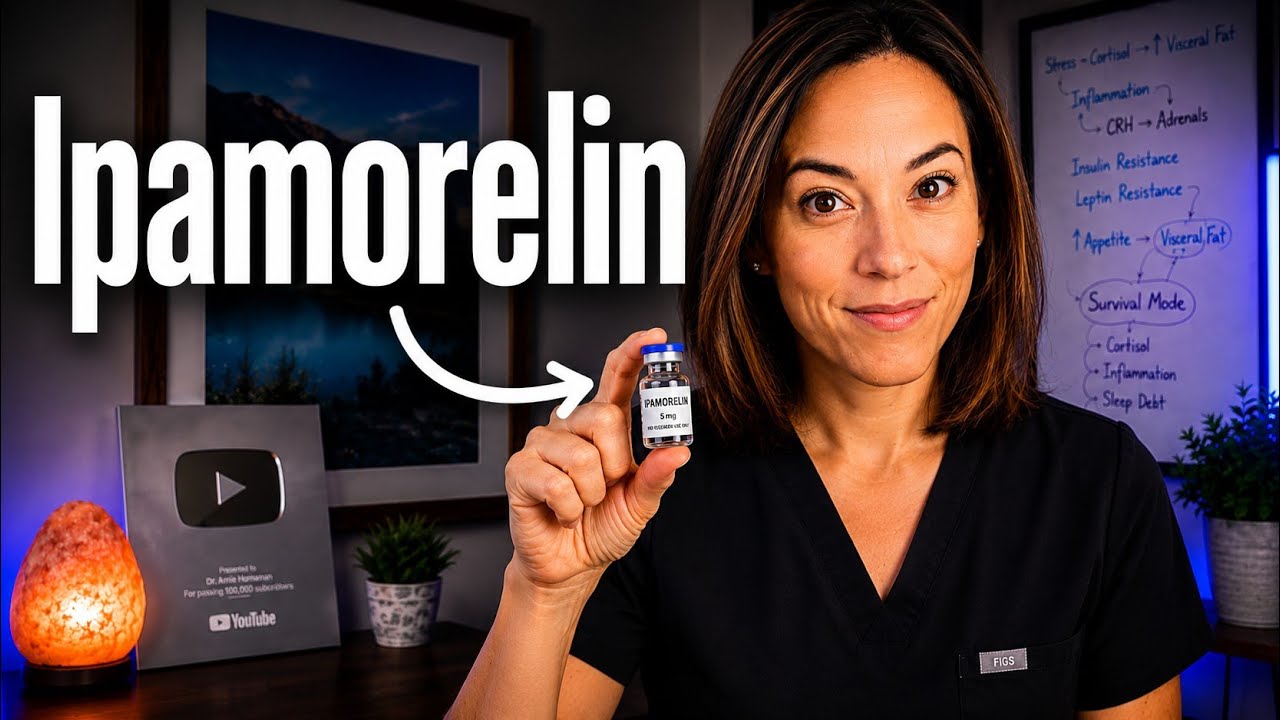
This is the ultimate biohack. It's a peptide that basically tricks your body into releasing growth hormone whenever you want. I'm a board-certified primary care doctor and a peptide expert, and this little muscle-building peptide is so wildly misunderstood that I need to set the record straight. Today we're talking about ipamorelin, what it is and what it actually does, why it's almost always paired with other peptides like What is CJC-1295 and whether it should be, what people actually notice when they take it, what the research says, and whether the hype is justified. And of course, the risks and safety concerns that you need to know. Don't just be injecting yourself with random chemicals you buy off the internet, people. I'm warning you. And just to be clear, I am a doctor on the internet, but I am not your doctor. This video is for me to have fun, for you to learn, and is in no way medical advice. Let's start with what is ipamorelin? Well, ipamorelin is a peptide that tells your pituitary gland to To release more growth hormone. The reason it's popular is because people are using it, despite the fact that it's never been approved for human use, to try to improve sleep quality, recovery, and body composition by encouraging the body to release more of its own growth hormone. Now, that doesn't make it unique. Peptides like Sermorelin, CJC-1295, and Tesamorelin all increase growth hormone too. What makes ipamorelin different is how it sends the signal. The peptides I just mentioned mimic a hormone called growth hormone releasing hormone, or GHRH. That's one of the body's natural ways of stimulating growth hormone release, but ipamorelin takes a completely different approach. Instead, it mimics a hormone called ghrelin. Now, at first glance, that seems kind of strange. Why would your body have 2 completely different hormones that both increase growth hormone? Well, the answer is that they evolved for completely different jobs. Growth hormone releasing hormone is your body's scheduled growth hormone system. It's released in carefully timed pulses throughout the day and especially at night to coordinate growth, repair, recovery, and maintenance. Ghrelin is your body's emergency growth hormone system. It's released when you're hungry, when calories are scarce, when your body thinks resources might be limited. Both systems ultimately increase growth hormone, but they're responding to very different biological situations. Human studies have demonstrated that ipamorelin produces a robust pulse of growth hormone that typically peaks around 40 minutes after it's taken, and it was generally well tolerated in the populations studied. One of the most interesting findings came from a study where ipamorelin was given repeatedly over 21 days, where we learned that the pituitary doesn't appear to become desensitized to the ipamorelin signal. And that's interesting because some of the GHRH-based peptides like sarmorelin and CJC-1295 can become less effective when the pituitary is repeatedly stimulated day The receptors for these peptides can get downregulated with repeated use. And in my opinion, that's why ipamorelin deserves a seat at the table. It's unique in this way. Now let's answer the question that everybody eventually asks. If ipamorelin works, why does everyone stack it with CJC-1295? Well, the answer is actually pretty cool, and it's because these peptides are not doing the same thing. Remember earlier when I told you that your body has 2 completely different systems for releasing growth hormone. One system uses growth hormone-releasing hormone, and the other system uses ghrelin. CJC-1295 works through the growth hormone-releasing hormone pathway, and ipamorelin works through the ghrelin pathway. Different hormones, different receptors, and different signaling pathways, but you get the same end goal. When researchers studied these pathways together, they noticed something fascinating. Individually, both types of peptides do increase growth hormone release, but when they put both In a system at the same time, the resulting growth hormone pulse becomes dramatically larger than either one can do by itself. See, it wasn't a 1+ 1= 2 situation. It was closer to 1+ 1= 5. And I've said this before, but it's like when you squeeze a sponge and a little bit of water comes out. Say that's like the peptide CJC-1295 or Sermorelin. But when you give the sponge a little squeeze and a little bit of water comes out, ipamorelin could technically come up and squeeze it a little harder. And let all the water out. You just get more. And that's why the stack became famous, not because ipamorelin doesn't work by itself or CJC-1295 doesn't work by itself, but because together they appear to create a much larger signal, more bang for your buck. Does that mean that everybody needs to use both? Well, no, but at least now you understand the science behind why the combination is popular. Now let's get to the part that everybody really cares about. What do people actually notice when they take ipamorelin? And let me be clear here, ipamorelin is not currently approved for human use. So here's where I'm stepping outside the world of approved medical indications and into the world of what I know people are actually doing, approved or not. But I do like to report what I know about things. What's interesting is that dramatic muscle building stories are actually pretty rare when people use ipamorelin by itself. The thing that comes up over and over again isn't really muscle gain, it's sleep. People talk about getting better, deeper sleep, more vivid dreams, and waking up feeling like they recovered better. And better sleep is probably single most commonly reported benefit. Another thing people talk about is recovery though. Less soreness, better recovery between workouts, feeling like they can train harder and bounce back faster. And that makes a lot of sense because growth hormone is associated with increased tissue repair and recovery. So that shouldn't surprise you. If somebody is consistent enough with ipamorelin, what they notice is over time their body composition does change, especially if they're putting in the effort in the gym. So fat loss seems a little bit easier, muscle gain seems a little bit better and training feels like it's slightly easier. Nothing dramatic, not like steroid changes, just gradual improvements that accumulate over a couple of months. But it's cool. Now this honestly goes with most of the peptides that increase growth hormone, but they notice changes in skin and hair quality. But the overall theme remains pretty consistent. You know, better sleep, better recovery, and over time, modest improvements in body composition. That's the real story of ipamorelin. Now here's my product plug. If you are actively doing something to change your body composition, I think the most important thing you can do is not just track your weight or cross your fingers and look in the mirror. People get frustrated when weight is the only variable. So here's where I'll tell you about what I personally use, which is the Hume BodyPod Analyzer. It's not a smart scale, it's a body analyzer. It uses 8 frequency sensors to scan your arms, your legs, and your torso with 98% accuracy. And I know because I tested it against other body scanners, including a DEXA scan. Instead of knowing just my weight, I like using my Hume Body Pod because I can see exactly where my fat mass is dropping and where my lean muscle is growing, or the other way around. So I got Hume Health to sponsor this video. Thank you to Hume Health. If you click on the link in my description, it can combine with Hume's current discounts to give you up to 50% off the total price. Plus, you can use an HSA or an FSA for it. So just for clarity's sake, let me say what most people get wrong about ipamorelin. 2 really big myths. And the first myth is you have to pair it with CJC-1295 or sermorelin or tesamorelin for it to work. But I hope from what we just went through, you understand, no, you absolutely do not. And we've already talked about why the combination became so popular. Remember, 1+ 1= 5? Well, when you stimulate both the growth hormone releasing hormone pathway and the ghrelin pathway at the same time, you can get a much larger growth hormone pulse than either pathway produces on its own. But that doesn't mean that ipamorelin suddenly stops working if you don't pair it with something else. In fact, I've seen people use ipamorelin completely differently depending on what they're trying to accomplish. Some people specifically use the ghrelin pathway during the day, particularly around training sessions, because they're trying to take advantage of that physiologic time to mobilize resources signal. Then they reserve the growth hormone-releasing hormone peptides like CJC-1295 or semaglutide for bedtime when it makes more physiologic sense to support the body's normal overnight growth hormone rhythm. The other thing worth mentioning is that I've personally seen some pretty pretty significant allergic reactions to the growth hormone-releasing hormone peptides. And I've seen it with sermorelin, with CJC-1295, and tesamorelin specifically. Not very common, but I've seen these reactions in each of these peptides, and they were severe enough to get my attention, like close to anaphylaxis-level reactions. Interestingly, I've never personally encountered that kind of reaction with ipamorelin or talked to anybody who had that reaction with ipamorelin. And I'm sure there are reports out there, but I haven't seen one myself. So if you've ever had a reaction to ipamorelin or know somebody who has, please put it in the comments. Or if you're somebody who's had a reaction to Sermorelin, CJC-1295, or Tesamorelin, but you're sad that you can't use those peptides anymore, add ipamorelin. The second myth that I see is that ipamorelin should only be taken at night, but really it just needs to be taken when you want growth hormone to come out and do its thing. Remember that it's an emergency recovery signaling system without the cortisol and prolactin. You can think of ipamorelin like putting your foot on the gas pedal, but you have another hormone called somatostatin that pushes the brakes and keeps the pituitary from releasing growth hormone all the time. But food is the key here. Within minutes of eating, your body starts releasing somatostatin. So if your goal is to maximize the growth hormone response from ipamorelin, taking it immediately around a meal probably doesn't make a lot of sense. You're essentially trying to step on the gas pedal while simultaneously standing on the One time I did this and launched my car. It was really fun, but I had to let my foot off the brake for that to work. Just a side note. Now, does that mean that timing with ipamorelin has to be perfect? No, but understanding the biology helps explain why people often choose to take these peptides away from meals. Okay, this video wouldn't be complete if I didn't warn you about the risks. One of the reasons ipamorelin became so popular is that compared to many of the peptides that came before it, it actually has a pretty clean side effect profile. For example, facial gets blamed on ipamorelin all the time, but in reality, that's usually a CJC-1295 thing, not an ipamorelin thing. That said, just because something appears relatively well tolerated doesn't mean it's risk-free. If you inject anything and develop hives, a rash, swelling, itchy palms, or any kind of allergic reaction, stop using it and seek appropriate medical care. And because ipamorelin increases growth hormone signaling, I would be extremely cautious in anyone with active cancer, a history of cancer, or concerns about cancer. Growth hormone is fundamentally a growth signal, and that's the entire point. Most of the time we're talking about muscle connective tissue recovery and repair, but cancers can also take advantage of growth hormone signaling. And then another thing worth mentioning is insulin sensitivity. Ghrelin exists in part to help your body mobilize energy during times of scarcity. Well, one of the ways that it accomplishes that is by temporarily creating insulin resistance. So while the real-world significance of that effect isn't entirely clear, it's something worth understanding if you're already dealing with metabolic dysfunction. Also remember that increasing growth hormone for lengthy periods can increase water retention and swelling. Let's talk about who ipamorelin makes sense for. Now obviously ipamorelin is not approved for human use yet, but if that ever changes, and it might really soon, here's where I think it would make the most sense. Not for a 20-year-old trying to gain 15 or 20 pounds of muscle before spring break, or a person looking for some sort of magical shortcut. The people I think that would benefit the most would be people who are doing everything right, but recovery just isn't what it used to be, or they want to see if they could get better recovery. Like a 45-year-old who's still training hard but stays sore for 3 days after every single workout, or a person who sleeps 7 hours but never wakes up feeling rested. They're not getting enough deep sleep. The person trying to maintain muscle, improve body composition, stay active and age well without immediately jumping to more aggressive interventions like hormone replacement, or even really active people who can't help but beat themselves up day after day. When you look at the research and when you look at the anecdotal reports, meaning this is people's experience with it, the same things keep showing up: better sleep, better recovery, and over time, better body composition. But if you're expecting some sort of steroid-like muscle gain or dramatic fat loss or sort of overnight transformation using peptides, you're probably going to be disappointed with this one. So after spending hours digging through the mechanisms, the studies, the history, and the real-world experiences surrounding ipamorelin for you, I do still feel like this is an amazing peptide. I mean, convince the body to pump out emergency growth hormone whenever you need it. I think that's pretty cool. Just know that it's important to be fasted when you do that, or you're putting the brakes on it. Now, if you want to go deeper into peptides, you have a need to eventually prescribe them or coach somebody through them and you'll want to know how all of these compounds actually work and how your biology could work with them. I created a course called Peptide Mastery for exactly that purpose. Whether you're a practitioner or a coach or somebody who just needs an organized place to learn about this stuff without spending hundreds of hours digging through research papers and internet forums, I'll put a link for that in the description below. And if you found this video helpful, please hit like for me, subscribe to my channel, and let me know in the comments which peptide you'd like me to break down next. And I hope you have Have the best day.