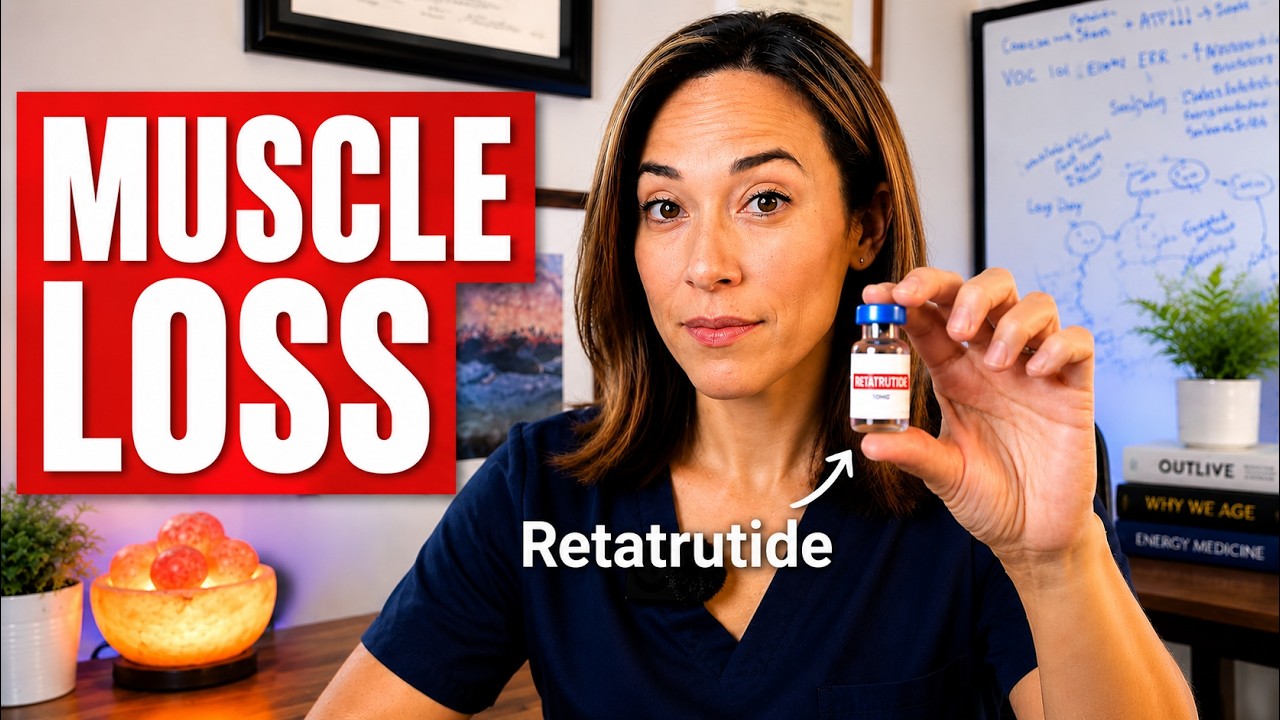
In this video Dr. Ashley Frazee explains that users of GLP‑1 drugs such as retatrutide, semaglutide, and tirzepatide often lose a significant portion of lean body mass—up to 40% of total weight loss can be muscle. She clarifies that the drug itself does not decide what tissue is lost; the body’s biological signals during a caloric deficit do. By default, weight loss follows an approximate 75% fat / 25% lean rule, but this can be altered. Frazee outlines three high‑impact, evidence‑based levers to preserve muscle while on these medications: (1) consume sufficient high‑quality protein (30‑50 g per meal, roughly 1.0‑1.2 g/kg body weight, or 100‑200 g per day) and use protein‑rich foods or supplements; (2) engage in regular resistance training with progressive overload (simple compound movements, adding reps or weight every 1‑2 weeks); and (3) avoid overly rapid weight loss, aiming for ~0.5‑1 lb per week for lean individuals or ~1‑2 lb per week for heavier starters. She also highlights a commonly overlooked side effect—electrolyte loss leading to fatigue, headaches, and cramps—due to insulin‑driven sodium excretion, recommending electrolyte supplementation (e.g., Element packets with a 1000 mg Na / 200 mg K / 60 mg Mg ratio). Finally, she notes that retatrutide’s glucagon receptor agonism may improve muscle quality by reducing intramuscular fat (myosteatosis). The video concludes with a call to prioritize health over sheer weight loss, and includes sponsorship disclosures and a promotion for her peptide course.
Chapters
Most people using GLP-1 drugs like retatrutide are losing not just fat, but lean body mass too. Muscle, strength, and in some cases, up to 40% of the weight they lose isn't fat at all. The scary part? Most people don't realize it's happening until months later when their metabolism is slowed down and their strength is down and they feel weaker than before they started. But here's what almost nobody is talking about. Your body has a set of biological signals that that determine whether weight loss comes from fat or muscle. And if you understand how to control these signals, you can dramatically shift the odds in your favor. In this video, I'm going to show you the 3 most important muscle-preserving mechanisms while you're on retatrutide or other GLPs, why most people get them wrong, and exactly what I tell my patients to help them keep muscle while losing weight. I'm Dr. Ashley Frazee. I've been working with GLP-1 drugs for over 5 years now, and retatrutide really has captured my attention as a potential cure-all for anyone dealing with extra weight or inflammation. If you don't know what it is, it's essentially the next generation of GLP-1 medications. It activates GLP-1, GIP, and glucagon receptors in the body, producing some of the most dramatic weight loss results we've ever seen in clinical trials. And what makes it special and different is the glucagon receptor agonism, causing the body to burn and waste more energy as heat and raising your metabolic floor. The amount of calories you burn at rest while you're in a caloric deficit. I'm still blown away by this. Now here's what everyone gets wrong about muscle loss. Reddit True Tide doesn't decide whether you lose fat or muscle. Your biology does. See, most people assume that whenever the scale goes down, their body's automatically losing fat. It's a win, but it's almost always losing more if you're not careful. So the standard rule of thumb is that weight loss defaults to 75% fat mass and 25% lean mass, including muscle. And this also lines up with the studies on fat versus lean tissue loss using all of the GLP-1 agonists, semaglutide, tirzepatide, and retatrutide, roughly. So it's not just the drugs causing the muscle loss, it's weight loss. It's very simple. But here's where things get really interesting. That 75/25 rule isn't a law. It's just what happens by default. In fact, researchers have repeatedly shown that some people can lose fat While preserving nearly all of their muscle. Some can even gain muscle while losing fat at the same time. Here's what the science says about why lean mass drops by default and how research proves that we can bypass that rule. So when you enter a caloric deficit, your body looks for stored energy that it can use. It doesn't just tap into fat tissue. It also looks at your lean tissue. This includes muscle, but also glycogen stores, connective tissue, and organ weight. And if the body is starving and has no physical reason to keep the more metabolically expensive tissues like muscle around, it will break it down to use the amino acids for energy production. But research has proven that you can lose fat without losing muscle if you manipulate 3 specific variables, and I'm going to show you what those are. But before I do, I want to talk to you about one of the most misunderstood things about using GLP-1 drugs and the side effects that can go along with it. So one of the most common complaints I hear from people on GLP-1 medications is fatigue. They assume it's the medication or being in a caloric deficit, but sometimes they're simply under-consuming electrolytes. So if someone is using retatrutide, even if they're not supposed to be, or another GLP-1 agonist like semaglutide or tirzepatide, or if you're just on a weight loss journey in general, what happens is that insulin levels fall. And when insulin falls, sodium follows it. So you lose a lot of sodium and electrolytes in general, which can create fatigue, headaches, muscle cramps, and sometimes an overall feeling of just being unwell. I even have to replace my sodium and electrolytes daily because it's hot where I live and I exercise most days. So I actually use Element electrolytes, which helps me a lot. The thing I love about the Element packets is that they use 1,000 milligrams of sodium, 200 milligrams of potassium, and 60 milligrams of magnesium, which is a research-backed ratio of electrolytes, and they don't add any sugar or junk to it. My nurse practitioner drinks Element daily, and I do end up recommending it to my patients almost daily. So Element graciously agreed to sponsor this video. If you click on the link in my description, you can get a free sample pack of their most popular flavors with any order. So just head to element.com/mylastnamefrazee to get yours. So back to my promise to share with you the 3 things that you can do to preserve muscle while losing weight, even on retatrutide, or really on any weight loss drug, if I'm being honest. And to be fair, this is not new science. This is the stuff that bodybuilders use when prepping for their shows, and it usually translates to their overall lifestyle in a really good way. And who doesn't want to look like a bodybuilder? I mean, for the most part, right? We have actual research where people given a 40% calorie restricted diet not only lost But instead of losing muscle too, they gained some. And all of the subjects in this study were exercising using high-intensity intervals and resistance training or weightlifting. But the difference was all in their protein intake. The ones that gained muscle ate 2.4 grams per kilogram, or about 1.1 gram per pound of their body weight in protein. And the other group in the study were fed about half that amount of protein And they actually did pretty well too. They didn't gain muscle, but they didn't lose any either. But hear me out. This wasn't just because of the protein. It was the protein and the weightlifting telling their brains that their body could not afford to let the muscle tissue go because the body needed it. So I hope that makes sense. See, muscle is metabolically expensive for your body to maintain. So if you eat the right amount of protein, it tells your body that it can afford So to shift your biology out of muscle-wasting mode, aim for 30 to 50 grams of protein per meal to consistently trigger muscle protein synthesis. And if that's hard for you, here are some tips just to target 100 to 200 grams of protein a day without overcomplicating it. So center your meals around high-yield options. If you're a meat eater, there's chicken, steak, eggs, Fish, shrimp is almost pure protein, tuna as well. And if you're not a meat eater, there's Greek yogurt and some dairy products that are really high in protein, like cottage cheese or edamame or tofu, whatever your heart desires and your gut tolerates. And then I'm somebody who doesn't sit down for a full meal very often, and so I use a lot of things like protein powders and shakes, collagen protein and coffee in the morning, and protein bars. Don't shame me, everybody. And if you're somebody who isn't into resistance training or weightlifting, I'm begging you, please start. Because your body doesn't care about your fitness goals. It cares about adaptation. If you only do cardio or track your daily steps, or you don't do anything at all and you sit at a desk all day, your body will view your muscle as an expensive thing that it can waste. But if your body thinks that you still need your muscle to survive, It keeps it. So if you're older or you're out of shape or you're entirely new to weightlifting, you do not need a complicated, grueling gym routine. You don't even have to go to the gym if you don't want to, although I would like you to. You just need to master a handful of simple things like squats or lunges for your lower body, shoulder presses, bench presses, rows, push and pull. Start there. Start with just those things. And every 1 to 2 weeks, just try to add One more rep or use a slightly heavier weight than you did the week before. Even small incremental increases, just small progressions will tell your body that it needs to lock down and protect your muscle tissue. It's good for your bones and everything. I mean, the simplest explanation I have for you is that if your body still thinks it needs its muscle, it keeps it. Now I've given you 2 things and I still need to tell you the 3rd piece of this equation because while increasing protein and lifting weights is absolutely critical for preserving muscle, There's something that a lot of people forget, and so I'm here to remind you. If you try to lose weight too fast, like sexy by summer, but summer's already here, you are sabotaging your body and any chance to bounce back and come off of the drug without your metabolic rate crashing to the floor. I've even seen people do this just with fasting and not eating enough calories, just trying to get weight off as fast as possible. But I always tell people, if you have a lot of weight to lose, 20 pounds in the first month is okay, but I'd actually rather it be more like 10. Or if you're pretty lean already, nothing more than half a pound to 1 pound per week. I promise you, when you're sad about your squat going down from 250 pounds to 150 pounds, it's really hard to get it back. All I'm saying is don't chase maximum weight loss in the fastest time possible. Just track your progress over time, and as long as you're not plateauing, keep Going with the plan. Now here's an unexpected twist. One very last thing that I think is worth mentioning about using retatrutide specifically. In the studies we have, we've seen that muscle quality may actually improve using this little peptide cocktail. We think it's because of the glucagon agonism spiking energy expenditure and lipolysis, or fat breakdown. Because glucagon specifically targets the liver and fat tissue to oxidize energy or mobilize it for energy, It behaves like a heat-seeking missile for the most toxic types of fat in the human body. And when people have poor metabolic health, they suffer from something called myosteatosis, which is essentially marbling of the muscle with fat tissue, exactly like a good ribeye steak. This fat infiltration degrades the muscle quality, making muscle insulin resistant, and it actually decreases physical strength. And so by aggressively clearing out the lipids in your muscle, the fat inside of the muscle cells, retatrutide helps clean that marbling up. Amazing, right? Well, after digging through the research and the realities on this topic, I don't think the right question is whether retatrutide causes muscle loss, even though everybody's asking that. Retatrutide doesn't decide whether you lose muscle or fat. You do. Every workout, every protein-rich meal. Every time you choose sustainable weight loss instead of chasing the fastest possible result. Just remember, the goal isn't to simply weigh less. The goal should be to become healthier. I'm Dr. Ashley Frazee. I want to keep my muscle, and I think you do too. If this video was helpful for you, please hit like for me and subscribe to my channel. And if you're a peptide nerd wannabe or a practitioner looking to get a concise, info-packed course on peptides that Won't bore you, feel free to check out a course that I built exactly for you. I'll link it in the description, and I hope you have the best day. Purchase your tracks today.