In this educational YouTube video, Dr. Ashley Frazee introduces SS31 (commercially known as Forzinity), a peptide that stabilizes mitochondrial membranes rather than directly boosting energy production. She explains mitochondrial anatomy, the crucial role of the phospholipid cardiolipin in maintaining inner‑membrane structure, and how damage to cardiolipin leads to electron leakage, reactive oxygen species, inflammation, and fatigue. The video details how SS31 binds to and shields cardiolipin, preventing its exposure to the immune system and the formation of anti‑cardiolipin antibodies—auto‑antibodies linked to chronic fatigue, microvascular clotting, and organ hypoperfusion. Frazee cites research showing a high prevalence of these antibodies in chronic‑fatigue patients and discusses SS31’s FDA‑approved use for Barth syndrome, highlighting its favorable safety profile (mostly mild injection‑site reactions). She addresses a common question about whether SS31 should be used before other mitochondrial agents such as MOTS‑c or urolithin A, recommending a logical sequence: first stabilize mitochondria with SS31, then consider boosting (MOTS‑c) or clearing senescent mitochondria (urolithin A). The presenter shares anecdotal patient stories of dramatic recovery from severe viral illness, toxic exposure, and unexplained chronic fatigue after SS31 treatment, emphasizing clinical intuition and targeted experimentation when standard labs are inconclusive. The video also includes a brief sponsor segment for LMNT electrolyte drink, linking electrolyte balance to overall cellular health, and a call‑to‑action for viewers to explore her peptide education course while warning against purchasing peptides from unverified online sources.
Chapters
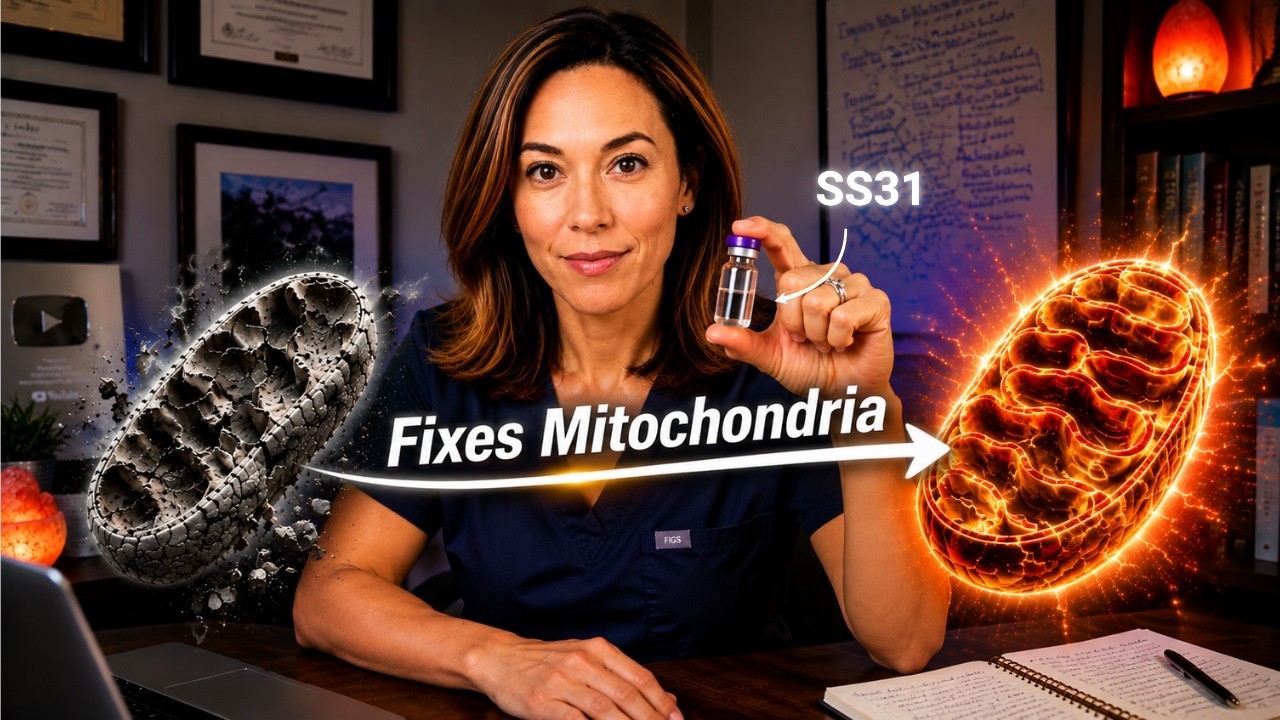
What if your mitochondria are literally falling apart and you have no idea? You've always thought the reason for your fatigue is hormones or bad sleep, but what if it's not? What if your body has decided to launch an attack against the literal energy factories in your cells? And what if something like this could fix it? This peptide is wildly misunderstood, and I'm here to set the record straight. By the end of this video, you'll understand what this peptide is and what it does, why it's completely different from other peptides, who it makes sense for, and whether you have to pair it with other peptides like MOTS-c, like the internet famously claims. This is SS31, and this is one of my very favorite peptides. Now, before I tell you all about this fascinating peptide, I want to thank the sponsor of this video, LMNT, but more on that later. So everyone thinks SS31 boosts mitochondria. It really doesn't. It stabilizes them and helps to keep them from falling apart. Let me explain. Your mitochondria are power plants. They're the source of all the energy you make. We have supplements like NAD and CoQ10 that boost the efficiency of our mitochondria and help them run better, like changing the oil in your engine. We have urolithin A, which helps get rid of old mitochondria when it's their time to go. We have a fascinating peptide, MOTS-c, that forces your body down the pathway of making more mitochondria. But this peptide, SS31, well, basically it helps hold your mitochondria together. And why is that important? Well, mitochondria can fall apart, slowly destroying your ability to create energy. But the reason for this is fascinating and important. So hold with me here. I'm going to show you whose mitochondria fall apart, So you can decide if this peptide could one day be for you. And just remember, I am a doctor on YouTube, but I am not your doctor, and anything I say today is purely educational. Also, SS31 is FDA approved for a very specific mitochondrial disease, which means we have a lot of data on it. But it's still worth a conversation with whoever you get this from, if you can get it, about why it could work for you. Knowledge is power, people. Anyone giving peptide advice who doesn't know what they're doing with this, well, feel free to take a look at my peptide course. Moving on. Okay, SS31 is a peptide that has a target in the mitochondria. Let me introduce you to cardiolipid. This is a phospholipid, but all you really need to know is that it's structurally important. It's like the scaffolding holding your inner mitochondrial membrane together. And if you learn anything about the mitochondria today, Know that the inner mitochondrial membrane has a folded-up shape, and its ability to hold that shape is very important. If the shape falls apart, the factory falls apart. And SS31 has the ability to target and stabilize cardiolipin in its place, keeping the mitochondria factory folded up and working right. Well, naturally, the next question then should be, what can damage cardiolipin and cause the membrane to fall apart? Because when cardiolipin does become damaged, your mitochondria become unstable, and then electrons leak out of the electron transport chain, the factory assembly line for your energy production, and you get more reactive oxygen species produced, which damage other mitochondria around them. And then you get inflammation and fatigue. So like I said, SS31 binds to cardiolipin and stabilizes it. It's kind of like that one Jenga piece that's keeping the tower from collapsing. You know what piece I'm talking about. And if you've got unstable mitochondria because cardiolipin has been damaged, but you can stabilize it with SS31, well then everything becomes more efficient again. But here's the part that nobody talks about. What damages cardiolipin? Okay, when mitochondria become badly damaged from anything that causes inflammation or poor recovery, like illnesses, poor metabolic health, Burning the candle at both ends, anything inflammatory. Well, cardiolipin then becomes exposed. It literally can leak out of the inner mitochondrial membrane, also out of the outer mitochondrial membrane, and into the extracellular space. And then the immune system sees it and it sees something that's foreign and it starts looking at it like, what are you doing here? And the immune system starts producing anti-cardiolipin antibodies. which attack cardiolipin. And I hope you see where this is going, but it's nowhere good. In fact, we actually have some research showing a high prevalence of anticardiolipin antibodies in a group of people with just chronic fatigue syndrome, which makes me personally wonder, should we be testing more people with chronic fatigue for anticardiolipin antibodies and then seeking out this as a potential treatment? We also have research showing that people who have anticardiolipin antibodies are susceptible to microvascular attacks, creating mini blood clots that can clog up the small blood vessels feeding tissue. So these mini blood clots can cause hypoperfusion injuries to organs like your kidneys or your eyes or your brain. In fact, people who have a lot of anticardiolipin antibodies can also develop bigger, worse clots that can lead to things like heart attacks and strokes. We actually have some research showing SS31 working to help improve kidney, brain, heart, and eye function, and it's most likely due to those hypoperfusion injuries getting reperfused, or the blood flow coming back, basically taking the domestic abuse away, allowing for healing to occur. Cool, right? We also know that up to 10% of perfectly healthy people have anticardiolipin antibodies, and that they often show up transiently during viral or bacterial infections. Imagine your mitochondria under attack every time you get a bad cold. And what if that problem never gets corrected? So I'm hoping now that you're starting to see the potential of SS31 in stabilizing cardiolipin. See, SS31 binds to cardiolipin and acts like a physical shield against these antibodies that attack it. And the peptide also blocks the opening of the outer mitochondrial membrane, preventing mitochondrial swelling and preventing cardiolipin from getting further exposed to the immune system. So it can be helpful to think of SS31 as like a structural repair mechanic for your cellular Power plants, but not necessarily as an energy booster like a lot of people think it is. It travels to the mitochondria, seeks out cardiolipin, and stabilizes it, thereby stabilizing the physical structure of the mitochondrial membrane, sealing electron leaks, stopping excessive reactive oxygen species, and allowing the cell to produce ATP or energy efficiently again. And unlike many other peptides we know about, we have a lot of human data on this one. Like I said, SS31 is FDA approved under the name Forzinity for a disease called Barth syndrome, which is caused by a genetic mutation that doesn't allow cardiolipin to mature or remodel itself. But one of the greatest things about all of the human data we have is that we know the side effects of this peptide, which are thankfully pretty lame, like injection site reactions, rarely a true allergy. And yes, that does mean that you can develop anaphylaxis to this peptide, Which is important to know, but overall it has a very favorable safety profile. But enough science. Now let's address one of the biggest questions I encounter on the internet every single day, that you must use SS31 before trying MOTS-c or other mitochondrial interventions. Is that necessarily true? But first, let me talk to you about the sponsor of today's video, LMNT. If you're watching this, chances are you're a bit health-conscious and you either drink a lot of water or you're like me and you know that you need to. But here's the problem: when you're active and you're sweating a lot or pushing your biology to the limit, when you sweat, you aren't just losing water, you're losing crucial electrolytes, and specifically sodium. So if you just drink a lot of extra water to hydrate, you can dilute the sodium levels remaining in your blood, and this can trigger a biological hiccup that can leave you feeling sluggish, physically weak, and even cause muscle cramps or headaches. I have learned this the hard way. I actually always get a headache when I work out too hard unless I drink Element before or during my workout. I'm not making that up. So just know sodium isn't a dietary villain anymore. It is the master key that opens up your cellular gates. When you actively replace it, especially with a clean science-backed ratio like Element, you aren't just drinking water. You're giving your cells what they need to maintain healthy blood volume, fire neural pathways, and optimize physical output. There's no sugar, no artificial coloring, and no junk— just the raw chemistry your body expects. Go to drinkelement.com/mylastnamefrazee to get a free sample pack with any order. I think that this watermelon drink is really amazing, especially when it's 100 degrees outside. So back to the question: should you use SS31 before you use anything else to boost mitochondria, like MOTS-c or urolithin A? Well, here's the thing. Based on knowing what SS31 does and when mitochondria are susceptible to falling apart, yeah, a lot of people could potentially benefit from trying this peptide. But if you do want to do any and everything, given that you're talking to a medical professional about it, I hope, well, it would make sense to have a calculated approach, either stabilizing the mitochondria first and then boosting them with MOTS-c later. And I have a video on MOTS-c if you need to understand how that one works. Or you could even use something like urolithin A to purge senescent or failing mitochondria first, and then stabilizing, and then boosting or rebuilding. This is 100% not a perfect science. It is all my opinion, but I do think the internet has a point in saying SS31 first and then MOTS-c. It's just best that you understand it, and I hope now that you do. And I'm not going to lie, I think SS31 is a miracle peptide. I have seen this peptide completely change lives. I've seen it work amazingly well in people who have run into big issues recovering from things like severe viral illnesses, toxic exposures, or chronic fatigue that just cannot be explained by blood work. You know, I've had people go to multiple specialists and doctors after experiencing something several years ago that they just couldn't recover from, and then they tried SS31 and things were much, much better. And I know the question that everyone asks is, well, how do you know if you actually need it? Well, sometimes you don't, and you just have to try something. And I'm probably going to get a lot of hate for saying that, but it's the truth. When the standard system kind of leaves you stranded with normal labs, but you can barely get out of bed, well, clinical intuition and safe targeted experimentation are sometimes the only way forward. Because think about it, it's not for everybody, but what if you are someone who has been through years of silent accumulated damage to your cellular walls? Or what if more people have anticardiolipin antibodies than we realize? These are just the questions that I like to ask. And again, I'm just one doctor, so please don't take this as fact. I can tell you that in traditional physician training, we're not trained to be testing for anticardiolipin antibodies as much as I think we should be, or maybe we should be in the future. And here's my call to action for providers or prescribers if this resonated with you. If you want to move past the guessing games, stop trying to patch over people's symptoms, and learn the wonderful world of peptides, that's exactly why I built a course on them, and I'll link that in the description for you. So most people think that chronic fatigue means that they just need more stimulation, they're lacking something, so they reach for more caffeine or more biohacks or supplements to force the body into high gear. But sometimes your cells don't need just more stimulation, they just need more Power plants repaired. So I hope this video fascinated you like the peptide SS31 fascinates me. I'm Dr. Ashley Frazee, and I hope you have the best day. Oh, and don't be buying peptides off the internet.