Fish Sauce Podcast | Gokul Rajaram - Square
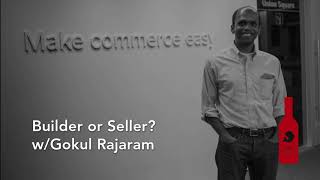
In this season‑final episode of the Fish Sauce podcast, hosts Elton and Wilson interview Gokul Rajaram—known as the “Godfather of AdSense”—about his career spanning Google, Facebook, and Square. Rajaram explains how he chooses mission‑driven, founder‑led companies, the importance of continuous learning, and the overlap between product management, founding, and investing. He contrasts operator and investor roles, shares practical advice on networking, risk‑taking, and self‑awareness for aspiring technologists, and describes his daily routine of talking to smart people to stay on top of industry trends. The conversation also delves into his Indian upbringing, the traits it instilled (hard‑work, analytical mindset, cultural heterogeneity), and his perspective on Asian‑American representation in tech leadership. Rajaram highlights the current inflection point in financial services for small businesses, his excitement about mission‑driven fintech, and offers concrete steps for listeners to break into tech and make an impact.
Chapters
What's up, Fish Sauce family? It's Elton and Wilson here. Today's episode is very special to us, and it's because it's our last speaker of the season. After this episode, we'll have our season finale episode where we wrap up the season with our reflections from the Fish Sauce journey, answer a few questions from our listeners, you guys, our Fish Sauce family, and talk about what to look look forward to in our next season, Season 2.
Next season! But before we move on so quickly, there's another reason to be so excited about this episode because we cap off our veteran series starting with Robbie Kwok, Head of Corporate Operations and Strategy from Slack. Then we had Dan Yue, COO of NerdWallet, and now we have Gokul Rajaram, who is dubbed the Godfather of AdSense.
What a lineup!
We really got a 3-person all-star here going on.
Trifecta.
And now we have Gokul Rajaram, like I said, godfather of AdSense, and he founded the concept at Google. Then he brought his talents to Facebook, and finally he's the product engineering lead at Square.
Wow.
I first read about Gokul when he published an article on First Round Capital's blog about making decisions, and being a decision maker myself, I was super impressed and wanted to use some of his tactics. I quickly saw that he worked at Square as well, where Wilson used to work, so I asked Wilson immediately if he could go stalk him and find him at Square.
I didn't read the article at the time when you read it, so thanks for forwarding that to me. And once you mentioned it, I immediately stalked him. I knew he would be on the 8th floor where his team sits, so I posted up at the standing desk, bumped into him, like, "Hey Gokul, funny running into you right now. By the way, my buddy Elton and I read your article and we're super excited about, you know, stuff you talked about." And afterwards I pitched him on the spot about our podcast Fish Sauce. And guess what? He said yes on the spot.
I couldn't believe it when Wilson told me that. I thought he was lying.
I still couldn't believe it until I thought back, like, hey, it actually happened today. I was super blown away, but that's how we landed him as our last guest speaker of Fish Sauce Season 1. So here's Gokul Rajaram, the Godfather of AdSense.
Woo!
Let's do it.
You've been dubbed as the Godfather of AdSense. You worked in ads. You worked at Square for payments. How would you describe your experience in your own words?
My goal in my career has always been to work with mission-driven companies and with great people who I can learn from. The keyword is learn. Life is short, careers are short, and the one thing that gives me satisfaction is learning and growing every single day, week, month, year. Things change and move so fast that the one skill set one truly has is the commitment to constantly learn. Learning new skills, learning new domains, learning new function areas. And that's what I've tried to do throughout my career.
Awesome. So we've seen in a couple of interviews that you've mentioned mission-driven companies a lot of times. How do you select mission-driven companies to join?
Great question. Mission-driven is a loaded term. Every company, of course, has a mission, but very few companies truly have missions that are world-changing or missions that impact people's lives in fundamental ways. I focus on companies whose missions transcend making money or building a business and focus on fundamentally empowering people or businesses. Square, Facebook, Google, all of these are companies that when you look at their mission, it is not about making money. It's nothing to do with making money. It's about improving the lives of people in a fundamental way. And those are the kinds of companies I've been lucky to work at. One easy way to test for this kind of mission-driven company is when you describe this company's mission and what they do to a 10-year-old, can they understand what they do and why it matters to the world? For example, with Square, it's very easy to go to a farmer's market, see sellers using Square. When you ask them why, You see them rave about how it's changed their lives. My kids fundamentally understand, even though technology-wise it's a very complex product. It's designed beautifully, but underneath there's a lot of complexity, but they understand inherently, implicitly exactly what it does for people. And that's a really good way to gauge mission-driven companies, especially mission-driven companies that truly are world-changing, that impact people's lives.
I've noticed also you've not only worked for these companies, but you have a history of angel investing. Do you have that same type of criteria when selecting companies either to invest or to advise?
Yes, I look for mission-driven companies for sure, but the other thing I look for, both even in terms of working and investing, is founder-driven companies. I truly believe that technology companies are successful when they, when they have a founder who lives and breathes the mission. And I think, uh, when you look at again Square or Google or Facebook, again, look at Square, our founder Jack is the ultimate embodiment of the mission. When you talk to him, he's not about making money or revenues. He's about how do we build the best products that can help sellers grow, that can help sellers transform their business. And that's the kind of founder you want. That's the kind of founder you want to back, you want to work with, you want to invest in, you want to advise. A founder who truly believes in and lives and breathes their mission.
This idea of truly believing in something, is that something that is organically brought up, you know, someone just lives and breathes that pain and wants to solve it, or can that be learned?
You can absolutely adopt it. Obviously, the pain ones are the ones you hear about a lot. So Mark Zuckerberg built Facebook because he had the pain. He didn't know who was— who were all the people in his undergraduate class. Jack built Square because his friend Jim, his co-founder Jim, couldn't take a payment. And so a lot of companies, great companies, are created because their founders feel the pain fundamentally. But absolutely, you can figure out what the pain is and go after the pain, but you still Ultimately, you cannot fake it. You still have to be authentic about it.
I think a lot of our, our listeners are interested in kind of the investor perspective as well as the operator perspective. And I think what's very unique about you, Gokul, is you've done a little bit of both, right? How would you describe some of the similarities as well as some of the differences as well? And what advice might you have for those who are looking to get into one area or the other?
The similarities between them are in both cases you get to work with smart people. And in both cases, they do use analytic skills. I think the baseline for almost any role in technology today is to have a solid base in analytics. This means you need to think analytically, you need to use data to make decisions. But the differences are, I think, more pronounced at a very— at a more macro level. An investor role is generally enjoyable, in my experience, to folks who don't want to be tied to a specific space or domain, but who want to rotate between domains, who want to almost have exposure to different domains, different kinds of things on a daily basis, who like diversity. While an operator role requires you to spend at least a few years building depth in a particular area, because when you start working in an area, you don't really add value till you at least spend 6-9 months, and then you truly start adding value for a year and a half, 2 years, 3 years. And, and so you really want to desire and enjoy going deep, going deep into an area. Most investors today, realities, do spend time on the operating side before switching to investing. So My advice is even if you want to go into investing, I'd advise you to spend a few years on the operating side to start with. I personally think of myself as an operator through and through. Investing is a good way for me to strengthen my operating skills because it exposes me to what's going on broadly in the industry. But I personally like being focused on a specific space at a given point in time and spending a few years in the space, fully understanding what the space is about, and really hopefully adding value in that space, in that area.
How do you balance that time since being an operator is a full-time job and more? Being an investor also, do you spend time outside of work advising them, or is that minimal time commitment, or depends on the company that you invested in?
I think it's all about structure. I do take 45 minutes to an hour every single day, which is maybe 10% of my time because I work about 10 hours a day to meet with entrepreneurs. Could be one meeting for an hour with an entrepreneur, it could be two half-an-hour calls with entrepreneurs. But doing that, A, keeps me attuned to what's going on in the world outside, and B, also helps me cater to this other part of me, which I think helps with operating. But if you just do it randomly, it really can intrude into your work, and then you really lose the balance. But it's really making sure you, you really wall off that time, and you make sure you have specific slots of time where you kind of use that for, you know, your brain is doing something different.
When I think of Gokul Rajaram, I think of three roles. I think of you as a PM, a founder, and investor. Is it coincidence that I'm thinking about these three roles that you've occupied, or are there overlapping qualities that makes it all similar?
You're very kind to say that. I personally don't think I am a founder. I was a founder, but now I enable and coach founders. I do think of myself as a product person, and I think that is probably the key, key similarity between all of these three, these three things that you mentioned. I respect and have a deep appreciation for great products that impact people's lives. And I think all of these three, to be successful, either as a founder or as an investor or as a PM, all of them have to be rooted in a deep understanding and focus on the product. You cannot be a good founder unless you focus on the problem that the product solves and focus on the product to solve the problem in a unique and remarkable way. You cannot be a good investor unless you again think deeply about the problem, whether it really solves a— whether there's a real problem to be solved. And of course, the PM is defined by the product or products they work on. So I think that's a common theme, which is products.
Is there a difference between kind of the companies you invest in, small scale to large scale, versus the products that you are working on, right? Do you more so enjoy working for larger companies such as the Facebooks and the Squares of the world, or is something that is small, non-existent yet, really fascinating to you?
It's a mix of both. I actually don't have any preference on the size, but what I want to make sure is impact. I want to work on a problem space that is large, that has the potential to be really large, versus the size of the company.
We're going to switch gears a little bit, and we're interested in learning about how does being Asian American uniquely affect your personal or career growth. Could you let our listeners know about what your ethnic background is, what is the community that you've grown up in?
So I grew up in India, and I got my undergraduate degree in India, and I came to the US for grad school. 3 big attributes that are ingrained in me growing up in India. First, the value of hard work and dealing with scarce resources. You get to realize that resources are scarce, and resources even extend to finding a, finding a position or a seat at a top college. For example, there were a million kids competing to get into the top engineering schools in India and only 2,000 seats. So you realize that you've got to work really hard and resources are scarce in general. The second one is analytical mindset. I think it's parental, societal, call it what you will, but in general there is a push to excel in math and science believing that it's the clearest path up the social ladder in India. And so that grounding in analytical thinking is critical regardless of what profession you follow. I think that was really valuable in general, and I feel today's citizens, any global citizens working in any industry, I think that key analytical thinking is so critical, that core analytical thinking. And the third one is, which is probably somewhat unique to India, is living in a diverse or heterogeneous society, treating people with respect and building relationships and friendships regardless of where the person comes from. India has 20+ national languages, or 20+ languages that people speak, and lots of different subcultures. So my friends growing up all spoke different languages at home and ate different kinds of foods, and it didn't really matter. We— I learned how to work well and play well with people from different backgrounds and different cultures and so on. And I think those three things— one of them is value of hard work and scarce resources and understanding scarcity, second analytical thinking, and the third is working with and being able to adapt to folks from different backgrounds.
Those two traits are awesome— hustler mentality and really integrating into the workplace. Have you found those three traits to be extremely valuable as you came to the US and now kind of have grown within different companies and organizations and grown grew with them?
I think the first two I always, I always intrinsically felt would be valuable. The third one, which is the heterogeneity, was really interesting. And I think India is— that's very different from many other Asian countries. Many Asian countries are somewhat more homogeneous, I feel, than India, where it is an amalgamation of many, many different pieces. The US is very similar, where of course there's incredible diversity, worldwide diversity. And so I didn't realize how interesting it is where if you look at a company like Square or any of the other companies, there's so much diversity of backgrounds of ethnicities and so on. And being able to work well with people from different backgrounds, different parts of the world, is so powerful. If you look at our C-suite, our exec team, I mean, it has people from France, from Ireland, from all of these different countries coming together. It's incredible.
Yeah, let's talk about our C-suite, or even other C-suites in the Bay Area, right? We do notice that in the Bay Area, or in tech, a third of the— from a demographic perspective is Asian. But from a C-suite perspective, by observation, It's probably much less than that, maybe 10%, maybe less. Why is there a discrepancy, and do you think that this will change in the future?
So diversity in technology at all levels is something that the industry at large is working on. The good news is Square is very much a part of that effort. As, as you know, Wilson, Square's C-suite boasts a pretty diverse group of folks from various backgrounds. 75% of Square's report up to female executives. So there's two kinds of diversity, multiple kinds actually. There's gender, ethnicity, etc. And beyond that, there is ethnic and geographic diversity in our executive team, so multiple countries and so on. Now, I have seen and worked for several amazing Asian American execs. So for example, one exec who really inspired me was a guy called Kevin Oye, O-Y-E, who was my boss at a company called Sycamore Networks in Massachusetts and pioneered optical networking during an internship. He was SVP of Biz Dev and Corp Dev, really helped me understand the key strategic role that partnerships can play at a company. I do think we're going to see diversity in the tech industry, C-suite, including Asian Americans, increase over the next decade. I'm pretty, pretty sure, just because there is just too much talent and excellence today in, in, you know, in every part of technology. And tech companies, more than any other company, know that the key to their success is continuing to nurture and grow talent. And, and they are the most meritocratic of all companies.
Why don't we see that today though? Is it like a lagging effect?
I think till about 5 years ago, there was not a conscious recognition of it. I've seen this in tech companies, don't realize that's a problem. They focus on what they think is a problem and they work on it. Once you realize there is a problem, as you've seen more recently, when they realize, all have realized that diversity is a problem, you have seen focused effort. It's problem-solving mentality.
Let's deep dive a little bit, just a little bit more, right? Why is that? Is there a reason why specifically Asian Americans are not represented yet and it takes a lot of proactive programs in nature to encourage that?
It's not clear. When I actually— I'm trying to figure out if you include Indian Americans and Asian Americans, which I do, it is actually a fairly— you know, if you look at both Microsoft and Google, for example, right, you recently saw Indian Americans, for example, became CEOs of both companies. I think every company is different. I feel that different companies reward people coming up different ladders. For example, you could imagine that it's likely that a company like Google, the product engineering ladder is probably wait a little bit more in terms of promotion. So maybe people who— maybe we need to look at where companies are promoting people out of, which ladder, and are there— is there representation on that ladder?
And then from your experience, have you ever faced any roadblocks or challenges being Indian American or actually Indian heritage?
No, it hasn't been. That's the amazing thing. And I think it's because I personally feel it's— maybe it's because the companies I worked at, but in general I feel it's companies are— I feel it might be just in the Valley. I do feel technology companies are just very, very meritocratic. At the same time, there is enough talented people who are basically raising their hand up. So you've got to be— I think one of the things that people don't realize is that just because you work hard and just kind of put your head down and do stuff doesn't mean that you're going to get, you know, you're going to get put up for the promotion. You've got to raise your hands and take on new things. And that's, I think, the key, key thing here. I think in many cultures, you know, Indian, Asian, American, etc., we're all probably taught to kind of just keep our head down and work and good thing. And it probably does to a certain level, but to get to the Swiss suite, you've got to do things that are above and beyond normal. You've got to be 2 standard deviations, and 2 standard deviation things come when you break the mold. So you've got to break the mold.
100%.
You've got to take on a project that is too beta. I mean, that, you know, and you can't be afraid of failure. I think that's the thing. I think I feel a lot of folks coming up get— because they do well academically, so they kind of are somewhat afraid of failing, so don't take risks. So you've got to take risks, and without risks there's no commensurate reward, both in terms of personal and professional growth. I definitely felt one of the things when I came here, it took me— I've done really well in academics, and initially when I was a software engineer, I would be— I was very careful, and I was just kind of putting my head down and doing projects. And slowly I realized that ultimately, you know, if you look at Mark Zuckerberg at Facebook or Jack, I mean, they dropped out of school. Think about that. They dropped out of school. It's unimaginable. In, you know, when you're doing well academically, you, you think of becoming valedictorian or something like that, or getting a 4 GPA. Dropping out of school to do a startup, and that's the kind of stuff you've got to do. And obviously, within a professional, what do you do to drop out of school? You say, you know, you're on a path to become a director or VP at your thing. But instead, no, I'm not going to do that. I'm going to take on this completely nebulous— that's what happened to me when I joined Google. I was put on this project, but then I found 4 engineers working on something on the side in a room, and they were working on a new project that Sergey had tasked them with called— it was not called anything, but it turned out to be AdSense. And I started working on it with them, and in addition to what I was doing. And I, I would encourage every one of your listeners to take risks to take risks, not just be happy that they are doing something and being on a path. If you want to achieve greatness, you've got to take— you've got to swing for the fences a few times.
So what can they do in their workplace to actually do that, to raise their hand more, speak up more in meetings?
First of all, they need to network and meet lots of people. They need to meet lots of people. They need to understand what's going on. You can't raise your hand for something till you know what's going on. That means your peers. It means going and networking with the execs at your company. They all want to hear from other people at the company. Give and be intelligent and thoughtful when you talk to them. Don't just go and introduce yourself and just shoot the shit with them, you know, shoot the breeze with them. Have some thoughts about what they're doing, what the company should be doing, what your thoughts are. And I think those are the things as you do that more aggressively, take time off, take 2 hours a week to do that, meet with 3 or 4 people every week, very quickly you'll start seeing what's going on at the company.
I have to say, when I first met you, it was actually in passing.
I heard about you. You've done that really well, Wilson.
And I read about your article and found ways to, you know, really start a conversation that I actually genuinely cared about. It took a little courage. It wasn't easy. You know, I walked by and I found some time and grateful enough that you were able to give me some time too at that point.
And most people have time and most people, it might not be right that week, but you'll easily be able to find time at most people's calendars. And the earlier you can do that and build that skill, the better. So it's great to see that you built that skill so early and it'll serve you well in life and career.
Yeah, I think we're going to go ahead and ask a couple wrap-up questions. So with your vast experience in product investing, entrepreneurship, What excites you about the newest startups or companies today?
I think the broad category of financial services for small business and individuals are at an inflection point. On one side, it's a really noble and inspiring mission because reality is individuals and small business are not well served by the existing financial services out there. I think, and, and on the other side, Square and other companies have shown that it's possible to build large businesses disrupting the status quo and building some innovative financial services. So I'm very excited about working on it, and that's one of— I think that's a broad, very broad category, obviously financial services for SMBs and individuals, but I think it is a massive multi-trillion dollar mission-driven category that can both be mission-driven, that they can inspire people to come into work every single day because you're doing something that impacts people's lives, yet it can also be a really big business.
I'm curious, personally curious, what your routines are to stay on top or understand the pulse of what's going on out there in terms of what's hot, what's exciting. but the trends are, do you have certain routines that you usually do, either talking to people or reading certain articles?
It's talking to people. It's like I said, spending an hour a day. Spending an hour a day talking to smart people. And you've got to filter the people you talk to to make sure that you are getting— and when you talk to people, you always want to have leading questions like, what's the most interesting company you've seen? Or a question like, what space are you interested in? So you get a sense of what's going on. And obviously you want to keep in touch with reading and so on, but there's nothing— no substitute for Talking to people who are actually out there operating, who are actually out there in the industry, because journalists filter and put spin on things to serve a certain storyline and so on, so it's hard to know what's going on in reality. You've got to meet with people and talk to them.
And I think wrapping everything up, a lot of people are looking to get into tech, right? They want to take that leap of faith, they want to take risk, right? They want to find the mission-driven companies that you spoke about. What lasting advice would you have for those people who, who want to join tech? How can they do that if they're not already in it? Or if they want to find a specific company knowing that VCs are tightening their amount of funding that they're giving out today, how do they pick that right company?
Two pieces of advice. First, first, understand yourself. Self-aware. Make sure you know what your core skill is, which, which means in other words, what side of the house are you on? Do you build products or sell them? Those are the two sides of the house. Got to be one side or the other. Keep honing and improving the skill, whatever you have, because that core skill will stay with you and persist through companies. And I think many people are trying somewhere in the middle They want to both be building and selling, but the reality is, especially the other companies, either a builder or you're a seller. You need to figure out which side of the house you're on and you need to commit. I'm definitely a builder, for example. And the second thing is just do it. What that means is a lot of people who call me saying, what should we do? Well, guess what? There is no catalyzing event. You have to make things happen. There's no like divine intervention that's going to come and suddenly like bless you with a company. No, there are thousands of startups that are hungry for help. You literally open up, I mean, go to a meetup, go to a networking, go to an incubator, go to WeWork. I mean, all of these places, there are hundreds of startups, and you need to understand what kind of startup you want. Obviously, you need to select them, but if you email 10 companies, guaranteed, with a clear pitch— here's what you can do, this comes back to the core skill set you have, I'm willing to help, even if it's for free— guess what? At least 3 of the 10 companies will reply and say yes. And it's crazy how many people don't think of doing that. And And just do it. I mean, so those are the two things. Figure out what your core skill set is and keep honing and refining it. Keep honing and refining it, whether it's building or selling, one of the two. Keep honing and refining it because that's going to be with you for a long time to come, polishing it. Second one is make it happen. Just do it.
So Wilson, wasn't that a great way to end our speaker series this season with Gokul Rajaram?
He was so good. His voice is actually really powerful. And to be in the same episode, same conversation as one of our greatest product leaders of our time, it's pretty awesome.
Yeah, definitely. Before we end, Wilson and I wanted to really share a behind-the-scenes look at what our experience was like recording this episode with Gokul, because we went back to Square where Wilson previously worked to interview with him.
Usually when Elton visits, it's usually at 7 PM, just in the nick of time for dinner. And I'm checking him in and the front desk person's like, "Oh, you again." But this time was a little bit different. This was like middle of the day, afternoon, broad daylight, and we were both sitting in the waiting room with our briefcases, you know, walking in and it was like, "Wait, this is not usual." It's familiar but unfamiliar at the same time.
Yeah, it really felt like Wilson and I were pitching a product or a company. It was something that we were working on and it's It's been in stealth, so none of our mutual friends actually knew what we were doing together. They were kind of questioning, and when they saw us, they're like, "Oh, Wilson, what are you doing back?" Like, they were shocked, they were surprised.
They usually see us in social settings during dinner. They join us, we're laughing, chat. But this time it was us walking into our board meeting where I usually present to my team, but this time Gokul walked in and they're all wondering what is going on.
And it was so surreal to be in the boardroom, um, like Wilson said, and we were definitely nervous. At the end of it, when we finished, we were so high on our adrenaline that we forgot to take a picture. And a picture is something that we take with every single one of our speakers, and it was the first time we actually just forgot.
Gokul left already, so we chased down the EA so that she can chase down Gokul, and eventually took the picture in front of Square's mission, kind of designed right in front of our boardroom meeting. It was a perfect way to end that meeting and to get a picture with him. So yeah, this is an awesome episode. I'm glad we got this Yeah, what an experience.
From finding Gokul to Wilson stalking him down to that interview experience, I think that was one to remember.
This was such a great way to end, but even though this was our last guest speaker episode, next one is our season 1 finale where we reflect on how we did this from 3 different time zones, and we'll be answering a couple of questions from Facebook, Instagram, and we'll give a little sneaky peeky of what's to come for season 2. There's a little mix of seriousness, a little bit goofing around, so, and a lot of laughter, so get your earbuds ready for that.
Thanks for listening to this week's episode of Fish Sauce.
If you like what you heard, like our Facebook page and follow us on Twitter @FishSaucePod for any episodes or latest updates.
If our mission resonates with you, please leave a review on iTunes and don't forget to share with your family and friends so we can welcome them into our Fish Sauce family.
And lastly, big shout out to our awesome editor Christian Edwards for making us sound better than we actually are in each episode of Fish Sauce.
More from Gokul

Gokul Rajaram on the 8 Moats Companies Need & Why Dropouts are "AI Maxing" the World





#80: Becoming an IC again is how products leaders will stay relevant in the AI era | Gokul Rajaram
#80: Becoming an IC again is how products leaders will stay relevant in the AI era | Gokul Rajaram


What I Learned Working for Coinbase, Pinterest, Facebook, & Google | Gokul Rajaram
What I Learned Working for Coinbase, Pinterest, Facebook, & Google | Gokul Rajaram