VC Fireside Chat - Door Dash's Gokul Rajaram | Lessons on Leadership and Culture
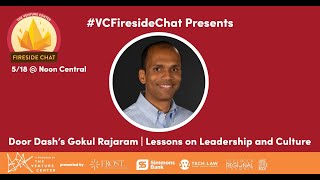
Gokul Rajaram, an executive who worked at Google, Facebook, Square, and DoorDash, shares leadership lessons from Larry Page, Mark Zuckerberg, Jack Dorsey, and Tony Xu. He explains how to build culture as both a constitutional guide and hiring filter, advocates eliminating director titles in favor of flexible "lead" roles, and uses Andy Grove's task-relevant maturity model to match supervision to experience.
Chapters
Woo-hoo! All right. Hello, everybody. Happy Tuesday. Hope you're having a productive week so far. It's only day 2. Hang in there. My name is Ashley Jones. Excited you can be with us today. I'm the managing director of community programs here at the Venture Center. And today's fireside chat is with DoorDash's Gokul Rajaram. He's here to talk to us about lessons on leadership and culture But before we get into all that, I have a few pieces that I have to get to first. First, want to thank our sponsors of today's program: Simmons Bank, Frost Accounting Firm, Wright Lindsey Jennings, and the Little Rock Regional Chamber. Not only do these organizations support us and all the programs that we're able to host, they support entrepreneurs. So any entrepreneurs that are attendees watching this today, they're on Zoom or Facebook, feel free to reach out if you're needing any financial or accounting or legal help or networking, we're able to connect you with these folks here in the community. Also want to talk to you about some upcoming programs we've got going on. Next Tuesday on May 25th from noon to 1, we have a VC Lunch and Learn that's all about mentorship and how mentorship accelerates entrepreneurship. If you are an entrepreneur, you need a mentor. And so we're going to take a deep dive and talk to a panel of experts on mentorship. Why it's important, how to seek a mentor, what that relationship looks like, how to get the best, uh, you know, benefits out of that relationship. So if you're interested in that, that's next Tuesday, May 25th, from noon to 1. Also on June 4th, uh, from noon to 1, we're continuing our VC Health Series. This is something that we began in January that's focused on entrepreneurs and mental health. We know this past year has been difficult. Entrepreneurship is difficult in and of itself. So we wanted to create a safe environment to talk through some of these issues. So on June 4th, we're talking about failure. We're gonna have a panel of entrepreneurs as well as Bruce Trimble with the Bridgeway and Ken Clark with Chenault Family Therapy here to talk about the experience of failure or coming close to failure and the stigma around it and how to cope. So make sure if you're interested in that, you can register there, June 4th, noon to 1. Also, final one, June 9th at 11 AM Central Standard Time, we've got the kickoff of our FIS FinTech Accelerator. I don't— I'm sure you guys are very familiar with this. This is our 6th iteration of this program with FIS, so we're extremely excited to kick off this next accelerator with 10 financial technology companies. Again, that's June 9th at 11 AM. Be sure to register for any and all of these programs that you're interested in. Either via our website that's been newly redone, thanks to Becky and our team and friends over at Stoneward, or you can find us on social media or subscribe to our newsletter. Again, like I said, today is all about Gokul Rajaram and learning the lessons on leadership and culture. I want to give a quick introduction and then we'll dive right into questions. Gokul Rajaram currently serves on the executive team at DoorDash, where he leads Caviar, a premium food ordering service. Prior to DoorDash, he worked at Square, where he led several product development teams and served on Square's executive team. Prior to Square, he served as product director of ads at Facebook, where he helped Facebook transition its advertising business to become mobile first. Earlier in his career, Rajaram served as a product management director for Google AdSense, where he helped launch the product and grow it into a substantial portion of Google's business. Rajaram holds a bachelor's degree in computer science engineering from the Indian Institute of Technology, Kanpur, where he was awarded the President of India's Gold Medal for being class valedictorian. He also holds an MBA from the Massachusetts Institute of Technology and a master of computer science from the University of Texas at Austin. Please welcome Gokul Rajaram.
Thank you, Ashley, and thank you, folks. Really excited to be here.
Absolutely. Let's go ahead and dive into some questions. So you've worked for some high-profile companies like Google and Facebook, Square, DoorDash, to name a few. Talk to us about what motivated you to work for these companies.
I've been lucky, like you said, Ashley, to work at these companies and actually to join these companies when they were fairly young. I was employee number 800 or 800 and something at Google. Around the same time at Facebook, 800-something, employee number 600 at Square, and in the first like 1,000 employees at DoorDash. And all of them went public 2, 3 years after I joined. And I think I never focused on financial metrics or anything else when I was looking at the company. I focused on two things, very simple. One is the mission of the company. Is the mission of the company meaningful enough large enough and consistent with what I believe in and I'm excited about. For me, I am excited about missions that directly touch the lives of people at scale, ideally worldwide or globally. And I felt that Google, Facebook, Square, now DoorDash, all of them have the opportunity to touch the lives of people in different ways. And so I stay away from, at least from, from my point of view, working at companies that would not fit the mission, or maybe enterprise software companies which are obviously very powerful companies, but they don't— they're not touching the lives of people very directly. And the second thing is the leader of the company. And so I strongly believe that the leader needs to embody the mission of the company. And when you talk to Larry Page, you see that he really embodies the technical excellence that Google is known for. Talk to Mark Zuckerberg, see that he really embodies the mission of social connectivity. He's one of the best social thinkers, uh, at Facebook. When you talk to Jack Dorsey, he really embodies economic empowerment. He's so about helping people succeed and grow and businesses. And then when you talk to Tony at DoorDash, he really embodies local community helping local businesses. So a leader who embodies a mission and a mission that's compelling and aligned with my values.
That's fantastic. And you alluded a little bit to the, to the next question that follows that, talking about the lessons or commonalities that you learned from the leaders of those companies, the Mark Zuckerbergs, the Jack Dorsey's of the world. How did they influence your own leadership style?
Yeah, I think, again, I've been lucky at these companies to work fairly closely with the leaders. I reported to Jack Dorsey, and I dotted line— I didn't directly report to Mark. I dotted line into Mark and also into Larry, where my boss reported into them. And I was in many, many meetings with all of them. I think besides embodying the mission, The two things I've learned from them is, first, uh, you have to hire leaders who are so good that they're essentially your peers. The best leaders hire people— like, if you look at Mark at Facebook, he hired Sheryl Sandberg, who arguably was better than him at many aspects of company building and scaling, especially on the business side. But he was able to then completely delegate huge swaths of the Facebook business to her. and that allowed him to fully focus on, on the product and the engineering and design side and thinking about how the product strategy for Facebook should be. So you need to really hire and not be afraid of hiring people who are better than you in every, you know, in certain parts. You have to hire people who are basically your peers. In fact, I think Mark Zuckerberg even said once that he only hires people that he would be comfortable working for if the situation reversed, where he feel that he would be okay working with them. So that's one. You have to hire extremely good people as leaders. The second one is that the number one job of the CEO in a company, especially at a scale company, is to see— besides having the right leaders— to see around the corners, as it were. In other words, to see how the future is going to unfold for your company and your industry, and what strategic moves you need to make before they happen, before the future happens. Most of a company, remember, is focused on executing on the plan for the year, for the month, for the quarter. You are one of the very few people who, if you have the right leaders and they're executing, you now have the luxury to actually look around the corners and say, what lies for me? I'll give you a story here. In 2015 or '16, I think we had almost finished annual planning for Square, and we are in January, and we were kind of started to execute. And then right after the holidays in January, Jack comes in and says, "Well, guess what? We're going to change our plan." We were like, "Hang on, what do you mean?" He's like, "Well, you know this credit cards, we all were swiping these cards. I believe that the credit card infrastructure in the US is going to go to a chip and PIN model. So we are not going to swipe anymore, we are going to slide it. It's going to be scanned." We were like, "No way. It's not going to change credit card infrastructure, take decades to change. That behavior is ingrained in the US." It's like, nope, I pretty much believe that this is going to happen and it's going to happen very fast. And if Square doesn't have a reader, we're going to be left behind. And we are going to make that our top priority for the company this year. We're like, hang on, this company is already 2,000, 3,000 people then, Square. We were like, it's a 3,000-person company. You can't just change. Like, yep, that's— as a CEO, we're going to do that. And we're going to basically build a new piece of hardware. Which takes this chip and PIN card and launch— we're going to launch it this year and we're going to ship, I think, some incredible number, I think a million of them this year. And this is hardware. We didn't even know what to build, let alone— I mean, hardware takes— it takes a year to even design and get the first prototype back. And he wanted to ship it, ship production units to merchants and ship millions of them in a year. But we did it. I mean, we basically Gokul Rajaraman called an emergency all hands for the whole company and said, this is the new priority for the company, get this new reader out. And the other thing he said, which is incredible, he said, I believe that till then Square had plugged into the audio jack of your phone. He said, Apple is going to eliminate the audio jack. We're like, that's crazy. How is Apple going to eliminate the audio jack? Everyone uses it for wireless phones, wireless headphones, sorry, for your headset. Nope, Apple is going to eliminate it. And do you have any connections at Apple that you say— nope, I don't, but I can see the breadcrumbs. This is what the future is going to be, and it's going to be in 1 or 2 years. And if you don't have— so this reader does not need to accommodate just chip and PIN, it also has to be wireless. It cannot plug into the headphones, it has to connect by Bluetooth to your phone or iPad. What? That— we've never built something like that. So literally completely changed the roadmap of the company. And that's what a leader— only the CEO has a gravitas And he was taking a bet the company move where he changed the whole roadmap for a year to say, this is what the future is going to be. But that's what, that's what great leaders do. That's exactly what great leaders do. See the future and then get the company to move towards the future in a way that no one else can. No one else could have done that, made that statement and made that. I couldn't have done it. I was leading product and engineering. I couldn't have done it. It's only Jack, the CEO. Incredible example.
And that's fantastic. You know, and being able to trust that visionary, you said, you know, I'm sure all of the people on the product development team were thinking your heads are spinning at this point. You think, Absolutely not. He's crazy. But you go with it because he's the leader, and clearly he knows something that you don't. That's amazing. Shifting gears a little bit to culture, want to talk a little bit about what does one— or how does one establish meaningful culture and values at an organization?
I think it's very important to know that culture is not just— I think many of us write a set of 5 or 6 things and say that's a culture. But let's just take, take a minute to talk about what the goals of culture are, right? Culture serves two purposes. One, it essentially acts as a constitution for the company. It allows teammates to have a shared understanding of what it means to be a good citizen of the company, right? So that's why it's like the constitution— how the company should behave every day in the service of mission and how people should behave. So it establishes a framework of behaviors. The second thing it does is It is almost like an immigration policy. In other words, it guides us to figure how we hire people who share in these common values and to screen out folks who are bad fits. So it helps us guide our behaviors, but it also helps us figure out who are the new teammates we should hire. So if you think of a culture as these two things, really the way to establish culture is not by sitting in a room and brainstorming, you know, values which sound really nice on, you know, when put on a piece of paper, is really to see what are behaviors that already exist at your company that have made them— have made people successful. So the way I've seen that work well, and I've done this myself a couple of times, is to interview as many people as possible across a company and ask them 4 questions. One, have them list out 3 to 5 attitudes or personality traits that you think describe the most successful people at the company. And then— and when describing the trait, you've got to describe it in a way that you know, a stranger can observe the behavior, and it's not like intrinsic, but it's actually exhibited in communication. For example, a trait could be when interviewing a customer or when talking to someone, you ask open-ended questions and display genuine curiosity about their answer versus interrupting them. And a stranger can actually discern that. So you list 3 to 5 CAT attributes. The second thing you And then you ideally give examples of people who have exhibited those attributes and how it's helped them succeed. The second thing is you list 2 to 5 attributes or attitudes or personality traits of people which describe the least successful people at the company. The third thing is think of someone in the organization who truly represents a culture of the company. Could you tell me about a time that he or she did something that exemplifies having the right attitude? It could be something big or small. It has to be something that made an impression on you. Also tell us why it made that impression. So that's the third question, like a specific anecdote, and go deep into that. And fourth, without naming names, think of someone who works for the company, works at the company, who did not represent our culture, and give an anecdote or an instance there about a time that this person did something that exemplifies having the wrong attitude. It could be something big or small, but it should be something that made an impression on you. And so by these 4 questions, you understand what to, you know, what— and then you basically synthesize. And what you'll see when you, when you do these interviews, you'll basically collect a bunch of stories and a bunch of traits. And so these stories are going to be assembled. You're going to assemble them into cultural pillars. And these cultural pillars is what you're going to say— each of these cultural pillars is what you then say, here's a pillar, and then there's a bunch of stories that that you can then even share with the company. And I think those stories are actually the most important thing, because if you just say here's a value but you don't actually narrate stories and anecdotes or people who exemplify the value, it's meaningless. Ultimately, culture is all about observed behaviors. And so that's, that's how I think you establish culture and values, by really talking to people and seeing who the, who the people are who best exemplify, and then distilling or extracting our story. The other thing is, as a leader you have to exemplify those values. If you are basically saying X but doing Y, people are just going to stop completely. Like, people are going to start ignoring the values and behave— they're going to follow what you do, not what you say. So it's very important that you don't just put something up and then you, you and your— and you can't tolerate your executive team also blatantly disregarding the same values that you put up.
That's a fair point. And to build off that a little bit, we've obviously gone from a time in our lives, if we can remember back to, you know, a little over a year ago when we were, most of us were back in an office, you know, working a 9 to 5, some of you were seeing your colleagues and bosses and folks every day. And then we transitioned to this work from home. What's your, what is your advice to leaders that feel like their culture's taken a hit in this work from home space?
I think it's a great question and one that every company is grappling with. I think there's no easy answers, but the things I've seen working are: one, I think, uh, you need to understand which groups of people need special attention. I think there's one group of people who are new hires. I think people who have already been in the company for a while know how to get stuff done, know who the people are. But people who've just joined the company in the last year during the pandemic, or people who are fairly new to work, because there are lots of young people who join the workforce every year, those are the people who need a mentor, a coach. So I think every— to help them navigate the company and be successful. So one, I think you need to personalize the company for these people, because unlike an in-person environment, you can't walk the halls anymore and see people and ask them questions. It's very hard to set up Zooms every time with someone to say, hey, I have a question. It's also You don't feel— you can do it once, but you can't just keep asking. Like, in the hallways, you might see people and just chat with them, walk with them. You can't do that anymore. So I think it's important for the company to proactively assign mentors to people that people feel comfortable just going to for any question they have, help navigating the company. The second thing is, I think, doing a lot more informal, smaller group sessions. So for leaders to actually get into smaller group sessions where they do ask me anythings. With smaller groups of people where they otherwise would not have done that, because everyone wants to feel that sense of connection to the company and hearing from leaders in smaller groups where they can actually feel open and ask questions versus groups of 30, 40 people. I think 8 to 9 people is the ideal, so you can see everyone in the one Zoom screen with 3 tiles of 3 each. As soon as you start scrolling, you can't see the other person's face and expression. So groups of 8 to 9 maximum. And doing those ask me anythings. I've seen a lot of leaders do that, where they go into their— and it doesn't need to be the CEO, it can be the functional leaders, it can be the other leaders, but you've got to get down to smaller intimate groups and be open and vulnerable and get them to feel that it's a safe space and be able to ask questions and have discussions around the company, the culture, themselves, et cetera.
I love that, and thanks for answering that. And in doing research for this conversation, you've— I know you've written articles on Medium and TechCrunch and One that kind of struck me that I wanted to talk to you a little bit about that you clearly have an opinion on is titles. So I want you to talk to our audience about your philosophy on titles and what you think about that.
Yeah, there's a good one because if you search for my name, audience, and you search for my name and the word titles, you'll come across the article that Ashley is mentioning. But I have a very simple philosophy around titles. I think organizations should, as early as possible, Actually, organization eliminate titles, especially director and above titles. And the reason for it is twofold. One, if you have titles, especially if you have director and above titles, everyone's goal doesn't— basically becomes to aim for those titles. People really, after a while, you start seeing people who don't even care. They just want the director title or the VP title, and it becomes a source of massive contention. And people's Stop, stop focusing on scope, autonomy, and impact, which are the things that really matter. And then you want to make sure you're fairly compensated for that. But scope and impact are things that truly matter in a role, not title. And people unfortunately start fixating on titles as, as what they're focused on versus, I want more scope, I want more impact, I want to roll with that. Well, I want to roll with the director title or VP title. And I think the problem with the, with, with my suggestion is that it's very hard to do. Once you already have titles. So I recommend that companies— I invest, I'm an angel investor, and I try to— the first thing I do when I get involved with the company is try to recommend the company, like, doesn't hire a single director. Once you have one director, it is very hard not to have a second one and a third one and a fourth one. You have to, because how the heck can you have one? And so if you have one or two, try to just eliminate those roles and call them leads or something, or eliminate the title and call them leads or something else. But once you get to 5+, it is very, very hard to staunch the stem or staunch the flow of titles. But this was— this came from, again, Square, where if you look at Square's management team page, if you search Square management team in Google and you look at the page, you'll see that outside of the CEO and the CFO, which are two titles required by Wall Street, basically no one else has any title. Everyone is called lead. There is seller lead, people lead, Cash App lead, etc., etc. And I think that's, that's how lead is a great substitute for director, VP, etc., because you can have leads reporting to other leads. I was Caviar lead at Square, and I had Caviar engineering lead reporting to me, Caviar product lead, Caviar sales lead, Caviar operations lead, and they had other leads reporting to them. So it's very easy then to layer other people. You can bring someone else if you have an engineering lead already. You can be another engineering lead reporting on top of them. So Otherwise, if you're VP of engineering, you may have one VP of engineering, you can never bring on another VP of engineering on top of them, even because that'll lead to this person either quitting, or basically you have to demote them and call them director of engineering, and either case is bad. You want to keep them, you want to retain them, and then it's great. Well, I'm still engineering lead, I just have a boss who's also engineering lead, that's okay. It's crazy, it plays with people's psychology, and I've seen this play out many, many times.
Absolutely. And it totally makes sense. I'd love the audience's feedback too. What are your thoughts on, on the use of the word lead versus director of this, director of that? I think that is an excellent point. And I'm glad you talked on that. How do you strike a balance between delegation, empowerment, micromanagement?
Mm-hmm. This is a great question. And I think every manager, however senior or junior they are, actively thinks about this, right? I think of— there is a good concept called task-relevant maturity. Task-relevant maturity, it was first espoused by Andy Grove, who was the legendary CEO of Intel, in his book High Output Management. And he— it's a framework to determine how to delegate, monitor, and manage performance. And it basically, it says that your management style should vary with the task-relevant maturity of the person that you're thinking of delegating to. So what exactly is it? It defines it as basically, you know, you can— what is a combination of their degree of achievement orientation and their readiness to take responsibility, as well as their experience. So essentially, what you need to understand is task-related maturity for any given person for a task is different for different tasks. So I might have very good maturity to, you know, basically a very high task-level maturity for, say, something in product development, because I've done that for many years, I understand the space. But you give me something in sales, I have very low task-level maturity. And so the simple philosophy is you evaluate for a given task this person's task-level maturity. If it is high, then you delegate as much as possible and you empower them. But if it is low, then it's your job as a manager to make sure that you are really doing essentially a very precise and detailed, almost micromanagement, where you are giving them very specific instructions, checking in multiple times a week, or maybe even on a daily basis, and guiding and coaching them. And hopefully by the end of the project, that task maturity increases, and so you can do more delegation. But the goal is to really For every task, make sure that you evaluate the task TRM of a person and adapt your management style, delegation or micromanagement, accordingly. And the key is to understand that there is no one-size-fits-all. Every person has different TRM for different kinds of projects, depending on their experience, depending on, you know, what they've done in the past, depending on their readiness to take on that task.
All good points. And speaking of balance, want to talk to about optimization and innovation. How do you strike a balance between those two?
You know, even— this is a great question because most companies don't even realize that, first of all, that they need to strike a balance. I think so the first step in thinking about optimization versus innovation is to recognize that every company beyond a certain scale needs both buckets. Core business, the core business of a company is the business driver of the company. It's a revenue driver. It's the growth engine. And that's what most likely is at a phase where it needs optimization because it's been growing. It's basically gotten to a point where it's growing, but it's not probably growing exponentially. So you need people who can optimize it, keep coming with new business lines, etc. While innovation is when you are trying to incubate new businesses, take something from zero to one, something that didn't exist today. Companies need that. Companies need that because your core business at some point of time is going to peter out. It's going to start maturing. It's going to start flattening out. And you need to have a few high-growth businesses so that you have a portfolio that can take over the mantle from that core business. So the first order of business is recognize that you have to have a mix of both efforts. The second one is to have a clearly defined model around resource allocation. And so what that means is different companies have different models. Google has a model they call 70-20-10, which means 70% of the resources of the company, primarily product and engineering, which are the most expensive resources, will be focused on optimization or the core business. 20% are gonna be focused on adjacent businesses. So high growth businesses that are already like, you know, have product market fit and are starting to scale. And then 10% on like very nascent businesses, So 70-20-10 adds up to 100. So you have a framework like that where you have the core, you have like, you know, high growth, and then you have venture bets, which are very, very small seed stage bets. Or at Square, we had something called core and bold bets. And so core was basically the core business, which was 70-80% of the business, depending on what year you were in, and 20-30% where we at any time would basically take 3 or 4 bold bets which basically were businesses that were fairly small, but once they graduated, they would move into the core and be eligible to get part of that 70 or 70-80% of allocation. So that's the second piece, which is having the resource allocation model. The third thing is we're managing each bucket separately, which means that the innovation bucket in particular, I've seen there are three, three ways that it succeeds. First, you have to have a single-threaded leader. What that means is everyone working on the innovation bucket needs to have one leader that they report into, uh, they, or at least one leader that they dot and line into all decisions around this bucket. It's almost like the CEO of the seed stage company. Uh, you can't have like people reporting into some other, and you've got to have this person making all the decisions on resourcing and what they work on. Uh, so that's one. The second one is you cannot You cannot have these people working on these innovation things be held to the same bureaucracy that governs the optimization bucket. The optimization bucket has a lot of bureaucracy. There's a lot of— you have to get CFO involved in things. You've got to get checkpoints, like maybe legal gets involved. Here you have to treat it like a startup, and you have to remove a lot of the burdens that are shackling, that get the core business to move maybe slowly, so they can move fast. They can break rules, unless they can't break the law, but they should basically be able to do anything that a startup can do. They should not be constrained and they should take risks. And the third thing is you need to really fund constrain them. You need to— they can't have that many resources, any optimization, any innovation bucket. They need to be funded like a VC startup. They need to be given a certain amount of capital, which is headcount really, and maybe some capital at the first stage, and they need to hit a certain milestone business milestone, product market fit, etc., before they get more capital or more resources. And then they get— so that's maybe their Series A funding, and then they need to hit the next milestone before they get their Series B funding, and so on and so forth. So you have to constrain them, and, and you have to tell them that if you can't hit those milestones and you maybe have a 2-year horizon, you will be shut down. And so when people in the optimization bucket grumble about the innovation bucket, well, they have so much freedom and autonomy, remember that the optimization bucket, your job is secure. In the innovation bucket, they're taking a risk that in 2 years their job might not exist anymore. That's a risk you take, and that's a trade-off. You get the autonomy, you get to do, you know, kind of take risks and not be— but then you're constrained in resources and you could lose the job. I mean, you obviously do something else in the company, but that job might not exist anymore.
Absolutely. Balance and a little bit of tough love if you're not hitting those milestones. That's a good, good little disclaimer at the end. How do product strategy and company strategy differ?
Aha, great question. So let's talk about what company strategy is. Company strategy at the company-wide level first starts with a clear north star. Where do we want to be in 5 years, right? What is a north star metric and how do we want to— like, what is that 5 years from now? So that kind of sets where our goal is. The next thing it does is defines who our customers are. Who do we want to serve? Which could be like more detailed understanding of the customer segment. Like it's broadly, where do we want to play, right? Which geographies, which customer segments, which use cases, all of those things. And the third is how do we win? Which is what is our strategy? Which is what is the set of actions that we are gonna take, which are going to help us get, you know, serve these customers better than our competitors and achieve our North Star metric in 5 years. So that's at a high level, very high, you know, distillation of what company strategy is. Where are we going? Who do we serve and how do we get there? Now, product strategy is an offshoot of company strategy. And so it's basically— it flows from the company strategy. It has to tie back to the company strategy. And so now that you have the company strategy, Product strategy is defining what products and features to build and what the road— in what sequence, very importantly, in what sequence, in order for the company to be able to accomplish its company strategy. And so the company strategy trade-offs are more around where do I allocate resources between product, between sales, between marketing, and which customers do I serve? Well, the product strategy is to figure out what products do I build? I know where I want to go. And, and, and, you know, what is the sequence in which— which— what should I do first, second, and third? And the art of product strategy is really around sequencing and prioritization, because anyone given a broad enough timeline can say, well, we need to build X, Y, and Z. The big question is, which order do you build X, Y, and Z in? Do you build it XYZ? Do you build YXZ? Do you build it ZXY? Because the order— if you change the order, you could die, literally, if you, if you have the wrong order, because you might end up building something for a long time that doesn't— it's not the right thing to build. And so sequencing and prioritization is probably the most critical part of it. But of course, the company strategy consists of many things like sales strategy, operations strategy, marketing strategy, product strategy. All of them together constitute the company strategy, the various parts of the company strategy, and they should all be working in unison with each other.
Absolutely, and that is a good point. Shifting gears a little bit, talking about burnout, how do you drive productivity and outcomes from your teams and while keeping in mind, you know, burnout?
You know, this is something that we've all dealt with, especially over the last year, because Zoom's on one time and one in one hand, they make things very flexible, but the other hand You can have endless meetings, like back to back to back to back, which I'm sure many folks in the audience have had, where you're basically going for 10, 15 meetings a day. I think the best way I've seen that people really embody the lesson or take the lesson is when leaders actually model it themselves. So as a leader, you've got to take breaks. You've got to show that you're off the computer, you're not responding to emails. For a period of time. If you are basically sending emails on Saturday, Sunday, Friday night, any random time, uh, you know, 3 AM in the morning, then people get— okay, people feel that's what is expected of them. Or you've gone on a holiday and you're still sending emails and communicate the same cadence, then people are like, well, that's what is expected. And that leads to burnout over time. So I think leaders need to model, and then leaders need to tell their leaders or the people on their team, encourage them actively to take breaks and basically almost chide them or like, you know, hold them accountable for making sure their teams also take breaks. I think it's— we have to be refreshed. This is a marathon. Building a company is a marathon, not a sprint. But the leader has to model it first and foremost. If the leader models it, things take care of itself, whether it's culture, almost anything. Leaders modeling some behavior is the best way to get the behavior to flow down to people.
Absolutely. And, you know, leadership influences culture and vice versa. I think that's, that's an important connection between the two. We've got a couple more questions, but I do want to open it up to our audience. If there's a question that you've got, something you'd like Gokul to answer, you can use the chat feature down at the bottom. You can use the Q&A function that's there, or you can raise your hand and we can unmute you and you can ask your question there. And I'll be sure to check Facebook as well if any questions come through there. We've got some members of our team that'll flag me down if I miss anything. One of these questions that, that always comes through when we have these fireside chats and panels is, what books or podcasts have you read that you would encourage others to think about as well?
I think there's two books that I read not just once, but I've not just read once, but I've read multiple times now. Incredible books. They just inspire me every time I read them. One of them is called Zero to One. It's a book by Peter Thiel. It talks about how to just think about starting a company and entrepreneurship. Incredible book. And the second one is a book called The Hard Thing About Hard Things. It's by Ben Horowitz. and it's about the entrepreneurial journey, the leadership journey. It's an incredible book. I mean, when you see what Ben went through when running LoudCloud and companies before that, and you just see almost everything. Whenever I have a tough time at work or thinking about work, I read a couple of chapters in The Hard Thing About Hard Things. I'm like, you know, this guy went through a lot more than I ever did, and it inspires me. He just writes in such a funny way. So Zero to One and The Hard Thing About Hard Things. I promise you, you won't regret reading either of them. Incredible books.
Both fantastic books. Absolutely. Any— I'm going to open it up to our audience. Any questions for Gokul? Don't be shy. Gokul, you answered all the questions. They have no questions.
I'm sure I haven't, but I'm also, you know, I, I do, uh, I'm happy to answer questions over email if that's easier for folks. So feel free to email. Oh, there we go. Uh-huh. Uh, I, I see you can feel free to email me at gokulr@gmail.com. I'm happy to answer any questions over email. I see a question.
Yeah, here we go. They're starting to come in. How has remote work affected people in your office?
I mean, the challenge, Becky, is that it's even hard to know because people are remote and it's hard to kind of have those heart-to-heart conversations unless you actually ask them. And so I've been doing smaller group settings, and I think it's affected people differently. That's the reality. Again, I think people are trying to balance flexibility, which is great, but also, you know, many people have responsibilities like childcare and other things that it's hard to— now you don't have childcare facilities open or you don't have schools open, so you have children at home. And so I think parents of kids, dual, you know, working parents of children have it the worst in some ways because their kids are at home, someone has to take care of them, and they're both at work. And so it's a very challenging situation. And so I think it's— I feel my heart goes out to folks who, you know, had to really, you know, I know that many people had to drop out of the workforce in order to take care of family and so on. And hopefully now that we are seeing reopening again, we'll see that. So I think the reality is it's been a mixed bag, like everything else, there's always a positive and a negative side. The positive side of Zoom and remote work has been flexibility. The negative side has been it's been harder. It can lead to burnout. And then people who have additional responsibilities, they have to take on those, continue doing those in addition to also now working from home. So it's been challenging.
We have a couple more questions that have come in. This one's a good one. What is one thing you know now that you wish you knew at age 25?
It's a great one. I think if the one thing, you know, I wish I knew is that when you think of a— when you find a great company, you just— this is more professional advice— you want to just own shares of the company or equity in the company for decades, because great companies keep compounding returns over decades, not over 5 years. The worst thing you can do is when a stock market palpitation happens, sell shares. It doesn't make sense because then you have cash, you have to pay taxes on it anyway, and then you're going to go back into the stock market. Google was my bitter experience where I was very early at Google and I had a good number of shares, but I sold many of them because I was like, "Well, it reached a certain point and it's not going to grow that much beyond that." Turns out it grew significantly beyond that. I made similar mistake, but smaller at Facebook, and thankfully didn't make that mistake at Square and DoorDash. So it took me two turns of the wheel to learn that. But I think when you have a great company, especially when you're employed at a great company or you know something of the great company that others don't, that this is why this is great, you need to own equity in that company. That's how, if you look at Warren Buffett or folks like that, or Bill Gates, or Jeff Bezos, that's how they've created wealth or impact by holding shares of just one or two companies over a very, very long period of time.
Very good advice. Another one is, is there a right size team for one manager to manage? When is having too many direct reports too many?
Yeah, I think it's a great point. I think this— it's called the span of control. Uh, and so the span for a manager is maximum— I've seen like, well, I've seen 50. There was like a manager at Google at 50, but because he just had a lot of engineers, he didn't want any managers. It's just very, very painful. But 8, I think, is the maximum that you can do without really— I think 6 to 8 is the optimal number. 6, I think 6 or 7 is probably a good number. I think 8 gets to the point, and 10 is too much. I think if you have too many managers, what that means is that you are stretched too thin. You don't have enough time for your team, and you're unable to problem solve with them, coach them, help them, mentor them, guide them. And you have a very— I think you got to then figure out, I think if you're at that 10 point, I think you should consider folding some of the more junior folks into the more senior folks and creating a team with say 7 direct reports and taking 3 of them and having them report to one of the other 7. It looks like some questions have come in also in the chat. What is the biggest innovation from Tei? What is the biggest innovation you've seen come out of the pandemic? I think it's almost mental. I think it is the fact that things we never imagined could be done remotely are now remote. I mean, you could never imagine that fundraising of billions of dollars or a billion-dollar round could close over Zoom without venture capitalists ever meeting. Turns out it can. So it basically has changed, I think, our conception of life and how many life activities we can actually get done remotely. Maybe not at 100% of, of, of the efficiency or of the impact that you can do in person, but at 80-90%. So I think we're going to see How many deals— we always thought for corporate, how many sales conventions did people attend before, and now how many things can you do without ever attending? I don't know at the Venture Center, Ashley, how many people, you know, were you basically doing in-person events at the Venture Center earlier, and now you basically can get people from across the country. I'm sitting here in Cupertino, California, and it fundamentally changed how you probably think about events going forward, probably a mix of some kind. And but it's— but the scalability, right? I mean, the fact that someone, you know, in a different state or country can connect with people, and, you know, it's, it's incredible. I think that's the biggest innovation. It's unlocking our minds to what is possible is, I think, the biggest innovation, more than any physical innovation or invention. From Facebook, from Molly, how important is— oh, this is from a Facebook Live— how important is mentorship to you? What are some ways to get the best from a mentor and return some value? And who has been a mentor to you? I think mentorship is really important, but I think people misconstrue how to, how to have a mentor and take advantage of mentorship. Many people think a mentorship simply means meeting with someone on a regular basis and talking about this and that. It doesn't mean that. Mentors are people who are busy. Their time is very valuable, and in order for them to really invest in you, you need to have a very clear sense of what you want to get from a mentor. And so I think for that, you need to look internally first to understand where do you want to grow, what dimension of your life. It could be a mentor on many— it could be like life, relationships, career, it could be any part of your life, but you need to really understand what kind of mentor you want. And what kinds of questions you have. So the best practice for a mentor is you first need to be very tactical about the questions you ask them, about, about, you know, ask them for something very tactical. And I think inviting something— someone to be a general mentor is always challenging because people don't know what that means. The mentors themselves, is that a lifelong commitment I'm making? Is it a 10-year commitment? Instead, just inviting someone with a very specific agenda saying, hey, I'd love to meet with you, and I have these questions. You know, this is, this is where I want to go. I think you could be a great person to chat. So even the word mentor, I think, is kind of nervous because people who are— who you might want to be a mentor are busy, and they may not want to make that ongoing commitment. You first have to make sure that it's worth their time. So I would suggest at the first meeting, you don't immediately burst out saying, can you be my mentor, before you ever met them. You meet them, You have a few set of questions for them, very tactical, and, and they answer them and they help you think through them. And then crucially, you follow up on their advice and you send back what happened after you took their advice. And that's the key, key spark. If someone basically asked me these questions and I said, here's how, here's my take, and I say, let me know how it goes, and they never let me know how it goes. And 2 years later they ping me again. I'm like, what the heck happened there? If you close the loop, ping them back again, say, here's how it went, I followed this, here's how it happened, you know, can we meet again, have some follow-up questions, it naturally and normally— it's reciprocity. You— they shared something, you give them feedback on how it worked, and now, yeah, they'll meet. You never need to use the word mentor then. You just need to have— again, then you have a set of questions, they give you some advice, you follow up, and you meet up again. So I think that's the way it should be versus a general purpose, generic mentorship thing, which is like, it's unclear on both sides what the value exchange is and no one gives feedback. Uh, there's no feedback one way or the other. And who's been a mentor to me? I think it's been, there's no ongoing mentor. And because I don't think of it that way, there've been people when I've had questions about certain things, I'll meet with people for 5 or 6 times. Over a period of a year, every 2 months, ask them questions, ask them questions again. And crazy enough, I've been a reverse mentor to them for certain other topics, and they've asked me the same thing. So it's typically quid pro quo where, like I said, task-relevant maturity depends on the person. So people can be mentors on different things and mentees on other things for the same person. And so I don't really have a mentor. I've had many people over the years. I've just asked for help and getting to a certain point, and that point, you know, it doesn't make sense to take up more of their time. And then maybe I'll re-engage with them on something else. Um, hopefully that was helpful.
Uh, that was. And Gokul, someone missed the two books that you mentioned. I think you mentioned The Hard Thing About Hard Things with Ben Horowitz. What was the other one?
Zero to One by Peter Thiel. Zero to One, Z-E-R-O-T-O-N-E, by Peter T-H-I-E-L. Peter Thiel. Very, very good books. Excellent. I've read each of them thrice. And I plan to read them once every 1 or 2 years.
And then we've got another question. Their company has launched a strategic plan, but then it wasn't talked about or really discussed throughout the year. What are some experiences you have had that keep the strategic goal top of mind and a priority?
I think it's a great question, Melanie, and I think this goes to the fact that companies need to have all hands on a regular basis. That's one. At least on a fortnightly basis. Small companies need to have all hands on a weekly basis, and larger companies like Square or DoorDash have all hands on a fortnightly basis. Google has all hands every week or every fortnight at this point. So when Google says— so at these all hands, an important part of the all hands is discussing, emphasizing, reiterating the strategy and priorities of the company. And so the most important thing you can do is to— I think many leaders will say something once and then forget about it, but you just repeat the same thing over and over and over and over again till people can just repeat it and get them to repeat it at sessions. And so I think the company needs to just— if it's never been mentioned again, it almost makes you question whether it's a strategic plan or whether the company is even adhering to the plan. And so I think the best way to keep it top of mind is to emphasize. I think at Square, in fact, our CFO, every— some of the finance team, every week or every 2 weeks would go up and, uh, metric of the week. They would say, here's a metric, a top-level metric that we care about, and they would explain and explain that metric to the rest of the company, what it means, why it's important, etc. And I think the strategic plan is the same way. Every, every 2 weeks, someone has to speak to a different part of the plan, and then every quarter at the all-hands the goals should be. The goals— so there's a plan, but the reality is 1 year is too long a time frame to have the same plan. You'll keep adjusting it, probably on a quarterly basis. And so every quarter, there should be a more formal presentation of the plan for the next quarter and how we tweaked it from what our plan was and what that means, etc., to the whole company. So there should be quarterly, and then there should be an annual plan presentation at the beginning of the year. But But then there should be quarterly updates to the plan that are presented, how we did against the plan and what that means for our plan going forward. And so without that, I think it's useless and people won't even remember. Everyone needs to understand how the work they're doing fits into the broader company plan. And if they don't, they're going to be demotivated and they're going to be going in different directions. I don't know how a company can ever keep people aligned in the same direction without telling them what the plan is and re-emphasizing the plan.
That's a really good point. Another question that came through is sort of a, maybe one that's up for debate. Maybe it's a hot topic. I don't know. It's the question of leadership. Are leaders born or are they made? What are your, what are your thoughts on those?
I think leaders are made. Personally, I never thought of myself as a leader. And I think to be a, but I'm a leader in certain situations. And I'm, I follow people in other situations. And I think leader, that's what I think you Leaders, I think, are shaped by the— in fact, you could argue they're situational, where you basically need to take a situation and, you know, different people will step up depending on the situation. And you need to give people the ability and the freedom to be able to step up. So I'm very confident. The more I've seen leaders in different situations emerge, these are people that you won't instinctively think of as leaders, myself included, but we step up and we take We take charge, in other words, or we drive results, take ownership, and lead a group of people in a certain situation. And it could be different people. So I personally feel leaders are forged through experiences, through, you know, through men, through basically seeing other people. I believe in the 70-20-10 model of education, learning anything, which is 10% you learn from studies and reading, 20% you learn by observing someone do it, and then 70% you learn by just doing it. And so you are, you're made a leader, I think, by just experiencing leadership situations time and again and again and again. And at some point, you, you basically internalize them and just do it.
I love that. That's so true. And we've had another question come in. How can leaders distinguish between when they need to step to their vision, like the example you spoke about, and when they really need to listen to those around them who are questioning that idea?
It's a great question. It's a great point. My take is that leaders always have to listen to people, uh, to gather input. I think it's— if you search for my name along with Spade, S-P-A-D-E, it's a decision-making framework that we came up with at Square, and it talks about the importance of Making sure we understand for every decision who the right person is to make the decision. It doesn't need to always be, it should not always be the highest paid person in the room or the most senior person. It's likely the person who's also responsible for executing on the decision. For example, if I have to buy a company, say if we have to buy a company, we will look at the— not the CEO of the company, should not be the person making the decision. It should be the general manager of the business who's going to inherit this company. They should be the one saying, "Hey, buying this company helps me accelerate my business. I'm going to be owning the performance of this company that we're buying. I should make the decision whether you buy the company or not." If you're unwilling to let the GM make that decision, that means you don't trust the GM. It's probably not— GM should not be there as a GM at the company. Of the business. So first, it's important to understand who the decision maker is, but the decision maker should consider inputs from as many people as possible. But ultimately, after they consider inputs and have a robust discussion of pros and cons, they have to make the decision. Consensus making is the worst way to make a decision because there's no owner. There's always going to be people who are arguing multiple sides of the decision, but once you identify who the decision maker is They need to make the decision, and then the culture of the company needs to be disagree and commit, which means, you know, even if I disagree with the decision, I'm going to commit to following and executing on that decision.
Thanks for that question, and thank you, Gokul Rajaram, for, for answering these questions. This has been a fantastic, valuable conversation, and I want to remind everybody that's watching or will in the future, this is recorded. So we record this via Zoom and we also host it on our Facebook page, Venture Center. So you can always go back and refer to this video and watch it. I know there are several people I saw, you know, lots of interesting questions and feedback. So I know there's gonna be folks that want to go back and watch this and share this. If there are no other questions currently, I want to thank our speaker today, Gokul Rajaram, again with DoorDash's executive team for for talking to us about leadership and culture and situations that you might find yourself in, in these two positions. So thank you so much for participating in this discussion, Gokul. I want to thank our program sponsors that are always supportive of these programs. Again, Simmons Bank, Frost Accounting Firm, Wright Lindsey Jennings, and Little Rock Regional Chamber. Thank you everyone for participating, asking questions, and we hope to see you all again at one of our future upcoming programs. And until then, Have a good day, and we will see you all again soon.
Thank you, team. Bye.
Thanks, Gokul.
Thank you, Molly.
Bye.
More from Gokul

Gokul Rajaram on the 8 Moats Companies Need & Why Dropouts are "AI Maxing" the World





#80: Becoming an IC again is how products leaders will stay relevant in the AI era | Gokul Rajaram
#80: Becoming an IC again is how products leaders will stay relevant in the AI era | Gokul Rajaram


What I Learned Working for Coinbase, Pinterest, Facebook, & Google | Gokul Rajaram
What I Learned Working for Coinbase, Pinterest, Facebook, & Google | Gokul Rajaram