Agent Talk #7: Pat Grady (Sequoia) - What actually works in AI startups
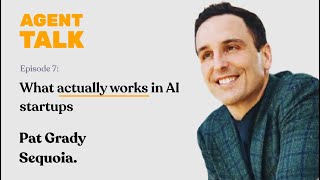
Sequoia's Pat Grady says building an AI company works like any other startup, but two things matter most: trust (show your work, explain reasoning) and persistence (that final 20% of polish that makes it reliable). The strongest moat isn't data or models. It's founder talent and execution.
Chapters
Pat, it's so good to see you. We have Pat Grady here at Agent Talk. He is one of the most prolific and accomplished and wonderful investors. He's also a great human being, which doesn't usually come in the same package. This one time, it invested in Zoom, he invested in Okta, he invested in Notion, he invested in HubSpot, out of all things. And he is just a good friend. And one of our investors in this round for our new venture paid Pat. So good to have you. Thank you for coming.
Thanks for having me, Manny. Great to be here.
Our audience are mostly agent builders. So tell us, what kind of pitches are you seeing? What are you investing in? What's top of mind for you in the agent world?
Well, there are a lot of different directions we can go with that. So maybe as a starting point, this is top of mind because we created this meme a couple years ago and we just sent it to our LPs a week or two ago. The meme is building an AI company. It's a Scooby Doo thing. You know, you've got Scooby Doo and they take the mask off and you see who it is. You know, it says, it says building an AI company. Turns out that it's building a company. And so the point is, a couple years ago when this wave began, everybody did what is natural, which is started to reinvent from first principles and tried to figure out what does it mean to build an AI company. And I think what we've learned over the past couple of years is that 95% of it is pretty similar to building a company. Most of the problems that people run into as their companies start to work, they're people problems. And so I think that other 5% is probably the topic of this conversation. But maybe just as general framing, building an AI company, building an agentic AI company, it's building a company. You got to hire great people, you got to clarify your mission, you got to rally the troops. You know, there's a lot of blocking and tackling that is kind of common to this stuff. And then for, for, for that last 5%, as far as what we're seeing in terms of the patterns that are working or, you know, what the more successful companies are doing. If I had to pick a number one, I'm going to, I'm going to do two number ones, if that's okay. We're going to be tied for number one, trust and persistence. And what I mean by that trust as almost a design pattern. People don't trust AI yet they don't trust your agent. You got to build that trust. How do you build the trust? Part of it is showing your work, showing what you are. You know, this is a design pattern that we're seeing emerging now where agents will tell you what they are doing. And so you're not just sitting there in the dark, you're not just trusting a black box to come back to you with the right answer. You can actually trust the work. When the work comes back, there are citations and so you can take it back to the source. You know exactly where it's coming from. A lot of the companies that are working have a top down distribution model. It's kind of back to the old days of enterprise sales. It's a very human serving, human sort of relationship and that helps to engender the trust. And so I think point number one would be trust. And there's a product aspect to it, there's a go to market aspect to it. I think point number two on persistence, for the most part, the people that we've heard over the last couple years, and this is true today with, with agentic behavior, and it was true a couple years ago with basic call and response type type patterns, generally speaking, the people who've been negative on AI are the people who haven't tried enough, they haven't tried hard enough, they haven't been persistent enough. They got to some 80, 20 experience in minutes, thought it was magical and then they didn't get the rest of the way there in the next hour. The people who really keep hammering away have found that this stuff is truly magical and it gets better every day. And it's sort of, it's sort of an amplified 8020 rule where you really can get 80% of the way there in five minutes and then it might take you another five weeks to get the rest of the way there. And getting the rest of it the way there is really important because of point number one, which is trust. If you just throw the 8020 over the wall and let the customer deal with it, you're setting yourself up for failure. If you really hammer away and kind of get the product to the point where it deserves to be trusted, then you're set up for success in your portfolio.
Who's doing a great job with the trust basing? How are they nailing it? Break it down for us.
Yeah, there are a few people, there's, you know, it's funny, the first one who comes to mind is, is in stealth and so I can't, I can't mention him. But if he's listening, he knows who he is. The, the second, the second one that comes to mind which is very similar is Day AI, which is an AI native CRM by Christopher o', Donnell, who I, I know you know as well.
I just talked, literally just hang up with him.
Love it. And so Christopher built the CRM product at HubSpot and then a couple years ago decided to try to reinvent CRM with AI. The company has a handful of customers, but they're really design partners at this point because they are just hammering away, trying to get it to the point where the product deserves to be trusted. And they're pretty darn close, which is tough because there's a lot of surface area in CRM that they've managed to cover. And sort of, once they get it to the point where when it auto generates the stages of your pipeline, it is correct. When it assigns companies that it sees in your email to each of those stages, it is correct. When it tees up an email for whatever the next action you should be taking with that prospect is, you just hit send. It's getting really close on these things to be kind of a self driving CRM. But it's because they haven't worried about vanity metrics, they haven't worried about adoption, engagement, retention, monetization. They haven't been focused on the typical fundraising metrics. They've been focused on what they care about, which is the quality of the product and deserving the trust of their customers. And I think they're getting pretty close and I think once they're there, we'll really see something that's really interesting because.
We literally just talked about how they auto generate your pipeline and then you get to see a pipeline that's auto generated and you're kind of surprised. Like some people can't handle the truth just on varnish and you know, straight like that. So he was telling me how they had to backtrack a little bit and like, you know, the surprising fact was that they have to create context around why the pipeline looks the way it does and give a lot of background on like why things ended up the way they did because otherwise people just get spooked. And that was great.
A lot of yeah, you gotta show your work. It's like back to elementary school, you know, it doesn't matter if you get the right answer, you gotta show your work. Same thing with agents.
So do you recommend for the, for the listeners out there, do you recommend that people follow that path of staying small, staying focused, not focus on Go to market, not going on growing too big, not focusing on the next round. He clearly has the name and the, and the background to go raise, you know, $50 million. Whoever out there to build this out and blow it up. He's doing it differently, right? Like why is it different and why now? And what, what do you recommend everyone else to take from this?
You know, our, our former partner Shailendra always used to say there are many paths to nirvana. And we've generally found that to be true. And I think that's true here too. So if you look at a different example, Harvey is another company that's working really well. And Harvey went about earning trust in a different way. And it was going after the very tip of the pyramid, so to speak. The very most prestigious law firm. Harvey's a, it's AI for legal. So they went after the most prestigious law firms and sort of earned their trust. And then once they were good enough for them, they were sort of good enough for everybody else. And so Harvey went after the most discerning customers as a starting point. Day by comparison is going after solopreneurs or founders who might have just hired their first couple of salespeople. So they're kind of going after the base of the market. And then you could look at things like Open Evidence. Open Evidence is a medical search product that has all of the research papers and a lot of the peer reviewed medical journals as the training corpus, so that it gives you better medical advice than any other AI product out there. Open Evidence released it into the wild, but had it highly constrained. And so at the beginning it would never hallucinate if it didn't know the answer. It would just tell you didn't know the answer. And in the beginning there were a lot of things where it just didn't know the answer. But over time, as the training got better and some of the RLHF started to, started to set in, it got to the point where it almost always gives you an answer. And so I think Harvey kind of started at the top days, kind of starting at the, at the base. Open Evidence took more of a, almost AWS style, you know, test and iterate and you know, learn in the wild sort of approach. So I think we've seen many different paths to nirvana.
Is there a reason, you know, you see this a lot, right, of agent or AI Companies in general are smaller and they have higher revenue per employee. They're growing at a faster clip than the SaaS equivalents. Why is that happening? Why they're smaller is that is that a learning or is that a constraint?
I think it's pretty straightforward actually. And I think that the fast growth in the dollars per employee are two different things. So the dollars per employee I think is as simple as AI. Companies tend to be more sophisticated than most in the use of AI. And so I think inside the building you have a lot of people who are getting a lot of leverage out of using AI to help them do their jobs. And I think that can literally be a 10 to 100x boost in your productivity. And I don't know if we've. Well, in some cases we've seen 10 to 100x revenue per employee, but that's why I think revenue for per employee is a lot higher. The other point on why they're growing a lot faster. If you look back at prior technology waves, most of them have been related to distribution. And you can go back to the early 80s and the PC cycle, like 83 and 84 was the PC overbuilt putting endpoints in people's homes? At that time there were tens of millions of people who had computers. In 1990, the Internet had like a million users. By the end of the 90s, the Internet was a big deal, but it still only had about a hundred million users. You know, mobile phone, Apple comes out in with the iPhone in 2007 and the App Store in 2008. You know, all of a sudden there are a billion people connected to the Internet. And if you fast forward to today, pretty much everybody on the planet is connected to the Internet. And so the distribution is already in place. Prior waves didn't move as fast because you had to build distribution as you go. Today the distribution is already in place. And so if you uncover some human need that isn't hadn't been met previously, or if you build some enterprise solution that solves an important problem in a compelling way, you can scale really, really fast because you're not building distribution as you go. It's already there.
But it feels different in that, you know, when we build the original SaaS, u know, Salesforce and then everyone else that built it after that, there was a whole like step function, right? You build the product, you evangelize yourself up to a million of it, say give or take, you know, found their sales, then you build it yourself. I mean you really have to scale it. And there is a correlation between the number of sales people that you bring and your productivity per rep and the amount of revenue you're going to hit, et cetera. It feels like that's being challenged right now. The reaching is faster with fewer individuals in the loop. Is that AI or is there something new, fundamentally different about this growth?
Yes, and yes, I think it is AI. I also think it's fundamentally different because of the distribution effect. The thing that's interesting now is again, if we try to analogize to past tectonic shifts in the technology landscape. In 1996, there was the Netscape moment where the browser came out and all of a sudden people kind of understood the Internet, but they still weren't connected. Right. In 2007, the iPhone came out, but you had to physically manufacture this device and get it into people's hands. Cloud got going depends on how you want to call it. You know, Salesforce got going in 98. AWS came out in 2003. I think Salesforce went public in 2004. So sometime like early 2000s, the cloud got going, but there were just a ton of on prem workloads that people had to painstakingly migrate over. Right. And so I think in each of these prior revolutions, there may or may not have been a standout moment like the Netscape moment or the release of the iPhone, but there was still some physical constraint on rate of adoption. And I think today we had that breakout moment. The ChatGPT moment in the fall of 2022 opened everybody's eyes. And I think since then it's been a boardroom topic. You know, it's been a, it's been a founder topic, kind of the whole gamut. People are talking about it and I, I think there's this, this hunger, this awareness, this pent up demand that occasionally gets unlocked when some new functionality is released. Now the thing that you got to be wary of as a founder or as an investor is the Vibes revenue, right? And, and the, the Vibes revenue, it can hurt you. You know, you get, you get, you go 0 to 100 overnight or whatever number it is, and then you look at the metrics and it turns out your engagement stinks and your retention stinks and everybody churns out, right? And it's because everybody's willing to try something and people are willing to try it. It's, it's pretty magical in a lot of cases. But the difference between having a magic moment and solving an end to end workflow in a unique and compelling way, that can be a pretty big difference. You know, back to that 8020 comment from earlier. You know, the 8020 might give you a magical moment, but you got to get that last 20% to get people to stick. And that's where a lot of people are getting stuck. That's the difference between the vibe revenue and the real revenue.
So I heard metrics like one month retention as being taught as like the big thing. I was like, oh, look at the, you know, the cohort a month after they're retained in SaaS. We would never say stuff like that. So what, what, so is there a new set of. In this, in this vibe environment where people are trying a bunch of stuff and you have to get to this other 80, these other 20% that actually makes a difference. What are the new metrics that you look at for engagement and retention and real business building?
Yes, let me mention three things and two of them we're looking for presence and the third is sort of an explicit. Doesn't matter the two where we're looking for presence. The first one is actually the consumer Internet metrics. And so even if you are a B2B business, it's a good time to take a page out of the consumer Internet book and look at adoption, engagement and retention and in particular the engagement and the retention. And even if you have five days worth of data like Dao Mao kind of stuff down mount for consumer Internet is kind of like magic number for sas. You know, it's a good high level metric, it's a blunt instrument, but then you really got to go deeper into it to try to figure out what's going on. But for example, even if you only have five days worth of data, okay, well how many people who showed up on day one came back on day two? How many of those came back on day three? How many of those came back on day four? You know, even if you only have a little bit of data, you can still start to dig in on how engaging is this product and how retentive is this product. And generally speaking, if it's highly engaging and highly retentive, you should have a pretty good path to monetization. And so that's point number one is look at the consumer Internet metrics. Point number two, this is more of a concept than a metric, but it's a concept that should show up in a metric for any given company. And the concept is the data flywheel. Everybody has a story about their data flywheel and how more usage is going to get them more data and that data is going to make the model better. And the better model is going to get you more usage, which is going to get you more data which is going to make the model better.
One of my decks for the past I don't know.
10 years is like a standard percent. 100% of founders can tell this story. 1% of founders can actually do it. And so. And so the concept of the data flywheel is wonderful. The execution of the data flywheel and getting it to actually move the needle is really hard. And if you are executing on it, you should have some sort of metric. Even if you just use it for yourself, to make sure that you're not lying to yourself, you should have some sort of metric that demonstrates it. And I mentioned open evidence earlier. This is a good example. One of the metric. They have several of these because they have several data flywheels, but they, they basically had a. I forget what they call it, a gatekeeper. They have a gatekeeper model that determines whether or not they're going to provide a response. And this is because it's. They're providing. They're effectively helping doctors make decisions at.
The point of care.
The last thing they want to do is, is give you a bad answer and hurt a patient. Right. And so their gatekeeper used to gatekeep most of the queries they got. But then over time, they refined the model and they got better and they trained it on more data and they learned from the way that people are using it. And now the gatekeeper model rarely gatekeeps anything because they're highly, highly confident that the vast majority of the time they can give you an accurate response. And so they can actually show the progression of that model over time, which is a way of demonstrating the data flywheel. So point number one, consumer Internet metrics, point number two, data flywheel. And then point number three, this is the one where we actually don't care about it. And so I think it's worth just being explicit that we don't care about it. A lot of these companies that are ripping right now have negative gross margins. That's okay. They're gonna scale. If you have negative gross margins because you're chronically underpricing your product, probably not good. If you have negative gross margins because you are subscale and you can see a path toward getting to 60, 70, 80% gross margins over time, that's okay. You gotta be intellectually honest with yourself. But. But if at a moment in time you have negative gross margins. Not the end of the world. Why is it not the end of the world? Well, in part because price per token has come down 99% in the last 12 to 18 months. And so the primary cost, which is the foundation model for a lot of these companies, you Know that that cost curve is going down. People are also getting a little more reasonable, I would say, on data privacy. And instead of needing local instances in every European country, for example, you can have a single instance that spans European country for enterprise customers. Instead of needing dedicated instances per customers because they're worried about their data leaking into somebody else's results, people are now accepting multi tenancy. And so there are lots of different things that are allowing capacity utilization to go up and cogs per unit to go down. And thus if your gross margins stink today, you might actually be okay as long as you can chart the path to having healthy gross margins over time, which obviously Agent Pig can help you with.
Now, what is the negative side of that? So tell me a pitch where somebody shows you a data flywheel and you're like, this is bs. How do you like, what is BS to you when it comes to the.
Thing, you know, it's kind of a guilty until proven innocent thing.
So everybody comes in guilty. You have to walk yourself out of that. Is that, is that how it works.
On data flywheels in particular? Because most our experience has been the vast majority of people who claim they have a data flywheel do not have a data flywheel. And so it's pretty straightforward to get us to believe. You just need to explain the logic and then show the evidence. And if you can explain the logic and show the evidence, terrific. We believe. But if it's all hand wavy, we don't believe.
So this is really interesting because I had the same challenge explaining, you know, our data flywheel at my last company. How do you demonstrate that the corpus of knowledge that you're creating is getting larger and that it matters? So for instance, let me tell you the negative case of this. Having access to the entire mailbox actually doesn't matter because that data is there for a reason. You can't do anything, you can't correlate it with other mailboxes, et cetera. So like it stays there. And the larger the mailbox doesn't make you any smarter. Like it just makes you consume a lot more credits. Matter of fact, this is Chris's problem when it's Christopher's, and I was talking to him just a minute ago about margins because of exactly this problem, right? Like some mailboxes are massive. They sync the whole thing and you don't get any advantages. So mobile skills are really small. And you get out, you know, you get everything you need. So that's a, that's a bad example of a data flywheel. You don't get any smart. So how do, how do you, like, what are the rubrics that you have seen people to make the argument that this, that this data flywheel is actually spinning? So, like the corpus of data of a medical thing, that's brilliant, but not that many medical companies out there. So for an aging company shipping trucks or in healthcare or in insurance or whatever, how do they show demonstrably that they have a data mode in a flywheel?
Well, the data, the data flywheel or the data moat is only relevant to the extent it drives some sort of business outcome. So this is an example from a million years ago, but this is one of the early data flywheels that was actually really compelling. There's a company called Noom, which has a nutrition app to help people get in better shape and lose weight and that sort of thing. And when they started it, they had human coaches, and then they started automating a lot of those conversations. And so instead of talking to a human through the app, you started to talk to an AI through the app. And in the early. I'm going to make these numbers up, but this is approximately correct. In the early days, it was something like 20 customers per human coach. And then as they automated more and more of those conversations, they could show this curve over time where it went from 20 to 100 to 200 to 500. And it, and it asymptoted to something like 15 or 20,000 patients per human coach. Like, it asymptoted to the point where the AI was almost entirely in. In control of the conversation. And so I, I think that's a good example where you can't. Now, now you have to make sure you're not causing negative externalities. You have to make sure that your NPS isn't plummeting and your churn is spiking. You know, you have to make sure that you are at least maintaining the quality of the experience as you do that, but holding other things equal. If you can actually show that business metric moving in the right direction as a result of improving the training of the model, that's pretty compelling, right?
What other moats do you look for? So I'm a, I'm an AI agent company, and I'm coming to pitch to you. And I don't talk about my data flywheel because I, you know, I forgot.
You know, the uncomfortable truth is the greatest moat by far is the founders. It's the people. And I know that maybe that sounds like motherhood and apple pie. The reason I say this is an Uncomfortable truth is twofold. One, it's hard for founders to just show up and say, hey, I'm the moat. You know, the reason we're going to win is because I'm not going to.
Rest until we do.
Right. Reason number two, it's hard for investors to show up in their partnership and say, the founder is the moat. You know, like, I believe in the founder. The founder is going to take us to the promised land. It's a lot easier to talk about the metrics and the product and the market and all that stuff. It's hard to talk about the person and really drill in on the person and why you believe in this person. But I think in most, in most companies, the reality is the moat is a function of the founder. And I'll give you two examples of companies that shouldn't exist. You know, the first one again is from a million years ago. But in the late 90s, the smart money was on ebay because the marketplace business model was so beautiful, nobody cared about the nerdy guy selling books. Well, it turns out that guy was Jeff Bezos. And so, and so, like, what, what, what natural moat did Amazon have? None. They should not have existed. They had. They were structurally inferior to ebay, but Jeff Bezos executed the heck out of that company and turned it into one of the most valuable businesses in the world. So that's example number one. Example number two of a business that shouldn't exist. DoorDash. Why in the world would DoorDash exist when Uber already has all these cars out on the streets? Like, Uber was willing to spend a lot more money. They had this physical infrastructure that DoorDash didn't have. Why didn't Uber Eats just totally destroy DoorDash? Tony. The answer is Tony. Nobody is more focused and maniacal on every last penny and nickel and every little lever that can improve the quality of their product for their customers than Tony. And so I, I think the reality is in most of these businesses, the DNA of the founder and their willingness to just run through walls and just keep going is the most important moat. And it's uncomfortable for everybody to talk about, but that's the reality.
So when, when somebody asks you. So for those founders out there listening to this, like, if somebody asks you what's your data mode, you can just say, it's me. You're looking at it.
There's a good way to do it, right? So, for example, we just got really close on an investment and this founder may know who he is if he happens to listen and he, he had actually written up a little bit of his life story and a little bit of what it is that drives him. And that was most of my investment thesis was believing in him and just believing that he will take the business to the promised land. That's also true. You know, if you look at Harvey as an example, we led the Series A a couple years ago. We just led the Series D a couple months ago. You know, we, we went from investing a small amount of money for a large percent ownership in the Series A to investing a large amount of money for small ownership in the Series D. Why would we do such a thing? I believe in Winston. I think he's going to take that business to the promised land.
That's amazing. Back to, back to the margin conversation real quick because that's one of a, one of our thesis here at Paid is that that most, most agent companies or AI companies have a mismatch of the margin versus the value that they are actually capturing. And that is observed both in their pricing, that is observed forth in the net cash flow, et cetera. Is there a resolution to this in your mind over say 5 to 10 years? Is it going to be outcome pricing or is it going to be more like this is going to be more like services where services were priced based on how the customer will consume and that was that. Or is it going to be like a standard in SaaS where there is a perceived model that wins overall? What's your take long term?
Well, I think in SaaS we sort of standardized around the per seat pricing, but then there's a lot of variation around that model. And I think similarly in AI we're going to standard standardize around some kind of outcome based pricing, but there will be a lot of variation around that model. You know, what we've seen thus far really varies market by market. And you can look at something like Salesforce where their agent Force product actually works pretty well, but it's very hard for them to sell it because if you make people more productive on top of your service cloud, for example, you're not going to sell more seats of service cloud. And that's where most of your revenue comes from right now. And oh by the way, there are other people who are willing to show up and say, hey, give me a million bucks and I'll build this thing and then you can own it and run it forever. And that has an impact on your ability to extract value for the outcomes if somebody else has gone from value based pricing to cost based pricing. And so it sort of varies Market by market. I think a good rule of thumb in this world is for founders to start with markets that other people might be overlooking or might appear small at time zero if there's a point of view on how they could become big over time. For example, we're involved with a company called Expo, which is an AI pen testing business. And pen testing as a market has been a services business historically. This is where you hire white hat hackers to come in and try to break into your systems. That's something that AI can actually now do at the same level as an elite hacker. And it's a good example of an agentic AI business where you can't just put a skin on top of a foundation model and let it rip. There's actually a lot of engineering you have to do on top to get it just right and to get it to perform at a superhuman level. But that's a market where the pen testing market is a smallish services market because it's artificially constrained by the presence of this very specialized talent. Now that you can instantiate that talent in agentic AI behavior, it should massively expand the TAM and they should be able to keep running in that market for a while before other people pay attention to it, because it's kind of an overlooked niche market at the moment.
This is fascinating because I actually have two follow up questions. Let me start with the one that is bugging me the most. So they came up with a rubric on how to charge for their services. Right? Because the alternative is you pay hourly to some really capable hacker to do it. And they came up with hacker hour concept in which they're going to create these different packages of like how many hacker hours or disruptive hours you're going to charge for for your thing. So he had to invent a new concept that almost like harmonize and standardize the way that you think about running Pen test.
Yes.
And that would in my mind, unlock the market. Is that, is that true or not? Like, would that.
Yeah, that's a really.
Actually make it grow faster.
That's a really good framing. And you can analogize to when AWS or Snowflake or some of the other cloud infrastructure providers came up with the idea of capacity units. People were used to owning a server. All of a sudden there's this server capacity unit, right? I think we're going to see the same thing here. People are used to paying a human. All of a sudden there's this capacity human unit, right? How much work could that human do in an hour? Or how much work would that human charge you to complete a particular job. And so there's a capacity unit that could be defined in terms of what work is happening. There's a capacity unit that could be defined in terms of what outcome is being driven. So you can kind of look at the input side, you could kind of look at the output side, but either way I think we're going to see that. And this goes back to what we're saying earlier about trust. You know, Expo is doing what a lot of these kind of leading edge agentic AI companies are doing, which is they're showing the work. And so there's the trust building element to that. But then there's also people see what is happening like oh gosh, this thing's actually doing a lot for me. I feel good about paying them a lot of money because doing a lot of work and they're creating a lot of value.
And this, and this is fascinating because it unlocks so many other agents as well. Just think about the fact that there could be a pen testing which you find nothing, but you spend a lot of time, you know, reviewing everything and going through every nook and cranny and creating this randomized behavior that sort of like is better than human behavior when it comes to hacking. And because you find nothing, there is no outcome per se, but the outcome is the intensity by which you, you bang this website or this service that allows you to find no, no, no, no, no violations or no ways to get in.
Yes.
And the fact that he had to invent that actually rounds up his story and now he can go to market and just go real fast. Right? Is that the advice for every AI agent company out there? To find their unit of measurement, of capacity unit and then go evangelize that and own the market? Or is, or is that once, you know, just is very, very pentest centric.
I think we're back to the mini pads to nirvana concept and pricing and packaging is tricky. I think pricing and packaging is one of the toughest nuts for a founder to crack. But, but I would say generally speaking, I think about the input side and the output side, the input side is what is the work that you are doing that resembles the work that a human would otherwise be doing. That and try to codify that, try to expose that, try to be transparent about all the different things that your, your agent is doing. Because you might be able to just charge based on those behaviors. Because it's very easy for people to say like, oh geez, it would have cost a Human. A thousand dollars to do that and you can do it for 300. That's amazing. Right? And then on the output side, even in the case of Expo, if the pen test comes back clean, terrific. The output is a clean bill of health.
Right, Right, right, right, right, right. And so when you go to a doctor, you're looking good.
Yeah.
Ten years on this.
And so I think. I think generally I'd say focus on the inputs. What is the agent doing that is that otherwise a human would be doing focus on the outputs. What is the business value that you are providing? What is the piece of work that you are finishing? And there's probably some businesses will anchor more to outputs and some will anchor more to inputs, but I would start with those as the primitives and try to get really clear on how do you define that unit in a way that makes sense for you and your internal cost structure and in a way that makes sense for your customer and whatever their mental model is for what the job to be done might be.
That's awesome. All right, last question. Hot take. What's. What's an invest. What is a whole category of investments out there that you're not going to touch until something.
I'm trying to think of something I can say that's not conventional wisdom at this point. So I'll give you two things. One is, one is, I think there are two places where we've been somewhat contrarian over the last couple of years, and we may or may not be right, but I think we're contrarian and we've continued to refine our hypotheses. So one is, when we look at foundation models, we. We don't analogize to AWS so much as we analogize to MongoDB. And what I mean by that is they are more like databases in terms of where they sit in the stack, in terms of how developers use them, in terms of their relationship with the underlying infrastructure, the physics of those businesses. They're more like databases than they are like a public cloud. Right. And MongoDB is a beautiful business, but it's a beautiful business that's worth tens of billions. It's not a beautiful business that's worth a trillion dollars. And so I think we've been contrarian in that our sense of the foundation models as API businesses doesn't lead you to hundreds of billions of dollars or trillions of dollars of market value. And so I think that's probably a contrarian point of view. Like, what is a foundation model? Now, the second contrarian view and I think we're actually seeing this out of the foundation models. A couple years ago application layer AI was derided as wrapper on top of GPT, right? And then we developed cognitive architectures and then we developed a gentic behavior. And I think increasingly people are seeing something that we believe for the last couple of years, which is that ultimately the value is in the application layer. And now as that relates to foundation models, one of the big outstanding questions right now, and some we think about every day, is how much of that application layer will be owned by the foundation models. Historically, infrastructure companies or database businesses have had a tough time getting up into the application layer. Maybe Oracle is a notable exception or SAP. You know, we do have existence proof from many, many years ago that it can be done. But in the cloud era, very few infrastructure or kind of infrastructure software companies successfully made it up in the application layer. So I think the key outstanding question is clearly for the mass market consumer product that is ChatGPT, kind of the next generation Google, so to speak, clearly that's going to be owned by foundation model. When we get into functional specific or vertical specific products, you know, software for law, software for medicine in next generation CRM, AI, pen testing, when we get into those things, those feel to me like categories where there's enough domain specific expertise and enough customer backed thinking required that they're going to sustain independent companies built on top of the foundation models. But the question is like, where in the middle do you draw the line? You know what, what will naturally be owned by foundation models? What will naturally be owned by the ecosystem that resides on top?
That's awesome. All right, thank you so much for the time, Pat. That's been amazing. Appreciate you coming out on the week of the launch, publicly announced and paid for us and thanks for your backing, thanks for your help and thanks for your friendship.
Thank you Manny, and congrats on the launch.
More from Pat

Sequoia Capital’s Pat Grady on Building Enduring Companies, the Sequoia Values, and AI’s Next Wave
Adapting to Change in Venture Capital and AI with Pat Grady of Sequoia Capital | 2025 Upfront Summit

Pat Grady: Sequoia Partner on Investing Lessons from Doug Leone, Roelof Botha and Alfred Lin | E1174
Lessons from Past Technology Waves: Pat Grady (Sequoia) in conversation with Eric Newcomer