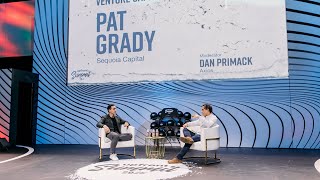
Lessons from Past Technology Waves: Pat Grady (Sequoia) in conversation with Eric Newcomer
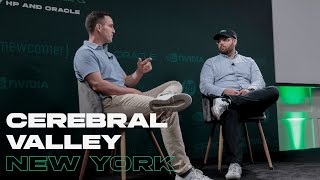
Sequoia's Pat Grady traces how the firm spotted the AI wave from Nvidia's 1993 start through the 2016-2018 Transformer breakthrough. He argues current models are already powerful enough for real work if engineers focus on tuning and reasoning, not waiting for GPT-5. The biggest opportunities are in services like law and accounting, where Sequoia backed Harvey Legal AI.
Chapters
Super excited to be here with Pat. I don't like to oversell people, but I think most people would agree here that Sequoia is widely seen as the top venture capital firm in the world, a firm that is consistently ahead of the rest. And Pat is one of the leaders at the firm path. When did you guys start to catch wind, I guess, of generative AI or how do you get the signs? When did you sort of see, oh, I think this is going to be another wave?
Well, first off, that was a very kind introduction, so thank you. There's an answer that I'm supposed to give, which is, back in 1993, we made the Series A investment in Nvidia. And that is true, but Nvidia was not.
And you didn't ride the Nvidia.
Yeah, yeah. Since 1993 we've been waiting for this moment. No, we did have a series of investments that kind of clued us in on some of the things that were happening. But I would probably say it was sort of 2016, 2017, 2018 happens to be when the original Transformer paper came out. But it was less about what was happening in AI, more about what was not happening in cloud and mobile. Because from a venture standpoint, that was pretty late cycle for cloud and mobile. And a lot of the ideas that we were seeing were sort of derivative ideas that didn't feel like they were addressing first class market opportunities. And so we started dedicating more of our time to just kind of scanning the horizon and figuring out what else might be out there. And one observation we had was a lot of prior tectonic shifts have been revolutions in distribution, where you increased the accessibility of technology by an order of magnitude. And with the mobile phone, revolutions in distribution have kind of reached their limit, like 7 of the 8 billion.
We're holding it all the time. We got it right.
And so, okay, well, if breadth is not going to be the next dimension, it must be depth, which means it's probably going to be a revolution in computation. Okay. Some of the most interesting and richest application experiences we see are driven by a lot of machine learning. And so we started thinking about kind of data machine learning, that whole soup. And that sort of led us to, you know, that led us to the modern data stack. But it also led us to like hugging face and OpenAI and some of these other companies.
Was hugging face your first? Or is there one you would sort of look back and say, oh, I guess that was our first generation?
No, there are other companies, there are other application layers like Gong, for example. Right. Like, there are other application layer companies that were using AI in various shapes and sizes that I think kind of led into this wave that would have predated Hugging Face or some of those.
So to get directly, I guess, into this lessons from the past question, how do you understand foundation model companies?
Right.
I mean, that's the. I guess I'm desperate to know. I think one dream is that they're like AWS or Google. Do you see that?
I was all fired up to unfurl my database analogy and Ollie, Ollie just took it. But I actually think that's the right analogy because if you look at what foundation models do, they are ways to manipulate information. That's basically what a database does for you. And the difference between a relational database or a NoSQL database and a reasoning engine, they are different capabilities that produce different outputs, but fundamentally they're kind of the same thing.
Yeah.
And so if you try to extrapolate from that to, okay, well, what's going to become of all these foundation models? Some of them will be the MongoDB. And MongoDB is an amazing business, but it's a business with a couple billion of revenue and tens of billions of market cap, not a business with tens of billions of revenue and hundreds of billions of market cap. Right. And so I think. I think we might be heading into a world where these foundation model companies, if they are primarily known for the foundation model itself and if their primary product is a developer API that people can build on top of, they look more like database companies at scale than anything else. Now, I think OpenAI is a special situation because you could argue that OpenAI has leapt from being a developer business to being a consumer business. And that puts it into kind of a different category in terms of what the potential is.
Yeah, definitely sort of faint praise. If the best anthropic can be is a mongodb.
Well, I think. But the story is yet to be written because I think anthropic also, there are different orders of magnitude, but there are plenty of consumers using Anthropic. There may be business products that become killer applications. I think the opportunity for these foundation models to get up into the application layer is there, but we got to see who executes.
Do you think models are intelligent enough right now to build great applications fundamentally, or how much do you think today, I guess maybe break your answer between sort of consumer and enterprise? How much you think the state of the art of the current crop of models is enough to build a transformative application?
I might have A contrarian point of view here, I might not, I don't know.
But that's what we do here. What is the consensus?
So my sense is that a lot of people believe that we really need GPT5, we really need GPT6. Like ah, they're not quite good enough I don't think. I believe that because what we're seeing is people who invest a lot of effort in the engineering on top of the model. And you can call it the cognitive architecture, you can talk about planning and reasoning, people use different names for different sort of things, but basically it is the engineering that you were doing on top of the model. When people put a lot of effort into that, they end up producing pretty magical experiences. And like for example, I know Matan from factory is around here somewhere, right? Like these guys are riding on top of other people's foundation models, but they've invested a lot in the cognitive architecture on top. And as a result a week ago they published a new record breaking performance on the SWE bench standard that a lot of people look at for development work. And so that's the sort of thing we're seeing more and more of. And so the sort of parallel universe imaginary experiment that we think about is if you actually just froze the capability set of the foundation models today and invested all of your incremental calories in tuning, optimization, ease of use, economics, the engineering on top, maybe you move some of the effort from these massive pre training runs to test time, compute and do more with planning and reasoning. If you did that, how many industries could you disrupt? And I think the answer is all of them. I think the capabilities today are enough to build just trillions of dollars worth of new businesses.
Is that line of thinking also sort of an implicit prediction that you don't think GPT5 and the rest will be sort of a big leap forward? Or do you have a general view on how much smarter they're going to get?
It's hard to say, I don't. I mean I'll start with everybody is doing their best to sniff around and figure out what's going on and what are we going to see in GPT5. And there are some things that are sort of known and there are some things that are not known.
People think people have access to it.
I'm sure that when GPT5 comes out it's going to blow people away. Or that would be my best guess. Whether or not that's a good thing for the ecosystem is sort of an open question. And the reason I say that is I might analogize to crypto. A lot of what you hear from crypto founders is, look, please give us regulation just so we know what the rules of the game are. I think similarly in the world of AI, please just give us a stable model where we don't have to redo our prompts every time a new version comes out. We're not trying to keep up with the game of different models leaping ahead and then you have to re platform again. And so I think a little bit of stability at the model layer would actually be good for the ecosystem on top because then you can make more reasonable predictions about what you need to build.
In our sort of historical analogy, how do you see Nvidia right now?
Well, are you a buyer?
So you could be right.
My purview is finding companies with a couple million of revenue.
The spikes are really light.
A lot of yeah, see, I like to find companies with a couple million of revenue and figure out if they can have a couple billion of revenue. That's more my business. If we're going to analogize to, you know, if we go back to the Internet transition, right, like where we are in AI right now feels like we're sort of late 90s, right. Netscape moment was 1996, which was when there was broad awareness of the power of the Internet. That was the ChatGPT moment in the fall of 2022, fast forward a couple years. The most valuable company on the planet was Cisco because they were laying the train tracks for the Internet. I think the analog to Cisco today is Nvidia. It is the core infrastructure provider for AI. I think when you lay the train tracks for the Internet, those train tracks have a pretty long useful life. I think when you're doing training runs and GPUs that depreciate in 24 months, the useful life is a little bit different. You could argue that's good for an Nvidia because they got to keep selling GPUs. You could argue that's bad for the people who are buying those GPUs because you may not be getting the return on all that Capex.
Right. Basically we're training up these models and then you need to build the next one before you make any money off the current. This is one of these almost too big questions, but I just want the training to inference shift. I mean, there's a lot going on with the question of are we going to shift from a lot of training to inference? It's partially. Do the models chill out? We train less. Is there less Competition, foundation models. So partially, are there useful applications that people are running inference for? What's your general view on this, like training to inference shift? Question.
I think in general, the amount of training that's taken place is probably more than we need. Back to my point on like tuning, optimization, ease of use, the engineering on top of the foundation models. I think some of the commentary earlier today was Talking about how PhDs have become a currency in and of themselves. And a lot of people believe that they need to go vertically integrated and train their own model, in part because that's like the sexy, fun thing to do.
Right?
But I think from a pragmatic standpoint, again, there's enough out there that's already been trained that you can build a pretty wide variety of great experiences. And so I think people are going to start to realize that and we're going to shift from the training phase into the inference phase pretty quickly.
So you're a big investor in Harvey Legal AI startup? Yeah. Talk about that and sort of how it fits into your general view of where the best applications are going to be found.
Well, you know, we try to. I guess the topic of this is like lessons from history or something. You know, we try to learn from history. I think the Internet analogy is good in some ways. I think the cloud analogy is good in some ways. And I think the cloud analogy is useful here because much like cloud AI is sort of this technical enabler that enables for new distribution models and new business models, but it's not really a consumer front end can enable a consumer front end in the form of ChatGPT, but it is not itself a consumer front end. I mentioned that in the context of Harvey because one school of thought would say, okay, if we're going to analogize to the cloud transition. Well, the thing to be done in the cloud transition was find the on prem software company, build the cloud equivalent. And that actually worked really well for that era. I think the thing to be done today is very different. It's not find the software company and build the AI native version of it. It's find the services industry and AI enable it. And if you go through the list of services industries that are large and bullseyes from a capability standpoint, legal is at the top of the list. It's a $400 billion TAM in the US alone. And the vast majority of what happens in the legal world is text in, text out, which is something that these models are amazing at.
Are you making a consulting bet? I feel like I read a report that McKinsey seems to be making more money off the of AI boom than anyone else.
But I think that that is the, you know, you've got legal, you've got consulting, you've got accounting, you've got bookkeeping. Like these are the venture capital maybe. I think these, these are the sort of things where I think, I think we're going to see a wave of companies that look kind of like Harvey, where they are in some ways the co pilot selling themselves as an assistant to the existing industry, in some ways the autopilot selling themselves as a service to expand the tam. I think for Harvey and probably for a lot of these, you're not going to replace Kirkland and Ellis with Harvey, but there are a gazillion people out there who don't have access to Kirkland and Ellis, who will hopefully someday have access to Harvey.
You love Latham at this.
Sorry, sorry, Latham, obviously best of the best.
You mentioned sort of offhand and your answer, will it displace venture capital? And I had Marco at Goldman today where he was sort of like, yeah, we think it will help trading, but it's not, you know, trading. It's not our best sort of answer for trading decisions today and getting alpha. Where are you as a venture capital firm in terms of using language models to invest more successfully?
Yeah. So you know, many years ago we sort of had this realization, well, geez, if software is eating the world, it's probably going to eat us at some point too. And you know, now, well, if AI is eating the world, it's probably going to eat us at some point too. And so many years ago we decided that we wanted to try to figure out what that looked like and to be the AI or software enabled venture firm versus getting killed by somebody else who does it. And so we have a pretty sophisticated system which is kind of like a smart CRM system, which just to give you an example, like the amount of information we have about a company that we've never met before is more than the amount of information we had at the time of final investment decision 15 years ago. Because there's so much available that you can go get. And for example, like if you're an investor, a big part of your job is doing research on different businesses. You could spend a couple of days just reading everything on the Internet about a company and learn a lot about the business. We don't have to spend a couple of days doing that because we have LLMs who do it for us. Which is why if you just look up a company in our system We've already summarized everything there is to know, not just on the public Internet, but also behind some of the paywalls that we have access to to so that we can automatically say like, here's what this company does, here is why people like it, here's why people don't like it. Here are some of the metrics that we figured out. Here are some of the things that.
Explain the metrics through a chat based interface.
There is, there are a variety of different interfaces that we built in. Most of this is like imagine a rich company profile and then you can go from there to query things.
What pieces of VC do you think AI has the potential to disrupt? And not.
So the basic value chain is sort of like sourcing, picking, winning, building, harvesting, sourcing. You can't ask an LLM to go build a relationship with a founder in any sort of meaningful way. You can ask AI to do a lot of the other bits and pieces of sourcing. And so I think that's part of the value chain where most of it is going to be programmatic over time. That feeds into picking because a lot of the stuff that's useful for sourcing helps to refine your decisions. So I think a pretty good chunk of that's going to be programmatic. You know, the winning piece, that's human to human, that's not likely to be very automated building piece, maybe half and half. There's some stuff you can do there, some stuff that's human and then harvesting, probably not a lot, but for the front end of the funnel, I think automation is going to be a big chunk. It is today it is rare that a company makes it to our partner meeting that hasn't been touched by our system on the critical path in some meaningful way.
Going back to the sort of lessons from history, I mean we've talked about sort of comparison companies and you sort of touched on this, but sort of the natural hype waves of any cycle. I think we experience the crypto boom that was I think very different because I believe in sort of a lot of the technological changes in AI that I didn't quite believe in crypto, but not just crypto, but the dot coms, the financial crisis. Where do you see us in sort of that boom bust cycle right now?
I mean it feels like we've kind of gone through this contracted hype cycle where, because with Cloud as an example, there was no Netscape moment with Cloud. And so Cloud was sort of this very long build as one company after another moved one workload after another into the cloud, you know, with the Internet, there was this public moment with Netscape, I think with AI, there was this public moment with ChatGPT. I think as a result, the hype cycle got smashed into a shorter period of time. We've sort of been through the peak of inflated expectations. I think we would have predicted that the start of this year was when that training to inference shift was really going to begin and a lot of things were to going to start going into production. It still hasn't really happened. And so I think what we're seeing is people kind of fighting their way out of that trough of disillusionment into the whatever that other thing is called. So I think we're seeing the reality set in. I actually don't think there's a lot of hype. We'll just be crystal clear, like there is a bubble in terms of funding for AI. Great, Let me just say that explicitly. But I think the reality of people building with it is fairly sober and people sort of understand at this point we're actually talking about engineering challenges to make this stuff useful. We're not talking about magic in a box.
Two companies outside of your portfolio that you're most bullish on in AI.
I can't think of companies outside of our portfolio. Companies outside of our portfolio that are most bullish. Well, I know. I think Sarah mentioned Haejin earlier this morning. Heygin is not in our portfolio. I think Joshua's amazing. I think that product has pretty broad applicability, so I'll give that as one. And then another company, I think Shardul mentioned Augment this morning. They're different, like many different approaches to that general category. I think that's a very good team and that's a business that I admire in a lot of ways.
Are you personally chasing consumer bets?
I sure try not to.
And in terms of our mini waves, like the whole SaaS wave, is it sort of destroyed or is it coming out? Do you see opportunity there? Or like in some ways AI papered over like a brutal downturn in this.
Well, this is interesting. We had our LP meeting that we do every two years just a couple months ago and like the most often asked question that we got from LPs was is AI going to hurt the existing portfolio? Because there's a lot of software in the existing portfolio. I think no. And it's in part because of what I said earlier. This is not AI is going to go kill the current generation of software companies. This is AI is going to go after services industries. I think that's a bigger opportunity. But also, if you look at the existing SaaS companies, they already have data, they already have distribution. A lot of the power of this product is freely available in the open source world or through one of the foundation models. And so, if the classic battle between startups and incumbents is can startups build distribution before incumbents build cool products? The answer here is in most cases, no. The incumbents can build cool products pretty quickly. Now, that being said, a lot of people want to talk about the data advantage that incumbents have. I think that is a mirage for most of these incumbents because their internal systems are such a mess and their contracts are written in such a way that they probably can't actually do as much as you would like to believe they can do with all of their own data.
Pat Grady, thank you so much.
Thank you.
More from Pat


Sequoia Capital’s Pat Grady on Building Enduring Companies, the Sequoia Values, and AI’s Next Wave
Adapting to Change in Venture Capital and AI with Pat Grady of Sequoia Capital | 2025 Upfront Summit

Pat Grady: Sequoia Partner on Investing Lessons from Doug Leone, Roelof Botha and Alfred Lin | E1174