Sequoia Capital’s Pat Grady on Building Enduring Companies, the Sequoia Values, and AI’s Next Wave
Pat Grady, a Sequoia partner, discusses his firm's approach to building enduring companies through early bets like ServiceNow and HubSpot. He explains why Sequoia is betting on AI applications in the middle stack—databases, identity, security—rather than foundation models, citing examples like legal-AI startup Harvey.
Chapters
Very grateful for Pat to take time. Join us all today. So, Pat, come, please join.
Thanks for having me.
Pat is one of my. Actually, not just for me, for everybody who works at Sequoia. Pat is a very aspirational leader of the firm and also really a role model for many VCs, because most would, of course, love his level of success, but also more than that, I think most would love to have his level of authenticity, style, how he engages founders, and somebody we've learned a lot from. So, Pat, thank you.
Thank you, Pat.
It would be awesome first to learn a little bit about what do you think shaped you as a young person? You know, so tell us a little bit.
Young person at Sequoia or Pre. No, no, prior.
Pre. Pre.
Okay.
I'm still at the Pre. Sequoia.
Yeah. You know, it's funny, we always want to find these founder stories where there are some torment, you know, in their upbringing. There's some, like, defect that drives them. And I had a pretty happy childhood. Like, we didn't, you know, we didn't. We moved around a decent amount because of my dad's job, and. And we were not. We didn't have, like, money or anything like that, but I had loving parents and I have a great brother. And we ended up in a coal mining town in Wyoming. And turns out that Wyoming is the single largest coal producing region in the country. And I think that helps me. That gave me this sort of desperate need to figure out what else was out there. Because in my town, a lot of people would go straight from high school to driving a haul truck in the coal mine, and 40 years later, they're still driving a haul truck in circles in a coal mine. And I saw that and I was like, okay, I got to figure out what else is out there in the world. And so I think some of that desperate need to win that is inculcated at Sequoia started to form at a fairly early age.
Wow. Actually, I did not know that story. And then as a teenager, what were you like, Pat? Were you very competitive back then?
Yes. Everything was a competition. I was probably a little bit too full myself. I mean, I was trying to find things that I could compete in and win. And so I won state championships in, like, seven different activities. Some athletics, some academic. And I just wanted to find outlets to compete even in my. For jobs. I went around to, like, the law firms in town, like local mom and pop law firms, trying to see if somebody would give me an internship because I thought that was a decent way to learn how work actually works, nobody would do it. And so I ended up working in construction. So I worked in construction for a number of years during high school. And you go onto a construction site, there aren't a lot of people running around. And when I got there I was like, okay, well we have a mission, we need to accomplish the mission. And so I would run from one task to the next, just trying to get it done as fast as I could. And as a result, I would get like these little bumps in pay that nobody else was getting. And so it was kind of a lesson to me that like, if you work hard, you get rewarded. But the other guys didn't like it because they didn't, you know, they wish that I would stop running so that they didn't have to run.
So I have a little anecdote that comes to mind. One time I was having this chat with Pat, I don't know if you remember it, I was like, pat, Everybody here at SKOI is so competitive and everybody, we hire this people with this big need to win. And he was like, yeah, that's the spec. That's the spec.
Yeah. The hiring spec is quite literally hyper competitive with the heart of gold. And the hyper competitive piece of that is the thing that drives individual performance. The heart of gold piece of that is the thing that allows you to thrive in a team oriented environment. And it allows you to remember that if you do right by founders, you'll do right by LPs. If you do right by LPs, you'll do right by the partnership. If you do right by the partnership, you'll do right by your team. And if you do right by your team, you'll do it right by yourself. But you have to keep it in that order or you won't end up in the right place. Because we're in the ultimate long feedback cycle business. And I think one of the mistakes that people make is they try to lunge for outcomes instead of just taking pride in the quality of the inputs. And if you take pride in the quality of the inputs and you do that day in and day out and you have your priorities straight in terms of that hierarchy, if you get a little luck along the way, you're going to end up in a good place. And then that hyper competitive piece, when I say that drives individual performance, one of the great joys of working in the venture capital business is you get to see people completely transform over a long period of time. And so when we're looking at people, whether it's founders or whether it's people who want to join our team. At Sequoia, the thing we care about is that slope. And the thing that gives you the slope is that inherent drive. And we try to kind of decompose this hyper competitive thing into drive and killer instinct. And the drive sort of analogizes to, are you willing to show up and put in the work? And then the killer instinct, which I think is good for investors and good for founders as well. You're so busy working every day, you might not recognize the one opportunity that really matters when it presents itself to you. And so there are plenty of, plenty of people who have a ton of drive, but they don't recognize that when that one opportunity that you're going to get in the next 12 months shows up, you got to drop everything and pounce on it. You know, that's where the killer instinct comes in. And that's those two things, the drive and the killer instinct. You have to have both to have this hyper competitive piece, but then you need the heart of gold to keep a bunch of hyper competitive people from killing each other.
Yeah, the latter one super important. Okay, Pat, tell us about your early years at Sequoia.
Yeah. Where should we start?
Well, I mean, I saw you work super crazy hard in those early years, and then you landed US ServiceNow very early, 2009. I think you're only two years into being at the firm. Maybe share that story of you and Doug, you know, trying to get into ServiceNow. And then obviously it ended up, I don't know, it's 150, $200 billion market cap company now. And we partnered, I still say we, we partnered with them, you know, at 250 pre or something. It was a small company.
60.
Okay, sorry, something in that order of magnitude when it was still a small company. It had been around for a bit. Maybe share that story a little.
Yeah, well, I'm just zooming out. So, you know, I joined Sequoia March 5th of 2007. I was 24 years old. That was an experiment. I was the youngest person we'd ever hired. And it was not at all clear that it was going to work. So there are some bumps in the road. But the thing that kind of kept me in good standing with the partnership was sort of like infinite work capacity and sort of the heart of gold thing, like the true dedication to doing the right thing, which not everybody in most businesses have. So for ServiceNow, at one point there was this grand thesis around what was happening with the transition to cloud. And so we did have some top down thinking around what was happening in the world and how the tectonic shift was going to play out. And ServiceNow fit neatly into that narrative. But the reality of what actually happened with ServiceNow was I was cold calling a ton of companies and once in a blue moon, I would sense a heartbeat from one of those companies and I would redouble my efforts and eventually, if we got in front of them, then we would figure out how interesting it was. And so serversnow was one of those. When I started pinging them in 2008, I had no idea that it was going to become the company that it is today. By the time we finally got in front of them in 2009, the puzzle pieces were starting to come together. And so the first in person meeting we had, I grabbed Doug. And at the time, if it was a company that I wasn't so sure about, I'd just go meet it myself. And if it was a company that looked really good, I would grab Doug. And so we go to San Diego and they were in this kind of funny building that looked like a spaceship. And it was across the street from the beach. And when you walk in, it was a two story building. The first floor was literally like surfboards and sand. And not like it was meant to be sand, like they tracked in the sand because they would go surfing at lunch. And then the second floor was Fred Luddy and a handful of engineers. And at that time, the vast majority of the code was being written by Fred Luddy himself. And. And the business was absolutely ripping, but not because of any particular strategy or, you know, operational excellence. It was just because Fred. You talk about 10x developers. Fred is 100x developer. He started ServiceNow when he was 54. He had dropped out of high school to become a programmer. And so the guy had been writing code for 40 years by the time he started ServiceNow. And he had built the prior generation in this category, these companies called Peregrine and Remedy, which they were competitors. They ended up merging. He was the CTO of both, so he sort of knew exactly what the customers needed and he was personally capable of building it. He built the first version of it on a flight from San Diego to London because he was bored and because he was just thinking. He thought he was retired, he was bored, and he was just thinking, I feel like I could have done it better if I did it all over again. So he just tried. His first big customer, it was him and his brother at that point. And they had this folding table at some local IT trade show in San Diego. And. And they're both. They're both kind of like nice, earnest people. So they were standing there in their blue blazers and they were smiling. And this woman came by, she said, because she felt sorry for him. And it turned out she was the CIO of TIAA Cref, which is a huge insurance company. It's like a Fortune 100 company here in the US and she came by out of pity. They showed her the product, she signed a $2 million deal. And so. And so this. It was just such a good product that it just started to take off. So when we intersected them in 2009, they were generating cash. They didn't need any money. And Doug did what Doug does, which is Doug. Doug. I have never in my life seen a more effective salesperson than Doug Leone. And it's not because he's salesy, it's because he is. He is so present and in the moment and so authentic in who he is. And he would meet with these founders and Fred was no exception. He'd meet with these founders and he would hammer them with questions. You know, it'd be 30, 40 minutes and he'd probably get in 60 questions because if he had the gist of it, he'd move on to the next one. Didn't matter if you were done. He would hammer them with questions, which is very unsettling for founders. But then at the end of that 30 or 40 minute barrage of questions, he would say, okay, I think what I heard was. And then he'd talk for like two, three minutes, and he would perfectly capture what was happening in their market, what was happening in their business, what was happening in their lives. And he would paint a picture of how they go from that to the promised land, whatever the promised land might be for them. And he would acknowledge whatever issues there were in the business, and he would gently suggest how we could help with those issues. And by the time he was done, every founder, 10 out of 10, 100 out of 100, every founder wanted to work with him. And so we did that. He did that. I just got him in the room. He did that when we went and met with Fred. And the specific thing that really helped was because the product was taking off and because this was 2009, AWS came out in 2006. In 2009, Public Cloud was not a thing. AWS was thought of as a toy for startups to prototype. It was not something you would build a business on. So the backend of ServiceNow was some managed hosting provider in Texas. And they were basically responsible for running the data center themselves. And because the product was taking off, they were starting to get a lot of latency and then they were starting to get some downtime. And these are big enterprise customers who can't handle that sort of thing. It was starting to impact their business. And so Doug literally just pulled out his phone and said, you need to call. Guy's name is Marty Abbott. You need to call Marty Abbott. Here's his number, he can help you. And we kind of left Fred with that and we went back to San Francisco. Fred called Marty Abbott. Marty Abbott helped. Next time Fred had a problem, he called Doug. Doug helped with that one. And so in a couple of months we went from first meeting to Freddie wanting to create an opportunity for us to invest because he just wanted, he liked the Sequoia brand and all that, but he really just wanted dug rounds.
Pretty incredible. I remember, you know, back in the day people used to, there's basically Salesforce, Workday and ServiceNow. These were the three companies in cloud. And it looks like, you know, ServiceNow may have been the smallest at the start, but is now either the largest or will get to be the largest cloud application company. Pretty close to it. Well, so pretty incredible. By the way, how does an experience like this shape you as an investor? Once you've sort of seen the art of the possible, seen the work ethic, seen that you can discover something from cold calls. I mean, seriously, like, how many people can in their careers as VCs discover like a ServiceNow through a cold call and a chance trip to San Diego with, with like sand and like whatever on the first floor? Like, you know, I mean, it's literally like, you know, rarely happens. Right. Like, I mean, all our young people in the team, like, you know, you have hope. Okay? Like, just please do what Pat did.
I guess in terms of how it shaped me, two of the most important moments in that company's life happened within a couple years of us, us investing. One of those was Fred had been kind of dropping hints that he didn't know if he wanted to be CEO. And so we, this is. And you know, we don't like first person pronouns at Sequoia, but I'm going to say I to illustrate the point that he's been as like a 27 year old with no particular skills. You can make an impact. Like, I heard Fred say this and so I kind of went to Doug and I was like, I don't, I'm not sure if Fred wants to be CEO. And Doug was like, okay, what do you think we should do? And I was like, why don't we just introduce him to a bunch of people who can help him figure it out? And so Doug and I put together this day where we introduced Fred to a ton of people. And the idea was like, learn what it means to be a CEO. Learn what it means to be a founder who grows into a CEO. Learn what it means to be a founder who's brought in a CEO, and talk to a bunch of people who've been in those configurations and try to figure out what's right for you. And we didn't have a preconceived notion on what the right answer was. We just wanted to help him figure it out. And at the end of that day, we go to dinner, and Fred's just, like, grinning ear to ear. And Doug's like, why are you so smiley? Whatever. And Fred's like, I figured it out. I definitely don't want to be a CEO. And Doug said, all right, we'll sleep on it, and if you still feel that way tomorrow, then let's figure out how to find a CEO for you. And so Fred very much made the decision on his own, and it was catalyzed by us just listening to him and realizing that he was kind of wrestling with this thing. And instead of just telling him the answer, we helped him get there. And then once he got there, we managed to find Frank Slootman. And that was kind of the second major stage in the life of the company was Frank Slootman coming in, and just like, we already had an amazing product in an amazing market, and then all of a sudden, we had an amazing CEO and everything just accelerated. And so I guess my point, if the question is, what did it teach me? One of the big lessons from that was you can have a pretty big impact if you just listen carefully and pay attention to what the founder is saying and what is happening in the company. And that's, you know, for a founder to decide to bring in a CEO, that's a huge decision. And I don't know if we would have necessarily gotten there if we hadn't been, like, listening really carefully to what he'd been saying.
Amazing. Well, I'm going to switch topics. Do you want to share the HubSpot story? How did HubSpot happen?
How did HubSpot happen?
And by the way, after doing ServiceNow and HubSpot and several others, Zoom, you know, no wonder you're at the, you know, not able to, like, not able to like many, many startups. You know zip code. Yeah, yeah.
My license plate says Dr. No because I tend to be pretty. I tend to have a high bar. So the HubSpot story. So I'll give you the full context. This was early 2011. This is the inside. This is the inside story that probably not supposed to share. So I joined Sequoia on March 5th of 2007. We invested in ServiceNow in 2009. There's some other stuff along the way. End of 2010, we do end of year performance reviews. End of 2010, my performance review was, you should think about whether or not this is the right career for you. Now if anybody doesn't know what that means, that's like your six month warning, right? Like we're going to fire you in six months. You should start thinking about it. And there was a guy at Sukhoi named Jim Goetz. And Jim is awesome. And Jim grabbed me in January. He's like, what'd you hear in your performance review? And I was like, I don't know, blah, blah, blah. And he's like, do you know what that means? I was like, what? And he's like, you're going to be fired in six months. Oh, okay. Thanks, Jim. I did not know what it meant, but thanks to Jim, I did. And so this is early 2011. And Jim was like, you know, don't worry, we'll fix this. So Jim was the one who brought in HubSpot. So it's now February of 2011. I'm two months removed from that performance review. Jim tried to position it as like Pat, thanks to his brilliant SaaS thing, found this company. So we'd end up in the partner meeting and Jim would be saying like, pat found this company. I'm like, jim, Jim, Jim found this company. And so he's trying to give me credit and I'm trying to set the record straight. But Anyway, with the HubSpot investment, I had a bit of a prepared mind on marketing because I'd been looking a lot at the category. I'd met a gazillion companies and I had a pretty decent sense for the overall landscape. Jim had a point of view on the people and those are the two ingredients in any given investment. It's the market and the people. And so when I met Brian and Dharmesh, I liked them. I couldn't have articulated what made them so special, but they are super special people and they're so complimentary and they work so well for that market that they went into. And Brian's now part of our team at Sequoia, like, you know, 15 years later. We like him so much and he likes us enough that he works at Sequoia a couple days a week now. But I think Jim really had a point of view on Brian and Dharmesh. I had a decent point of view on the market and sort of.
Could.
Make the case for why this company, which at the time was one of many, and even at that point, the Martech landscape was already a joke in terms of how overcrowded it was, kind of had a point of view on how it could become an important company. And so we did a bunch of work with them and kind of put together this three step playbook that we thought they could execute on. And then they did. And so the first board meeting we went to, much to the chagrin of the other investors, they put up this slide and they said the Sequoia playbook. And it was like the three recommendations that we made during diligence, which had to do with what part of the market to focus on, what product applies to that part of the market, how do you price and package it? And they executed really well on that. But that company in the early days, they were masterful at storytelling and they were masterful at building community. And by their own admission they were not very good at anything else. And it turns out that if you are good enough at storytelling and community building, you get a lot of breathing room to figure out what the exact right product is. And so when they eventually had a great product, then things really started to take off.
Now I heard some 4am stories about early days of HubSpot, trying to maybe. Yeah.
I think while we were doing all this diligence work. So there was one night where they got back to us with some, some of the information we were looking for. And it was like, I don't know, 7pm California time, 10pm Boston time or whatever. And I said, this is great. When can you guys meet, know to discuss? And they're like, oh, you know, whenever you want. I was like, how about 7am tomorrow? And they're like 7am all right, that's 10am our time. I was like, no, no, how about 7am your time? And, and they were like, but that's, that's 4:00am Your time. I was like, I know, and, and, and, and, and, and the point was just, I'm usually up at 4 o' clock anyway. But the point was just to, to kind of send the message like it's important, let's go. You know, and so that Brian tells that story today. You know the message. The message landed.
Super nice. Amazing. Okay, I'm going to switch topics. Let's talk a little bit about Sequoia's values. Yeah. How we partner with founders, the thoughts around building an enduring company. What are the two, three things that stand out for you in house? Coyer wants to partner with founders. And also, what, in your opinion has made us enduring in addition to the companies keep saying us and we for now.
Well, I remember Michael Moritz one time was asked this question, you know, what makes Sequoia different? And his answer, which I like, was, we never forget that the competition is outside the building, not inside the building. Because I think the natural way for venture capital firms is to let egos get in the way and to tear each other apart. And I think most venture capital firms approach it as a golf team where, like, everybody goes out and plays around and then you add up the scores. And I think we approach it more as a cricket. Cricket club.
Yeah, sure.
We're like, I think different people have different jobs, but whatever.
It's what Mike Moritz does, understand cricket because, you know, he's.
And so we view it very much as a team sport. And we try to hire people who have different backgrounds and different spikes. And if we can get people of different backgrounds and different spikes to work well together, then our customer, the founder, gets the benefit of all of those skills. And that makes us, as a partnership, a much better offering for them than if you're just getting a single person. And it makes each of us inside the building far more effective because now we have all these different weapons at our disposal in the form of our partners who have different skills than we do. And that's really hard to maintain that as a homeostasis because we are in the outlier business, which means that when you are so lucky as to have an outlier outcome or what seems to be an outlier opportunity, your ego desperately wants to associate it with that thing, right? And so there's this constant pressure that you feel, even with the best possible intentions, to try to, you know, to try to grab credit. And that's the thing that we have to get rid of. Like, the thing that we have to get rid of is the credit seeking behavior and just sort of institute this mentality of, like, you can accomplish amazing things if you don't care who gets the credit and you just do the right thing and do it over and over again, you'll end up with plenty of credit. Right. Like, you'll be fine. But that's hard and that's not human nature. And that's part of what we've managed to, I think, get right is to just have such strong social incentives on doing the right thing, not seeking credit, playing as a team. And I think that's what's allowed us to stay together and to perform for so long. Because we've been around for 53 years now. I've only been here for 18 of those, but over 53 years we've had multiple generational transitions, we've been through multiple technology platform shifts, we've been through multiple macroeconomic cycles. Most of those things would blow up a venture capital firm. And we've managed to sustain the performance, I think largely because the team oriented approach and because of that hierarchy I mentioned earlier, which is founders, LPs partnership, team self.
By the way, for those who don't know this, we are in the same industry, like, you know, at peak 15. You've seen many firms over the years. This is very, very hard and rare to find in a venture capital firm. What Pat just articulated. I recently had an experience four months ago where we met a founder here in the US and he asked me a question. He said, you know, what do you, by the way, what do you think about Sequoia? And I said, look, we'd love to invest, but if you get an offer from them, take it above mine. You know, I told him, I said, look, it's a very special group and I think he knew you. So he said, like, what do you think about Sequoia? What do you think of Pat? I said, if Pat invests, I will happily, gladly say, take his capital. And he can probably help you better and is a phenomenal person. So this is a real story. I can say it in public. So Pat, tell us a little bit about what's going on in AI. And you're pretty forward leaning and I think you have a little bit of a front row seat at Sequoia and you're personally spending a lot of time in it. Yeah, yeah. What is Sequoia up to? What are you guys seeing? What is the state of the. What are the mindset? Yeah.
I'm gonna start super high level and then drill in. Okay, so super high level. Our mission is to help the daring build legendary companies from idea to IPO and beyond. And one of the important words in that statement is the word legendary. If you're going to build a legendary company, meaning you're going to build one of the most important companies in the next couple of decades, you probably need to take advantage of some major tectonic shift that is happening in the world of technology. And so one of the things that we've tried to do is to at least have a series of working hypotheses about what are those tectonic shifts.
Right.
For the most part, when we talk about tectonic shifts, what we're talking about is the transition from on prem to cloud. Right. And so for the last 15 or 20 years, most of the market cap that has been created has been created by enterprises replatforming for the cloud and consumers refocusing their attention around a mobile device. That's it, cloud and mobile. That's most of it. So those are two big tectonic shifts. If you go back six, seven years ago, it felt like the first class opportunities in the cloud transition had already been taken. You could look at the systems of record in yesterday's world and there was already a system of record for tomorrow's world. Salesforce, Workday, ServiceNow, they're already there. And so it felt like a lot of the kind of SaaS companies that were getting started were these second and third derivative markets where it's probably not a system of record. It might not even be a full fledged application, it might just be a feature of somebody else's application. And so six, seven years ago, we started thinking, okay, what could the next tectonic shift be? And I think it was Ruloff who first proposed data as the answer. And so we kind of started pulling this thread around data and that was part of what led to Snowflake and DBT and some of the other modern data stack type investments. But it also led us to kind of see what was going on when BERT came out and NLP started becoming more interesting. And then NLP sort of morphed into machine learning and AI. And we kind of saw that stuff coming because we just had a prepared mind on the topic. And Fast forward to 2020, 2021. We got into business with OpenAI before ChatGPT came out, just because it felt, it felt clear that this is the way the world was going right now I think that's a consensus opinion, but I think having kind of gotten an advance start on thinking through it, we don't necessarily have the same hypotheses on how it's going to play out that most people have. And so I think one example is for the last couple of years, our focus has primarily been at the application layer. And people ask us all the time, why haven't you made any big bets on foundation model companies, we don't think they make sense for the most part they might, but I think if they do, it's because of the apps that those foundation model companies build on top of the models. Like I think OpenAI as an example. I don't think the value of OpenAI ends up being in the API business. I think the value of OpenAI ends up being in the consumer property.
Correct.
It's like chatgpt with hundreds of millions of daily actives. That's a valuable thing. But that's an application. Right. And so our focus has very much been at the application layer. I think that was a contrarian hypothesis a couple years ago. It's becoming more of a consensus hypothesis today. I think Deep SEQ accelerated that consensus. I think our view is that for the most part there's going to be a lot of competition at the model layer, including from open source. And that's wonderful for people who are building on top. There is this pejorative a couple years ago about being a wrapper on top of GPT. We never bought into that. Like, it is true that when ChatGPT first came out and people were first building on top of GPT3 at the time, it is true that if you release a product in 48 hours, there's not much to Is also true that if you pay really close attention to your customer and observe what they are doing in your product and make it better every single day, you can build a hell of a moat on top of a foundation model by dealing with all the messiness of the real world. And so I think application layer is where the value is. That seems to be becoming more true every day. I don't think that was always a consensus opinion.
Yeah, I do think it is now becoming more and more consensus. But I agree with you. We have similar views. We don't understand why five foundation models should exist and each spend billions of dollars like it does in the long term, 10 years.
There's also, I think for the stuff coming from hyperscalers, it's a lot of game theoretic behavior.
Correct?
Right. Like it's not microeconomics that are driving this. It's the idea that if in fact this is the next tectonic shift, you can't afford to lose and therefore you can afford to spend seemingly irrational amounts of money to make sure that you stay in the race. I don't know if that logic is totally sound because the difference between an investment and an expense is that an investment yields a future benefit and an expense does Not. And I remember when Uber and Lyft were beating the snot out of each other.
Yeah, exactly. I was going to say the same.
And they had this hypothesis that driver subsidies will lock up the supply side and then we have a moat. At no point has a driver subsidy locked up the supply side. There are no moats.
Right. Actually, rarely in the history of investing has capital expenditure been able to build moat. Except if you're in very serious infrastructure businesses, it's very hard to see, like if you're building a foundry, probably, you know, you need 10 billion of CapEx upfront. Yeah. So I'm guessing you're a skeptic on the 50 to $100 billion annual spend that all the big tech companies are trying to do near term.
Well, it kind of depends on what. It kind of depends on what game you want to play. Right. Like model progress is somebody with a ton of talent, a ton of capex achieves a breakthrough of some sort. Within weeks it is replicated and distilled and available in open source. Better, faster, cheaper. Right. If you want to be in the breakthrough business, sure. You got to have massive capex for data centers and you got to have the best people. That's a high stakes game. If you want to be in the, let me distill it down and make it more accessible business that doesn't require much money at all. I think right now there are a bunch of people trying to play this game in part because it feels more prestigious and I think over time you'll have more people playing this game because it's more economically rational.
Yeah, totally makes sense. And any last. We caught up in December and I know there's a few AI companies you're excited about.
Yeah.
Any specifics you want to share and like, what's making you personally.
Yeah.
So I mean, again, when I talk.
About the application layer, at the risk of being reductionist, if you want to decompose the stack, let's say we got infrastructure on the bottom, we got apps on top, we got some stuff in the middle, infrastructure on the bottom. There's an enormous amount of value that's going to be created. But that is a game of economies of scale. That value has already gone to Nvidia and the hyperscalers. It will continue to go to Nvidia and the hyperscalers the same way that in the cloud and mobile transition, that value went to Apple and the public clouds. So infrastructure, not a great place to be from a venture capital standpoint. Too many economies of scale. That next layer between the apps and the infrastructure, that's where we think about things like databases and identity and security and analytics and integration and all the connective tissue between the apps themselves and the infrastructure. That's actually a pretty darn good place to be. And if we analogize to the cloud mobile transition, There were about 15 companies that were founded and grew up as part of that, that got to a billion plus of revenue operating at that layer. And that's stuff like MongoDB and Palo Alto Networks and Okta and Snowflake. You know, they were kind of all in this middle ground. I think we'll see a bunch of that eventually in the world of AI. But you don't really need that until you have an application that's in production. Right. And so the apps kind of need to pull that and the apps are kind of just getting there. And so I think this, the wave in the middle hasn't quite started yet. But then if you go to the top at the application layer, again to analogize, Cloud produced 20, 25 companies with a billion plus of revenue at the application layer. So did mobile. So you've got 40 or 50 companies in the last generation that got to a billion plus of revenue at the top. So you got 40 or 50 up here, 15ish in the middle one maybe down here. I think similarly, we'll kind of have this inverted pyramid where most of the opportunities in the application layer that'll pull through some of these developer tools or security type businesses that you need once your application's in production, and then the infrastructure stuff is largely the domain of the incumbents at the app layer. Sort of the exercise to be done 15 years ago was to just map out the buying centers in the enterprise and say, okay, what's the system of record of yesterday? Let's go find the system of record of tomorrow. I don't, I don't think that's the primary exercise to be done right now. I think the primary exercise to be done is to say, okay, what are massive services industries that are super inefficient?
Correct.
I think legal is a bullseye, hence our investment in Harvey. I think medical is a bullseye. And so I think there are few of these industries where there's just an enormous amount of money spent that is not spent particularly well. Because a lot of the work that is happening can actually just be done better, faster, cheaper with AI, which leaves people to do the higher value stuff that they're more interested in anyway. Like how many lawyers want to spend 8 hours a day reviewing NDAs, none of them. Right. And so I think it's actually good for them and good for the industry because when you make things better, faster, cheaper, you make it more accessible, you tend to expand the tam, you know, it tends to be a net positive for most of the people involved. So that that shape of opportunity is really interesting. The second shape that I think is this is where one of our assumptions has changed. So when we headed into this wave we said, okay, I don't think there's going to be a next gen salesforce, I don't think there's going to be a next gen service now. I don't think there's going to be a next gen workday. I think because they have data and distribution and so much of what's new is freely available either in the open source world or via commercial API. They can plug that stuff in the same way that a startup can plug that stuff in. And they should be able to make it through this AI transition. That was our initial hypothesis. I now actually think that's wrong. I think some of those companies will make the transition and some will not, but they're going to have to execute really well to do it. Because what we're seeing with this new wave of AI applications is it's not kind of the same thing you would have built a couple years ago, but there's an API call, it's like a wholesale reinvention of the business. And the way you develop product is completely different because all of a sudden it's probabilistic, right? The way you sell that product is completely different because it's a high trust sale. This AI stuff is scary and you really need to either have crazy high bar on quality for the product and let it sell itself or you need to be pretty darn hands on with the customer and make sure that there's enough trust to get through whatever hiccups happen to occur. And so I do think we're actually going to see a lot of the current incumbent software companies get challenged by a new wave of AI natives. And one example there is, there's a company called Day AI which is started by a guy named Christopher O', Donnell, who we know thanks to HubSpot. If you look at HubSpot's business, roughly speaking, it's like a billion of marketing cloud and a billion of sales cloud. The sales cloud is a dramatically better business because that's sort of a bottoms up PLG business with really nice unit economics. The marketing business is more of a traditional like inside sales sort of Business. The guy who started the sales business is this guy, Christopher o'. Donnell. And he did it in the context of a company that was already working, but he didn't have any resources, he didn't have any go to market work. His mandate was like, build a product that will sell itself, you know, because we can't live with three to one LTV to CAC forever. Right. And so he did that at HubSpot. He was there for about a decade. He ended up being chief product officer of the whole business. That CRM that he built at HubSpot is the only viable challenger to Salesforce today. And about a year and a half ago, which was really good timing, coincidental, but really good timing, about a year and a half ago he said, I actually think I could do it better with what's starting to come out of these foundation models. Let me give it a shot. And and so we seeded him just with the idea about 18 months ago. But I think the thing that made us want to double down is what you can do now with AI. Native CRM is so dramatically different than historical CRM. I think we now have religion that there is actually a new generation of applications to come and they do look very different than Salesforce and ServiceNow and Workday on all those.
You know, one of the thought, at least I've struggled with is all these years, in the last 20, 30 years, what happened is making software was so hard that every enterprise had to sort of map their process to a CRM or an ERP or SAP's, you know, how they had built the platform. And so there's this process in a way, inadvertently or whatever, through the way software evolved. There's all this standardization being going on in various industries and I wonder if in an AI first world people will do a lot more bespoke things because it's so much easier to make and to change software now. Yeah.
So Day's a good example of this. One of the. If you think about the users of a CRM, there's the administrator who's setting it up and there's a salesperson who's actually using it. Okay. One of the things that Day can do is all you have to do is give it access to wherever you do your work, give it access to your email, give it access to your zoom, and just by observing that, it can auto construct the CRM for you. You don't have to tell it the stages of your pipeline, you don't have to tell it what's an opportunity. You don't have to tell it anything. It just figures it out based on the context. And so to your point about it not being so standardized. That's exactly right. Your experience of DAY AI and my experience of dayai may be completely different.
Which is not the case in prior generations of software.
Because they're generating the workflows based on your work.
Correct.
As opposed to saying, here are the workflows, good luck using them.
Correct. Yeah. And I think that has such a profound implication. So like when people tell me, hey, will all these software companies go out of business or people will not be needed. I actually think like 10x software will be written now. It'll be so easy like. Or we could see orders of magnitude more software products get created or products that become so much more bespoke because they're smarter and they don't need to stay stick to a script or a workflow. Whatever.
This is. And this is one of the things that SAS did, right. Like SAS lowered the barrier to adoption for software because in the on prem world, you needed a million bucks in nine months to implement a piece of software. And all of a sudden in the SaaS world, you can just swipe a credit card. I think this is the next evolution to lowering the barrier to adoption for Software. Because with SaaS you still had to learn whatever workflows that software company decided you needed.
Correct.
With. With. With AI, you don't. It can just wrap itself around you.
Correct.
And it can just accelerate whatever it is you're doing.
Yeah. It'll be a very interesting next few decades. Awesome. On that awesome note, Pat, we could keep going for a long time. Thank you.
Thanks for having.
Thank you so much. Thank you.
More from Pat
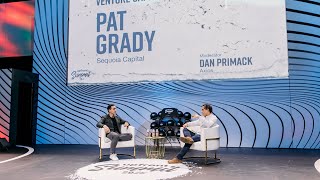
Adapting to Change in Venture Capital and AI with Pat Grady of Sequoia Capital | 2025 Upfront Summit
Pat Grady: Sequoia Partner on Investing Lessons from Doug Leone, Roelof Botha and Alfred Lin | E1174
Lessons from Past Technology Waves: Pat Grady (Sequoia) in conversation with Eric Newcomer