Best (and Worst) Online Business Models for Coaches
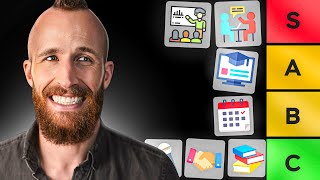
Greg Faxon ranks seven coaching business models from S to C tier, drawing on $1M+ in sales. Group and one-on-one coaching top the list, while affiliate deals and books rank lowest. The key is matching your model to your strengths and how much you want to trade time for scale.
Questions this video answers
April 22, 2024.
Over $1,000,000.
$176,000.
S.
S.
Chapters
In this video, I'm going to rank the best and the worst online business models for coaches and consultants. There are a bunch of different ways you can use your expertise to make money online, and I've tried basically all of them. They each have their own pros and cons, most of which I've learned the hard way. I sold over a million dollars of coaching and courses before I turned 30. And what I realized is this. It's not necessarily about how hard you work. It's about choosing a business model that's going to be easy and that's going to work for your strengths. So we're going to go through seven online business models in this video, and I'm rank them using a tier system. So it's going to go S, A, B, C. If you haven't seen this before, it comes from video games. S is the highest level. It stands for super, and then abc, best to worst. Okay, so let's go through the models, and I think you're going to be really surprised by the last one because people kind of give it a hard time. And it's actually one of my favorite models. So let's dive into number one, affiliate deals. So not a lot of coaches and consultants consider this and affiliate. Those are basically when you sell someone else's product. So that could mean having an Amazon affiliate link. It could mean selling something software and getting a cut of that, or it could be bigger things. You're selling someone else's course or coaching program. For most coaches and consultants, affiliate income is a bad fit. You really need a large audience to make money doing it. You're making pennies on the dollar. And the other thing is you don't get a real sense of the impact that you're making because someone goes and buys the other person's thing. So you don't have control ultimately over the product. So it takes a big audience to really start making money with this. But if you love making content and if you have a large email list, this is something worth. I have this little tools page on my site that lists some of my favorite tools, and some of those are affiliate links. But I really don't rely on that to make money. Okay, so we're putting affiliate stuff in C. I don't think it's a very good business model for most people. Number two is books. Okay, writing a book. And we're going to assume for the sake of this video that you're not going to write a bestseller that sells millions of copies. It might happen, but it's not A good strategy to rely on because there's a lot of luck involved. So if it's not a major New York Times bestseller, what are you left with? Basically, a product that you can sell for $10. So to generate 25k in revenue, you'd be selling 25,000 books every single month. And then you have the shipping costs. You're not even getting 100% of that $10. So it's actually more than that. Books usually aren't a great way to make money online. The main way I think about books is as a marketing tool. So I have a book and I use it to get on podcasts, to get press. I use it to send to potential clients to warm them up between sales, and it can help for that. But I don't think books are the most efficient marketing tool anyway. You should only write a book if it's a labor of love, if the process of writing the book would be worth it even if you didn't make money from it. So we're going to put books in the C spot as well. I don't think that it's a great fit for most people. You shouldn't build your whole business around a book. Okay. Number three is a low monthly membership. Membership sites were very in vogue a few years ago because the dream is you have recurring revenue every month. You're not starting from zero. And typically those businesses are seen as more valuable from investors because you're not selling new people into the program all the time. That's the dream. The reality is that you're dealing with churn each month. Not everyone that enrolls is going to stay in the program. And so unlike software where you can have a recurring revenue model that's very sticky. Like someone signs up for your email marketing software if you're mailchimp and they don't leave because they keep using it. With a membership site, you have to keep pumping out information, you have to keep doing those Q and A calls. It never really stops. And if you do stop, you start losing people. So I think for most people it ends up more of a hamster wheel. I coach a client, Gemma Gilbert, and she had a membership site that was successful, is doing well. I think it was doing 5 to 10k per month in revenue. And she just found it so complex and exhausting that she ended up moving to one of the next business models that we're going to talk about. So low price memberships for me are a B, they're better than affiliate and books, but they're not as good as Some of our other picks. And that brings us to number four, which is online courses. And these usually sell for between $100 to $2,000. Sometimes they're DIY courses where the person pays for it and they're on their own. Sometimes the course involves Q and A calls or a group or something like that. You can launch the course live. You can have an evergreen like webinar funnel where people are buying it each month. And I like online courses. I think that they have their place. A few years ago I did the math and realized actually made 176k from online courses in total. They can be a good form of semi passive income. But you still have to do the work up front to create the course and then you have to create the marketing for it. A lot of coaches assume that because they can sell one on one, it's going to be easy to create a course and then do the copywriting that's involved in the sales page. But it's really a whole different set of skills that you have to learn. And you need an audience too. You need a big enough audience to sell something for 500, 1,000, $2,000 and still hit your revenue goals. The other con is that even if you do a good job to make the course actionable and easy to implement, not everyone's going to even log into the course and do the work. They don't have that accountability that comes from being live or one on one. But on the other hand, if someone does take action on it, they've gotten a great deal, they're going to get an awesome return on investment because the information is all there. They just have to go take action on it. And they're not paying to work with you one on one. So you get more scale with a course. But it needs to be in alignment and you need to actually enjoy teaching. Online courses are an A. I want to put them at A. I think online courses definitely deserve a spot for a lot of online businesses. Number five is in person events in most cases. I think live events are way more trouble than they're worth. They're expensive to put on, they're a pain to fill. I remember I held a live event in Washington D.C. it was a two day event and it was really, really hard to fill. I sold it for like $750 and on one side I was selling coaching packages for like 10k, 12k and I could not sell this live event. Why was it so hard? One reason is because people have to go travel to the event. Even if you fill the event. Now you have all the expenses related to feeding people, renting out the rooms. You might have a hotel block that you need to fill. And I remember there was a point where I was meditating every an hour leading up to the event just because I was stressed about filling this event. I didn't want to show up and have no one there and feel like an idiot and be losing money. So in most cases it's just easier to invite people to a consult and then enroll them as a one on one client. If your event breaks even and then you get one on one clients off the back end, I think you can justify it. But it's not the first place I'd look for your business model. Now if you're speaking at someone else's event to get clients and they do all the work, or you're getting paid specifically for like a corporate speaking gig or workshop, then that's a different story and that can be a good use of your time. So we're going to put in person events at level C. I don't think that they're great and I think most of the time when people do it, it's just based on ego. They want to say that they did a live event. We have two business models left. Before I share those. If you're feeling a little overwhelmed and want support going through these business models and thinking through what you want to add to your business, then apply for a complimentary strategy session with me. You can go to gregfaxon.com apply and if you qualify on the call, I'll walk you through these and support you in figuring out a game plan. All right, so number six. Number six is group coaching. Group coaching is pretty interesting because you can charge high prices for it. You can charge 9k, you can charge 18k. I've even been in a group that cost that much or even more. But you still have some time leverage. You're not working individually with each client. Of course there's still a cap on the number of people you can take on before you have to cap that program or bring on team members to support those people. And there's a big difference with how a group coaching program feels versus a one on one program. Personally, I enjoy doing one on one coaching myself. I find group a little bit stressful. And you're trying to facilitate all these different people getting their needs met. But if you like facilitating group calls and you're good at it, then group coaching is a really, really good option. It's also a good option if you can't charge super premium prices for your niche. Maybe you're not in a business niche. You help people with like parenting or a fitness thing and you're like, well, Greg, I can't charge 20k to do that one on one. I can maybe charge 5k and then you might want to do a group program for that. I've run a bunch of group programs over the years. They always make a ton of money. People get great results. But I think you have to think about whether it's aligned with how you want to spend your time. The mistake most people make is trying to move to group too early. They have a few one on one clients and they're like, I should now do a group because I'll have leverage. But they don't have enough of an audience yet to pull people into the group and have everyone enrolled and starting by a certain date. Group coaching is an S. Group coaching, if you enjoy it, is excellent. A lot of the big successful coaching companies use this model. And finally, number seven, one on one coaching. This is where most coaches start. They're in the trenches, they're enrolling someone individually and they're working with that person to help them get a result. But most people assume that once they've done a bit of that, they need to change their model in order to make more money and in order to scale. Not necessarily. You can make 25k per month. You can make even more than that exclusively doing one on one. The change that you have to make is increasing your prices and increasing the type of client and the value that they get. And the cool thing about that is if you're charging enough, it only takes you enrolling one or two new high end clients a month month to hit that 25, 30k per month mark. The downside to this model is in order to really scale it, you will need to build a team. You'll need to build a team of coaches who are working with clients and that can become a headache. There's a lot of admin involved and if you love the one on one part, then you don't want to be out of the process. You want to be supporting clients. I think people overall sell one on one coaching short. It's simple, it can be very lucrative and it's fulfilling. You're usually getting really good case studies when you're working with people one on one. Whatever models you experiment with, it's great to have that foundation of one on one that you know you can always come back to to pay your bills. So we're putting one on one coaching as an S I'm putting it right there with group coaching and I think how you choose you can do both obviously, but which one you choose just depends on whether you enjoy more working with a small handful of clients individually at very high prices or if you want a group program at a slightly lower price and then they get the dynamics and benefit from having a group of peers to go through the program with. I'm curious, put in the comments. Do you agree with these rankings? This is my own experience, so you might have a different experience and going to have to figure out what works for you. My main advice would be keep it simple. Choose something that you enjoy that you can figure out that model because if you keep jumping from one thing to the next, you'll never go deep enough to make the model work for you. If you want to see my online business model, how I generate six figures in profit each year, how that breaks down, then watch this video because I walk through the two main things that I use on this list in order to make money. Check it out now.










