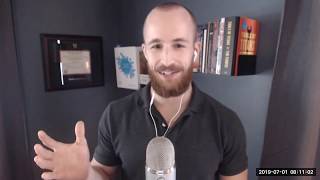
A YouTube interview (recorded July 7, 2019) in which George interviews Greg Faxon about transitioning from business coaching to launching a fitness coaching business called Enough Fitness. Greg describes his experiment of applying his Coaching Business Bootcamp to a new niche, how he acquired initial clients from his warm network, early results (clients lost 10–30 pounds over 90 days), and the concept of marketing archetypes (connectors, mavens, salespeople) to choose suitable marketing strategies.
Questions this video answers
July 7, 2019
gregfaxon.com and enoughfitness.com
George
Clients lost between 10 and 30 pounds during 90 days
Chapters
Today, I'm really excited to interview Greg Faxson. He is an extraordinary business coach, but he's also building a new coaching business in a different niche. So I'm excited to ask him about that and hear the lessons that he's learning as he's applying his own business and marketing strategies and experience into a new niche. And I know that a lot of you watching this are trying to build a service kind of business from scratch. So I think you're gonna get a lot out of this interview. So Greg and I first met because he was writing a blog post that was going to incorporate different sort of thoughts from different experts. And when he reached out to me, I said, you know, I don't really do that kind of thing, but maybe we could stay in touch by other things. And somehow we got back in touch. And. And that's also to the testament of the power of authentic networking. Like, we wanted to find a way to connect, to collaborate in a way that felt really good for both of us. And Greg was. I think either Greg reached back out or I reached back out, but we felt something there. And that's what I encourage all of you to do too, is like, when you find a kindred spirit, keep in touch. Try to find a way that will works for both of you to feel like, hey, this is a value add to both of us and to our communities, etc. So Greg has been so generous over the years in mentioning me in his blog posts or to his clients. And I know a lot of you haven't yet met him, so I wanted to bring him on and share his wisdom and his story with you guys. So, Greg, thanks so much for doing this interview.
My pleasure. Thank you for having me. And I want to let you know, George, I was thinking earlier today that I really appreciate your approach to staying connected and when you reach out and you know what you want to chat about. And I remember we looked at each other's websites a while ago, so I appreciate how you model that sort of authentic networking approach.
Thank you. Absolutely. So you're such an interesting guy because you are, like, always on the cutting edge of your field. That's the feeling that I have anyway. I mean, gregfaxon.com, g r e g f a x o n.com for those who are looking for the main site that I've known about. Now we're going to talk about the new website too. You are just very focused on helping coaches and service providers fill their client roster. So for those of you who would like I would love to fill my client roster. Go and check out gregfaxon.com f a x o N and he has amazing articles there. He also has an online course there. If you want his strategies and wisdom on how to do this, have a full business. And you are. I like that you're. It speaks to your integrity that you're like, you know what? I want to apply my own strategies to filling a new business. And you have multiple interests. You have been a very dedicated athlete for most of your life. You've been a weightlifter, you've been a wrestler. And now you're like, you know what? I'm going to teach men how to stay fit. Right. So tell us about your new business.
Sure. So this started around this time last year, actually, and I had a couple thoughts at the same time which kicked this new business off. One thought was, you know, coaches often come to me and say, well, your strategy works because you're working with coaches, so of course they're going to invest in coaching. And so maybe what if what you teach only works if you're coaching coaches? Right. And we are kind of in a world that gets very meta, right, where there are a lot of people, you know, offering to help coaches build their business as well. So sometimes if you're just getting into it and you're not a coach for coaches, you're a life coach, business coach, you know, health coach, whatever it is, it's easy to say, well, am I just in this weird little snow globe that isn't actually, no one makes money except if they're working with other coaches. So the first thing is I kind of wanted to prove that wrong. Like, I heard it enough times, I was like, alright, let me just show. Because I knew I had worked with clients and none of my clients coach other coaches. But I wanted to show people that it was possible. Not just that I could give advice of how to get clients, but actually show people how to do it. That was number one. And number two, I was starting to get to the point where I was antsy. I know you will sometimes have side businesses, side projects, and it's this constant tension of mastery comes from focus and discipline and not just quitting when you're in the dip, as Seth Godin would say, but also if you're a creative person, you sometimes reach points where you're lacking motivation or something that's not as exciting and you need to try other stuff. And for me, I was at a point where I was more passionate than ever about fitness, which had always been an interest of mine. So I started off last year just running an experiment, and I said, here's what I'm going to do. I'm going to go through my own course, which is called Coaching Business Bootcamp. I'm going to do it in a whole other niche, and I'm going to journal my process. Each week, I'm going to make a video. I'm going to write a journal entry for my audience of what I did that week, what results I got, what I learned. And it'll be hopefully, a fun way to both kick off the new business and spend time on that without neglecting my existing business, because I'll kind of be two birds with one stone in terms of serving both sides. So I did what I recommend in my course, which for anyone who's kicking off a business, this is a good strategy. This is one of the things I teach, is to put out an offer to your warm network. Everyone always wants to start with Facebook ads or building funnels and webinars and things, but you already have a sea of people who know, like, and trust you. So tapping into that can be scary, especially if you're in a new world as a coach or a spiritual advisor or healer, because maybe that's something you've kept a little bit to yourself. So you don't want to be judged by the old friend from college who, you know, you used to go drinking with, and they knew you as this one person and now you're this other person, and you know that they're going to see that. But sort of coming out as a coach, putting yourself out there to your warm network and offering. Are you still with me? And offering a complimentary strategy session, clarity session, whatever you want to call it. But a coaching conversation with people in a. With. With who are dealing with a specific challenge in their life.
Right. Yeah.
Putting that out in a warm way, but also in a compelling way that shows the value of that conversation. It's not just, hey, I'll spend 90 minutes coaching you, it's, hey, here's going to be the focus of this time and what you're going to get out of it. Yeah. Now, of course, a certain percentage of those people will want to work with you beyond that single session. So that's how I recommend that most people get their first five clients, is by tapping into their warm network feel. Facebook tends to be the best way. You can also use Instagram, put the offer out there, and I give people a template that they customize to their voice and their niche. So I did That I went through my course, I got five clients in this new fitness coaching niche and started working with them and did that alongside my main business. And those clients that I got, that batch of clients, they were primarily focused on losing weight. And in the fitness niche, that's a pretty common result or outcome. And that's sort of a painful, frustrating problem if someone's been struggling with that. And throughout the 90 day program I was working with these people. One on one. People lost between 10 and 30 pounds during those 90 days using a really habit based approach, a good, sustainable approach. And then I just kind of put it to the side. I did those eight weeks of journal entries and I was like, all right, this is good. I got to now focus back on my business. I got to have that discipline to just stay focused on. It's hard enough to scale an existing business. So I spent some more time fine tuning and tuning stuff in. And in the first quarter of this year, I actually had the best year financially that I've ever had. And I was just focused on gregfaxon.com I dialed in a lot of my own systems and at the end of that quarter was also the least motivated I ever was for Gregfaxon.com so it was this very weird, very weird contrast and I just couldn't let go of those experiences I had had with the batch of five clients. And there was something about helping someone with their fitness and their confidence and how they felt in their body that just was really, really fulfilling for me. So around end of third quarter this year, I jumped back in and I've been doing more journal entries so people can see right. On my blog each week you're seeing what I'm trying and what's working and what's not. And I'm really having to go through that process, building from scratch. It's crazy to look on, you know, my ConvertKit account and it's like 11 people or whatever, right? But I'm used to having an audience and it's good to cultivate that beginner's mind again too, of going through the process and really having empathy. Around the same time I was starting this back up, I was running a live cohort of one of my courses and like really being able to feel how they were feeling. Where when I was only doing Gregfaxon.com, i had sort of forgotten what it was like to be in that starting phase. So that's the story of sort of how I've gotten to this point of starting the new business. It's called Enough Fitness. It's@enoughfitness.com and my main focus that I'm working through now and the specialty is helping guys feel good naked. So it tends to be guys 25 to 35 have very, very demanding careers, oftentimes have gone up and down in their weight throughout their life. And so I'm sort of exploring what's gonna work in terms of attracting clients. Am I focused on guest blogging? Am I gonna focus on building a podcast? Am I to focus on Instagram? There's so many different options. And so I can even speak a little bit to. I've been speaking for a while, but I can speak a little bit to this idea that might help people in your audience of marketing archetypes. I don't know if we've even chatted about this, but.
No, we haven't. We haven't. But there's a lot to unpack in what you just said. There's. I want to encourage people to go to your website, Greg Faxson, to see those journal entries about you. Eight weeks of building a new business. A lot of the folks watching this know that I have also over the last year been dabbling with a new side project. Now the difference between you and me is that I think you gave enough time to it. I mean, even in the eight weeks when you were doing it, how much time would you say you spent in those eight weeks?
Man, I'm sure I put it in my journal entries. But actually, like you, I'm like very dedicated to my calendar and blocking things off. And I spent 10 to 25 hours a week on it.
See, that's the key. That's what I didn't do. I spent an hour and a half to two hours a week on that side project. That's it. And so all I could really do was write something, make a video, run Facebook ads. Cause my commitment was that I would keep it secret so that my current audience I wouldn't benefit from, oh, Georgia's already well known or whatever. But it's like, no, no people who have no idea who I am. Not no friends and family, nothing. It's just like new people, random people finding me through Facebook ads. Anyway, so that's the core. I want to just, I want to make that point that if you think that you could also build a business in two hours a week or even four hours a week, it's really, really, I mean, even for so called business experts like us, it's highly unrealistic. So at this point, just give everyone an update. I'M still dedicated to that. Hour and a half, two hours a week. But I'm making a hobby now and maybe long term it could become something. But I want to ask you right now about enoughfitness.com so enough fitness, your new business, how is that related to your eight weeks business?
Yes.
Okay.
Yeah, so that was me picking it. That was me picking it back up.
Okay.
So yes, I view those, those eight weeks I did last year was almost like what you would do alongside a full time job. Like, is this gonna work? Can I make money doing this?
So great.
And then this phase now is like basically as if I basically quit my job.
And so because now you're spending 90% of your time. Yeah, Enough fitness.
And I wanted to offer something to what you said. There's a flip side to that. It's really delicate, that balance. I think that, you know, when I was spending, I'll say probably it was probably 10 hours a week. It probably wasn't more than that when I was doing the trial. I think that's important to you need. It's tough because you got to put enough time in to get traction. But then you also can't let go of the thing that's making most of your income and where you already have traction. And so I think the flip side is now is, you know, my wife and I recently moved to Burlington, Vermont. So we just went through a move a couple weeks ago. And that was, that move coincided with me transitioning to this new business. So the cash flow is more limited. I have some money coming in from Gregfax.com passively. But there's two sides to that is like you have to spend the time. But also there's sacrifices and there's instability in that transition as well. But I think that's the balance is can you get five paid clients? That's sort of how I did it when I started this original business. Like can you make some good? Can you validate it alongside whatever your main gig is, even if that's an existing business that you already built and then being able to devote more time to it.
So about enough fitness. I mean, this video is going to go on Facebook and YouTube and I was thinking, man, YouTube is your audience. Because YouTube is like mostly men. I mean, at least when I look at my stats, whereas Facebook, most of the viewers are women on Facebook for my page anyway. But on my channel, on YouTube it's mostly men. But that's, that's generally true for YouTube. It's mostly men in there from teens, all the Way to, you know, 30s, 40s, 50s, et cetera. But it's. It's very. So anyway, I want to encourage you to add YouTube to the mix, and I think you're going to reach a lot of your people there. So you started to mention marketing archetypes. No, we haven't talked about that. Do you want to kind of talk a bit about that?
Sure. So one of the things that's been aiding me in figuring out what is my channel and what is my way of reaching people, and I appreciate the tip about YouTube, is this idea that I developed in the original business around marketing archetypes. And this is something I'd recommend. After you get your first five clients, don't really worry about this until you go through the process. It's not that difficult to get your first five paid clients. There's actually a pretty solid formula that basically works for everyone. You don't need to figure out what your own way of marketing is. Just reach out to your warm network in the right way. And it's pretty straightforward. After that, you got to figure out, well, there's hundreds of different ways to get clients. It's really easy to get overwhelmed by everyone. Okay, this is my special system. Or you have to do it this way, or you have to be on Instagram, and then you end up doing 10 things in a mediocre fashion. So I stole this idea from Malcolm Gladwell, or I adopted it to marketing and coaching. He has this idea and the tipping point that there's three types of people. There's three archetypes that help ideas spread. The first is connectors, second is mavens, and the third are salespeople. Okay. So connectors have a naturally large and deep networks. They are naturally curious. They're just charismatic, good at connecting with people, good at listening. Connectors tend to be the pure coaches, the coaches who, like, I don't want to have a signature system. I just want to ask the client questions and do that pure coaching, Right. And I don't even really want to market myself. I just like being with people. The mavens are. You and I are both mavens, so we're idea people, thought leaders. We like to, like, think about the system and the. And the right, like the best way of sharing a concept and idea. And we like to teach that. Okay, so mavens are natural teachers. And salespeople are a lot of people. As you know, a lot of people in our audience get turned off by the concept sales, but they're naturally persuasive when they have an idea or something they're starting. People just naturally want to buy in because they show this excitement and they're convincing and they're persuasive. And so people that are salespeople, like in our industry, think about, like Brendon Bouchard or Marie Forleo or Tony Robbins. Like, those people just rally behind them because they're just very persuasive and they get people excited about things. So if you know your archetype and actually have a quiz on Gregfax.com I can give you the direct link. But if people scroll down to the footer, it says quiz, and they can figure out their archetype, you can get a sense in this conversation. And then each archetype has a series of strategies that tend to work well for that archetype. So, like most of the stuff we do, all this is really made up. It's not that you have to be just one archetype or that you can't do other things. It's just a way to help guide yourself, to narrow down the options and have a sense of your personality so you can market best for your strengths and personality. So let's talk about connectors. So if you think you might be a connector, you tend to know a lot of people. You tend to like being with people, asking questions, being curious. Things that work well for connect is referral partnerships, right? Who else in your niche might serve your audience in a complementary way, not necessarily in a competitive way where they're doing exactly what you're doing, but in a complimentary way. How can you add value to their audience? How can you just reach out and start a conversation and start a connection? So this would be an example of good connector strategy. You reached out, we're doing interview, we're sharing concepts. I'm also getting the opportunity to teach, which is more of a maven strategy. Right. So for connectors, referral partnerships, establishing those referrals can be a really good strategy. Connectors also tend to do really well on those, like free session offers when you launch the business, because they've gotten to know and they've established trust with all of these different people, and they haven't really tapped into it yet. So second archetype, mavens, what works well for people who are good at teaching? So we like doing webinars, we like teaching, we like having really super detailed, like, I'll create these blog posts that are really, really, really long, where I'm breaking stuff down and establishing your kind of unique concepts and thought leaderships. And even naming your concepts and things like that so you become the person. Oh, this is George. He's well known for this concept. For salespeople, you really want to be on calls as much as possible because if you can get people, a potential client on a call, they're probably going to want to sign up with you. Even if you're not doing a fancy script or anything like that, they're just going to be excited to hop on board with you. Live speaking engagements can work really well for salespeople because, again, people need to be around your energy field. You have a magnetic energy field. Facebook Live, videos, anywhere where people are getting as directly connected to that natural energy field as possible tend to work really well. The reason I brought this up is because knowing that I'm a maven, it's helping to sort through some of the different strategies that could work for attracting clients. And I know the things that probably don't make as much sense to spend time on because I know what my archetype is.
So good. So good. I love that. I love that you are kind of giving people the permission not to have to be good at everything. I think that's really key. It's like, no, I can lean into my strengths and know that if I am consistent there, there will be fruit, you know, that comes from it. Well, Greg, it's been great to chat with you. So just to recap, for those who are wanting to fill their client roster, who want more clients, who want to understand their marketing archetype and the strategies there, people should go to gregfaxon.com g r e g f a x o n.com Greg Faxon I'll put the link in the notes of the video. And for those who are men, particularly. So your ideal client for enough fitness is guys 20s and 30s, right? Okay. Who are wanting to be fit, look good naked. I love that idea. It's like, yeah, you know, we look at ourselves in the mirror, we take a shower, we're like, yeah, there's some work here that needs to be done.
Why is this always happening?
Or whatever. So, yeah, for those, the guys who want to look good naked, go check out enough fitness. I haven't even looked at it myself. I'll go check it out. Enoughfitness.com Greg, you walk your talk both in terms of the business coaching, marketing stuff as well as your fitness. So thank you for the work that you do. Thanks for being a good model in the world.
Thanks, George. Appreciate it.
Thank you.










