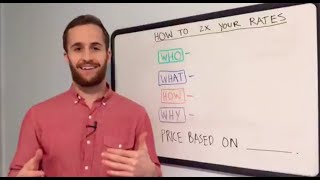
YouTube video by Greg Faxon explaining an ethical framework to double coaching or service rates by increasing perceived value rather than arbitrarily raising prices. Faxon presents four components coaches should clarify: who they serve (target audience hunger and ability to pay), what result they provide (tangible, high-ROI outcomes), how they deliver the result (a distinct, hard-to-copy process), and why clients invest (the buyer’s story, urgency/scarcity). The core recommendation is to price based on client value and return on investment, not time or credentials.
Chapters
This video, we're going to talk about how to double your rates without sacrificing any integrity. And a lot of times, as coaches or service providers or entrepreneurs, we think about getting more clients or getting more customers, which is fine, but it can be really time consuming. So what I want you to focus on today instead is what would happen if you could increase your rates. Well, you'd probably only need half as many clients, which would save you a lot of time, a lot of energy. But there's a way to do it that is ethical, and there's a way to do it that's just arbitrary, and we want the ethical way. So there's four things that you need to think about. Four components. You got to get clear on if you want to double your rates. And if you get clear on them, you can double your rates this week. It doesn't have to be waiting for years and years for you to build up your skills and, you know, get better over time. That's great. That's one component. But the other component is figuring out how to raise the value of your service. That's exactly what we're going to talk about. All right, so the first component is the who. And we're talking about here is who you serve. All right, who you serve. We want to target people who are hungry for what we offer. And here's an example of this. If I had a sports supplement company, I probably wouldn't want to target just your average Joe who didn't really go to the gym much, who didn't really put in the work to have a great body, who wasn't an athlete. I would want to target the elite athlete. Why is that? Because if I target the elite athlete, that person is hungry to get an edge, and they're going to be willing to pay more for that little incremental improvement in their performance, much more than someone who just messes around on the weekends. And that person has already spent a lot on their sport and to improve their performance and on supplements. So I know that they're less sensitive to price because there's more value there for them. Right. There's more value to increase performance to the elite athlete than there is to the weekend warrior. So get clear on who you serve and figure out, is the person that I'm targeting right now willing and able to pay for the service that I provide. And if not, you might consider serving a different audience. Okay, the second component is what? Okay, and this is, what result do you provide? All right, what result do you provide? We want to choose to provide a result that has a high return on investment for the person, that it's either moving them away from a painful or frustrating situation or it's moving them towards an irrational desire or a goal that they really want to achieve. If the return on investment isn't there, you're not going to be able to raise your rates because ideally your rates should be correlated to the value that your service provides. So the value is based on, you know, how frustrating or painful their current situation is or how great it would be to, to have that certain result. And so if you're providing kind of an intangible result where people can't really tell what the value of it would be, then you might think about getting a little bit more tangible, specific and measurable with the result that you provide. And the test here is to figure out from your target market, once you choose who you serve, what is the result that they want? Not necessarily what you want to provide them, but what is the result that they're willing to pay for and then trying to deliver two to three to 10 times more value than they paid. Right. And that doesn't necessarily mean you have to be in business coaching, right? For me, it's easy. I help people increase their monthly income in their business. So I can say if you invest this much, you're going to multiply that by x amount. Right? Depending on what we do together. But say someone's been trying to lose weight for their entire life and they haven't been successful. Well, they might have a whole different life if they lost weight. Right. They might be able to fit into a different dress size. They might have a wedding coming up and it's really important now for them to lose weight, there's some urgency. They might not feel comfortable with their partner intimately because they're at a certain weight. So the value to them is really high. To have a specific tangible result like losing weight, you know, in six to eight weeks, you know, I lost ten pounds in six to eight weeks. For that person, the person that you serve who's hungry for it, that specific result is really, really valuable. Okay. The third piece is how, okay, how do you provide the result? And what we want to do here is we want to provide it in a way that no one else can. Alright, How you provide it. Okay. If you can say I help you get this result for this type of person in a way no one else can, whether it's faster than easier, different, more effective, that's going to increase the value of the service. So if that person can Help me lose weight from our previous example, meeting every day for a year. Well, that result is still valuable for me, but the process is not that valuable. It's going to take more than my money. It's going to take time and energy that I might not have. But if you can help me lose ten pounds in six to eight weeks by only meeting once a week, and then you have different supplemental tools that you give me, well, that's really a valuable delivery service. And if you can do it without me having to give up, I don't know my favorite foods. You just increase the value again. So think about how are you delivering your service? Where is the value that you can provide there? Last piece is why you need to know why they invest. So these people, the people that you serve, why do they invest? What's the story that they tell themselves when they pay for your coaching or your service? Anything that we buy, whether it's coaching or a product, we have a story that goes along with it, right? We have a story that goes along with it. So oftentimes with coaching, it's, you know, this is helping me get a certain result. I have support and I have confidence now and certainty that I'm going to know the steps to get this result I've been working so hard for. And so you need to know why they invest. Are they moving away from something that's painful? Are they moving towards something that they want? Do you only have limited amount of spaces? Right? So there's scarcity and there's urgency, so it's more valuable. Does your program start and end at a certain time? So they have to make the decision before that cutoff point? That's increasing the value, too, because it's giving them a reason to invest. And if you don't have a reason to invest, in addition to all these other three that we've mentioned, it's going to be very hard to double your rates. The last point I want to make, guys, is the cardinal rule here is we want to price based on value. Okay? So we'll find my black marker here, which is over at that table. So we won't use that one. We want to price based on value. A lot of times, coaches want to price on how much time it takes them to deliver the service. They want to price on how long they've been coaching. They want to price on whether they have a certification for it. And the person that you serve doesn't give a shit about any of that. What they care is, can you deliver the result? Am I hungry for it? Why am I investing now? How do you provide it in a way that's different? And that's where value comes into play. So when you feel tempted to price on some other aspect, take the customer's perspective and say, well, what is it worth? And two questions you can ask yourself are, what's the return on investment? If they do invest in this, use your price relative to that their return on investment. Or what is the cost of staying where they are? If the cost of staying where they are and not making this change in their life is very high, they're going to be willing to pay more. And that's where you're able to double your rates. Hope this is helpful, guys. Let me know if you have any questions and we'll talk soon.