I read Profit First so you don’t have to
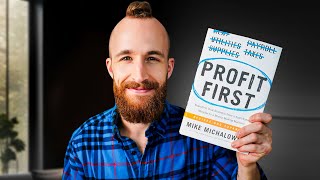
Greg Faxon breaks down Mike Michalowicz's Profit First: flip the formula to profit minus expenses, split revenue into separate accounts using target allocation percentages, focus on your most profitable offers, and run on what you can afford today. For businesses under $250k, that's 5% profit, 50% owner's pay, 15% tax, 30% operating expenses.
Chapters
In this video, I'm going to review Profit first by Mike Michalowicz. I'll share my four biggest takeaways from the book and I'm going to dive into this mind map here, go through each of the lessons that I took away so that even if you don't read the full book, you can put those into action. And I'll give a review of the book at the end, so stay tuned for that. But let's dive into point number one. So the first big lesson I took away from the book was to take profit first from day one. So, so Mike talks about how the typical accounting formula is sales minus expenses equals profit, right? So the money comes in, we pay all our expenses, all our contractors, and we have profit left over. But he says we need to invert this formula so that it's sales minus profit equals expenses. Okay? So we're taking our profit out first to make sure that we have it left over at the end of the day instead of just hoping that it's left over after our expenses are accounted for. And just that simple switch of taking your profit out first, stashing it away can make a big difference for how you view your business. So I have some quotes in this mind map and one of them in the book is she wants to grow, grow, grow. He's talking about an entrepreneur so that she can make a profit one day. Profit is something that happens in the future. And he says profit is not an event, profit is a habit. It's something that you do right, it's something that you take out on a regular schedule before you pay for your expenses. So he says the perfect size for your business, it will happen naturally when you take your profit first. And I found this formula pretty handy, says for each full time employee, your company should generate real revenue. So revenue after you pay your subcontractors or your fixed your cost of delivering the service of 150k to 250k. So each employee you need to have real revenue in your business of 150 to 250, ideally more. But this is a minimum. So if you own a million dollar company, you know you can afford four to six employees and that includes you, you're one of those full time employees. If your business only makes, you know, 150 to 250 in real revenue, you might only be able to afford just yourself, right? As the full time employee, you might not be able to hire anyone else full time until your business is making more money. So he says to start early, right? So even if you just get the $1,000 deposit. You're going to transfer $10 into your profit account. Okay, that 1%. And, and that builds the habit, proving to yourself, okay, I can actually take profit out first, even though it's a small amount and I'm still going to have $990 to pay for my expenses. You won't notice that small amount, but it will prove to yourself that this system works. So he says most business owners try to grow their way out of problems, hinging salvation on the next big sale or customer or investor. But the result is simply a bigger monster. You can't sell your way out of problems. And that's what a lot of us do. When you, when we're focused on this first equation, we're like, all right, we have a lot of expenses, so we better increase sales if we want any leftover. But when you have sales minus profit equals expenses, you know how much you can afford at that point, you don't grow your way into a bigger monster. He says selling is the most difficult way to increase profits. I don't know if I totally agree with that. That's a little bit extreme. But I like the idea that selling more isn't the only option. You can also create more efficiency in your business and, and lower your expenses. He says the fastest, healthiest growth comes from business that prioritize profit. Okay, so revenue is sort of a vanity number at the end of the day, profit what you take home as an owner and then the profit that's left over in the business, that's the additional value that you've created. Okay, so that is point number one. Take profit first from day one. Second lesson that the book shares is to separate your bank accounts. And Mike is really big on this. He tells a story at the beginning of the book about his nine year old daughter. And when his businesses were struggling because he hadn't yet learned the profit first formula, his nine year old daughter came to the dinner table with her piggy bank and she was like, hey dad, we're going to be okay, right? And she has whatever $10 saved up in the piggy bank. But he realized, okay, she actually learned this lesson, which is if you want to save money, if you want to have money left over, you need to put it somewhere where you can't easily access it. Right? With the piggy bank, you obviously have to break the piggy bank to go access your money. So save your money and block access to it so it doesn't get stolen by you. Then he talks about having these separate bank accounts which essential essentially act as these separate piggy banks. And we'll go over that in a second. But I want to make the analogy to a lot of you have heard in personal finance, the concept of the envelope strategy. I think Dave Ramsey talks a bit about this really old school would be literally keeping cash in an envelope for the different categories of your personal expenditures. And then you know how much you have to work with instead of saying, I have $50,000 in my business account and so obviously I have money there, so I can just spend it on this, I can afford this. But you're not thinking about the $20,000 payroll you have at the end of the month or the $10,000 you're going to pay for the business coaching program that you already have outstanding. By dividing that money up, it allows us to think more critically about our expenditures. So this brings us to taps, which is the target allocation percentages of profit first. And let's look at this table. If you search profit first taps you, you can pull this up. And he basically gives different percentages to allocate to these envelopes, which are basically separate bank accounts in profit first based on the real revenue of your business. So if you're making up to 250k in revenue annually, these are your target allocation percentages. It's always 100% for real revenue. That's the first bank account he wants you to set up is where does the money always come in. Then the profit account would be a separate bank account and you'd allocate 5% of any real revenue that came in twice a month. You look at that number and you'd allocate 5% and put it into the profit account. Because remember, we're doing sales minus profit equals expenses. So profit comes out first. The other bank account is owner's pay. This is what you're going to pay yourself essentially as an employee of the business. And that's 50% at 0 to 250k annually. You'll notice that that drops off as the revenue gets higher, but profit actually increases. Okay, so 50% would go to the owner's pay bank account. Then you'd have a tax bank account. And the only thing that comes out of that is, is the taxes, right? Your estimated quarterlies or whatever you owe at the end of the year, 15%. And then operating expenses, or what he calls OPEX, is 30%. So these percentages change with the size of the business. But the idea is you're going to have five accounts revenue profit owners pay tax, operating Expenses. You're creating these separate envelopes for yourself, essentially, in the business, these separate piggy banks. And you're making sure that money always comes in the revenue account and it gets distributed. And then, for example, operating expenses would only ever be paid out of the operating expenses account. And you're not transferring anything else or doing anything else funky to kind of cheat the system. The profit stays in the profit account until how he does it is every quarter, I believe you take 50% of the profit account, and you pay yourself an owner's distribution to reward yourself. And that's, you know, the whole point of the book is like, you should be doing that. You should be benefiting from your business, and then that amount will continue to grow because you're taking 50%. So you have that other 50% for a rainy day, or if you really need to invest back in the business in some way, and you have an opportunity. Okay? So those are your target allocation percentages. He says to make those transfers to these separate bank accounts two times per month. And he recommends separate accounts to minimize willpower. Right. Because if you literally have the money in a different account, instead of just looking at the number in your checking, if you have one checking, and it seems like a big number, so you spend more, you've kind of limited your access to it, but you don't have to do it that way. That's one of my criticisms of the book, is that Mike very strongly says you need to do separate bank accounts. And I think that's true for a lot of business owners. If you think that you're someone who will be tempted to kind of cheat the system, move money around, and so it won't work for you, then you should have separate bank accounts and create that extra friction for yourself. Others of us might find that we're not big spenders in the business, and it just is unnecessarily complicated. You have, like, five different accounts, maybe with multiple banks, and it just becomes a pain in the butt. So you can use software like Ynab, which is usually used as a personal budgeting software. It's create basically these separate envelopes for you so that you can track your expenses, and you can break out these five different accounts and maybe make them into two different accounts. So for me, what I do is I have one checking account, and I have one savings account, and in the savings account, I have profit and tax, because I want to keep that out of sight, out of mind. And that's usually hanging out a bit longer. So I want a little bit of interest on that. And then everything else is in a checking account. Owner's pay, operating expenses, and then essentially it's the real revenue account where money comes in. So I can. If it's helpful, I'm happy to create a longer video on my system and how I've done profit first. With only two bank accounts, there's some other changes I make. So I actually make it so there's automatic transfers into my savings account. So I'm not twice a month having to say, all right, what's 10% of my row revenue? Put that into the profit account. I've kind of simplified it for myself, but keeping the general principle. So if that's helpful, leave a comment below and I will create that video going more in depth. But back to this point, number two of separate bank accounts, he gives another analogy of like, intentionally making less toothpaste available to brush your teeth. So he says, when we get that fresh tube of toothpaste, we're kind of liberal with it, right? We're like spreading that stuff on the toothbrush. But then when we get to the very bottom, we're like, okay, I'm actually probably good with a really small amount of toothpaste because we know we don't have a lot left. That's what the separate bank accounts do is it appears that you have less money when you're only looking in each account, and so you're more thrifty, more efficient. He says if there isn't any money left for expenses in the expense account, it doesn't mean you need to pull from other accounts. What it means that your business is telling you you can't afford those expenses and you need to get rid of them. And that's how this system creates that discipline for us. He says when you have less money available to run your business, you'll find ways to get the same or better results with less. By taking your profit first, you'll be forced to think smarter and innovate more. So one prompt that I love from the book is, how can we keep doing what we're doing for one third of the cost? And that's only a question you ask when you're forced to. Right? And by taking profit first, you're forced to. So he also said, set up an account specifically for prepayment so you could take advantage of those deals when they're available. Right. If you get 10, 15% off for paying for a software subscription in full, you can have a separate account. Or if you were doing my system with Ynab, you'd have a separate line item where you were saving for that goal. If a purchase will bring your bottom line up and create significant efficiency, find ways to cut costs elsewhere. So basically, this whole thing is based on if we take profit first and we separate our bank accounts, we're going to be forced to get creative. But there's more to the book than that. So the third lesson was to find your most profitable offers. And I like that. M includes a section not just on saving money, but how can we make more money with better offers. He says you must figure out the things that make profit and dump the things that don't. Many of the decisions we make around just selling in fact take us further away from our true vision. And he says, when Ernie offers me a new service because it will make fast money, he hasn't considered it has nothing to do with what he wants his company to become or whom he wants his company to serve. And I think we've all done that as entrepreneurs. We sort of realized if we create something new, a new offering, sell it to our same audience or group of people, and we're going to make more money in the short term because it's new, but we don't realize how we get spread out and our vision gets spread out. When we just create a new service for money, it might not align with where we want to go. It creates some operational inefficiency because now you have two things, two funnels, two delivery methods that you have to deal with. So he says, to grow the biggest and fastest, you need to be the best at one thing you do. So you want to duplicate your best clients, those who have a consistent need. And in turn, you want to reduce the variety of things you do to the fewest that will serve your best clients needs. So the fewest things you can do repetitively to serve a consistent core customer need. This spells efficiency. So when it comes to what we sell, not just saving money by reducing expenses, but when it comes to what we sell, find your profitable offers. And if you do an audit of this and you literally look at how much money am I making with this versus how much do we spend in time and money to deliver it, you're going to find that some are much more profitable than others. So what if you got rid of the junk and, and just focused on your profitable offers? That's what he's recommending. Final Lesson is number four, check your ego at the door. He says 8 out of 10 of businesses fail, and the number one reason they fail is lack of profitability. So he says, run your business based on what you can afford to do today, not what you hope to be able to afford someday. And the profit first system is obviously helpful for that, but it's also a mindset. So he says a great quarter can trick you into believing your business is on a permanent upswing. And you start spending like this is the new normal. That guy driving the new Tesla, whose children go to private school via chauffeur and who live in a massive house and runs a $3 million company, is one bad month away from declaring bankruptcy. This reminds me of Morgan Housel's book the Psychology of Money, which essentially says wealth is what you don't see, right? Wealth is the money not spent similarly in business or with your personal finances. Your profitability, your wealth is, is the money you didn't spend on stuff. It's the money that's left over. So he says, when you realize that 99.99% of people who know you or know of you won't care what you own or where you hang out or what your circumstances are. So be careful not to make expenditures personally or with the business out of ego. I've done this myself. I've hired employees, I've created offers because I thought that that would make me look like a better entrepreneur, like a real entrepreneur. But it wasn't healthy for the business financially. He says if you want to grow for ego and to boast, that is just dumb. Okay, I've been dumb. Maybe you've been dumb. And it's a good reminder to do things for what's healthy for the business. Okay, so that's the summary we got. Take profit first. From day one, separate your bank accounts, find your most profitable offers, and check your ego at the door. So let's get into my review of the book. What did I think of the book overall and is it worth reading the full thing? So look, I'm not like a profit first professional. I know Mike set up this whole certification program where there's bookkeepers. I'm not an accountant. I'm just an entrepreneur who read the book to try to build a healthier business. So if you're like me, here's what I'd say. I'm giving the book four out of five stars. Four out of five stars? Why not? Five out of five is, I would say the valuable part here is really the system is understanding the concept of sales minus profit equals expenses. Flipping that equation around and creating either separate bank accounts or, or separate envelopes that you can see in software to divide up those five categories, and then the target allocation percentages I thought were really, really helpful because it gives you a sense of like, okay, if you're making this much, you should probably have 50% of that be owner's pay, right? So that's a really helpful number to know, or 10% being profit. So I love that system. I think reading the full book isn't really necessary, especially now that I've given you the four takeaways, but I definitely recommend implementing the system. Like I said, if you want my variation on the system, feel free to leave a comment. And then you can kind of do it without the five separate bank accounts. But overall, great system, great book. I use this every day in my business. It's created a lot less stress, a lot more peace in my business. So if you want the mind map that I showed you in this video so that you can reference it later when you go to implement profit first in your own business, I'm going to put a link in the description so you can go download that mind map. So go get that now and I'll see you in the next one.










