Seth Godin Interview - How to Dance with Fear
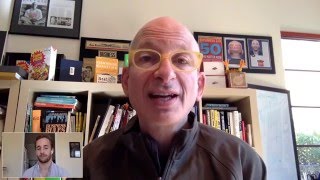
A recorded interview (Greg Faxon with Seth Godin) exploring how to "dance with" fear rather than simply "deal with" it. Godin reframes bravery as overrated yet accessible, recommends rituals, building capacity for fear, sales-as-sonar, and relentless generosity as ways to cultivate bravery, and shares publishing anecdotes and practical advice about finding a small, engaged audience.
Chapters
Welcome to the Bravery Project. Today I'm talking to Seth Godin, and I'm really, really excited about this. Seth is an author, a marketer, an entrepreneur, but most of all, Seth is a teacher. And I had the pleasure of being taught by him recently at Ruckus Makers, which is a seminar that he put on in Hastings on Hudson a few weeks ago. And, Seth, thank you for being here. I really appreciate your time.
Well, thank you, Greg. And having you at the seminar really made a difference. Your contribution did not go unnoticed. People really benefited from knowing you.
I'm glad. So one of the things that I wanted to start off with was you're very careful when you speak and write about this, but the difference between mentors and heroes. And I just want to tell you up front that you're a big hero for me, kind of virtually and I guess now live. When I saw you at Ruckus Makers, the first book that I read by you was Poke the Box. And at the time, I'm sure there's hundreds of stories like this. At the time, I was in a great job, great people doing marketing, but I was kind of sitting there and saying, how long is it going to take for me to make an impact in this specific situation? Being young and kind of that, getting that idea of, if I fail more than you, I win, which you mention in the book. I love that. And at the same time. And so that's what urged me to go off and start creating what I'm creating and get to talk to you now, which is pretty cool, I think. The idea of failure, we understand it philosophically. When I talk to clients and when I read your work, we get it philosophically, okay, I fail more. It gives me more data coming in, get more of a chance to eventually not fail and succeed. But it's still not that fun to think about it. It's still not like, okay, I still have to fail, though, but I don't really want to fail.
How do you.
When you're urging people and teaching people in writing, is there a way to make failure more palatable or more easy to actually go out and say, this might not work, but I'm going to do it anyway?
Let's talk first about how deep this runs. Imagine that you're on the subway or the bus and someone with, let's say, a mild form of mental illness is just glaring at you the whole time. Glaring with just shooting daggers from their eyes. It's almost impossible to feel good about yourself when you get off the train, that you will go through all the depth of your subconscious looking for what you did to this person. Because that's how we're wired, right? We're wired just as you can see. A dog is wired not to look someone in the eye who's got more power than they do. We're trying to very hard to please the people around us. We're trying very hard not to be seen as a fraud and as a failure. I get that. It's true. We cannot make it go away. My argument is this. We don't do physical labor for a living anymore. Physical labor. Digging ditches, carrying large sheets of metal, risking our lives to put out fires. Most of us don't do that. Most of us do emotional labor. And the question is, what is difficult about emotional labor? It's not the free coffee and donuts. It's not the getting to wear whatever clothes we want. To work and surfing Amazon all day looking for Christmas presents. These are not difficult tasks. The difficult task is confronting the fear of failure. That's what we are paid to do. That's what we are rewarded for. So when it shows up and it's hard, when the tension shows up, when the fear shows up, we don't get to say, how do I make this easy? Just like the marathon runner doesn't get to say, how do I make myself untired? What we say is, oh, now it's time for me to do my work.
I love that. One thing that you talk about is the marathon runner knows that there's going to be pain in the process. In the last few miles, it. Where do you put the pain? So, Seth, when you're writing, you know, you're writing on this blog every single day, you're doing talks, creating all this stuff in the world. Where do you put your fear?
You know, I think that over the years, I have built a little bucket that it can go in, and my bucket isn't as big as some people give it credit for. There are plenty of things that I have the leverage to do that I don't do. And I don't do them because I feel like it would make the bucket overflow and it would keep me from doing the work I want to do. You know, writing a blog post every day that gets read by a lot of people is a privilege. But I'm not sure that I could sustain that. If I had to do it live with comments and anonymous people criticizing me and putting it on periscope or meerkat or something. All of those things would add up in my head to A whole narrative that would overflow the bucket. So what I have done, what most creative people I know have done, is not insulated themselves from the fear, but over time, gradually built a bigger bucket.
You kind of whittle away at the things, the spaces where fear can come in, too, it sounds like. By paring down, I asked our little Facebook group of the Ruckus Makers if they had any questions to ask you. And one of the questions I got was, how do you deal with what are kind of the specific. The specific strategies or tactics to deal with fear and overwhelm?
Well, the key word is deal with. You know, I think the better word is dance with that. Dealing with implies, you know, you deal with termites by exterminating them. You don't deal with fear, you dance with fear. Here it comes again. What am I going to do with it? That makes a benefit happen, that helps people. So that could be things like when I went to business school with Chip Conley all those years ago. Chip started a group of five of us that met every Tuesday in the anthropology department, which is down the street from the Stanford Business School. We knew Tuesday from 6 to 9, we were going to be in a room where the only thing that would ever happen in that room is a positive, brave, exciting brainstorming session about business models. And probably 30 times the five of us met for three hours. And the minute you walked into the room, all you felt like was a creative powerhouse, because that's all that ever happened in that room. No criticism, no failure, no truth of the market. Just that's what we do here. So we can create these rituals, these places, these moments where we do it on a regular basis, and we can make ourselves more afraid of not doing it than we are of fear.
What are your daily kind of rituals? I want to be careful because I know that every creative does their own thing, their own way. So I'm not asking for a template. But you've also talked about how when we kind of can pull out some of the choices and make things more automatic, it makes it a little more seamless. So I'm curious if you have any rituals that help you.
Yeah, well, you know, in my new book, you turn, I have a rant about Stephen King's pencil, because people are always asking Stephen King what kind of pencil he uses, and it doesn't matter one bit. And I love hearing the sound of my own voice. And I could go on for hours about my rituals, and I'm not going to tell you anything, any of them, because they don't matter.
So I'd like to go somewhere. I'd like to play with you a little bit. Are you okay with that?
See what we can do.
So finish this sentence. Bravery is.
Overrated.
All right, tell me a little bit about that.
We can say, he's so brave or she's so brave. One of the reasons we say that is because we can point out how special it is to be brave and therefore let ourselves off the hook. Bravery is for heroes. Bravery is for people with special DNA. Bravery. You know, wasn't Steve Jobs brave to launch the iPhone? No. Actually, any of us could choose to be in a place where we do things that other people think are brave. And if we overrate bravery and put it up there with artistic genius, we've insulated ourselves and let ourselves off the hook. Now bravery is for everybody.
So it can give us a way to hide as kind of being a labeler.
Yeah.
You tell a story about when you started off in book publishing and your first day, you know, you submit the book. It's great. It's a $5,000 deal, it's accepted, and then you go through something like 900. I've heard 850 or 900 rejection letters after that. What were you thinking when you sent out the 901st proposal?
So this is actually the one that Chip and I did together, the very first one. So Chip got 2,500, and I got 2,500. In those days, a laser printer was too expensive to buy, so I would have to walk down the street and pay a dollar to print out a page of a proposal. So I would try to make proposals shorter because I didn't have enough dollars to print out long proposals. And I would. I think that what happened around the 900th, 800th submission was I started to learn what people were resonating with. And it's that learning that separates the annoying jerk from the person who's on their way, that I wasn't sending the same bad proposal out again and again and again. I knew my proposals were getting better, and I knew why they were getting better. And I knew if I could just keep getting them to get better, it was going to work. Because I was sending the proposals to people who, for a living, read proposals, and I was sending them to an industry that, for a living, bought the kind of thing I was selling. And those are two key elements to what we have to do if we're trying to bootstrap our way forward. Too many people hide by trying to sell the unsellable to People who don't buy what they're selling anyway. And you say, well, yeah, But I made 400 calls today. Well, no, you spammed. 400 people who didn't want to hear from you. But even though I had 30 people who had rejected me 30 times, those 30 people, almost all of them wanted to hear my next idea. Almost all of them had interacted with me enough that they knew that one day I was going to have something they wanted to buy. And it's that listening that we see so rarely on the Internet. You know, if you tweet the same stupid way 400 times in a row, don't think that the 401st one's going to work, because no one here is waiting for you to do that. But if you can figure out where the threads are and follow them and earn the privilege, and I've never seen it as anything but a privilege, the privilege of. Of pitching people who want to be pitched, then you can keep going.
I'm getting this kind of image as you're talking. I love the threat analogy almost, of when you're doing something that might not work. You're kind of in a dark room looking for the door, and you can kind of keep banging your head against the wall, or you can reach out and kind of try to figure out. And each time you get more information about where the doorway might be. And I guess that's why it's so important to at least accept that failure is part of the process, because when you reach out the first time, you're probably not going to grab the doorknob right away the first time. Yeah.
And to take the analogy one little step further, you know, it's really about sonar. Sonar, as you get closer to various things, gives you a hint about what's ahead. And that sonar doesn't mean you can see the door, but it means you are getting proprioceptic feedback that lets you understand where you are in the room.
Okay, so that's interesting. So people listening. And I'm curious, too. How do you develop that sonar?
I think you develop that sonar by learning how to sell. Okay. I learned how to sell by selling ice cream sandwiches when I was 15 at the high school cafeteria. And then I started a ski club when I was 15 and a half, 16. And then I used to sell the lessons that I needed to teach up at summer camp in Canada. And then I started selling posters when I got to college, where I would. First day of school, I'd lay out all these posters on the school commons. And you could see which posters people wanted to buy. You could look people in the eye. You could understand. Oh, when I put this sort of thing in front of someone, this is the sort of thing they do. And I learned the hard way what it was to talk to someone who wanted to buy but didn't want to buy what I had. And I learned how to judge accurately the difference between someone who says they're not interested and someone who truly isn't interested. And selling face to face is underrated and super valuable if you can do it in a way where you are welcome.
You know, I'm a coach, and in a way, you know, the coaches. A lot of coaches get into the game because they want to serve people and help and be great coaches. And a lot of it is selling, obviously, because you have to get a client in front of you. And selling, I think one of the things you're saying is selling can be great market research, working with people in that way, because then you can scale it and do the marketing thing. But a lot of the people who succeed as entrepreneurs early on that I see are great at sales to start off, and they just got to get that one right.
And an acupuncturist can also be great at sales, even though the acupuncturist doesn't have to stand outside waving her needles around saying, may I poke you? The fact is, you go back to the acupuncturist the second time, not because she put the needles in the right place. You go back the second time because she sold the service to you in a way that makes you want it again.
So I'd like to flip back to bravery briefly, because it seems like there's kind of two views. There's the bravery is overrated. And I'm hearing that. And then there's the bravery is something that all of us can have, too. And it also kind of seems important if it's. If we define bravery as dancing with fear in some way. So do you think bravery can be cultivated?
Oh, you bet. Where else is it going to come from?
So how do you cultivate bravery? What are some strategies that you've seen or that you've used?
Well, okay, let's understand that at an industrial life or death scale, we know that the Navy SEALs figure out how to turn people who are average into people who are brave beyond measure. So given time and money, we can force people into this. We can brainwash them into being brave. So let's leave out guns and. And crazy things like that and say, yeah, but how do I become brave? And I think it's pretty straightforward. You become generous first.
Okay, tell me more.
If you can figure out how to become relentlessly generous in a way that changes people around you for the better, in a way that benefits them without benefiting you in any visible way, and you get hooked on that, then the next thing you're going to want to do is be even more generous. And the only way to be even more generous is to do something that might not work. You become more generous by putting yourself out there in a way that might not work. So we can agree that Mother Teresa was one of the bravest people of our generation, right? But she never made a penny. Bravery doesn't mean closing the sale. Bravery means how far can you go on behalf of someone else? And too often people who are in some small way broken aren't willing to be generous until after they are successful, until after they are well off. But the way you become successful and sometimes even well off is by being relentlessly generous. Hmm.
What scares you?
You know, it. It varies over time. In this stage of my life, the thing that scares me the most about my work is not doing it justice. You know, I've got half an hour with you. Will this be the best podcast I ever did? I'm certainly trying for that. And if I fail at that, I will be disappointed in myself for not having the guts to put more of myself into it. More people read my blog than in a long time. Will I waste it Tomorrow I got a chance to talk to people about, in this case, April Fools. Will I waste this? 2015 April Fools? Can I do it justice? I'm afraid of letting that opportunity go by.
Sounds like the fear changes because that pressure that you feel now is probably different than when you just get started off. You kind of have other fears. It's kind of a. Will this even work? In general, yeah.
And then in between is the huge Brene Brown fear of being found out to be a fraud. Because the fact is, if you are not bending steel or digging ditches, you are a fraud. Right? That. What right does Greg have to be talking to people about bravery? He's not brave all the time. But what right does Seth Godin have to talk about anything? Because the number of failures is right there and it's huge. I failed more than most people. None of us have a right to do any of this stuff. It's all just a bunch of hoo ha that we do with each other in a way that's as generous as we can. But if some inquiring reporter wants to write an expose to prove that we're a fraud, they will succeed. Because at some level, we are all vulnerable and we're all human. And the way you can be called out on that is by someone saying, you're not as blank as you think you are. Because the only way to leap, the only way to make a difference is to be better at whatever than we think we are.
Why did you write this book? What to do when it's your turn. Why did you write it?
I think paper is important. I think words and pictures matter. And I think that culture is changed more than ever from the bottom up. That when Clark Gable took off a shirt in a movie and wasn't wearing a T shirt, T shirt sales plummeted. That's top down. Culture change. Culture change. Now is is that Greg tells 50 people about this book or Susan gives three of her friends a copy. And I've been studying the world of publishing for my whole professional life, and bookstores are broken and I miss them, and publishing is floundering, and I love those people. We need to figure out a way to keep changing the culture. So it struck me that this was a moment in time when I could speak up without using a blog post in a way that would have more leverage to change the people I care about.
Looking at it even more broadly, because I love that. Why do you do what you do in general?
You know, work is a practice now for many of us. If you've got a roof over your head and are making a decent living, you still have a hundred hours a week where you're not asleep or at work. And the question is, what will we do with that time? And for me, the practice. I'm not practicing medicine, and sometimes, you know, I get to be in front of people. The practice of helping the culture change in a way that I'm proud of is, I think, an interesting way to spend my days. It would make, I hope, my mom proud. And it's a privilege, and I don't want to walk away from that and just sit on a beach. And I don't think I'd be any good at playing the stock market. So this seems to me like a useful use of my time.
I love it. In your book, the Dip, one of the main ideas is that being number one, you disproportionately get more rewards and more respect, and you have more power to be generous than number two or number three. And so it's about being the best in your world, and however you Define world. A lot of the people in my audience and me all the time, we have trouble kind of defining what do we want that world to be and uncovering what that little world is. And that's sort of the game, in a way. What advice would you give to someone who is a year in or two years in and is still kind of thrashing around and defining what is that world that I want to change? Or do you do that right up front, or do you never really find out?
You know, I blogged about this the other day. The smallest possible world that can sustain you is the world you can choose. So my job when I started being a book packager, was among the world of 30 people. How could I be seen as the best at making complicated books like almanacs? Just 30 people. That's the whole world. Or when I started writing for Fast Company, the entire world were the hundred thousand subscribers of Fast Company. That's all. All I wanted was those hundred thousand people to open the magazine to my page first and then to Xerox what I wrote and give it to people who weren't in my world, because that would expand it. Then when I started blogging, which was right during the Fast Company days, the number of people who were reading content on the Internet, and we're seeking change at work, and we're part of the tribe that you and I are now part of. How many people was that? 100,000? 200,000? It wasn't a billion. And so being the best blogger for those people wasn't too daunting because there were only 12 other people who were trying to be the best blogger for those people. So then when Twitter shows up, Twitter is daunting because it looks like you need to tweet to 100 million potential people. Well, I didn't go on Twitter because I said to myself, to do the work that would make me the best at using Twitter, I will have to stop doing something else. What do I want to give up that I'm already good at so that I won't be mediocre at this? And almost everyone who tweets on Twitter is mediocre by definition, right? By definition, one standard deviation is 93%. 93% of the people on Twitter are mediocre at using Twitter because they're putting in a little. But if you're willing the way Chris Brogan did a bunch of years ago, to answer every single message to do this, to do this, to do this, you could be the best in the world for this community at that. Laura Fitton Pistachio became the best in the world at her little niche and transformed that into a company which she sold, which turned into a great job. Blah, blah, blah, blah, blah. So again, minimum viable audience. As my friends at Copyblogger say, minimum viable audience.
So is that little world that you're trying to change, is that the same as a niche, or do you see them as different?
The word niche first came out in the popular business culture from Trout and Reese's book positioning. Find a niche and fill it. Find a slot in the prospect's brain where you can be right next to someone else's and fill an existing spot. They have a lot in common. My take is this. If you say to people, find a small niche, they feel like they're compromising and trading down. What I wanted to say with a very similar strategy is the whole world that cares is your niche. It's not everyone. It's just the world that cares. Treat different people differently. Find the weird, find the edges. Those people are your niche. Niche is not defined by you. It's defined by them. And I think that's a huge distinction. This group, do they see each other when they look in the mirror? Do they say, we all have this problem? Because if they see it and then you show up with that language, they will see you as the person who can help them.
The same with tribes. The tribe already kind of exists, and you just uncovered it. Awesome. Thank you, Seth. I'm going to respect your time and let you go. I have one more question for you. It's from another ruckus maker.
Okay.
It's kind of a fun one. So what's the most creative or thoughtful expression of gratitude that you've ever received from a client, friend, or colleague?
Without doubt, it is when someone reports to me how they took what they learned and did something with it that benefited people in ways I never could have expected, that they have saved lives, built institutions, taught people, built schools, raised money, started organizations, hired people in ways that I didn't say, go do that, then this will happen. They took some tools I gave them, added some insight on their part, and built something that transformed their part of the culture. That is what I wake up hoping will happen every single day. That is the legacy I am seeking. Not who did I teach, but the people I taught. Who did they teach?
You've definitely done that for me, so thank you, Seth. I encourage everyone to go out and check out seth's stuff@sethgodin.com, pick up his book and get some for some friends. Seth. We'll talk soon.
Thanks, Greg. We'll see you later. Bye. Bye.










