Better Business Is B Corp?
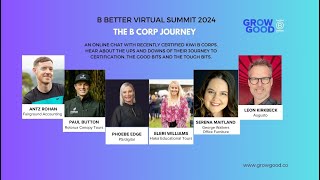
Steve Ardagh, Tesh Randall, and others discuss why they pursued B Corp certification. Steve first certified in 2012 and recertified for the third time last year. Tesh spent 18 months earning certification by January. The Business Impact Assessment prompted real changes: whistleblower policies, formalized remote practices. About 46 B Corps operate in New Zealand.
Questions this video answers
2012
"I think we're at 46 now."
"We got our certification through start of the year in end of Jan."
Initial score ~84.5; he expected the recertification score to be "well over 90."
2006
Chapters
Well, there we go. Apparently we're live, so.
Oh, and we have Austin joining us just in the nick of time. There we go. Cool. So hopefully we're live. Hopefully people have linked in. If you can hear us, let us know. This is all new to all of us. Hopefully we're working. So. Yeah. Kia ora. Welcome to B Core is Better Business. Question mark. Live panel event with some awesome, amazing humans from various different B corporations, all theoretically Kiwi, apart from Steve, who's in America, but we won't hold that against him. So really, I guess the aim behind what I'm trying to do here is introduce the idea, the topic of B corporations to more people in New Zealand. We've got quite a few of them already. I think we're at 46 now. I keep losing count. We keep getting more and more every day, but also really just to get under the hood a little bit of what B corporations are, why some of these amazing organizations chose to go down that route. What have they got out of being a B corporation? And maybe what the future of B corporation in New Zealand looks like. So, yeah, I guess it was always going to be my intention to pick on Steve first because, Steve, it is genuinely all your fault that any of us here are B corporations in New Zealand because you were the first B corporation to certify in New Zealand. And what year was that?
It was 2012, I believe. I get confused. It's an age thing. I get confused. But it's also been in America thing, I think been a day behind. But I don't think I can take the blame for the B corps. I think you can yourself. You've championed the thing. We sort of were first for various reasons, which I can go into. But if I do, then no one else here will have anything to say because there'll be no time. But it was just one of those things we did. But yeah, it's been a long time and I think we've recertified for the third time last year, which was really tough, to be honest. We're in a difficult industry to be a B corp, but we managed to get through each time and luckily it's now three years, which helps us.
Yeah. So what was it, though, that made you. I mean, it wasn't even a thing, you know, for you to sort of find this thing or have connected to this idea of B corporations. Like, what was it that drove you to certify and be the first in New Zealand?
Well, it's interesting in Amy's Fine Foods, which is a customer of ours over here has just become a B corp and they were a B corp the day they started, but they just weren't certified. So I like to think we were reasonably similar. We ran the business in that way. We wanted to empower people to have wonderful lives. And even selling disposable gloves, you can still, you know, be excited about what you do. And we are literally on a mission to save the world one glove at a time. Hence we're in the States, been here five years and we're making really good progress here on saving the US Particularly the food system over here, one glove at a time. And it needs it. They need somebody like us in our business. But so that's how we started. Linda and I started the business and then in 2006 and I was traveling to the, to the Europe via the States. And one time I stopped in at San Francisco and discovered a company called Method who do detergents and dishwashing and love their business because they, like us, are in a very boring business. And they turned it around into a bit of a designer saying they were recently bought, well, not recently, a few years ago, bought out by Ecova, which is a European, I think B Corp as well. But they've done some wonderful stuff. And through that I found the San Francisco office of B Lab at the time and met up with them. This was probably in 2011. And I just liked the whole idea of it and thought it would be interesting to go through the process. And I have to say they were incredibly patient.
We were talking with them from all around the world and at that stage the impact assessment was very American orientated and there were all sorts of things that didn't really fit with New Zealand. But it took us about a year, but we eventually got through and it was just really nice. And then no one noticed, of course, except us. And no one even knew what it was. I think we were the third in Australasia and about just under 200 or maybe around 200 around the world at that stage. And it was, it was pretty cool. And the only person who actually noticed was a guy called Tim Jones who came knocking on our door soon after and said, damn, I thought I was going to be the first B Corp in New Zealand. And so, and that's, that's where it sort of all started. So it was, it's been an interesting and rewarding experience. You know, we, we tell people we are no way a social enterprise. We sell products for profit unashamedly. It's how we do that and what we do with the profit. That's the difference. Our business is built around a profit center, not around a social goal as such. But we are saving. We know, for example, we're saving hundreds of thousands of pounds to use the American lingo of waste every year. Just by helping people with their process, we. We're keeping factories safe for workers in Malaysia, Thailand, Indonesia and China. So all these sort of things are a byproduct of running a business that has run under the B Corp sort of philosophy.
Nice. And how about you, Tesh? Because, Tesh, you're. I think, maybe B Corp number 42, 43. I've suggested to B Lab recently that kind of like the All Blacks, you know, when you get your test cap, you know, you get given a T shirt, you know, B Corp number 42 or whatever, so that we all know you know, who's who and what's what. But you're one of the newer corporations. So what. What was it about the movement or. Yeah. That made you want to be a part of it and go through the certification?
So we got our certification through start of the year in end of Jan, and that was after working towards it for the last nearly two years, a good year and a half. And, yeah, it was quite a process. It was something that I'd heard about and was familiar with, and I'd sort of recognized other brands that I really admire who were B Corps and thought, yep, we want to become one of those. But I didn't realize how much was involved. The process was a lot more intense and detailed and thorough than I think I could have imagined. And that was great. We learned heaps going through the process. We came across all these things that we should have already had in place and needed to put in place. And so now we have those all sorted. So it was almost like a business coaching tool. At the same time, you know, I found it really educational. I really enjoyed everything that we learned out of it. And then it felt truly satisfying when we did get our certification because we've gone through other certification processes, and this was by far the most intense.
That's really. Yeah, I think that's true reflection. I don't think anyone relishes going through the assessment, although obviously we're trying to coax more people to want to be a B Corporation. But I think that that is the validity of the assessment is that it's not just, hey, take my money, we'll put a stamp on our business and, you know, we can claim now that we're doing some good, you know, and I think Steve's alluded to it being. How is it you refer to yourselves again, like the cleanest, dirtiest business in the world or something along those. Like, that was a great tagline you.
Had that we just call ourselves the dirtiest B corp in the world, but with the biggest opportunity because we. Shipping a product from a long way away gets used for 10 minutes and then thrown out. So how do we make that better? Yeah, that's sort of underlying theme.
Nice. And so, yeah, it's open to the floor. I mean, who else like going through the assessment? I know. I know a lot of businesses. I love that description, Tash. It's kind of like a coaching, you know, program for your business because you do get asked a lot of questions that in other frameworks or just questions that you wouldn't typically ponder on as a business owner. So, yeah, anyone else from the floor who. Who was kind of intrigued or shocked or had some epiphanies when they were going through the assessment as to. Yeah. The types of questions you were being asked?
Tim, We've just pressed go this morning. We've just sent our second assessment and so that went out at 11am this morning. So we've just finished the recertification. It's like, hallelujah, it's done, you know, and look, I think for us, I got interested in it because of Alex Hennant, who's on the board of B Lab in Australia, and he said, harve, there's. I think you'll be really interested in this. There's some great companies and so forth. And so that's where I started. And I think, picking up on Tasha's point is that for me, B Corp is an action, so it's about actually doing something. And we learned a lot about better business by going through the assessment. And I think it's just a. I think it's something that's overlooked. For me, it's more about what you can learn about your business than getting the stamp. The stamp's lovely to get, but I think it's really important to look at it as a learning tool and where to next. And so with this, we're looking to lift our mark. Our first mark was 84 and a half. This time I think it'll be well over 90, but let's see what they come back with. But. But I think it's. For us, it is a guide to actually.
Performing our commercial business in a better way and giving us the guideline. And so just a quick example of something that we put in place because the wonderful thing with the assessment.
Tells you what they're looking for. We've put in place now a process where by a whistleblower policy. So now we have got somebody outside the business that any staff can contact. If there is any bullying, any sexual misconduct, any issues, any of the staff can contact this person outside the company and report it. Now I hope that is never ever used obviously, but it's there. And what if we had that in place? It wasn't going through recertification. No, we wouldn't have. But they gave us a guideline of what to do there. So there's, that's just an example and going back to it, it's an action, it's not a theory based thing, it's an action. And our business performance better because we're a B corp and that's why we did it.
Nice. So performance wise.
Better performing across more metrics though than just the financial. I guess that's kind of the. I know Steve, you're, you're very much like, hey look, we're a for profit business first and but while we're doing that we're trying to make, you know, as much good as we can. But I think that that really is the whole concept behind the B Corporation. I guess concept and framework is, you know, better business for better outcomes for all stakeholders rather than just the, the, the old world, I guess model of for the shareholders which is primarily what business has been based on historically. So I'm going to pick on Brian and Austin next because you both essentially are organizations that have an element of certification and audit in terms of the businesses that you do and your organizations that are certifying other businesses and you are both B corporations. So yeah, how does B Corporation fit into the, I guess like the sustainable frameworks that you offer for your clients? Maybe ladies first, Austin.
Yeah, I think that was one of the things that really drove us to B Corp was that it aligned with our own principles of, you know, you can't manage what you're not measuring, so measure it, get it independently verified and you know exactly what you have to work with. And it gives you that really solid baseline. And I think echoing what everyone else says, it's the questions that it makes you ask yourself. We were just going through a self assessment yesterday with my CE and some admins, the beekeepers and just sort of sitting there and having a chat about oh gosh, actually this thing that we're doing is still really informal. How do we formalize that? How do we make sure that it's really locked in. So that should something change that we can't stop the good work that we're already doing. You know, having an environmental business impact model to begin with as an environmental certification company, you know, we can take a lot of things ourselves quite easily, but there's still a lot of work to be done and I think we're quite proud of what a strong sort of score we have on our, the care we give to workers because you know, if you don't have take care of your staff, you're not going to have a business. And so it's, it's nice to have that recognition and that framework to evaluate the work you're doing. And then yeah, I love that when you go through the assessment it gives you so many great ideas and then you can tap into the network and get more ideas about what can you practically actually do to boost your performance, to boost, you know, to push yourself to constantly be doing better.
Nice. And how about you Brian? Maybe give an explanation of what COGO is all about as well? Sure, sure.
No, thank you. Yeah, COGO is really on a mission to, to change the world and I guess within B Corp space that comes up relatively regularly more than in common business. But the idea is really to link, you know, people out there and public who are looking to engage and you know, purchase things, to buy things based on their values with businesses who are, who are delivering in those spaces. So it's not so much that we're certifying, we're trying to simplify to the market, you know, to people who are looking to buy and to support the right kind of businesses where they can go with a bit of confidence. So it's very much a platform to highlight certifications and the things that businesses are doing already. So the reason for us to get on board with B Corp was really to walk the talk and make sure that we're doing all the things that we should be. When we're talking about how to link the public with businesses and get that virtual cycle going, are we actually aligned with those businesses and those good practices? And it's really a, it's probably the most credible framework out there that's, that's covering, you know, all the broad topics of sustainability. So you know, for your business it's not that you need to go in and tick all the boxes, but you have the ability to get, get credit for the good things that you're doing and in particular the stuff around the impact business model scoring and recognition. So for purpose led businesses, that's really Exciting area where we can have a really good think about we're trying to deliver this impact with our business model. And how are we measuring that, how are we delivering on that and are we making.
Right.
Kind of progress?
Oh, you're on mute, Tim.
Sorry.
Which is good for me. I'm cool with you being on mute.
First time running this show, kids. We're working, working on everything. Yeah. I think what's really interesting for me and the thing that I really liked when I first met Steve, you know, literally I was working for a company and I was thinking, right, we need to be better at measuring, you know, stuff. There was some cultural challenges internally in terms of corporate culture. So I literally googled, you know, HR fix plus environmental stuff. And B Corporation came up as this model of how to, you know, measure a business across different, varying different metrics. And I think it's really interesting as well that you know, two organizations who are primarily focused on carbon. So in Coco and Toy to.
You'Re kind of being asked to ponder and measure other topics. So your social impact, what are you doing for your customers and for me. That's why I think B Corporation currently is the holy grail of certification protocols. Because it's relatively easy to say, well, yeah, we've got our carbon emissions under control and maybe we're even.
Carbon positive, if that's the right word. Or we've really got our emissions under control, but we could have child labor in our supply chain. But we're not talking about that because we want you to focus on the good we're doing over here on our environmental. Yeah, Lee, let's bring Lee in. So again, another, I guess like environmentally focused organization method recycling. I frequently see your beautifully designed bins around various locations that I'm around. So yes. What does B Corporation certification mean to you guys?
Yeah, so for method, obviously we're a product based company with a really heavy focus on circularity and design. So. So as a both purpose and founder based business, we started with a set of principles that have really driven method.
To where they are.
And obviously I've only joined in the past couple of years, but we already had some really good practices in place. But we weren't measuring them, they weren't formalized. So BCorp for us was a big part of formalizing what we did as well as identifying things we maybe weren't seeing because they weren't directly in front of us. One of the biggest parts that came out of it for us was that we are gold standard in our office. Obviously sustainability is what we do but we weren't thinking so much about our remote teams and how that translates to the people in Australia and the uk. So that was a big part of it for us and one of the biggest things that come out for us is being in such a great community of people willing to help or share their expertise. The reason we finally got certified is actually going to see a talk from sharesies and they said stop questioning yourself. If you've got 80 points, hit submit. And a little bit of help from Tim as well. So for us certifying was great. It helped us formalize a lot of things we were already doing. But for us it's about the community of being around like minded businesses and wanting to see ourselves alongside the Cogos and the little yellow birds and shares these who we admire so much and that community that's built around it.
Fantastic. That's really, really cool.
So what do you think is stopping more businesses from getting onto B Corp certification like open to the panel? What stopped you from doing it earlier? Maybe who wants to take that one on?
I think one of the things just to point about where the world studious B Corp one of the things that really appealed to us and people possibly don't know enough yet is that you don't have to be some wonderful environmentally friendly, carbon positive business to get into it. You can be a normal sort of business and work your way through. And the great thing is with the BIA business impact assessment is it helps you so much. We started I think at 56 points was our first time when we went through it and it was like we had toast but with the help of the B lab at the time in the States we worked our way up to 80 points and we've sort of gone a bit further and cath from our team who you know Tim has worked really hard over the last couple of recertifications to sort of edge those points up. Although I have to say they make it harder every time which seems to be rather tough on the people. But I understand what they're doing, they're lifting us all up. So I think that's one of the things that people should understand is you don't have to be some special business and you see companies like Brewdog, one of my favorite brewery out of Scotland and they are in the world.
Enjoy a pink ipa. So those sort of again sort of mainstream sort of businesses if you like rather than ones that are pretty special and some, and some pretty special ones as well. But it's a great group and I think that's something that people maybe don't understand. They maybe think it's for the privileged few. But it's actually one of the only certifications I think that any business could attempt. Maybe if you're drilling for oil, that could be difficult or something like that. But apart from that, you know, there's, there's almost anything you could do and that's why people like Danone, I guess have managed to work their way into it and other huge businesses in New Zealand as well.
Yeah. Brian, you want to say something there?
Yeah. Extra to Steve's point, I think it's, it's great that the framework is able. Is catering for small through to large businesses. So it's not like a framework that's come out of corporate space and then you know, like it's totally. Just doesn't make sense and is totally overly bureaucratic and challenging and just illogical for small businesses. So it has that scale element to it which is a big plus.
No, I totally agree, Tim.
I think initially it looked like just some smaller.
I'm going to call them boutique businesses. That's not the right word. But smaller businesses, you know, getting involved. I think we've broken through that now that, that with Kathmandu and Sinlay accrediting in New Zealand. I think that's a really good sign to New Zealand. It's still, you know, it's like trying to get anything up and going. Even if it's good news, it's hard to sell. You know, if B Corp were drugged dealers that we get a whole lot more publicity. Right. So good news is a really hard thing to sell. Maybe we could get into that. But the good thing, this isn't live and it's not going to be. Nobody's going to listen to it. But I think, you know, good. I think good news is a really hard thing to sell. And so most people still don't know about B Corp. It's still a relatively new thing that is under the radar. And I think going to Steve's point, this is not for special companies. This is for any company to take on and look at. Because there is no doubt going through the certification you will become a better business. You will make more money, your staff will be happier. There's a whole lot of benefits come out of this. So I don't see B Corp as a feel good thing. I see it as, you know, I'm a practical person. I like practical things. B Corp is a practical measure that is going to lift the performance of your business. That's why we do it. And so I think more companies can look at this, regardless of what, regardless of the industry.
And go, go through the set, go through. It's all open, you can go through, measure your business, see where you're at and go, okay, what do we need to lift? And you know, on 56 points, starting off, you'd go, wow, we'll never get there. But you have. And so I would encourage any business to look at the framework. The other thing is there is too much wastage in the system of people lining up at the start line and not getting through and there's too much wastage. So we've got to find a way of helping companies. And I know you're great at this time that when companies line up to the start gate and go, yeah, we want to certify to make sure you've got enough support around you to get through because it is hard. It's good that it's hard and I hope it's never easy.
You know, I'm really proud we're a B corp because it's bloody hard to get and that's good. So make sure you've got enough support around you that when you line up, that you've got the momentum and enough people behind you to get you through.
Definitely and totally echo all those points. I think, yeah, the kind of it's applicable for anyone. Size doesn't kind of matter. I think you're all right. You know, when I look back, you know, Steve, obviously B Corp number one and then the first kind of 10 pretty much were all small businesses who were already doing good. So they had, it was more a validation of the good that we're doing rather than a, hey, we need to look at this assessment to understand how we could do more good. Whereas, yeah, when you've got your sinlade and you Kathmandu. So, you know, the two biggest by size, sort of by volume B corporations in the Australia, New Zealand region, in New Zealand, thumbs up to us that changes the narrative. And I'm really hopeful because obviously, you know, we only have an NZX50. We don't need to get many CEOs in a room to have a conversation. Hopefully some of them might watch this or one of their team might listen in. And, you know, I think it's relatively. I was doing some numbers doing the stats here. The.