The AI Agent Every Company is About to Build | Vercel CEO Guillermo Rauch

In this interview, Vercel CEO Guillermo Rauch discusses the emerging "agentic revolution" and how AI agents are becoming essential tools for modern businesses. He outlines the killer applications of agents—particularly coding agents that automate software development and "brain agents" that act as a company’s knowledge hub, handling data analysis, project management, and customer insights. Rauch explains Vercel’s internal agent, called V, which operates within Slack and orchestrates a network of sub‑agents (e.g., content creation, data analysis) through a modular skill system. He introduces the Eve framework, the open‑source platform Vercel built to let teams create, configure, and deploy their own agents using a simple file‑system metaphor (instructions.md, tools folder, skills folder) and a "soul.md" that defines the agent’s purpose. Governance, security, and access control are highlighted as critical challenges; Vercel provides Vercel Connect to securely link agents to over 100 external services (Stripe, email, etc.) and supports event‑driven triggers. The conversation also covers proactive agents that run scheduled tasks, model‑agnostic design that lets agents select the best model for each job, and the importance of evaluation loops (thumbs‑up/down feedback, automated evals) for continuous improvement. Finally, Rauch offers practical advice for non‑technical business owners on building team agents, balancing a single "god" agent versus specialized sub‑agents, and emphasizes that as model costs drop and performance rises, agents will become more ubiquitous and powerful.
TranscriptAuto-generated · 54 min
Guillermo Rauch
Really important thing about OpenClaw, which is soul.md. So it's like the soul of your agent that's gonna help you run your company, for example. What I believe will happen in the future is that even before you build a website, you're gonna build that agent that's gonna help you build a company. Most of the world still thinks about agents as something you prompt. Can we sort of automate even the prompting such that the agent can be doing useful work for me while I'm not on the computer?
Riley
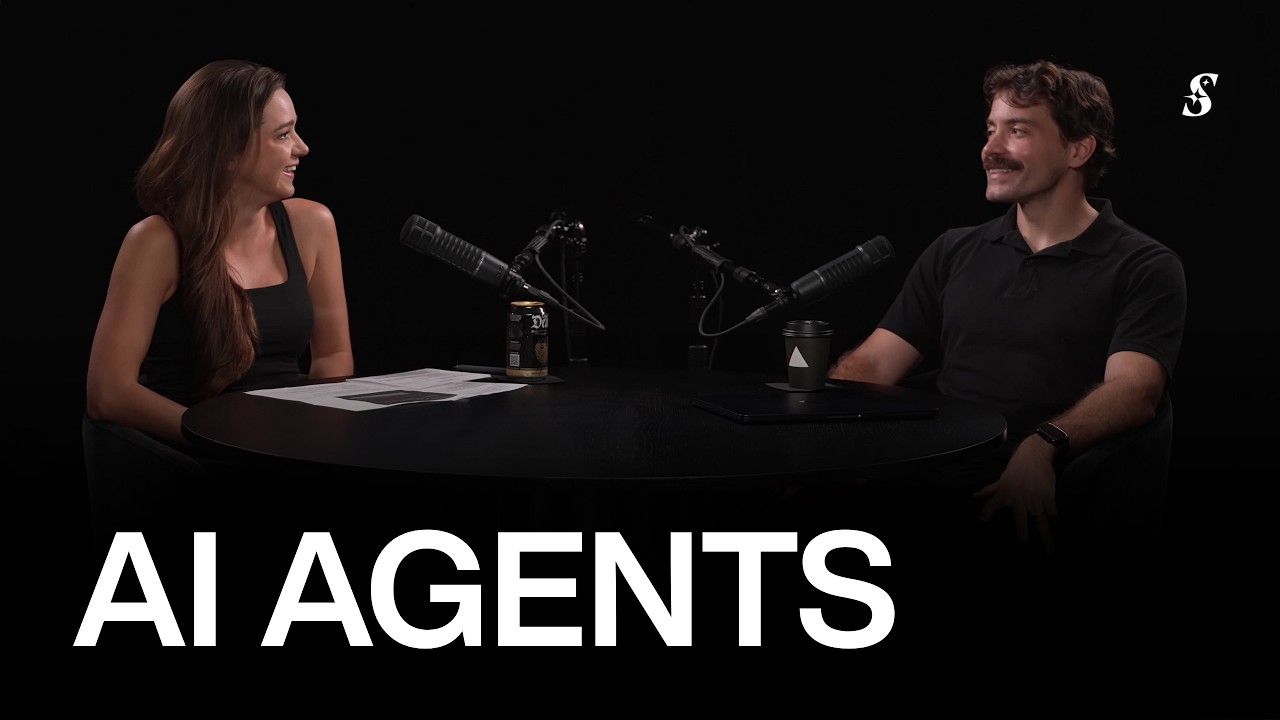
Today I'm having a conversation with Guillermo Rauch, the CEO of a multi-billion dollar company, Vercel. And today we're talking about agents, Specifically how companies are using agents within their business. In this video, we talk about Vercel's internal agent that almost 1,000 people use within the company. We also talk about whether companies need one god agent or a team of many agents. We also talk about the challenges of setting up agents right now and how to get started building agents that actually improve your business workflows. We also talk about open source models like Kimmy K3 and a lot more. My goal with this conversation is to answer the following question: How do we as business operators, employees, and individuals use AI agents to be more productive. And if you like videos like these, please consider hitting that like button and subscribing to this podcast. It helps me out a ton. Let's dive in. Guillermo, thank you so much for joining me on this, on this episode of Agent Native.
Guillermo Rauch
It's great to be here.
Riley
My first question to you is, you know, obviously we have all these models coming out, right? We have KIMI models from China, models built in the US, Claude, Fable, now Claude Opus 5. We have all these different platforms people can use. And my audience are— most people are business operators. They work in a big company. They want to use agents in their business to become more efficient and to become like a better team. Where are companies at in terms of implementing AI agents in their business?
Guillermo Rauch
Yeah, when I think about, we can call it the agentic revolution, Just like any new platform that has hit the internet or the software landscape, you think about the killer apps, right? When the personal computer came out, what were the killer apps? The word processor. For some of us, playing video games on our personal computers and things like that. Then mobile came along, right? And I think the killer app of mobile in many ways was You know, not only shrinking interfaces from things that we used to use and putting them in a smaller screen, but enabling entire new use cases. And I think with agents, we see a similar thing. So number one, clearly one of the killer apps of agents is building software. And building software, or, you know, what you could call coding agents, happens to be a core capability of solving a number of knowledge worker tasks. 'Cause when you think about, okay, I'm preparing a presentation for somebody, you occasionally will say, well, we have to do some data science over here in order to then get a report or get some data back and put it into a slide. Or you'll say, I'll automate a bunch of different steps and summarize some documents, and then I'll put some other information into a slide. And so I think clearly one of the foundational parts of this new period of time where we do a lot of our work increasingly with agencies, coding as a capability. I think this has transformed everyone's jobs, right? You can think of it as a number of sort of levels of expertise, I guess, when it comes to coding. So there are people like myself that can do agentic engineering, meaning I've been programming for 20 years, and now if I sit down and face a really hard engineering task, I will use a coding agent. To enhance my engineering. Then there's this new emergence of what you would call vibe coding, which is everybody building a prototype of software or even a full-stack application, depending on where your ambitions are and maybe even how ambitious the application itself is. And so you have products like v0 and Lovable and things like this that are making it more— I guess they're democratizing building software or even building the creative act or enhancing the creative act of coming up with new software. I also think agents are— one of the killer apps is what I would call the run your company better agent or the knowledge base plus data analysis plus project management agent. Sort of brain agent that sits alongside of you and disseminates knowledge, business intelligence, even day-to-day tasks like, you know, who should I talk to within the company that is an expert in a certain task, like navigating the org chart, navigating the— what is to many overwhelming amounts of information that reside in the internal systems of a company. So to think of this as like making the company's backend more efficient. And as I mentioned, I think coding is this omnipresent capability. So to give you a concrete example from within Vercel, what we noticed pretty quickly is that anybody that's helping a customer, anybody that's trying to close a sale, anybody that's even building new software, needs to ask questions about, you know, what are our customers doing? When did they first reach out? How much time do we spend with them? How much do they use our platform? How many SKUs of Vercel does this customer use? And so this internal brain agent has sort of emerged as, I think, one of the killer apps of AI. And maybe for a lot of people, this still seems foreign. Like, what are you talking about? There's an agent that can run my company? So excited to make that more of a thing.
Riley
It all sounds like amazing in theory, right? Like this brain agent that everyone at a company can talk to. It kind of understands kind of the SOPs and the rules of the company, the best practices, that type of thing. And I've been trying to implement this. You know, I have a 9-person marketing team now that like helps me create content on my channels, on other channels. And my question to you is like, you know, for me, when I use AI personally, I'm inside Codex. That's just the tool that I've been using because I think it's good for knowledge work because I can ask it to create basically any type of document or something, and it'll kind of open up in the side window. But what I can't figure out personally is like, how do I enable this for a team? You know, if I were to onboard someone new and I want them to have access to my skills and— but also like a lot of my skills involve my personal connections, like my personal email. So they can't actually get access to that skill because— Yeah. There's all these like permissions that I need to keep separate, but then at oftentimes I want them to be able to use the same skills that I can. And so I'm wondering like at Vercel, like, are you guys kind of trying to create this internally and like how do you get across these barriers and like what is the actual interface of using agents within a team?
Guillermo Rauch
Yeah, even if you have a team of 10 people or a team of hundreds of people like at Vercel, I think the way that I think about tools like Codex is that— or ChatGPT— is they give you a taste of what AI can do. But your job, the new job of someone that runs a company, is to actually enable their workforce with agents and to work on the agent. I think the future of what you would consider to be your intellectual property at the company or your edge against competitors is the ability to create tune, optimize, and disseminate these agents internally. And, you know, while you can have this sort of aha moment when you use something like ChatGPT, maybe to give you an example of our internal agent, it's called V. So anyone within Vercel can go into our Slack workspace and say @V and sort of navigate their day-to-day, whether it's— you give a great example. So if I need to create new content, For example, our marketing team needs to help promote a new product that we worked on, or communicate a product change, or write an engineering blog post in collaboration with an engineer that worked on a certain capability. All of this goes through this V-agent, and this V-agent has a number of skills that we continuously sort of update and improve. It has sub-agents. It has sort of— imagine the ability to create like a virtual employee team. So there is the content agent that is really good at writing marketing materials. There is the data analysis agent. We internally call this D0, but it's one of the— think of it as like the nexus of intelligence within our company. Like anytime when you get information about how a customer is doing or, you know, how they could use more Vercel or things like this. We have this sort of v0 agent that is connected to our data warehouse. And so the experience of using an agent actually ends up being extremely user-friendly. Why? Because all you need to do is you join Vercel, you join our chat workspace, and now you sort of have this omnipresent intelligence that can help you. And now you might, you know, you might go to V and say, hey, can you change some information on the website? And so V can still sort of coordinate with other agents. It could delegate a task to Codex if it wanted to. It can create a prototype with V0. It can query Vercel to get information about our production systems. But I think what's key is enabling every company in the world to sort of deploy this brain and this intelligence and continue to sort of optimize it over time.
Riley
I have a lot of questions based on this. My first one is, do you have like a team that manages Vee? Like that where— okay, you have a team. What does that team look like? How big is it? And like, what do they do on a day-to-day basis?
Guillermo Rauch
So maybe to back up, I wanted to share a little bit about our product development philosophy at Vercel. When we have a vision of the future that can be informed by pains that our customers have or things that we notice internally could be better, we try to solve that problem ourselves first. So this idea of let's have an agent that can help with every aspect of our job sort of emerged pretty obviously. Like you mentioned, anyone that uses ChatGPT notices, oh, It can reason. But ChatGPT doesn't have access to my internal knowledge base and customer records and the set of best practices of how we build software, et cetera. And so the inspiration was, anytime you talk to somebody, could there have been an agentic intelligence layer that could have gotten you that information sooner? So that was sort of like the inkling, the inspiration for it. Next thing is, how do we build this? And so Vercel has built a number of agentic infrastructure services and tools, right? So we built the AI SDK that helps developers talk to any model in the world. We built AI Gateway, which helps you get tokens from any model in the world. At the end of the day, you know, what we realized is that, okay, if there's an agent like V, I don't want it to necessarily be Claude or Codex or OpenWeight. At the end of the day, the customer doesn't matter, and ideally we autonomously choose the best model for each task. So we almost thought of V as a superset of all agents in the world. And so we designated a few folks to sort of like try it out and build this conversational experience. First, it started out as a support assistant. And that alone was extremely useful. Why? Because we are hiring new people. And also in Slack, we talk to a lot of our customers. And so anytime that you have a question about how Vercel works, we wanted to have an @vercel functionality that could know anything about Vercel. And that itself was super, super, super helpful because it became sort of like this easy way of giving support to our customers. But the difference between an AI assistant and an agent is that an agent can do things for you. And so we started thinking in terms of skills and in terms of jobs to be done. So this— we gave it a name, so V, for our internal purposes. And so we wanted to have a clear distinction between the customer-facing agent, the agent we give users of Vercel, which is @vercel, And the agent that runs our company. So V is sort of the shorthand for this. So we created the V Team. The other thing we realized in this process, and maybe this goes at the heart of your question, is it's actually pretty hard to assemble all of the tools, all of the frameworks, and all of the infrastructure to make something like this happen and to improve it over time. And so that gave inspiration for us to We built Vee, and then we shared the framework that we used to build it back to the world. We call this Eve. You might sound like we're super creative with our names— Vee, Eve, Vercel. But Eve is sort of the Next.js or React, what they did to the web. They made it really easy to build websites and web applications. The thing that I think every knowledge worker, every individual, every entrepreneur will want in the future is to have an agent that they can call their own. Uh, and this is, uh, what we're helping people enable with, with Eve.
Riley
Got you. Yeah, I think, you know, this is something I've spent a lot of time thinking about, like, how do you give the normal person the access to not only just have an agent that has a bunch of context, but to also kind of like customize it? And I think although it feels like now that OpenCLAW was kind of a fad, you know, you know, if you look at the Google Trends, it's like gone way down. I do think it unlocked kind of a magic moment, or I do— there's a reason it went viral in the first place. Yeah. It wasn't because there was some secret paid promos by OpenClaw. I think there was a genuine, um, desire for people to put an agent on a computer and let it do things for you.
Guillermo Rauch
I had a lot of epiphanies, uh, from OpenClaw that informed the development of Eve. I think you're absolutely spot on. One of those things is that OpenCLAW showed how, just how much a coding agent can do. Back to my initial point, like, what is OpenCLAW fundamentally? It's the raw intelligence of the model plus every tool at its disposal, right?
Riley
Like full, full access. Yeah.
Guillermo Rauch
It can write code, it can run it, and it can have access to everything. And that's magic.
Riley
To the point where it could do things accidentally. And like, I think that's, I remember listening to Peter who created OpenCLAW. He said something like that, He like asked for something and then it like gave, it found an API key on his computer and it did something that he didn't even ask for. And I think that was kind of the magic moment. You know, they added like the heartbeat, which was this thing that kind of like initiated it to wake up.
Guillermo Rauch
There's another really important thing about OpenCLAW, which is soul.md. So when you, when you create an OpenCLAW or when you use OpenCLAW, you're not just taking the off-the-shelf agent that somebody else built. Clearly Claude, for example, it's a great agent, but Claude is Anthropic's agent. It has its own set of principles and sure, they give you ways to customize it and whatnot, but it's not truly yours. It doesn't have a soul of its own, right? And so I think that was another really big unlock, which is what is this soul.md file? It's just It's just literally Markdown text that defines the genesis of that model. So when you create an agent with Eve, we basically learn from that. And basically, an Eve agent at its most basic is a folder with an instructions.md file in it. So it's like the soul of your agent that's going to help you run your company, for example. And then the other thing that we learned is it's awesome that it can run code, write code, it has a computer for it, right? Like the whole like Mac Mini thing was actually quite meaningful, right? Like people realized, okay, this agent can do anything under the sun, but it's dangerous. And it needs a space, it needs its own like thing, and it's give the agent some space, right? And so people bought Mac Minis. And that basically— giving an agent a computer massively improves its performance, its reasoning performance, and its ability to deliver outcomes for you. And so what's really fascinating is it's not too unlike hiring a knowledge worker. What is the first thing a modern firm does when they hire a human? Here's your computer. IT gave us a MacBook, it has a bunch of programs installed, it's logged into all of your key systems. And so we wanted to give you that as well for your own agents that you build, but we wanted to build a secure and efficient environment for it to run. And so the security part is that you define the tools, the human-in-the-loop approvals, and the data access controls for anything that the agent can do. And the other aspect of it is it doesn't assume that the agent is always running in a computer, which is actually kind of counterintuitive. I just said an agent gets better if it has a computer, but not every agent needs a computer that's running 24/7. And so in our lingo of the Vercel and cloud world, we call this serverless. The idea is that if the agent is not doing anything, it can go to sleep. Maybe another metaphor is imagining a Mac Mini that hibernates when the agent doesn't have anything to do so that it doesn't use electricity. And so because we at Vercel, we run billions of deployments, we needed a mechanism such that agents can be very, very, very efficiently operated and run. And so that's another sort of ingredient that we learned from the open claws of the world. Okay, if we're going to run these things at massive scale, scale and we need to run them securely. How can we create infrastructure that enables that?
Riley
Got you. That makes sense. Yeah, I think all of the big AI labs who are kind of releasing a product that is an agent on a computer is trying to shake it into people. They're like, this is a computer, it has a computer, and it's not easy to communicate to the average people. OpenAI is struggling with that right now where they're literally tweeting. They're like, GPT Work is an agent with a computer. And it's not easy to convey that as you interact with a chatbot, you know, like it's like, what does that even mean? Yeah. And, you know, and I'm even, I'm even struggling with it, you know? And I think, you know, and I think you can kind of divide it whether you look at Anthropic or OpenAI, like you can kind of divide their products into like how much computer access they have. It's like the chatbot doesn't have any computer. GPT Work has some computer. It doesn't— it can't run terminal commands, but then Codex can run terminal commands, but you can only get it on your computer. Because they don't have— and so I think that is actually the computer aspect of agents, I think, is one of the parts that makes it really confusing at this stage right now.
Guillermo Rauch
I agree. And my goal with the agents that we build in Vee is that whether you're an intern that just joined Vercel or you're a super experienced engineer or you're somewhere in between, I don't think whether— I think that's sort of the implementation detail that the agent builder needs to know about. You need to— what I want for the future is that someone that's building an agent can very carefully define governance, data access control, and the security model, right? Because agents are interacting with customer data. So you can't just be like, I don't know, man, it runs a computer and it has access to all of the databases of everything. You have to be really, really, really thoughtful about it. That's literally our new job, right? And— but whether it runs one or it runs a million computers, completely inconsequential to the end user. In fact, you know, you can think of these agents as being orchestrators. In fact, when someone goes to our Slack and says @V, they're really talking to the orchestrating agent, the one that could delegate a task to a million computers, to one computer, Maybe even no computer. You know, we have customers of Vercel that have built agents that have so much usage that they figured out ways to make the computer smaller and smaller and smaller just for the sake of cost efficiency. And so I think the— my hope for the future is that the very technical people can sort of know like, oh, this particular conversation with this agent resulted in all of this usage of computers and whatnot. But for the most part, it's all about getting high-quality outcomes, high-quality analysis, high-quality, accurate information. Performance is becoming more and more of the talk of town, right? People really care for fast models and fast execution. So that's another aspect of how do you get your agent to be delightful.
Riley
Okay, so let's say for a sec I wanted to create a V agent for my team.
Guillermo Rauch
Yeah.
Riley
My first question with this, and this is something that I've realized talking to a lot of business owners who are like, kind of know about agents and they're trying— they're confused on whether you want one agent that's like a god agent that knows everything, or if you want a team of agents that sort of like share a knowledge base. Because the conversation that I'm having with a lot of business owners is like, well, the marketing team has access to these things and the finance team, like, I don't even— I don't even want the marketing team to know about certain finance documents.
Guillermo Rauch
Totally.
Riley
And so like, that's my question is like, how, if I were to be creating my own V agent for my company, how do I think about that? You know, God agent or— Yeah.
Guillermo Rauch
So first of all, I'm a user experience guy. You know, I started Vercel because I was frustrated with how slow creating software was and how slow the average website and web application experience was. So I always try to work backwards from the user experience. The ideal user experience with an agent is the Star Trek computer or the Iron Man Jarvis. It's ambient computing, and I don't need to target a specific capability. That's why we're reasoning with agents to begin with. It's like there's probably hundreds, if not thousands, of internal tools that people at Vercel have built. That I don't even know they exist, frankly. There's just too much, right? And so when you have this intelligent agents, they can act as routers. Vee, our internal Eve agent, is a router. So if you ask it about Vercel knowledge, it goes to the capability that we have for looking up our documentation, our knowledge base, et cetera. If you ask about— if you need to help a customer with a support case, it has a support agent within it that has access to our support ticket infrastructure. Okay, so that answers sort of my perspective is that it's more on the God model. And maybe to give you a metaphor, because I really think that what we're doing here is we're redefining how companies of the future will work. When you join a corporation, they might give you a corporate phone. And that corporate phone is already preconfigured with your identity, and with a set of applications. You have the application for the, I don't know, internal chat, you have the application for this and that. So I think the internal agent that helps you run the company is not unlike that, is the job of the new sort of IT department is to say, what are the capabilities that we're bundling into this agent? And also crucially, how do we manage identity? And who gets to access what information, which is also extremely business-specific. It depends on how regulated your business is. If you're a small startup, I can believe that, you know, your 9-person team, they all have pretty equal access to most of the information of the company. Maybe 2 have information to the financials, or, or maybe the distinction— I remember when I started Vercel was like some of us had read/write/admin. But I think most of the first 10-person Vercel team had read access to almost everything, right? And so the job of the person that works on this foundational agent is to determine the access control, the tools, the guardrails, the audit trails. And like I said, this is actually pretty hard work to do. And why we wanted to create a framework that made that the fundamental job because wiring up the model, wiring up the infrastructure and all of that, customers can offload to us.
Riley
That makes sense. And so, yeah, I guess the agent would also be able to see where the message is coming from. So it's like, okay, if it gets sent in this channel, it'll delegate to this sub-agent or access these certain files. That makes a lot of sense.
Guillermo Rauch
Totally. I
Riley
just get— I guess because what you're telling me is like so appealing, like being able to create your team's agent. And I don't think anyone's cracked the interface for this yet. And I know you guys are building a framework. You deal with a lot of developers. I guess what I'm dying for is like a way, some sort of interface to understand it, because even the technical people, like I've even showed technical people Eve where I like, I'm like, can you help me make sense of this? And I think it's still at a stage where it's not. super easy to fully understand. And so I guess, yeah, I just wish there was an interface where I could go in and set these rules. Maybe I'm talking to an AI and it's configuring it. I guess—
Guillermo Rauch
The way that most of these agents are built is that you're talking to an AI that is helping you maintain your Eve project. You'll hear me use the word file system or folder a lot. I find that it's It makes the world really easy to understand if you think about it as a hierarchy of files and folders. So the way that a Neve agent works is that you start with that instructions file that says, you are the agent that helps run Riley's business. You can even have some context about who you are. Like, our business is in— we disseminate information about AI, and our values are— Transparency, we're not opinionated, and we love shipping things. Like something like that, right? Okay, but that agent still knows nothing. It's a tabula rasa. It just has the raw intelligence that comes from the model, and it has a basic set of instructions. How can it do something useful for you? Well, you talked about, okay, let's help the marketing team create content. And let's say that one of the things that you really care about is posting on your blog. OK, so in an EVE agent, the first thing you do is you can create a tools folder. And you can now start exposing tools to the agent. And so you can say— let's say that your blog is running WordPress or some system like that. Now I can say to the agent, now you have a tool to read and write blog posts to WordPress. OK? Great, you created that file wordpress.ts on that folder and then you ship your agent. You use the word channel, also very important. This agent needs to communicate to your team in some channel. So Eve supports every channel under the sun. It can be WhatsApp, it can be Telegram, it can be Slack, it can be Microsoft Teams.
Riley
iMessage?
Guillermo Rauch
It can be iMessage, yes.
Riley
Amazing.
Guillermo Rauch
And so the next question is, okay, I created the agent. I gave it this sort of soul. I gave it access to WordPress. Now you hire an intern. Can the intern ship any blog post that it authors together with your internal agent to prod? You probably don't want that. And so this is the job of— at some point, maybe Riley, you were working on your Eve agent, or someone in your team you designate as sort of the agent administrator. You're going to say, OK, if the person lives within a certain part of the organization, we let them write directly to WordPress. Another approach that I've seen people take is that when they interact with the intern over Slack or over Telegram or whatever, you have to authenticate with WordPress. So you delegate to an existing permission system that you already have. So the Eve agent ends up being sort of the facilitator of the transaction. But it doesn't have direct access to WordPress itself. It will help you sort of draft up the content. So this is just an idea that we cooked up in this conversation, but imagine that every day you start realizing, hmm, that's really powerful. I just unblocked my entire team to be able to draft up blog posts that go directly to WordPress. But next time, tomorrow you hear an escalation and you hear, hey, @Riley, I just saw your blog post. It's that I read your most recent blog post. It reads like complete clod slop. What do you do? And you go, you go into your team and say, guys, what did we just do? We became really productive and we started shipping a lot of slop. You know what you do next? You work on the content writing skill of your Eve agent. And so this is the meta work that we will all be doing in the future. We're not working on the blog post. Itself. You did not go to the intern and scolded him for like, hey, what do you do? You shipped a bunch of slop. You're putting that intelligence into the agent in the form of skills, in the form of tools. And of course, over time, you can get more sophisticated. And it's not just about blog. Like, how can we infuse the content writing capability with what people are saying on X? About your business.
Riley
I was gonna say that like a lot of the skills that I find very useful for content ends up just being like grounding in some relevant source. And so you can put, I call them like plugins, like where, like there's one called Scrape Creators. It's some API that I found that scrapes content from certain channels. And so like before it ever writes anything or before it ever ideates an idea for YouTube or a packaging concept, like a title and thumbnail, it'll go and like look on social media and find those things.
Guillermo Rauch
Totally. Yeah.
Riley
And that's another thing like, okay, so if I'm creating a V agent, yeah, I'd want to add certain APIs and you can add, I would, yeah, you can call them plugins or like how do we distinguish between plugins and skills? Can you add plugins to skills or how are they all just skills?
Guillermo Rauch
Yeah. So going back to you, you got that escalation that says, Riley, you just shipped, you're shipping a lot of blog posts. But they all— they have too many em dashes. And so this is what's beautiful about that idea of it's just a folder. You go into your Eve agent, and in the folder skills, you say contentwriting.md, and you say, this is how we write. This is what I like. This is what I don't like. You also talked about— I think that the future of work will be the agent becoming a lot more proactive, as well. So Eve can have a schedule. For example, every day at night it reads social media, it parses keywords, it gets replies from your posts, and from that it can do something. It can draft up new content, it can even give you a report inside of Slack. And this we actually have found to be extremely helpful at Vercel. The idea that our agents proactively give us information. So every Monday I have a— I have my internal agent give me a download of what's happening across every product area. What are the key metrics that I care about? So you can have the agent be doing thinking in the background on your behalf. And I think it's not just about— I think most of the world still thinks about agents as something you prompt. But I think there's a lot of alpha in thinking about, can we sort of automate even the prompting such that the agent can be doing useful work for me while I'm not on the computer?
Riley
I think one of the limitations for me, and I've been able, I have a lot of automation set up that trigger an agent to do certain tasks, and it is really useful. One thing that I'm struggling figuring out how to set up, especially at the team level, is to get outside things to trigger the agent. And there's many ways I think you could do this. But yeah, like, do you guys have any of that set up? Like, if some event happens, it automatically— Totally. OK, yeah. Can you talk about that?
Guillermo Rauch
So I think events that originate in systems like Stripe, like there is a refund request, we make it really easy to connect all those systems. In fact, when we sat down and we thought about what makes it really hard to build an agent, it's actually not the proof of concept part. Because anybody in the world can sit down, open Claude code or Codex, and build an agent in the sense that, like, when you're prompting it, you realize what it becomes capable of. What we talked about with OpenCLAW, like, the raw intelligence is already there. What's hard is securely connecting it to your systems. So we built a capability on Vercel called Vercel Connect. that gives your agents access to 100+ systems, but it doesn't just give them full read/write everything access right away. It gives you, the developer, the control. And that might mean that you subscribe to an event, and then you send it to your agent. You can say, hey, every time Stripe has a failed payment, let the agent know. Every time we get an email Let the agent know. And so you start thinking about the world in terms of events. In fact, I mentioned that a lot of our agent interactions are happening in Slack. Slack is just another event. It's someone said something and the agent— that gets fed into the agent's brain. And so any connector of this sort of repertoire of connectors can originate some kind of behavior in the agent.
Riley
Got you. That makes sense. Yeah, that's just something we've been thinking about a lot, um, because you're right, everything is just an event. It's just things happening. And then when something happens, if an agent can take care of it, they— it should take care of it. And I think I'm like, I've automated none of that in terms of what I could possibly automate, which is really interesting.
Guillermo Rauch
Yeah, you know, a mental model. So I mentioned that the, the thing that I'm excited about with Eve is that when, when I started Vercel, the most imminent thing that I needed to build was a website. Like, it felt like, how do I put my fingerprint in the world? What is one of the earliest things that you do when you create a company? You register in Delaware if you are in the United States, or even internationally you incorporate. You choose a name, and so you register the domain name, and you ship a website. Even a website says like, hey, we're in business, or welcome to the minimum viable sort of identity of your company on the internet. What I believe will happen in the future is that even before you build a website, you're going to build that agent that's going to help you build a company. It's going to be your factory. It's going to be the, the trusted partner and advisor in everything you do that's constantly learning about the trajectory of your business. And so it's extremely critical that as you sort of evolve your business this agent gets access to more of these data streams of knowledge and information. And everything really is an event in this world. Another important factor there is self-improvement. So whenever you start a company, you're constantly learning, you're teaching your employees, you're helping them learn from mistakes, learn from incidents, learn from customer feedback, etc. It's going to be very important that your agent over time And so with EVE, we thought about, okay, if there is a baseline of information that your agent has, how do you evaluate the agent? Can you write tests, or can you give it exams so that you actually know that you're making forward progress as this agent sort of gets more sophisticated and more capable over time? Yeah. Think of this as sort of even more fundamental than the dot-com of your company.
Riley
Yeah. And do you guys put evals into Slack? Are there any ways to evaluate whether an agent does well or doesn't do well? Like, could you, based on someone, like, could an employee who got a response from V, could they say, like, oh, this wasn't a good response? And okay, they can do that.
Guillermo Rauch
Yeah, so every response that we give on Slack has a— and by the way, maybe to also give kudos to the Slack team, Slack is kind of becoming like an agent operating system of sorts, right? Because it used to be for messages between humans, now it's humans and agents. And so they have built UI that is just really easy for the developer to add, right? So the thumbs up, thumbs down thing, super easy to add. And so every EVE agent we create, for example, at night we can have a job that aggregates all of the negative feedback and proposes the next stage of self-improvement. We can say, hey—
Riley
That makes sense.
Guillermo Rauch
We got 5 thumbs down on these answers. What are the things that— the agent itself can even propose how to improve itself. Oh, I missed this. Oh, this person critiqued this part of my response, or they said I hallucinated or whatnot. I do think it's very important that humans are still involved in that loop. But I think increasingly more and more of the job of the agent getting better is also being done by the framework. So the framework itself comes with evals that are basically test cases, right? When you build a web application or a website, you write unit tests. And you make sure that the logic is sound. When you create an EVE agent, you write evals also to ascertain that the logic is sound, but that the information it gathers is sound and it's accurate. There can be evals about personality. At some point we were hearing from people that our internal company agent was too verbose. It was speaking too much. And so you— we kind of basically gave it a better personality, and you can create evals around that as well.
Riley
So do you view this in the near future, over the next few years, do you think it's just going to be mostly technical people building agents for companies? Or do you view this as something that whether you can code or not, you'll be able to create agents for your team?
Guillermo Rauch
So because building software is being so democratized, think of it as, again, let's go back to that idea of I'm starting a company and the first website that I built, It's sort of like I could have used any service on the planet, drag and drop, give me a free website with my domain name, like anything like that. That's right. And so I think that first building block of your agent, everybody's gonna be able to create. I think that over time, I mean, the whole business runs on this. Hundreds of millions of dollars of revenue are dependent on the well-being of this agent. Because our sales reps depend on it, our support team depends on it, I depend on it. And so you— this is a very important piece of software. And so I think it's a combination of everyone can contribute to the agent— information, skills, critique, feedback— and then there is engineers that are working on the core system loop, the access to data, the governance, security, all of those pieces that I think need to be more technically minded. But I don't think that the code writing part is as important these days. It's— I think I would describe it as people that really understand data flows, threat models, and architecture of systems design so that they can carefully think about the operational excellence of the agent and the security model of the agent.
Riley
Very interesting. Yeah, because I think there's a lot of people, business owners, not all of them are technical, who are reaching out and they're trying to create agents. And so I'm just trying to leave people with a tangible thing that they can do, like a point to a place where they can go to kind of build their first agent or build their V, because I think With what I've realized with these agent tools, all of them, is we can have conversations about it, we can talk about it, I can learn, I can use AI to like learn about it, but nothing hits like doing it. And I think that's kind of like, like once you do it, then you're like, oh, I can do that. That means I could do this thing, this thing, and this thing. And like kind of your world opens up as you do even the most trivial things. And so, yeah.
Guillermo Rauch
And the combination there would be, you know what I've seen? Give people an aha moment is create an Eve agent. Go to eve.dev, deploy your first agent, but connect it to your favorite chat medium. If you— if your company works in Slack, connect it to Slack. If you like WhatsApp, connect it to WhatsApp. And pick one boring or, you know, kind of Pick a toil task of your business that has a system to it, but it's not, you know, it's something that if you could automate it away, you'd absolutely automate it away, and write down the skill of that task. It could be, for example, something we do a lot at Vercel is we put a lot of work into drafting up our product changelog. When you go to vercel.com/changelog, Every piece of content there narrates the storytelling or evolution of our product. And in many ways, that changelog is a grounding for my engineering team. How do I know if an engineer is being productive or not and whatever? Like, well, one of the things that I do is I measure it by, have you shipped something that we can communicate to customers is an improvement to our platform. So one changelog that's about to go out, maybe by the time you watch this has already gone out, is we improved the end-to-end deployment process of an application or agent to Vercel by 7 seconds. 7 seconds we've shaved off over a lot of infrastructure work. So when you go to vercel.com/changelog, you're going to find that we improved our product And we shaved down 7 seconds. So it used to actually take a lot of work for an engineer that is in the depths of infrastructure to collaborate with the marketing team and get that thing out into the world. Because we have an agent internally, we've cut down that process into one Slack thread that the engineer creates, the agent refines what they're telling me, because engineers are sometimes so in the weeds that they struggle to communicate things in a way that is— I call it context-free. Maybe they start talking about computer science, or like— I'm just, hey, can we boil it down to the business benefit? Simple. 7 seconds. It's enabled for every customer. It's free. So that's kind of like a little formula that I have. People want to know what's the benefit, how much does it cost, and what do I do to get it? And so that formula that I developed over many years of product marketing skill, I put into that Eve agent. And so for the listeners, think about something like that. Maybe it's like quote unquote a secret sauce of something you do really well. But takes a lot of time and you want to do more of it. And so start with that skill, connect it to a communication channel, ship it on Vercel.
Riley
Got you. Okay. That makes sense. Yeah. I think, um, to kind of, I know we're, we're running up on our time here, but, um, what are you most excited about? Um, in ter— it could be a model, it could be computer use or some browser use. Like what unlock do you think we're gonna get in the next, like, 3 to 6 months that will make using agents way more fun or way more effective?
Guillermo Rauch
Very simple. Cost of intelligence continuing to go down. More intelligence for more people, more variety of models. One of the great things about building with Eve and building in Vercel generally is that we give you access to every provider of models and every model in the world.
Riley
It's model agnostic. Yeah.
Guillermo Rauch
Totally model agnostic, right? And that plays into your benefit because you retain ownership of your data, of your skills. You get to choose models, and you get to benefit from the competition. There is some news that's going to go out tomorrow about models getting dramatically cheaper. Literally tomorrow.
Riley
Tomorrow.
Guillermo Rauch
And if you were building in this way, you're going to benefit. So the other one is fast. Models are going to get way faster. I think we're going to start seeing what happened with the personal computing and mobile computing revolution, which is that we got the iPhone. If you could travel back in time or even pulled out the first iPhone out of a drawer, you'd be astonished. I was astonished at how slow it was. The refresh rate. Like, you would open an app, it would do nothing for several seconds, and then slowly, at maybe 10 frames per second, the application would show up in front of your eyes.
Riley
Right.
Guillermo Rauch
That's where AI is at today.
Riley
Yeah, I think for most knowledge tasks, like, I just want faster. You know, my biggest problem isn't like, oh, I wish this was better. It's just like, why did I have to wait 14 minutes For this, you know, and like, if it was 10 times faster, it would be insane. And I feel like we're pro— like, how long do you think it'll take for the models at like a 5.6 level, like SOL level?
Guillermo Rauch
Days. Days. Well, I mean, maybe days is the most optimistic. I think we're literally weeks, single-digit months away. One of the data points that I can share is On the open weight, and this is why I'm excited about open weight models. The competition between the inference providers around open weight is so extreme that GLM dropped. We added it to Vercel AI Gateway. It's an incredibly good model, GLM 5.2. Within days, we had a fast variant that was four times faster. There we have more providers coming online for GLM that keep raising the bar of token per second performance. GLM 5.2 Fast is astonishingly fast and it's only getting faster.
Riley
What
Guillermo Rauch
did you think of Kimi?
Riley
Kimi
Guillermo Rauch
K3 is going to happen to Kimi. I think we're still in the early innings of that.
Riley
What did you think of the model like in general? Like, do you think it's— you think it's really good? You think it's up to par with like an Opus 4.8?
Guillermo Rauch
I think GLM 5.2 was already in that category. I think Kimi raises the bar. I think Kimi can do things that perhaps only fabled class models could do. Not quite in all of its dimensions, but for example, when we evaluated it for cybersecurity, it outperformed Opus 4.8 clearly. And it was almost at SOL level. SOL is still at the frontier. But again, this is the beautiful thing about having choice is that depending on what you're doing, You're going to choose different price-performance ratios. Grok for fast and highly accurate. Like if I have to choose today a model that's going to be my workhorse model, that would be like the default. If I have an agent that is my Slack and needs to do a wide variety of tasks and it has to do it quickly because there's another person waiting on the other side, I would absolutely go with Grok 4.5 or GLM. In terms of like price performance. Mm-hmm. Now, I mentioned proactivity. What about, for example, at night finding opportunities in our business, crunching data and extracting novel insights for the executive team? Well, those things I can throw more reasoning power and it can take more time. Mm-hmm. I might even want to throw a consortium of models. At it. Why not have Kimmy and Sol and Grok come up with 3 points of view and then give you the summary? And this is why I find it so interesting, right? Like, we're still in the early innings of understanding what are the principles of design and user interface engineering, but for agents.
Riley
Yeah.
Guillermo Rauch
If I'm talking to an agent interactively, I want fast. If the agent is doing an asynchronous job, I want accuracy.
Riley
Yeah, you don't care if it takes all night. Like, it doesn't make a difference if you're— Exactly. Yeah, yeah, that's true. I didn't think about that.
Guillermo Rauch
We're about to launch a capability in AI Gateway, which is you as a developer or even your agent can say, please do inference, please, like, get me tokens. but in batch. And I don't care how long you're gonna take. Like, you communicate. It's a little bit like putting in a buy order and you're not worried when it gets fulfilled, right? Like, you're just willing to wait. And then anyone in this market can fulfill your order. Almost like a spot market for intelligence, right?
Riley
That makes sense, yeah.
Guillermo Rauch
And, uh, and this is extremely exciting because you might say, hey, like, come up with a proof or disproof of the Jacobian conjecture for 2 dimensions, and I don't really care when, but spend this many tokens. And someone at some point is gonna say, hey, I already paid for the GPU, it's connected to the internet.
Riley
Yeah.
Guillermo Rauch
No one is using it, let's throw some capacity. It's a little bit like SETI@home, for those who remember. Yeah. Rent out your spare compute capacity, solve hard problems.
Riley
Yeah. 'Cause if you get it next week, it doesn't matter. You know, you're still solving a really crazy thing. Anyway, I really appreciate, uh, you joining. Um, I think you guys are gonna do great. Uh, one thing I didn't realize is how much business owners don't want to get locked into a certain provider. I mean, you know, like Claude Tag is their kind of, I don't wanna say it's their version of V, but it's like kind of an agent you can add to Slack. And so many people are resistant to it because they don't want to get locked into only Claude's models. So I think that is something that you guys will have going for you. That's really cool.
Guillermo Rauch
And it goes beyond, you know, the model. I think it's not about having Claude in your workspace. It's about having an intelligence of your own.
Riley
Right.
Guillermo Rauch
So there is almost like an element of like baptizing your agents. Like, this is our agent. This is our company. It's, you know, I actually liken it to the web because the web was all about I own my domain name. Mm-hmm. I'm the king of my own domain. And I think we're now seeing, we're living through the version of that for the intelligence age.
Riley
100%. Yeah, I agree. Thank you so much for coming on. This was a lot of fun. Let's do it sometime soon.
Guillermo Rauch
Anytime, Riley. Thank you.
More from Guillermo

The Library of Minds | Vercel CEO: How to Raise Kids Who Can Think in the AI Era | Guillermo Rauch


Inside Vercel's AI-era playbook: "Recursive Founder Mode" | Guillermo Rauch (CEO)


Guillermo Rauch at Founders in Arms Live: Simplicity, Focus, and the Bet That Built Vercel
The Man Who Built a $9B Dev Platform Thinks You're Overcomplicating AI | Guillermo Rauch


Inside v0: How Guillermo Rauch Is Building 100 Million Engineers | Lenny's Podcast - EP.89