Inside v0: How Guillermo Rauch Is Building 100 Million Engineers | Lenny's Podcast - EP.89

In this episode of Lenny’s Podcast, host Lenny Rachitsky interviews Farhan Thawar, a senior engineering leader who has spent the past decade working with high‑profile investors and founders (Joe Limon, Chamath Palihapitiya, Toby Limon). Farhan explains how he deliberately aligns himself with “irrational” long‑term visionaries, using a personal decision‑making framework he writes down to filter job opportunities and to know when to quit. He emphasizes the importance of intensity—getting more done per hour rather than working longer hours—and describes how Shopify cultivates that intensity through practices such as pair programming, weekly GSD (Get Shit Done) updates, 6‑week review cycles, and rapid incident‑response pairing. Farhan details the under‑utilized power of pair programming, including extreme practices like deleting code after an hour if a solution isn’t elegant, and how AI copilots (e.g., GitHub Copilot, voice‑driven tools) now act as virtual pair programmers. He shares Shopify’s “meeting armageddon” ritual of annually wiping recurring meetings and a two‑week moratorium to force teams to rethink cadence, dramatically cutting meeting time for individual contributors. He also discusses moving announcements to Meta Workplace to reduce Slack distraction, using metrics and alerts (e.g., Code Yellow) to protect developer experience, and building platform‑first infrastructure (e.g., NFT‑gating APIs) that enables anyone to ship features in an hour. Throughout, Farhan weaves anecdotes about resilience practices like Chaos Monkey, the importance of aligning personal strengths with visionary leaders, and the cultural mindset that prioritizes rapid, high‑quality output over bureaucratic processes.
Chapters
Thank you so much for being here. Welcome to the podcast.
Thanks for having me. Longtime listener, first time, I guess, participating in the podcast and, uh, love being here.
Uh, I appreciate that. Okay. So I know you saw this. I did the survey recently where I asked my readers, what tools do you use most in your day-to-day work as a product builder, as a product manager? And in the category of engineering tools, uh, v0 came in right below Cursor and GitHub for people's most used AI building tools. So clearly people love what you're doing.
Yeah, we're very happy to see that. And for us, we're at the very beginning of the journey in some ways because v0 is a relatively new tool. But Vercel, you know, our company has been around for a while. You know, the way that I explain to people is anytime you're using the internet, if there is a website or web application that's really fast, innovative, hopefully it's running on our platform. We're out there, we are running a lot of websites at scale. If you watch the Super Bowl recently, 3 different companies were promoting digital products that were built and delivered on Vercel. So not only can you deploy your ideas and build them on Vercel, they can scale to huge volumes of traffic and huge audiences. So a lot of people know us because of a framework called Next.js. It's an open source framework, uh, based on the React technology, open source by Meta. And it powers some of the most innovative products on the internet. So when you use Claude or Groq or Midjourney, you're using Next.js, you're using Vercel's technologies. So with v0, what we're trying to do is, and you, it's funny cuz you, you put us in the, rightfully I think, in the building or development category in that survey, but what we're trying to do with v0 is help more people participate in building software. Increase the sort of the total addressable market of people that are actually shipping things, shipping real products. And at the same time, just like you would with ChatGPT, we want v0 to be just extremely, extremely easy and the outputs that it generates, make them as refined and realistic as possible. Like the things that you create with v0 hopefully live up to that standard set by you know, some of the best and largest websites on the internet.
Uh, I was gonna ask you how v0 came out of Vercel, and I, I, I, my theory was it was like you guys are sitting around being like, how do we get more people building websites? And it's like, okay, let's just help them do it really easily. Is that, it's like TAM expansion for Vercel.
Is that— Yeah, it's in some ways it's, it's what I've been doing for not only 10 years that I've been, uh, almost working on Vercel, but maybe my entire life because my strength as a developer is kind of meta. It's been to create developer tools. So I've created a bunch of open source frameworks that are really popular. So Next.js is one, but before that, in a previous life, I created another tool called Socket.IO, which is a real-time communication mechanism that powers, for example, every time you use Notion, I think you interviewed Ivan, uh, when Notion needs to broadcast messages in real time to other collaborators. They use a real-time engine that I built for Socket.IO. So the reason that startups and companies have used my products in the past is because I took something that was very difficult to do, but very compelling. Like it was with real-time in the past, like it's building cutting-edge applications on the web with Next.js, and I try to make it as easy as possible, but you still needed to know development skills, right? For us, and the opportunity was, If there is maybe 5 million React developers, which is the sort of the library engine that we use, and there is maybe 20 million JavaScript developers, how many product builders or people with aspirations of building products exist? My back of the napkin, like minimum calculation is 100 million. And I'll tell you, it's funny where I get that number from Slack. Has about 100 million monthly active users. And what do you do on Slack is you go in it and you talk to people, and a lot of those people are building digital products, right? And they talk to one another about what they would want to see in the world. They talk to customers through shared channels. I love that feature. We talk to a lot of the Vercel customers and like they tell us like, I wanna build this, I wanna see that, I want this feature, I want that thing. And so the opportunity with v0 was, It's not that you're gonna stop talking to other people, but what if you could yap into the computer and see something happen? Build a prototype, build your first version of a product, build a demo, build a full-stack product, build it and ship it. And so the, the inspiration for it was very natural to the mission of Vercel. But concretely, the genesis story was when ChatGPT came out, we noticed that it was very good at writing the code that our tools used. So ChatGPT right off, right out of the bat was good at JavaScript, was good at Tailwind, which is a CSS styling technology, was good at Next.js. And again, the power of open source, our tools are already in the training data of the internet. And so that long-term bet and vision in open source really paid off. And so because the models were so good at writing this kind of code, The idea for v0 came naturally from what if we could build a ChatGPT for building web products?
Speaking of that, I didn't actually know. So I had Bolt CEO on the podcast and he talked about how Claude kind of unlocked what they are doing. And you guys, do you guys sit on ChatGPT and OpenAI stuff?
We started out on OpenAI and we've always used a combination of models. It's funny, right now on Twitter, there's a million, there's thread with a million views of people trying to reverse engineer the prompt and the models on Reddit. And they're all finding that there's all this kind of different models models that are specialists in different tasks, and there's a pipeline of models where a model could hand off work to another model. And so OpenAI, Gemini, Claude, but we predate Anthropic because I'll give credit to ChatGPT that, you know, the utility of it was so general purpose, but from the very first release, it was very good. In fact, by the way, if I'm not mistaken, the first prototype of v0 might have even predated ChatGPT or At the very least, I think we were running on GPT-3.5. So we've always had this vision of unlocking more power for the web through LLMs. And there's a lot of very interesting technical details of why, by the way, LLMs happen to be so good at the task of web design and web development that we could get into. But it was like the perfect timing for us.
That's, I wanna come back to that. That's actually a really good question. But let me ask a couple other questions here in terms of v0. What's the scale at this point? We hear all these numbers about all the folks in the space. What can you share about what's happening with v0?
I can share that it's growing exponentially and that over 1.3 million users have interacted with v0 so far. We had our largest day ever yesterday and today again. We're the largest— we're one of the largest customers of most of cloud providers at this point. We're hitting the limits of every GPU LLM infrastructure out there in the planet. And what the most exciting thing for me is what I'm seeing people build with v0. So we launched a feature about a month ago, maybe even less than a month ago called v0 Community. It already has 20,000 submissions. If I'm sure people in your audience have used Figma, one of the things that I love at Figma is Figma files. That I can go and grab a starting point for a, for something. Could be a logo, could be a menu, and you can start with something that someone has already contributed, kind of like that spirit of open source. And so in less than a month, I think we've done over 20,000 community submissions. So we've learned so much about building AI products with this, and we continue to sort of open source and share our best practices. But one of the things that I've definitely learned is Prompting it seems like the easiest interface in the world because it's just an input, right? And you put text in it, but there's a little bit of a writer's block sometimes. So one of my favorite things that I've seen, and I'm even looking at the homepage right now, and you can see like a random assortment of community submissions and they have 1,200 forks and 1,500 forks and 6,000 forks. And this is every time people saying like, oh, instead of starting from scratch, I'll start from this application that someone else has built. I'm going to prompt it to modify it and make it my own.
So these, the community submissions are people building apps on v0 and sharing what they built. Correct. You can look at the code and fork it.
And it's becoming like a compounding investment, right? Like people share something, someone else grabs it, makes it better. Maybe you use it at that point. In many ways, I see this as the next evolution of GitHub. Whereas GitHub was so— it was a marvel for, for software development because it, it— I don't know if you remember this, but like the initial little tagline underneath the GitHub logo was social coding and it had this democratization effect of building software, but you still needed to know how to code. And so what we're after is social product building in many ways, right? Like everybody should be able to cook and share what they're, what they're building.
I love how I hadn't thought of it this way, but I love that it connects so much to your open source roots where people are building on v0 and then sharing what they're building and then people can build off those things. It's kind of like an open source AI building experience.
It's fascinating, right? Like in many ways, if you think about the Git commit, the Git commit is super interesting. If you, if you, if you watch how an engineer works, they look at a problem, They spend a lot of time in their code editor and at the end they say, I think I, I got it. I think I, I, I think I've fixed it. And then they produce a Git commit. They summarize their intent and what they try to do after they've done the work. v0 inverts that. The Git commit is you go into the chat and say, Please change the color of this button, and when I click it, save this form to a database. And so you're starting with the intent, and the output is the code. And as a side effect, we can also produce a Git commit for you. That feature is not online yet, but it's coming in the next couple days. Spoiler alert for the group. And so I like this idea of we can create this superset of all software building with this platform. And that is true to my initial intention with Vercel. Our mission is to enable the world to build and ship the best products. And so enabling that for the largest possible group of people is very exciting to me.
So let's go to this question of just, uh, kind of the elephant in the room for a lot of people seeing these same things happening, product builders that have, you know, that have been doing things a certain way for a long time. With apps like this coming around, whether you could just type a thing in and build it for you and it's beautiful. How do you think things are gonna change for product managers, for product teams? Where do you think, where do you think the biggest change is gonna happen? How do you think product will be built in the next few years?
The most profound one that I kind of alluded to is that conversations between product builders and their customers will be mediated by this, these zero-links, these artifacts. I think when Claude came up with the name artifacts, I found it phenomenal because we're all in this world, especially in this group of people. We're here to build awesome things and share them with the world. Steve Jobs had this awesome speech about it's, it's like our form of giving back to the world is to try and do the best possible job we can and share it with the world. And so the idea that when we talk, we would not have the power to make those ideas a reality seems— it seems like an L to me. I would love to see people constantly live in the product. Be in the design, spend time tuning and trying out new ideas. And that's what the ideal work of the future should look like. And less about kind of, again, that abstraction, that being removed from the product, or even the— sometimes I can feel powerless to not be able to change something. This happens a lot when the departments collaborate within an organization. Marketing wants design to do something, marketing wants engineering to do something, engineering needs design. It cuts all ways, right? Like, one of the things that people had got excited about that we published on the Vercel blog was about design engineering because a lot of the people that we were noticing were being very successful at Vercel were people that had both the design and engineering skills. And that was actually another huge motivator and inspiration for v0 because we realized that people could be more full stack. We shouldn't put limits on ourselves and what we can build and what we can ship and what we can dream about making possible on this web surfaces. And so you could imagine removing all those limitations. A designer that can ship a fully baked product, a product manager that can prototype and ship to production, an engineer. A lot of people that use V0 are backend engineers that never had the ability to, you know, sort of like they could ship an API, they could build a great low-level infrastructure system, but to actually bring their end-to-end vision to life, V0 is sort of completing that for them.
So let me follow the thread on engineers. A lot of people are wondering, do we need engineers in the future? What happens to engineers? Should I learn how to code? Uh, you're a longtime engineer. Thoughts for folks that are trying to decide the career for themselves?
Yeah, I think knowing how things work is the most important skill in the world. I foresee a lot of people becoming incredibly impactful in building and shipping amazing products and building gigantic companies and everything you could imagine where a single person can do the job of 100 different people in 100 different specializations. Take the example of one skillset that's really important to build a frontend product is you need to know how to use CSS or Tailwind to style it. And once upon a time, I would hire people that were truly specialists in this task. This task of there's a Figma design or there is some kind of sketch and translating that into reality because they knew really well how to manipulate layouts, layout code, box model code, we call it. And borders, paddings, margins, flexbox, all these technologies for styling. And notice I actually use the word translation very intentionally because the origin of the LLM goes as, or the Transformer architecture at least, goes as far back as the architecture for systems like Google Translate. They were generative LLM techniques, basically. That's how they crossed that chasm of like, remember when translating tools were horrible and then one day the problem was just solved, right? And I look at, I look at a lot of the programming jobs to be done that used to be specializations that I think are going away in a way. Or the tasks to be done, they're translation tasks. We were translating from a screenshot or intent or a design into a React and Tailwind CSS implementation. And right now v0 is incredibly good at doing that. It's so good that every time we put a new generation of the model out, I run this test of like converting my own website and try to generate it with D0. Last time I did it, it had taken me like 10 prompts to replicate it. Keep in mind, I'm an expert frontend engineer that's been, you know, in the arena since I'm like 10 years old and I'm 35 now. And so I do that test because it's almost like a test of like self-imposed humility of like, I remember exactly how long it took me to build my website with Next.js, the framework that I created, and ship it. And so with the last model, it took me maybe 10, 15 prompts. With the most recent model, it took me 2 prompts. And so that translation from the design intent into working implementation— another anecdote that I like to share with people is the model, because v0 tries to embed all of the best practices of, of the web, the model output more accessible code. Than when I wrote. It follows the accessibility guidelines that the Web Standards Consortium put out better than I did, because it just knows everything. And so that those tasks where you can almost model it to a translation task, definitely going away. But knowing how things work under the hood, notice all the— I'm using specific tokens in this conversation. I'm saying CSS, I'm saying layout, I'm, I'm naming styles. Knowing those tokens is going to be very important for you because you're going to be able to influence the model and make it follow your intention a lot better. And so the TL;DR would be knowing how things work, the symbolic systems. And that will mean that you have to probably go into each subject with less depth. I have engineers at Vercel that know every single CSS property by heart. They know when they became available in a certain web browser. They've been tracking this specification. Like, it's almost like you're in encyclopedia of knowledge of each CSS property. You probably won't need that in the future, and probably that's good because you'll free up your mind. For more ambitious things.
That is fascinating. So what I'm hearing is a skill that will continue to be valuable in the future, uh, no matter— and but I want to push on this a little bit— no matter how far AI gets is understanding conceptually how software works, backend systems, databases, CSS as a thing. Uh, so say, I don't know if you have kids, whether you have kids or not, just say they were like trying to decide What should I learn to be, you know, to thrive in this future? Well, how would you summarize it? Like how far should they get into software engineering?
Great question because I have 5 kids and I've already enrolled them in this school of G myself in the sense that I'm already guiding them towards the things I think are gonna be very useful to them. So understanding how things work needs, I think the ability to, understand the fundamental logic behind things, incredibly valuable. So I push them really hard on math. If you don't know math really well, you're out of my house. Just kidding. But like, it's a fundamental like skill that I want them to know. Eloquence. So I joke sometimes, have you heard a meme of word cells versus shape rotators? Yeah. So a shape rotator is someone that only has a math brain, right? You could argue the, the kings and queens of Silicon Valley have been the shape rotators because those have been the jobs that have historically commanded the most status, respect, net worth, whatever. And then there's the word cells, which is communicating more of the liberal arts. There's also the funny and awesome slide of Apple saying that they are at the intersection of liberal arts. And technology. I've always had immense amounts of respect for both sides of the brain, so to speak. But I think developing great eloquence in knowing and memorizing those tokens that I talked about, knowing how to refer to things in that global mental map of symbolic systems will be highly valuable. And we have some tools to help people prompt better, but prompt enhancement and embellishment cannot replace thinking and cannot replace your own creativity that you want to infuse into the world. So one of the things that v0 does is it tries and it, it succeeds, I think, at creating very nice designs out of the box. We try to infuse what we've learned about what do people think is typically good web design. We've influenced the model in that direction. But still, like, we also don't want the whole internet to look the same way. So your ability to steer the model with your words into those references, into those inspirations, is gonna be very important. I actually have an amazing anecdote. We hosted a, a design demo night at the Vercel HQ in San Francisco last night, and we were showing off how Vercel uses D0 to build v0 and to build Vercel. And one of our designers showed this amazing animation that he built, actually two, two amazing animations that he built. And in one of them, it was this amazing triangle that had an animation that I didn't think was possible to make, and that it was all built with v0. And he used the word turbulence to describe the effect that he wanted. So I just want to call out that to people because the difference between knowing that word and not knowing it is getting that style into that beautiful triangle that he created that was interactive. And it's probably going to end up in some landing page soon that you're going to visit on Vercel.com. And so developing eloquence and your linguistic ability, I think, is going to be very important. So I love my kids to know that. And I think that idea of sharing things and putting yourself out there and broadcasting to the world. So another thing that I do is I take my kids to hackathons. We just went to an awesome hackathon at University of San Francisco, USF. It was called the Bloom Hackathon, and I took two of my kids and I wanted to watch how people presented their ideas. And they had, we had a lot of fun. We also ate waffles and grilled sandwiches, which is a bonus. But so presenting and putting yourself out there. I mentioned in the beginning of the podcast when we were chatting, I've learned so much from you and your guests because you put out all this awesome little posts on X and these videos and these snippets of your interviews. And so the ability to present what you've built and put yourself out there. Incredibly important skill in the future, especially in a world where the marginal cost of producing software and new things are going down. You need to build an audience. You need to know how to talk to people. You need to build your own signature brand and style. And so maybe they're a little too young for that one, but I guess taking them into hackathons, probably like, you know, back, is influencing their neural networks or pre-training data for the future.
I love it. They're gonna tell their friends, oh, my dad took me to a hackathon. What's that? Yeah. So are you actually, are you encouraging them to learn to code? 'Cause it's interesting you mentioned math, eloquence, presenting, and then, okay, so also learn to code.
Yeah, I think again, learning how to prompt, learning how to code. With v0, we show you the code when we build things. So, that if you can build that mapping of like, maybe not learning how to code in the, necessarily in like the, as an abstraction, if you do have a knack for it, kind of like, you know, I'm a big believer also that my 5 kids have like super diverse personalities and inclinations and I don't wanna be, you know, pushing for something that they wouldn't wanna do or whatever. And so learning, To code in the abstract might be good for some people, might be good, may not be the fun thing to do for other people. And so what I would recommend is try to understand how things work. So if, if you prompt v0 or any other tool and it generates some code, try to build an understanding of what that does at a high level. It's like actually maybe an extension even of eloquence. One of the bets that I made early on with Vercel that really paid off is We, Vercel, maybe as a metaphor, is like AWS in easy mode for a lot of people. We have a very large user base of people that would have otherwise not have been able to configure all of the ins and outs of the cloud, but do want the scale, flexibility, speed, et cetera. They want to create very high quality products and services. So I like to give the Super Bowl example because one of our customers, Ramp, had a 43x increase in traffic when their, when their ad went live. The engineer that worked on that only needed to learn Next.js. Then they pushed their code to Vercel and now they can reach an audience of 100 million people without a blip, 100% uptime. That superpower comes from we made it as easy as possible to get started. And the language that we choose is actually very relevant in the story. JavaScript is almost— in my mind, has always been almost like the English of programming languages. It's a language that if you learn it, you reach billions of devices. So it's not a coincidence that when you ask ChatGPT or Anthropic or Gemini to build you a web app, It uses these tools, it uses JavaScript, it uses React, is— it's become the lingua franca of building products on the web. So I would tell to my— I would say to my kids, look, if you do want to go deeper into programming, start learning there. You can reach huge numbers of people. If you have a passion, I would say there's going to be a fundamental engineering skill that's going to be useful for decades or centuries to come. Which is creating foundational infrastructure. Think about LLMs in terms of they're like oracles that can go and write software for you, but there's a limit to how much software they can write. There's context windows, there is time and computational constraints. So it's very hard for an agent today to go and say, I'm gonna write a cloud from scratch. I'm gonna write all the foundational services. I'm gonna write the framework from scratch. I'm gonna write the compiler. No, the LM is orchestrating those tools and infrastructure. It's not writing the compiler from scratch. Otherwise you get into the Newton thing. In order to create an apple, you have to create the entire underlying universe. No, the LMs are interoperating with the universe as it exists. And so the engineers that learn foundational infrastructure are probably gonna be extremely empowered still for years to come.
Like there's a world where you could argue ChatGPT will build the next version of ChatGPT. What I'm hearing from you is that's a long ways away, if ever.
Absolutely. This is why, you know, the common, the running joke is that all of these companies have, you go to their careers page and it's like, engineer, engineer, engineer, engineer, right? The counterpoint of that is that at Vercel, we have 150 engineers that can write code and 600 total headcount. Now we have 600 engineers. One of the best things that I, some of the best things that I've seen created with v0 have not come from our engineering team. They've come from the marketing team, they've come from the sales team, they've come from the product management team. The product management team is, it's fascinating, right? Because now they're actually building the product. So last night I saw how we've specced out in v0, think of it as like a live PRD, we've specced out how the new functionality for deploying a v0 to Vercel is gonna work. The amount of detail that was contained in that v0, I mean, it was, we're all just saying like, well, just ship it. There's nothing else to discuss, right? Like it was animated, it was interactive. We were demonstrated the error state, the success state, the slow stream state. So it really empowers product builders, not only with technical skills. I think that does a disservice to the tool. It empowers them to explore and augment their thinking with a lot of things that perhaps they wouldn't have considered otherwise. A lot of states of the product they wouldn't have considered otherwise.
The name v0 implies the product is for prototypes, for kind of like the first attempt at stuff. And that's definitely where all these tools are, are finding product market fit prototypes, PMs showing a thing working versus just design. Do you expect v0 and other tools to get to a place where you can build salesforce.com and scale it to billions of dollars like you, you do?
Okay. We already, we already have a customer, an enterprise customer of v0. That only works with v0. All of their products, all of their features, all of their client communications are v0 native. Two days ago, I just heard anecdotally on X, someone tells me, my brother just sold his first website to a client completely built in v0. Yesterday at an investor conference, an investor walks up to me and says, two of my friends just got engaged on v0. I was like, okay, okay. V0 is a dating app now. So the, the engagement website, the proposal, the wedding, like it's all V0 native. So because we've integrated V0, the Vercel infrastructure, we can do that whole story that I just told you of like, I have a website to build and I can get it in front of 100 million people. We can enable that for everybody now. And so the end-to-end full-stack, v0-native, and built on this awesome fluid serverless infrastructure that scales to billions of people, all just from prompts or screenshots or just copying and pasting your PRDs into the tool.
So let's, let's help people be successful with v0, and then let's also do a demo. But before we get there, let me ask you this. So imagine you could magically sit next to someone who's about to use v0 for the first time and whisper a tip in their ear to be successful with v0, what would your— what would a couple of tips be?
So number one is you can be as ambitious as you want in terms of what you ask the tool. If you can steer the tool towards some kind of inspiration that you have, you're always going to get better results. If you're— if you don't have ideas on what to build or what to prompt, I would recommend using the v0 community. So that you can find something to fork to get started. I would say in some ways, if you have technical skills, this one is interesting, but have some suspension of disbelief. Like what I— like it humbled me, right? I was saying about like accessibility. So be open-minded about whether the tool actually knows some things that you might not know. And so focus more on the product description, right? Like focus more on like What do you want the end user to experience? What do you want the product to do? And try to be open-minded about how well the tool can implement it. Those would be my main ones. You also have to have a sense of iteration, I guess. Think of it this way. If you were working with a design firm or an agency that you've hired, You will go back and forth and say, try something else. If you were coaching an engineer that's getting stuck in something, you would say, try something else. It's amazing how many times I've gotten unstuck in v0 by just saying like, just try something else.
Just saying that as the prompt, not even giving it words.
Just saying that, like, I'm in a chat, it's like, v0, we need to have, it's like, yeah, Is it, you know, like you have a one-on-one performance review with a tool? Hey, way to talk, try something else. What you're doing so far is not working. And it's amazing. Like one fitness function that I'm keeping in my head is I really want to find the thing that I cannot build with V0. So I, as part of the V0 community, I have my own profile. We'll share the link with people. You can see 6 or 7 things that I've built that I consider to be pretty impressive. So for example, I was flying from Tokyo to San Francisco. The internet was horrible. What I like to do during flights is I like to monitor our own flight while I'm on the flight. So I open Flightradar or whatever, and I was extremely bored as well. And I noticed that Flightradar— I don't know which one it was, the Flightradar is like 4 or 5 of them. They were very bloated. They had ads. They were not what I wanted the flight radar to look like. So I built my own during the flight with the worst internet connection that you could imagine in the world, integrated into a flight data API called Edge Aviation. So I, I, what, this is what I told V0, you're gonna build, we're gonna build the best flight radar on the planet. I didn't, I wasn't, um, prescriptive about how. So it used a tool called Mapbox and a JavaScript library called Leaflet. I didn't tell him that, or her, and if he's here, what it is. And subsequently, once we cooked on the design, which looks, I would say, beautiful, I then got more ambitious and I said, all right, let's make it real now. And by the way, that's actually how I would work. So it's how I like to work. I like to work experience first, and that's also how Vercel was built. Let's start with the frontend. Let's start with the planes on the screen. And by the way, there's a lot of subtleties here. For example, there's so many flights going on at any given time that there's just too many. So I had to work with V0 on improving performance. And once again, I wasn't prescriptive. I just said, we have a lot of flights, chief. Let's— Did you say chief? I actually do say that a lot. And this is, I think when I shared it on X, it blew a lot of engineers' minds because it created a canvas-based— Canvas is the sort of underlying rendering surface that very sophisticated products use like Figma. And it created this awesome overlay on top of the map that can render tens of thousands of flights at any given time. And then I told it, let's make it a full-stack application. I, okay, plug it into the, the Flights API. So that's an example of like, we cooked and there was no limit. And so I'm always in the lookout, the service that I'm providing to the v0 community is, I'm part of the team that is really trying to break this. And say like, can it not build something? Or, and even when it does build it, we're very obsessed with quality and performance. Like it has to be real. That's our commitment to our users. And how much does this cost? How much time does this take to make something like this? So the flight radar example or VisuXpert?
Yeah, the flight radar example specifically, just like—
I mean, that one probably took less than 2 hours. With the worst internet. Sorry, Japan Airlines, I love you, but like, you give me a hard time. And, and what did that cost?
Like, like $10? Like, what would you estimate?
I mean, I pay for the $20 Visa subscription.
$20, okay, for a month. So it's like a month, but you use it for 2 hours, $20. Yeah. If you had engineers building this, how much do you think that would cost? How long do you think that would take?
I mean, weeks easily.
Easily. And that's like tens of thousands of dollars.
Maybe the most cracked engineer at Vercel could knock it out in a, like, without using any AI, could knock it out in a couple days. But then what about the design? What about like me? 'Cause I'm the bottleneck, not the engineer. And this is what's amazing about this collaboration, right? 'Cause like I'm providing the product guidance. I'm saying draw a dashed line between the pla— by the way, this is— v0 just blew my mind so hard. I said draw a dashed line between the two destination airports, and v0 said, well, I have to account for the spherical, or what is it, it's a pseudosphere, for the curvature of the Earth. It's like, okay, v0, super genius, like whatever. Like, and so that's what I mentioned about like how you can kind of go back and forth is it's like a product copilot is like an all-knowing being. One of our users yesterday submitted feedback to the tool and it was positive feedback. They were very happy, but they were saying like, V0 is like a super genius 5-year-old PhD with ADHD. So like you still have to like, I'm not gonna, I'm not gonna oversell this as like it knows everything about everything, it gets everything perfect, of course. But it has these sparks of brilliance. Really, truly, I think I've been a big believer that AGI undersells what we're collectively building because we already have all of these sparks of superintelligence. I don't believe that v0 is an AGI. If it knows everything about how to draw a dashed line according to the curvature of the earth on this high-performance map of airplanes, like that's just superhuman. And it's, yeah, it's a joy to use.
Today's episode is brought to you by LinkedIn Ads. One of the hardest and also most important parts of B2B marketing is reaching the right people. I'm constantly getting ads for products that I will never buy. And I almost feel sorry for the money that these companies are spending pitching me on their spend management software or some kind of cybersecurity solution that my one-man business just does not need. When you're ready to reach the right professionals, use LinkedIn Ads. LinkedIn has grown to a network of over 1 billion professionals, including 130 million decision makers. And that's where it stands apart from other ad platforms. You can target your ad buyers by job title, industry, company, role, seniority, skills, even company revenue. All the professionals that you need to reach in one place. Stop wasting budget on the wrong audience and start targeting the right professionals only on LinkedIn ads. LinkedIn will even give you $100 credit on your next campaign so that you can try it for yourself. Just go to linkedin.com/podlenny. That's linkedin.com/podlenny. /pod Lenny. Terms and conditions apply only on LinkedIn Ads. As you talk, it's interesting the way I'm thinking about this now. There's almost like 3 core skills in building apps with AI. There's figuring out what to build, there's making it look good, like design, and then there's getting it unstuck. Yeah. And it's interesting how like these are going to— coaching it. Yeah. Or just like, here's a— oh, here's the Here's like the database error. I don't know, it's not figuring it out. Yeah. On the, I guess, does that resonate? I've never thought about it.
Oh, absolutely. In fact, uh, I'll tell you a little bit of a story of, um, something that I, so even going way back in time, Next.js builds on React. React was this UI component library that Facebook created actually with very similar goals. They had so many cracked engineers and they had to help them collaborate on an enormous product surface. So they invented, or at least pioneered, I would say, the concept of this component as a unit of reusability, as a, as a building block, as a Lego brick of how you build software. It's no coincidence that LLMs love to work with React components, by the way. And one of the things that always stood out to me about that model is it basically enables people to scale in how they worked together. And one of the key design principles that they embedded into this thing is they called it a scape hatch. The API, when, when React doesn't perfectly model your problem with its component system, they give you a scape hatch. They say, okay, engineer, you're on your own now. There's no guardrails. And in fact, one of these escape hatches is called dangerouslySetInnerHTML. They want the developer to know uncharted territory, but they did give people the API. That is a profound systems design engineering principle. And throughout my life, I've always thought about escape hatches. One amazing escape hatch that B0 has is that you're looking at the code that we're generating with Next.js. You can edit it, you can even have other experts look at it. One thing that, one of our demos last night, it came from this awesome company, Luma Labs. They're creating one of the most amazing video models in the world and they use v0 and Vercel extensively to build their application, their websites, et cetera. And the design engineer was talking about how he was on a V0 that had 120 or so iterations. So he was knee deep into the latent space. He was in the matrix. And at one point he got stuck, but you know what he did? He copied and pasted the code that we generated and he gave it to ChatGPT-01. And ChatGPT-01 thought about the solution. I honestly, I'd never even thought about this myself. I was so blown away and it does speak to, I love your third point of you need to learn a skill of how to get unstuck. It's like a profound like life lesson. Like it's just more generic life advice. You need to get, Facebook actually had a principle, don't get blocked, like seek to get unblocked, seek help from other people. What's fascinating is that you can seek help from other AIs. To get unstuck. And those escape hatches of like actually understanding and seeing the code underneath and even being able to say, okay, now let's use Git, let's turn this into a less— more of a hybrid project, not just prompts, but also traditional software engineering. The fact that that door is open to you is extremely valuable.
Let's actually make this super concrete and show people what this actually looks like in v0. So pull up, I'll share screen and then we'll do a little live demo. We'll keep it brief. I find people are like, ah, okay, I get it, but we'll make it fun and brief at the same time. There it is. I see it. Beautiful.
How can I help you ship? Yeah, of course. We're all about shipping. Uh, okay. So as I mentioned, you write in English, you yap. Into the tool. I'll say for a demo, let's create a contact sales form in the style of— by the way, I had a typo. I don't care. Yeah, let's get it. It's of Supreme, the clothing company, for an online store. Now, I mentioned that sometimes people get blocked on— like, there is like a writer paralysis. At this step. So we added enhanced prompt. So now, like, you're tapping into the latent space of the model, which has a random component to it. And by the way, this is still not a substitute. It doesn't contradict what I said earlier of knowing the meaningful tokens, knowing what, what, like, the right style is and what it's called and whatever is still highly valuable. So the first thing you're going to notice is that as the model thinks, you can introspect its thinking. So we added this recently and it's been mostly inspired actually by the DeepSeq revolution, I would say. So the fact that when you tell it develop a contact sales form, like what is it going to do? Like we talked about escape hatches. Okay. It's going to use ChatCUI. It's going to use Tailwind CSS. It's going to use React. And this is your opportunity that if v0 is not doing exactly what you wanted, this is your opportunity to actually go and sort of correct or influence or give feedback and so on. So you're going to notice it spits out a bunch of files and it gives me the thing that I wanted, right? So I'm going to zoom out a little bit here. So a couple of things that stand out here that I mean, as a— again, as an experienced engineer, I can point out. The underlying component system that it uses is the same component system that the best tools on the planet are built with. This is called ChatCN. If you go to groq.com today, they're using ChatCN to build their UI. They're using Next.js. You're getting that caliber of code. The other thing that it did is, people on social media talk about this a lot. When you use a global shared component system with the world, you don't want everything to look the same. So the fact that he was able to apply the style and he kind of knew what Supreme looked like was kind of cool. But now I'm going to say, actually, because I'm building a financial institution, make it more serious. Make it in the style of, let's say, Charles Schwab. Change typefaces. So this is the iteration process of like, I'm gonna go and give feedback to the model. I'm gonna make it try different things. So once that initial generation was already created, now the model is actually acting more as an editor. It's going and making tweaks to what's already been built. And this actually scales to very large projects. You could have started with something much bigger. So in the meantime, I'm gonna show you what Luma Labs created with v0, which is absolutely phenomenal. I, I love this. Last night it already has 2,000 forks. I was telling you about the, the power of our community. So by the way, you can just click, um, community here on the Bezier sidebar. I'm gonna fork it because they generously shared it with the world. Notice all the incredible animations here. By the way, they shipped this to hire and attract talent to their company. I recommend them, by the way, like you should, if you wanna be a brand designer, take, take them into consideration. Notice that it's an interactive, everything is AI generated. They use their own AI image generation tool to create this beautiful frames. These are all AI generated as well. And, uh, it's interactive. So like the, there is the, uh, auto-playing functionality. This is actually a complex layout. An animation system that they built entirely in V0. I was telling you that at one point they even got some advice from O1, so shout out to OpenAI. I'm gonna say, make it sepia style colors. So this is an example of like, okay, I fork something, I already have a starting point. My bank-grade contact form is ready in the meantime. Another fun thing to do is you can start with a screenshot. So I'll use another Next.js user as an example, which is fortune.com. Shout out to them, they built a slick website. But let's say that I'm actually wanting to break into the news business. So I'm just gonna paste a screenshot. I could have also attached a Figma file, and I'm gonna have, v0 already knows, v0 is, can answer questions as well about the engineering design product world. So like I can ask v0, what is a newsletter? Explain with a diagram. Use Lenny as an example. So v0 is also a knowledge-seeking tool, but we do strongly sort of like, quote unquote, steer the tool to create things. So if I paste a screenshot, As you can see, it's cooking on creating a hopefully awesome news website. I specifically asked 'cause I think it's funny to explain a newsletter with a diagram. So this, Visio can create again like explanations, content, knowledge. The creator is Lenny. You were a former Airbnb product lead. I guess I should have used some examples from Airbnb, by the way. But let's look at here at what it created with Fortune. So notice that the— I'm just noticing now the sidebar should have been on the center. Let's use the— I'm going to zoom out a little bit. Let's use the refinement tool to center this. I call this, by the way, one of the hardest problems in computer science is actually centering things. With CSS. So, uh, that's right. Centering a div. And in fact, look at it. It was a div. So, notice that I did a precise sort of inline prompt. And, and the difference between v0 and a lot of other tools is that yes, you do have the code and code is very important, but I call it code last rather than code first. You're living in the product. So it's centered that, um, another website that I love, uh, also built with Next.js is Semaphore. So I really like their sepia style. So I'm gonna say, use this, apply this style instead, including—
so you're sharing a screen. So you used, uh, a screenshot to design, to build a site. And I'm using a different screenshot to tell it, make it look like this. Yes.
And, and so the idea is that v0 can grok different aspects of what it needs to build. It can be functional aspects, it can be layout aspects. One, and one of the things that's also very important to know is we influence the model. So a lot of the things that you would have had to prompt, you might get for free. One that's important to call out is responsiveness. So as an example, if I notice that if I do this, it's going to like make it work quite well on mobile, it's going to give me that hamburger menu. I can now tell it like, apply that style to everything. In the meantime, I'll show you, uh, this is actually to me very, very impressive. And I don't know why today I'm so fixated on the theme of Sepia. But notice that not only did it change the background, I hope people can notice this, it applied it to the checkboxes and it applied a CSS— I'm assuming this is CSS filter. Yeah, it applied a CSS filter just for the sake of it because I'm a nerd. I'm going to look at it, but yes, it applied a CSS filter. Confession time, I actually didn't know that there was a sepia function in the filter property of CSS. There were many ways to accomplish this. You could have also written the images or the videos to a canvas and like apply all kinds of algorithms and whatever.
I like that it did it more elegantly than you would have.
Yeah, exactly. So that's why you can't be too opinionated, uh, with the tool. Um, so I, another cool thing is I do like showing screenshots. But I do wanna remind people that the idea is not to clone other people's websites necessarily, right? Like it's just a cool demo.
It's a simple way to show off what it can do.
Exactly. Like, yeah, take screenshots of your own things, right? Take screenshots of your, uh, artboards, take screenshots of things that people post in Slack, and also don't hesitate to add functionality.
Incredible. Thank you for doing the demo. It's, I'm just trying to imagine having an engineer I'm working with asking them to do these things and Not only just how annoying that would be, like make it sepia, but just how much time it would take from, okay, do this thing, copy fortune.com. It would be like days, weeks. Here it's just like, oh, check it out here. Months, if ever. Maybe it never ships. That's right. Well, something that I noticed that I loved at the beginning when you were doing the prompting and that prompt, uh, improvement feature is it, it basically is like best practices to make it look good and look better. Which I think is one of the more interesting, uh, I don't know, levers to working with AI is it just has best practices to help you build things that are beautiful. And also feels like there's this opportunity of just like, uh, helping you figure out if what you're building is at all a good idea. Like, uh, what is the problem you're trying to solve? Like, it feels like there's a, like a PM1 pager step that should exist. Like, how do you know this is a problem? What, uh, what have users told you?
How many people have told you this? Things like that. Yeah, there's something to be said about the fact that over time we're more and more peeking into the mind of the AI. That in itself is becoming a killer feature. So the, the DeepSeek extreme, the thinking tokens moment was a very big moment for industry, I think, because OpenAI did have the technology. But they decided that for competitive reasons, which, you know, are— it's a reasonable thing to think, no pun intended, they were going to withhold it. And also it wasn't clear that there was going to be product and user and product utility. But when Deepseek hit, it was very obvious that people really liked the idea of understanding how the AI thinks and influencing where it should go. We've gotten actually amazing feedback and bug reports where people actually specifically point out look, this is where the AI went wrong, please fix it. So the more people we get on this product, the more thumbs up, thumbs down, the more user feedback we get. And by the way, I'll tell you, like, for people out there building products, my number one guidance or piece of advice I would give to any startup founder was create a lot of opportunities for people to give you feedback inside the product. I drew inspiration from Stripe, and this was amazing for the early days of Vercel. There was a feedback button with a very slick inline form with 4 emojis that would allow you to decide how you were feeling about the feature, the product at that very moment. And that would go straight into Slack. And we were building day in and day out, just like streaming users' thoughts right into our, consciousness, and maybe we would get, I don't know, like tens, hundreds a day, especially in the early days, maybe like a couple a day and whatever. When you're building AI products, it's a constant stream of user feedback. So for people that are thinking about not building AI products, you know, it's, it's gonna be hard to compete with something that has such a tight feedback loop with users. It's the whole idea is to capture users' feedback. So the next iteration of the model, the prompt, the fine-tuning, the examples, the RAG is better. And one of the things that Vercel has done as a result of this insight is we've open-sourced a lot of what makes v0 work. So let's say that you wanted to create the v0 for doctors. As an example. You can go to versel.com/templates and you can clone a ChatGPT template that basically follows all of the best practices in the world for like really high performance, awesome UIs. And now you can go out and build your own AI products. We've also open sourced the AI SDK, which is the foundational plumbing of v0. It allows you to connect any model and generate UI from its responses, not just output text, but actually generate UI. So maybe because I love showing stuff, I'll just really quickly show you this 'cause I'm kind of excited about it.
Let's do it.
So if you go to chat.vercel.ai super quick, you're gonna see this is the open source ChatGPT demo that we've built. It can, you can ask questions like, old school LLM, but also you can ask, let's actually finish this. Let's ask, what is the weather in San Francisco? We call this generative UI. It's responding not with just plain text, it's creating components as a result. Last but not least, and this is the sort of easier style opportunity, let's ask it to help me write an essay about Silicon Valley. Is going to create a canvas or artifacts-style experience. And everything is generative, but also users can edit, refine, et cetera, et cetera, et cetera.
This actually reminds me of something I've been thinking about. There's all these startups that are building vertical AI tools. This is kind of like a little bit of a tangent. And there's always this like AI stuff for lawyers, AI stuff for doctors, nurses. And the pitch there is that these are gonna be founders that know a lot about the specific problem in this use case. Totally. Market. And so they'll build like the tools that are very specific to that.
I'm, yeah, I'm absolutely convinced that expert AI tools are the future. There's an amazing product being built on Vercel called chatprd.com. It's the v0 for writing PRDs and it's gonna get a v0 integration soon so that you can write your PRD with AI and then you can deploy it to that created with AI. That's just an example of like a vertical that you can go after. There's also Open Evidence. It's like the ChatGPT for doctors, actually. There is an amazing startup building x-ray AI tooling. So the ideas I think are infinite and, and what I've seen from users of AI at Vercel, like for example, our legal team loves this tool called getgc.ai. They could in theory go to ChatGPT to ask legal questions, but someone out there decided, I'm gonna build the best legal AI tool in the world. It's gonna be up to date. I'm gonna obsess about this problem. The CEO herself is a lawyer, so it's gonna be hard to compete with that, I think.
But here's, here's what I'm thinking. This is like almost the opposite, and I'm curious to get your take, but let's not spend too much time on this 'cause it's a complete tangent. No, no, I love it. So you showed me this, the weather widget that you just built. Basically, it's like a little mini app that the AI built as you're talking to it. Is there a world where when AI, when AGI is far enough and approaching superintelligence, can it just build you a Harvey, for example, in real time? Here's the best experience for a lawyer. Here we go. We got it for you.
Totally, totally. I believe that eventually, yes, but humans will always want to have some guardrails. The reality is that GetGC is taking a double job. One is making the best tools for lawyers possible, but also putting their, you know, weight behind it, putting, saying like, we've actually used this and we believe that this is, this is what the future should look like. There is a sense of direction and opinion about things. And I think left to its own devices, AI I don't know, like, this is the double-edged sort of like prompt embellishment. Like, AI doesn't always know exactly what we want or what we need. It's still very much a copilot, a partner, an assistant. It's not really running our lives. And I don't know that we even would want that ultimately.
Okay, I'm gonna go in a whole different direction, which is taste. We hear this word taste all the time. It feels like the thing that people are always suggesting this will continue to be an important skill to know what is good, basically to know what people are likely to find valuable and good. And I know clearly you have great taste. You're building incredibly beautiful products. v0 is clearly, uh, it's like the most beautiful by default builder out there, as we've seen. So in terms of building taste, people are always like, how the hell do I do that? I have great taste. I know I do. I don't need to. How have you built taste? How do you think that is? How do you think you built taste? And any advice for folks that are trying to improve their taste?
Yes, I think it's extremely important to try lots of products. You need to get yourself out there. I think it's very important to go back to that sort of like, get into the world, ship things, don't be hesitant of self-promotion in a way. So being very honest with yourself, like building something, getting it out there, see how people react, go back to the drawing board. I think it's about exposure. At Vercel, we have one of our sort of internal operating principles as increasing exposure hours. Try to quantify how much time you expose yourself to watching how people use your products. Even to watch how people use other products and you'll develop that muscle. Like taste, sometimes I think we think of as like this inaccessible thing that, oh, that person was born with taste. I see it as a skill that it can develop. And again, the AI will help you a lot here because we try and capture some of the universal principles of it, but there's also trends in the world, right? Like, I'm not a super, like, couture guy, but like, you can see that like every year, like, Paris Fashion Week has like a theme to it. And like, there is some innovations that happen, some breakthroughs, whatever. And so trying to stay at the frontier or even try and define the frontier as well is certainly very exciting.
I love how doable this is, increasing your exposure hours. Basically what I'm hearing is use the best apps. Yes, there's like a feedback cycle component to it. Just like show—
understand these nuances, right? So I actually recently created a— I published it to my community profile on BeZero. I created a ChatGPT-style interface inspired by Grok, and I captured a few things that Grok does that are just so smart. So On mobile web, when you press Enter on their input, they default to creating a new line because they know that the way that people are used to submitting things on mobile is not by hitting Enter like we would do on a desktop computer. You can tap the little icon and like your message goes out. On desktop, they inverted it. When you press Enter, you're expected to submit and I think If you got a new line, I think a lot of people would get frustrated that most people don't know that they can press Command+Enter to submit and whatever, and like it slows everything down. And you can basically prompt for those things, right? But you have to pay attention to the details and you have to, you know, decide what you want to see in the world. And sometimes that means like either defining best practices or seeking the best practices and learning from others. Another aspect of exposure hours is that you tend to overrate how well your products work. It's very important to give your product to another person and watch them interact with it. Expose yourself to the pain of reality. And the more you sort of like submerge yourself in the, in the real deal nitty-gritty of what happens when people use your, your interfaces and whatnot, I think you'll, you'll come out stronger, more grounded, hopefully more humbled.
We don't like pain, though, and I like that this is a push. Create some more pain in your life. Show people the thing you're building. Is there like a— you have like a heuristic or number of how many exposure hours per week, per month you want your team to have? Or is it just more is always better?
Yeah, more is always better. I mean, because the inertia is to get inside your head, And the inertia is to think you know everything and assume that everything is going good and, you know, there are no errors. Of course it's fast. It worked on my machine. I think it's always a push for more. I do sometimes little things like I ask my team to color my calendar. So I say like, I have to have a certain amount of like one-on-ones with my team represented on my calendar. Kinda like meetings so that I can sync with people and see how the company's doing. Then I want to have customer meetings, and during those customer meetings, I push myself to use the products. In fact, with our enterprise customers, something that I do is like, I try to forget how things are built, what feature of Next.js or Vercel they use and whatever. I just frequently use their products and I want the product to be great. That's all. And then I try to work backwards into the technology. So a form of exposure hours for me is seeing what kind of success our customers are having in the real world. And so, but again, it's just a heuristic, like maybe 1/3 of my meetings this week were customer meetings and I tried and watched them do. Another really quick one is we invite people frequently to demo how they use the product live, sometimes to the executive team, sometimes to the whole company. And we always inevitably discover something interesting from the customer about maybe there is something that they're in pain about that we didn't know about, or maybe something was not as intuitive as we thought.
And I find with these sorts of things, when you do them, when you talk to customers, you have them show how they use the product, you always like, why have I not done this more often? Why am I, what am I thinking? This is, it's just so mind-blowing usually. Yes. I want to talk about limitations of v0 at this point. So what should people know about just like what v0 can't do? Like, can you, if you have an existing codebase, can you plug it in and start doing stuff? Or is that coming? What else should people know?
Just like, okay, it's not going to do this yet, but yeah, you can import codebases through zip files and Git is coming very soon. Uh, it can do full stack development. It can connect to APIs. In the next couple days, maybe even before this podcast is out, we'll have this very tight integrations so that if you need a database or if you need an AI model, or if the AI decides it needs that, it'll just seamlessly install it from the Vercel Marketplace. And the Vercel Marketplace has already curated some of the best infrastructure products in the world to store data, to, uh, search data, et cetera. So it's gonna, it's gonna make the product even more powerful. I'll say again, I kind of did that exercise and I do that exercise every day of like, I have a wild idea and try to see if it can come to life. It's very powerful so far. AIs are still very much a work in progress. They can make mistakes. We have it as a little disclaimer underneath the input. You will find errors. Our fitness function, and we've seen such a strong correlation between user love and retention. V0 is actually a very retentive product compared to other AI products that I've built in the past or, you know, little demos that we've done or whatever. People subscribe and use it every single day and are very sort of like, if they notice a bug, they're like very, very like jittery about it because they're depending on it day in and day out. But I'll say errors are still possible, right? Like every once in a while you might get a runtime error or whatever. But a lot of the technology that we've added is so that v0 is very agentic. It has a lot of agency in how to act. So you're going to see very frequently that if it runs into errors, v0 tries to solve them itself. And then last, I will say, when products get really big, AI today is just not as good at dealing with massive codebases. But going back to that idea of the React component, because we break down things into files and components, we tend to do quite well in that dimension. In fact, one thing that Next.js was sort of known for is that in order to start a project, you just create a file and Next.js will route to that page. It was, if anyone is familiar with PHP, it's kind of like how PHP worked. And so it's so good that LLMs are good at working with files now because it fits very naturally into our world. And if you can scope down when things get really big, if you can give it a smaller task to work on a specific component or a specific file, you decrease that likelihood of the LM not being able to reason over very, very, very long context windows.
I want to go back to design. We talked about how V0 is really good at just great design by default. To kind of lean into that more, if someone wants to improve the design of their product, you know, most people are not designers. They don't really know how to make it look good. They don't know what to ask for. Any just tips and best practices for making their app even better, look even nicer?
Yeah, it was really interesting. Uh, the other day I met with a CIO who of a large bank who on the side does a lot of coding or like tries out new technologies and whatnot. And I showed him v0 and he immediately became a v0 addict. Like he texts me every day with feedback. He moved two websites of his own from another like sort of website builder type provider to v0 and Vercel, deploy them, gave them a domain name, they're live in production. And then he said, look, I have this challenge, I have this, music festival that I organized with a couple friends, and this is what the designer gave us. And he had this kind of like brochure. It looked very much like a print style design. And so he gave that to v0, and the first result, he was kind of like dinging me for it. He's like, look, this doesn't look good. And then because I have experience with the tool, I said like, why don't I just give it the feedback? Like literally, you know, you were asking yesterday, like I was earlier, some of the things that I've learned with the product and I was, or the best practice, what would I recommend if I were sitting next to someone? Not only you should not hesitate to give the AI feedback, it's so interesting, dude. Like sometimes people will press a feedback button to tell us what they wanted v0 to do. And literally all we had to do in many cases He says, can you just tell Vizier that? And so he sent me this message saying like, yeah, I just don't like the design. And I give him back a prompt that I would have given. I said like, I don't know what I said specifically, but I say make it more jazzy, get it, make it more, make it pop, make it. And so trying and again goes back to like try to draw inspiration from variety that the AI already knows about. So in a couple of prompts, we ended up something that was in his mind better than the original print design of that brochure, that concert lineup. And at that time, again, I'm even learning about what v0 is capable of and the best ways to use it. But with design, I think unleashing its creativity with and seeing things and playing with it is is definitely super helpful.
So one thing I'm hearing here is just tell it, uh, make this look better, make it pop, make it pop.
You can totally, but, and if you can use tokens that are, uh, relevant, so neo-brutalist, minimalist, newspaper-like, vintage, make it look like a telegram, like you can sort of like try and reach for things that you that maybe would not naturally come to mind, and you'll be surprised about how well it can transfer those ideas into reality. Incredible. Too easy.
Maybe to close out our conversation, we'll see where this topic goes. You had this tweet that I loved that I super resonate with. The secret to product quality is blood, sweat, and tears. I completely agree. I think that's why I think my newsletter's been successful. I spend so much time on every newsletter post, more than I think anyone spends on a newsletter post, like 10, 20, 30 hours. And that's why I think it works. Is there anything more behind that tweet? Anything you've learned? It's just the importance of working hard, I guess, to create great stuff.
Yeah, I mentioned, uh, Exposure Hours is a good example of like, look, it can be painful. It can be painful to see your baby break in front of everyone and noticing all the— the other thing is that a great product is made up of 1,000 little details, right? And so you're never really done. There's a humility that comes from the process also of why the best product builders will say 9 nos for every yes. Because when you say yes, it's like adopting a puppy. A feature is like adopting a puppy. It grows into a beast that you have to take care of and is very demanding and loving, but also, you know, it's a lot. And poops everywhere. So you have to have a creative restraint. And while you also have to have a give, you have to withhold sometimes with the respect of the real world complexity that emerges. A little thing that I, you know, kind of obsess about, I'll give kudos to the Midjourney team. I really love how Midjourney works on mobile web. I don't know if they have an app yet, like a native app, but like their mobile website is phenomenal. And to get it to be that good, by the way, it's possible. It's actually possible to get, make great things on mobile web, but it needs that sense of love and restraint and obsession and testing a lot and using your pro, your own products a lot. Dogfooding is a great mechanism, obviously. So we use the heck out of Vercel and v0 to make Vercel and v0, and hopefully that helps us do better. But there is a lot of blood, sweat, and tears in the process.
Yeah, you can tell how much you use the product. Like it comes through in everything you, you say. Let me actually ask about this. You talked about how you have, you said you have 600 engineers?
Uh, no, 600 people total. 600 people total. 150, so.
How, how is AI changing the way they work? Is there anything there? Because I feel like you guys are at the cutting edge of how, how products are built. What's happening? Like, is it just everyone's on Cursor and v0 to build stuff?
Yeah. Yes, but actually it's more profound. I think it's the everybody can ship. It's the we build with AI principles in mind. I actually will give a shout out to the Luma Labs engineer who said, well, I'll use AI for everything. I'll use AI also to generate the images for the website, you know? And I'm seeing, for example, our designers that are working on our next conference generate all of the animations with video models. I'm looking at our marketing team are creating demos of how the infrastructure works with v0 that are better than any static diagram or landing page that I've ever seen. One of my most viral zits or X-posts is something that one of our designers created, which explains how our compute infrastructure works with an interactive demo. And until, until Heesh created that, by the way, he designed it and created and we shipped it all in the tool. First of all, it wasn't part of his day-to-day job to do that. He— it— Deezer is making you such a powerful generalist that you can step out of your comfort zone of like, well, my job was to do only this. You can just create. We have a ritual every Friday. We had it this morning called Demo Fridays. And so it's very important to create the space for people to step out of that comfort zone. And use AI. So us giving permission to people to build and ship things is part of that cultural backdrop that makes these things possible. We had a demo today as part of Demo Friday of, of our VP of Sales Engineering also creating an amazing tool that he's gonna use to help prospects understand Vercel with v0. So I've heard from DevOps and infrastructure engineers how much they use tools like Cursor to work on the low levels of the Vercel infrastructure. So I think very quickly we're seeing AI being embedded everywhere. I just heard a product request from a customer that was saying, okay, Vercel, you sell domain names, let me come up with new domain ideas with AI. So I just see a future where AI becomes synonymous with software. I do look forward to it because we need to stop talking about AI at some point. I foresee it's probably not going to happen, but it is useful to remind people that AI equals software now. And we're a software company. We build software and we use software to build software.
So, and AI is just a part of that. Yeah. Guillermo, what a beautiful way to end it. Is there, is there anything else you wanted to mention? Anything else that you want to leave listeners with? Before I let you go?
I'll leave you with my vision of the future, which is we have this billboard in San Francisco, which is "Everybody can cook." It's also part of the Ratatouille film, one of my favorite movies. I look forward to a future where everybody can get their ideas out there. If you can dream it, you can ship it. And also that when you use products and when you see the creations of other people and the things that they put out into the world, that we are collectively making the world better. So anything you experience hopefully gets faster, higher quality, fewer bugs as we go along. And I think we're all contributing to that. And, uh, I look forward, look forward to that and look forward to everyone's feedback on how Vercel can, can play a part in that future.
So to build on that, where can folks find you online? Where can they, should they just go to vercel.com? Is it v0.com?
Yeah. And go to v0.dev to get started. Mm-hmm. Uh, I did mention the, if you wanna, if you wanna build your own v0, this is more advanced, but check out our templates on vercel.com/templates. And also I'm RauchG on X, so you can DM me or, or, or tweet at me at any time.
Amazing. Guillermo, thank you so much for being here.
Thank you, Lenny.
It was so fun. Bye everyone. Thank you so much for listening. If you found this valuable, you can subscribe to the show on Apple Podcasts, Spotify, or your favorite podcast app. Also, please consider giving us a rating or leaving a review as that really helps other listeners find the podcast. You can find all past episodes or learn more about the show at LennysPodcast.com. See you in the next episode.
Something that's fascinated me for decades, ever since I could think about this question, and that's the arrow of time.
I can have photographs of the past. I cannot have photographs that are truly representing what happens in the future. The early universe, 14 billion years ago, near the Big Bang, was in a very special organized state, and it's becoming more disorganized and higher entropy, as we say, ever since then. That's where the arrow of time comes from.
This is StarTalk Cosmic Queries Edition. Neil deGrasse Tyson, your personal astrophysicist. We got here, of course, Lord Chuck Nice. Hey, what's, what's happening, man? You, you locked and loaded there?
Locked and loaded, cuz we got queries, man.
And they're not just queries about anything to anyone. No, the queries on like cosmology. Yes, to one of our cosmologists about town. Yes, one of my— one of our fave interviews. We've got Sean Carroll on the line.
Sean, how you doing, man? Hey, how's it going, Lord Chuck? I didn't know you got a promotion.
Yeah, if you try hard like he does, you might get one too.
Yeah, I mean, no kings, but lords are okay. The occasional lord. There you go, that's right.
No, I'm down with the no kings, but I'm still Lord Nice.
And so let's catch people up on your trajectory through life. You spent a lot of your professional career at Caltech over in Pasadena, and now you joined us back on the East Coast in Baltimore at the Johns Hopkins University. That's right. And I've got you as the Homeward Professor of Natural Philosophy.
That's right, there aren't that many of those. I'm basically the only one, so it's nice.
Right, this is a very retro title. It is. Okay, I think Newton had a title of natural philosophy, philosophy, before the word physics was a thing. Yeah. And you're one of my favorite people out there, 'cause not only do you bring science to the public, which is something we care deeply about here at StarTalk, but you have the, for me, the best combination of astrophysics fluency, physics fluency, and philosophy fluency. Right. You put all that together, and There's no boring conversation you will ever have, ever. True.
But we're going to try to change that today.
I'm going to take this as a challenge.
Yeah, I bet I can do it. So Sean, you had a couple of books recently. I mean, you're always out there, you know, talking physics smack with an interested public. You have two in a row here, Space-Time and Motion. You know, that's, that's, you know, what's left after that, right? Right.
That's a lot. Yeah, that's pretty much everything, right?
But, but no, not for Sean Carroll. Right. He's got quanta and fields.
Oh wow, look at that. Now it is everything. Yeah, space-time and motion, and then quanta and fields. What's left?
What's left will be volume 3, which is complexity and emergence. That's what I'm nearly done with writing right now. So it's a whole 3-part series called The Biggest Ideas in the Universe. Yeah.
That's definitely what that is. That is. For sure, for sure. You know, fields is a thing. Right. That if I didn't study physics, I'd still think they were kind of imaginary. Go back to Faraday, right, who says there's magnetism there, but there's a field. Well, can I see it? No. No. But like the iron filings can see it, but I can't. Right. Okay, but if you take away the iron filings, is it still there? Yeah. And so just, What did it take to get everybody comfortable with the idea of a field?
That's a great question because it wasn't easy. It took a while. Isaac Newton worried about the fact that he didn't know about the concept of fields. He said that there was a gravitational force between the sun and the Earth, and it depends on the distance, the inverse square law, the bigger the distance, the less the force. But he didn't know how it got there. How does the Earth know where the sun is, how far away it is, how massive it is? And he said, "Uh, this is over my pay grade. I'm gonna leave this for future generations to decide," which is not the kind of thing that Isaac Newton said very often. So it wasn't until the 1800s. So he knew something was up. He knew something was up.
But needed further explanation.
Yeah. Wow. Action at a distance.
Einstein famously said, "Spooky action at a distance" for quantum mechanics. But even in Newton's time, there was this weird thing. What is it that takes the gravitational force and moves it from the sun to the Earth, et cetera? And vice versa. And in some way, there was an answer there from Laplace, Pierre-Simon Laplace, but it wasn't until Faraday, like you said, that he starts moving magnets and watching electrical currents pop up in a wire next to it. Not there, not touching it, right? Through empty space, something happened. And the great thing about Faraday was he was an absolutely genius, intuitive physicist. He was not the math expert that you sometimes need to be. Maxwell, James Clerk Maxwell came along, was a huge admirer of Faraday, and basically made it all mathematically respectable and said, "Yeah, there's these things called the electric field and the magnetic field, and they fill all of space and you can't see them, but we can predict what they're gonna do, and they're super duper important for explaining everything." I think Faraday, if memory serves, in none of his published papers does an equation of any kind appear.
That's possible.
I didn't know quite that factoid, but it's absolutely in keeping. He was thinking about— in fact, it wasn't even fields that he primarily focused on. He imagined lines of force. So like out of an electron, there's an electric field, we would say now, but he thought they were like literally lines of force filling all of space. And Maxwell's first papers were about trying to make mathematical sense of lines of force. And he eventually said, "Nah, it's better to think of fields with little vectors." So like little arrows at every point, and then the lines are sort of moving in the direction of the arrows.
And that all happened in the 19th century.
All happened in the 19th century. And the great thing was, if you think of the number of different apparent phenomena in the world that we now think of as electricity and magnetism in action, right? Heat, light, radio waves, X-rays, the magnets, all this stuff, like very, very different things. All explained in just two fields talking to each other, electricity and magnetism. That's amazing.
That's completely crazy. It's just crazy.
And I was just thinking, I go through this sort of existential moment maybe once a month. I'm sitting there and I press a button on my smartphone and it changes the channel on my TV. Right. And then I press another button, it starts my car. Right. Which is 3 miles away. Yeah. And I'm thinking, this is magic. Yeah, basically.
Yeah. And that's— this is why writing books is good, because you write a book and you say, like, you point your remote control at your TV and a radio wave comes out and turns it on. And you get many emails saying, that's an infrared wave, not a radio wave. You don't know what you're talking about. But they're all different manifestations of electromagnetism. And so—
no, no, wait, wait, but my cell phone is not—
your cell phone is not, but your TV remote control is. Yeah, that's for sure. Yeah, yeah, exactly. Like, who knows these things? I can't keep track of these things. I'm just a theoretical physicist.
It's funny, while you guys are talking, I'm sitting here with my iPad and I'm taking my finger and moving the screen up and down into this void above your— right. And it's exactly the same thing. You're like, that's— isn't that the electromagnetic field on my finger?
Basically everything is electromagnetic field. Yeah, other than gravity, it's all electromagnetism all the way down.
Yeah, we live it. We just live it.
There's a hugely important philosophy of science lesson here because like Neil said, you can't see the electric field or the magnetic field, but they're clearly everywhere. Like, we have equations that describe them exactly and make predictions and fit all the data. Therefore, we accept that they are there. You don't need to see them with your eyes to have evidence that they're part of reality.
I do a whole stand-up bit about that, which is very—
And I try to beat that into Chuck every time when I say the universe is under no obligation to make sense to you.
Which, believe it or not, I can't accept. You must make sense to me because I am the center of all things.
And so Sean, what's this latest paper we have you publish here, co-authored? What Hawking radiation looks like as you fall into a black hole. Was that something that needed to be addressed?
It's something that I have worried about for decades, and honestly— Really? Yeah, well, so here's the question. There's two things that we think are true about a black hole. One is, if you're standing very far away and you look at the black hole, Stephen Hawking says black holes give off radiation, okay? Not that much radiation, admittedly, especially for a big black hole, but he, again, has an equation that predicts exactly how much you should see. The second thing is we have this feeling— no one's ever done it, but we have this belief— that if you fall into a black hole, you see nothing special when you cross the boundary, you cross the event horizon, right? It just looks like ordinary empty space everywhere. But these two statements seem a little bit contradictory, because if I'm standing far away and I see radiation coming out, and then I just fall in, right? I just— I stop, you know, my rocket ship or whatever, I let myself fall in. You know, Neil, that you should see that redshift, that that radiation get blueshifted. It should look brighter and brighter and more and more energetic. So why does it turn off when you hit the event horizon? What actually happens? What is it that you see? And it turns out this is 100%, you know, implicit in all the equations that we have, but took a lot of work to actually pull it out. And the answer, in a very short, slightly oversimplified form, is there is high-intensity radiation when you're crossing the event horizon, but you're moving so fast that you don't have time to observe it. So it looks to you like there's nothing there. What? Yes.
Wow. I mean, in a Heisenberg uncertainty principle way, you, you don't have time to observe it.
Yeah, exactly right. And by the way, before I forget, I got to give huge credit to Chris Chaloux, my co-author on this. He was a grad student at Harvard who just graduated, did all the heavy lifting on this and other projects, and he, he was fantastic. So he, you know, he got the right answer after other people's got wrong.
Graduate students, they have to have an exception to the slave amendment in the Constitution for graduate students, right? Just so you know. Why are they not—
are they only 3/5 of a person?
No, no, 3/5 of a scientist.
Yeah, 3/5 of a scientist.
Is that what they are? If graduate student did the heavy lifting, right? There it is. But see, that's— Sean is in the Bahamas and his graduate student—
that's where it should be. Sean already did his work.
Okay, that's the whole idea. I would have loved to do the heavy lifting, but but for his sake, I needed to let him have that experience. You know how it is.
Of course, yes. I mean, listen, Leonardo da Vinci, uh, when he painted, he had artisans that worked under him. Yeah. And they do a bunch of the work. Yeah. And then you come in and you sign your name.
No, but I will tell you this, that in physics and astronomy, in our journals, it is not our tradition to put our degrees after our name. The way it is in the social sciences. And why is that? Well, I made up a reason why that's good, but I don't know if it had different origins. And Sean, you might have some insight here. If you didn't otherwise know the people, you have no idea who is senior, who is junior, because any— a brilliant idea can come out of anybody. Gotcha. Even your students. Right. And so there's no reason to segregate who's got title and who doesn't, because a brilliant idea is a brilliant idea no matter the package, and a stupid idea is a stupid idea.
True. No matter who comes up with it, yeah. That's— I like that.
I like that. It's very egalitarian. Yeah, I like that. Nope, that's lame. Ready? Do you harbor questions about the universe? Some long-held bit of cosmic curiosity lingering within you? Or questions about anything at all? You can become a Patreon supporter of of StarTalk. You have access to our exclusive question line on our website. Those are where we draw our questions for our cosmic questions.
Some of the most extreme objects in the universe.
StarTalk is a work in progress where we every month come up with some new way, some new idea, some new understanding of how to bring the universe down to Earth. We could not do that without your support. Thank you. And as always, keep looking up. Sure, one other thing before we get to our Patreon questions, something that's fascinated me for decades, ever since I could think about this question, and that's the arrow of time. Some of my earliest books in middle school were all about time and how it passes and why do we know time is going forward rather than backwards. And you have some emergent thinking on that?
I absolutely do. This is something that was hugely important for me in my career. The arrow of time is just the fact that the past and future are different from each other. I can have photographs of the past. I cannot have photographs that are truly representing what happens in the future. AI's got your future. Lord Chuck can do it, but I can't do it. So why is this true? And Aristotle wouldn't even have had the question. They're just different things. Why is an elephant not an orange? What are you even asking? But once Isaac Newton comes along with his theory of physics, suddenly the distinction between the past and future disappears. Like, these equations don't treat the past and future differently, right? So it turns out, long story short, that it's a cosmology question. The early universe 14 billion years ago, near the Big Bang, was in a very special organized state, and it's becoming more disorganized and higher entropy, as we say, ever since then. That's where the arrow of time comes from. But okay, why was the early universe like that? And that We don't know. So I wrote a paper about this 20 years ago, and I'm revisiting that now to try to improve upon it. We still don't know, but I do think we're making progress in that direction.
Well, I'd hope so after 20 years.
That's not very long in the history of the universe.
Yeah, I was gonna say, excuse me, universe on me. It's a fourth of your life, a fifth of your life. The universe will wait. We know which direction time moves because certain phenomena we would never see in reverse. Like some famous ones are, you drop a blob of ink in water, the ink will disperse. You never see that happen in reverse. In reverse. Right. So if you're just eavesdropping on a scene, and no one told you which way time was pointing, just by phenomena that occur, you should be able to know. You should be able to figure it out.
Yeah. Like you never see an orange fall up from the ground back onto a branch.
Right. But these are, you know, you're picking good examples, but let's admit you're picking the easy examples. We understand those examples. But I can make a choice about what to do right now. Like, I could make a choice right now— this is the most boring podcast ever, I'm going to storm off and not do it. You won't be the first. But I can't make a choice now not to have come on the podcast in the first place. I can't make a choice that affects the past. Oh, look at that. And so that's right there at the boundary of physics and philosophy. Both the physicists and the philosophers need to think about this. And again, we have good ideas, but there's still work to be done.
Wow. And now, now you got me thinking about the multiple timelines and parallel universes and every single— like, if we are on a— call it a trajectory, every choice that we make All those other possible trajectories from this point of decision still continue forward, just without me. So what the hell is happening there?
I'm not sure if I'm quite on board with your, um, uh, explanation there of what's going on.
No, what I'm saying is I'm being way too literal, Sean. What I'm saying is the possibilities of all those trajectories.
What are the many worlds hypothesis? Is that what that is? I think that's what you're talking about.
Okay, well, it's pretty close. I mean, many worlds is like really down to earth and, and equation-based. There's the Schrödinger equation of quantum mechanics tells you what set of things happen in the future and which don't. And it's a— it's not because you're making a decision that creates a difference between one world and another. It's because of entanglement in the underlying quantum structure of reality. But, but we do have reason to believe that there are other copies of the universe where things turned out a little bit different. And, uh, it's, it's, uh, you can all— if you have an iPhone, you can download an app called Universe Splitter. And I'm a big, I'm a big, uh, salesman for this app here. And I don't get any commission or anything, but I think everyone should get it because when you're torn between two decisions, um, you know, should I take this job or should I, you know, just continue, um, living a life of leisure, you can ask the phone. And it will, you know, you can plug in these two options and it will send a photon down a beam splitter that has a 50/50 chance of saying you should take the job or you should just stay sitting around. And then there will be, if you do it, if you obey the instructions, you know there will be a world in which you did the other thing.
That brings me to my question. Oh, you got a question before we start? Before we even start. And specifically, did you pay your $5 a month? Um, I'ma owe you.
In another world, he did. In another world, I paid it.
That's funny. All right, Sean, this is specifically for you, okay? I— this question, that is your question. It's my question. First of all, you have to be familiar with this experiment, uh, in the double-slit delayed-choice quantum eraser experiment, okay?
I know you've been worrying about that one.
Yeah, no, I really am, Sean. I'm dead serious. So, Sean, I told Neil this This is keeping me up at night, Sean.
That's a thing? It's a thing.
Yeah, it's a thing, right? It's the double-slip delayed-choice quantum eraser experiment.
Okay, I've never heard of this. Okay, go.
Okay, and maybe it's all— I don't know, maybe it's— I read about it and I'm just like, this is crazy, maybe it's BS, I don't know. Give it to me. All right, so it appears that the photons know they're being measured, like they actually know. All right, so the signal photons and the idler photons show a constructive wave interference pattern when they're not measured by a detector. But there's 4 detectors and they can't know because of the way the detectors are set up, because the photons are split and some go on not to be measured and some go on to be measured. Okay. Now here's the deal. There is no wave interference pattern when they are measured. So this makes it look like they know when they're being observed. I can understand the whole explanation of entanglement. I don't know why I should say I can accept it. I don't know why it's easy for me to accept that, but I can just accept it. What I can't know or understand is a particle knowing that it's being watched. So are there any hypotheses that would explain why this thing would know.
Wait, wait, so that's just that your query there sounds like you just need the double slit experiment. No, I'm still distracted by the rest of what it's called.
No, this is beyond the double split, double slit experiment, because, well, maybe I'll let Sean explain it because I can explain it, but I'm probably not going to do, uh, explain it as eloquently as Sean, the, the way the experiment is set up.
It's, uh, yeah, the double slit experiment is of course a famous thought experiment originally. They wrote down what it should do long before they ever did it to illustrate the magic of quantum mechanics. You have a single electron going through two slits. It's detected somewhere on the other side, and it's just a dot. You know, you can't figure out that much from the dot, but you do that many, many, many times, and what you see is an interference pattern. It's like a wave went through the two slits, and waves go up and down depending on how far away they are from the target. And so a wave going through one slit can interfere with the wave going through the other slit. And that's what you see in the distribution of dots on the detector screen. So the miracle occurs when you observe which slit the electron goes through, right? Because in the Copenhagen usual way of thinking about quantum mechanics, when you observe the electron, you collapse its wave function. It's no longer going through both slits. You saw it go through one or the other. And magically, the interference pattern goes away because indeed you changed the electron dramatically by observing which one it goes through. So that's all, that's all standard stuff. Everyone, you know, and their mom learns that in kindergarten when they're learning about quantum mechanics. The delayed choice quantum eraser experiment is a hilariously convoluted elaboration of that which makes people feel bad for no good reason at all. Oh, thank God. I actually wrote I wrote a blog post about it, uh, called The Notorious Delayed Choice Quantum Eraser, where I make fun of people who are trying to make you lose sleep because of this.
Well, they got to me. They got it. I know.
Yeah, we're all victims here, I think. Um, so the way that that works is rather than just observe whether the electron goes to the left slit or the right slit— what do you mean by observe? You mean like maybe you with your eyeball or with some measuring apparatus have detected it? But what if you just entangle it a little bit, like you entangle it with one little particle? Okay. Then unlike if you personally had observed it, you could imagine unentangling it. You could imagine not letting it get, uh, the interference pattern destroyed, or you could imagine having it be destroyed. And you can make that decision after the electron's been detected. That's the slightly spooky part, right? That's, that's the spooky part, right? If you were the kind of person who spoke a language of The electron goes through one slit or the other slit, and it's making a decision. Then what Chuck says, like, it sounds like the electron's decision was affected by what I did after it was detected. Oh my God, how could that be? But if you just talk the language of a wave going through and becoming entangled and taking quantum mechanics seriously, all of this is 100% what is predicted by the Schrödinger equation of quantum mechanics without anything knowing anything, anything making any choices, or anything going backward in time.
Okay, so there, so there you have it.
It's hard to explain, but I encourage people to Google notorious delayed choice quantum eraser, and they will find my blog post and they will, uh, hear it all. And this is literally the chapter I wrote for my book Something Deeply Hidden, which is all about quantum mechanics. And I read the chapter and said, this is too much, like they don't need this, like this is too complicated and specific. So I just made it a blog post instead.
Excellent. And where do we find that blog post?
Uh, on my blog, um, preposterousuniverse.com/blog. But again, if you just Google delayed choice quantum eraser with the word notorious in front, my blog post will come up first, I promise you.
Preposterous Universe. Preposterous Universe. That's preposterous. Exactly.
All right, all right, well, that was good, man.
All right, thanks for that. You got your $0 worth.
Yeah, I got my $0 worth. It's a That's a perfect example of, rather than trying to demystify quantum mechanics, sometimes people try to mystify it. They try to make it sound even more confusing than it is. Even more quantum mechanics really is confusing. You don't need to make it sound more confusing than it is.
And that's what this is doing. That's, that's, and you're absolutely right. Well, that's cool, man. I'm, I'm, well, I appreciate that. Okay, here we go. This is from our buddy Kevin the Sommelier, and he says, If dark matter were a wine varietal, would we be at the "I know it exists, but I can't quite describe it" stage or the "I swear I taste something, but everyone thinks I'm making it up" stage? That's funny. On a more grounded note for the holidays, Gaja Promis. Gaia. Gaia. Gaia. Oh, Gaia. Like Gaia. G-A-I-A. It's Italian. Okay. Gaia Promis, which is a beautiful Super Tuscan, will pair incredibly well with any roast that you are planning. And you're familiar with this Gaia Promis.
It's expensive, but it's good. Oh, okay.
Yeah. Yeah. All right. And you say, you say that like, Chuck, you can't afford it.
That's what you just said. That's what I was hearing.
That's all I heard. You were like, Gaia. Yeah. Chuck, you cannot afford it. Okay, so maybe one day I'll pour it for you at my house. In the meantime, keep dreaming.
But the Yellowtail is good, Chuck.
Don't worry, you'll love it. And Two Buck Chuck.
It's Two Buck Chuck.
I'm down. So, so in that question, I guess he's trying to, using his wine expertise, trying to probe what's really going on with the dark matter, dark energy, or both?
No, he said dark matter.
Just dark matter. Yeah, yeah. Could you just put some some anchoring onto, because a lot of people think we're just making it up. Yeah, making it up. Yeah.
And does it have to be a particle?
Ooh, ooh, that's a tougher one. You made it tough. I had an easy question. You threw me a softball there.
See, this is what I do, man. You just saw what I did with that stupid delayed double slit thing. I can't help it. And Neil, we just did this earlier. We were together earlier before you got on, and he was just like, Chuck, you overthink everything. Just calm down, bro.
Look, you know, back in my day when, when Neil and I were young, it was perfectly okay to think that maybe dark matter didn't exist. In other words, there were absolutely things going on in galaxies and clusters of galaxies, things like that, that looked like dark matter, looked like there's more matter in a galaxy than we could attribute, account for, just by counting the stars and the gas and the dust. But maybe there was something weird going on with gravity, you know, maybe Isaac Newton and Albert Einstein didn't have the last word. We've long since passed that phase of the development of cosmology, and I think a lot of people haven't caught up because we've learned so much more from the leftover radiation from the Big Bang, the cosmic microwave background, from gravitational lensing with clusters of galaxies, from the growth of structure of galaxies and clusters and things like that. Dark matter exists, it's really there in some form or another. Now maybe gravity is also modified. That's, that's perfectly okay. But yeah, there's something called dark matter. Is it a particle? Well, we got to admit we don't know what it is. The range of possibilities goes from, you know, some tiny fraction of the mass of an electron to the mass of the moon or something like that, right? I mean, there's a very, very large range of possible masses that dark matter could have if it's a particle. Could it be something beyond a particle? Um, it always could be, like this, you know, anything is possible. But boy, it really acts like particle-like. Like, we know a lot about where the dark matter is, how much of it there is, how fast it's moving. It looks exactly like some massive, slowly moving particle that was sort of still, stationary in the early universe and started moving ever since then. So it's our job to go actually find it, then we'll know.
So two small points. The— I, I, whenever given the occasion, I don't describe it as dark matter because we don't know it's matter, but it is definitely dark gravity. That's what it is, right? Because we're tracking gravity at every turn that we say we're measuring the dark matter. So I think that's the, the most honest way to describe it because, because Sean, you've seen this. They're clickbait. There's a news article that says, you know, scientists may be wrong about dark matter. Of course, it might not be matter. Yeah, but you're right. But we can't be wrong about dark gravity because we don't know what it is, right? I'm just trying to distinguish that.
No, I think that's a perfectly good and fair distinction. But I think that I would just be more conclusive about what we do know. You know, like I said—
And you sounded very good there.
You sounded really good. In the '80s, what we were discovering was there's more gravity at the edges of galaxies than there is that you would predict from the stars, etc., inside. So okay, maybe gravity is different, but nowadays we see gravity where there is no ordinary matter to cause it. Okay, so it's not just that the strength of gravity is different, but it's just pointing at something which we're not seeing. So that's dark matter.
You said a moment ago that we might one day need to modify gravity, but that's not what we need to do to explain dark matter.
It is not sufficient to explain dark matter. We need extra stuff out there. And just to be super duper clear, because again, much like the notorious delayed choice quantum eraser experiment, sometimes people like to make things harder to understand rather than easier to understand. There are people who have theories of modified gravity where they've changed Einstein's theory of gravity and they say, I can explain away the dark matter. But when you look at their theory of gravity, in addition to changing gravity, they've also put new sources of gravity in there which are just dark matter, right?
They break the universe in the process, right?
Okay. All right, well, that's super cool. Okay, Kevin, kudos for the, uh, thank you, creative posing of the question. This is Rachel Ambrose, and Rachel says, "Hey, Rachel here from Austin, Texas. I'm a big fan of Sean and his Mindscape podcast." Thank you, Rachel. Product placement. Rachel says, "I've been thinking about the spinning universe hypothesis, which says the entire universe may be rotating very slowly as a whole. This was hypothesized to help resolve the Hubble tension, but I was thinking, if it's true, could this also help us explain dark energy as a kind of centrifugal force, or centrifugal depending upon how you want to say it?
Yeah, look, uh, I'll be super honest, and my honest answer is I don't know. That sounds like a research program. Uh, Rachel should write a paper about this and submit it to the Physical Review. Um, I don't— I doubt it is the slightly longer answer because If the universe is rotating, then that tends to break the isotropy of the universe.
Okay. God bless you for that.
I'm going to fill you in. Isotropy just means things look the same in every direction.
Okay. Statistically the same.
Statistically the same. Not exactly the same. Of course.
That's right. So there's not a big hotspot in one side of the universe and cold spot on the other side. It's more or less the same average everywhere with little fluctuations around it. —and we have that right now. That's exactly what we have. And so once you start messing with that, can you mess with it like just a little bit and maybe no one has noticed yet? Sure, you absolutely always can, but it's hard to do that. And the theory that we have for dark energy with Einstein's cosmological constant just does a really good job at fitting the data in a sort of a simple, direct, blatant kind of, uh, here I go, kind of way. Um, so I'm absolutely open to creative new things like the rotation of the universe, but But where would that come from? I'm not sure. And what other effects would it have on observable quantities? I'm also not sure. So that sounds like a work. All right. Okay, very cool.
Well, Dave. Plus I think we still need verification that that net angular momentum is manifest everywhere. I think it was just one pocket of the universe where they made this measurement. And so you would need to do more of the universe would reveal this if it's really true. So it was just, it was the, it's which way spiral galaxies are rotating. If there's a net rotation in one direction over here, that says there's something going on in the whole universe. 'Cause these galaxies wouldn't know about each other necessarily.
There's something in the big picture. So they would be responding to the same thing if that's the case. Correct. I got you.
By the way, there's just to, so people know that you gotta be careful about these things. There was one study that had the brilliant idea— it was a while back, so we didn't have, you know, the computers weren't there. They had volunteers. It was like citizen science. They said, here are some pictures of spiral galaxies. You go through them, you citizen scientists, and tell us, are they counterclockwise spirals or are they clockwise spirals? Okay. And you would expect it to be 50/50, but it was like 70/30. Like, there were a lot more clockwise spirals than counterclockwise spirals. And astronomers were like, oh my God, what is going on? And someone had the brilliant idea Okay, let's give the same galaxies to the same people, but let's take the mirror image of them. Let's flip them.
Ah, what a smart idea!
And guess what? It was still 70% clockwise galaxies. It was— people were seeing things. People are not unobjective.
Get people out of the equation at all times. Yeah, there you go.
So you just, just got to be careful about all these things.
Sean Browning says, hello, this is Sean Browning from Hood River, Oregon. In a previous episode, Neil stated that if you were to fall into a black hole, that would see the future in— of the universe unfold, or you would see the future of the universe unfold.
Behind you. Right. Yeah, yeah.
If that's true, then what would happen if the black hole finished evaporating before the universe ended?
So I think that the details matter here. You know, we— there's a way that we have of thinking about black holes that is sort of idealized. Like, I wrote a textbook on general relativity, and you can learn about black holes in there, but the real-world black holes are messy, and, you know, they're made of stuff and things like that. So I don't actually think it's true that you see an enormous amount of the past of the universe in a real black hole. In a real black hole, you would, as, as you know, get spaghettified and die very quickly, right? So, right, if you're in a real evaporating black hole, you would first get spaghettified, and then you would be released as a stream of, uh, blackbody radiation, and you're none of you is experiencing anything here. So, uh, yeah, I think that you don't need to worry. Like, you would, you would see more maybe than you would if you were outside the black hole, but there's no apparent paradox that you're going to see the whole thing.
Gotcha. Okay, you're very literal, Sean.
Um, but the point is, if your time is slowing down as you near the black hole, then the time for the rest of the universe is speeding up, right? I mean, you see, sorry, you're normal and the rest of the universe is speeding up. So I think that's the foundation of this question. That is. However long it takes you to fall into the black hole, will the universe, or vice versa, will one of them live out their days before the other one finishes what it's doing? Mm-hmm.
I think you should always think about, I mean, what I would like is that everyone in the world thought about spacetime diagrams and light cones. You know, your past light cone, which is the set of all things can send light signals to you without moving faster than the speed of light, uh, it never covers the whole universe. It never sees the future. It never sees things that are further away from you than the speed of light can get. That's true whether you're inside a black hole or not. So there's some quantitative question about how much you see, but there's no worry you're seeing things that didn't happen yet before the black hole evaporated.
Wow, that— well, yeah, that's a bummer.
You're the one falling into a black hole. There's other bummers you have to worry about.
Let me tell you, this is true. This is not your biggest bummer.
Yeah, it's not the biggest bummer. All right, this is Shadow Dominic, and he says, hello, Shadow Dominic.
Yeah.
All right, he says, hi, this is Dominic from Madison, Wisconsin. If you could instantly know the answer to one currently unsolved physics problem, no strings attached— was that a pun?
Um, yeah, yeah, stay away from strings.
Yeah, was that a pun? What are you doing, bro?
He says, "Which one would you pick and why?" I mean, the cheating answer is yes, tell me the theory of everything. Then I could like work out everything else from that.
Let me double up behind you. What gives you the confidence that a theory of everything even exists? Because the universe exists. No, no, no, I'm not accepting that. No, don't tell me, no, so.
You should accept the universe, Neil.
It could be that quantum physics and general relativity in this universe never come together, and there's nothing that would ever bring them together. That's just how the universe is. We're invoking a philosophical bias of beauty to even assert that there is one theory of everything.
Nope, that's not true. Oh, tell me. Ooh! The universe exists. There is something that happens. Right? We don't know the best way of summarizing what happens. The best way of summarizing what happens in the universe might just be to literally list everything that happens. That would be a terribly uninformative theory of the world. We think we can do much better than that. I'm not saying that the theory of everything is simple or elegant or fits on a napkin or a t-shirt or anything like that, but there is some full and complete description of the universe.
The fact that you said It could be a very long account of everything that happens, but if it's everything that happens, then that's it.
Then it's everything that happens.
Then it's everything that happens. Yeah, okay. So that could be just a really messy, ugly, not philosophically beautiful theory of everything. 'Cause there's a page in the book for everything that happens. Right. Right?
Because I'm very much in agreement with the philosophy that we should not be going around telling the universe how to behave. Like, we can't decide ahead of time what the universe is like. It's, it's absolutely possible that the ultimate explanations are not that simple. I actually don't believe that. I think the ultimate explanation probably will be really, really simple, but I don't know. Yeah.
What if you can't access that information? Like, it is non-accessible on this plane of existence, but the answer is there?
Or you're saying, are we just too stupid as humans? That's another way to ask your question.
Yeah, I guess it is.
Yeah, Sean, do you think that we have sufficient intellect to, to even get there? Yes. Okay. Oh, all right, that's encouraging. Loving him some Homo sapiens there. Okay.
I mean, again, we don't know, but what I, what I like to do is just think about how far we've already come. You know, 100 years ago, we had just finished getting quantum mechanics. We didn't know about the expansion of the universe. We certainly didn't know about quantum fields and the Standard Model and all these things, and We didn't know about other galaxies yet.
It happened in 1926. Holy moly.
Yeah, of course it's possible we'll never get there, but the rate at which we've been learning things— and this is just the past 100 years, think about the past 1,000 years and 10,000 years from now— we're gonna know a lot if we're here.
Yeah, if we are here. One of the hypotheses that I thought was intriguing was that as we measure the limits of whatever the limits are of what we're measuring, we might reach a cutoff like in a Truman Show example where he goes to the horizon, but the horizon is a painted sky. So we look at like the energy levels of gamma rays or we find a cutoff that would have no No natural explanation other than that somebody programmed this and they had to put in a limit because they couldn't put infinity into their software.
Yeah. Yeah. So I think that's, it's fascinating to imagine at a slightly more detailed, careful level, what are the ways that we could become convinced that we're not ever gonna find a simple theory of everything.
That's another way to think about it.
Yeah. And things like that are, you know, maybe we get evidence that we live in a simulation or that, you know, that the law Laws of physics are different from place to place and time to time, and so even if we get them figured out here, we won't know them some other way. But again, what's amazing to me is how rock solid and reliable the laws of physics are. Like, we're able to extrapolate them way past the environments in which we invent them, and they still work. Just— I just got to put one example on the table, which is Big Bang nucleosynthesis. This is my favorite example of exactly this. You know, a bunch of scientists, mostly in the 20th century, figured out the rules of nuclear physics, the rules of gravity, the rules of cosmology, and they realized the universe is 14 billion years old. And they extrapolate these rules back to when the universe was 1 minute old, and they make a prediction for how much hydrogen and helium there should be, and they got it right. Like, what in the world? That's the impressive thing to me. Like, we can figure this stuff out. Fantastic. That is, well, that's very encouraging.
And there's another, there's an example I got from Rich Gott. George Gamow makes a prediction based on this early nucleosynthesis of the universe that there should be a residual temperature of the universe.
And that would be the temperature pretty much, not pretty much, that'd be the temperature everywhere.
Everywhere, everywhere. So think of the level of extrapolation this required. And he said the temperature would be 10 degrees. Okay. Okay. So then we finally measure it. It's 3 degrees. Wow. Okay.
So you can say he was an idiot. He really crapped the bed.
But the standards were lower back then, Chuck.
It was a very different time. But Rich Gott said that's like predicting that a 10-foot flying saucer would land on the lawn of the White House, but it was a 3-foot flying saucer instead.
Yeah, that's pretty wild. Oh my gosh, there's a flying saucer! Right, yeah, no, that's super impressive. Yeah, yeah. All right, very cool.
Okay, so you, you helped me talk me off the ledge there. You know, every now and then I just wake up skeptical that we're gonna ever figure anything out. Figured out. And what we have figured out, I need to be more impressed with that.
People are impatient. Yeah, I know.
Like, it'll take some time. Thank you. So what else you got?
All right, this is Shota. I'll say Ziziguri.
Ziziguri. I'm betting that is so not right, but go on. Easy for you to say.
All right, Shota Ziziguri. Anyway, hello, this is Shota from Georgia. With a name like that?
Anyway, um, Maybe it's Soviet Georgia, was it?
I mean, Georgia, it's not Soviet anymore, but yeah, I know what you're saying. Uh, he said, uh, or Shota says, regarding the many-worlds interpretation, is it simply a mathematical framework we use to describe quantum behavior and apparent wave function collapse, or do you think it represents an actual physical process in which the universe truly branches into to separate real worlds.
Yeah, how real are these, these other worlds? Yeah, it's a great question.
So the way I like to think about it is we have an equation, the Schrödinger equation. Uh, you can read about it in my book, Quanta and Fields, by the way. And the equation makes predictions for what's going to happen. And the, the simplest reading of the prediction is that the universe branches into these many copies, slightly changed, because in one the electron is spinning clockwise, in the other it's counterclockwise, but otherwise the universe is the same. And we live in one of those possibilities. We don't see the other ones, and it seems to fit the data. So then you say, okay, what about all those other possibilities? Should we take them seriously as real? And the answer is, if you take our possibility as real, then you have two choices. Number one, either you take the other possibilities as also real, you treat them equal, they're all there in the equation, I'm going to take them seriously. Or you tell me why I shouldn't treat the other ones as real. And there's a long history of people trying to come up with reasons why the other worlds aren't there— disappearing worlds theories of quantum mechanics, as Ted Bunn has called them. It turns out to be hard, it turns out to be awkward, and doesn't fit in well with modern physics. You can try to do it, it's a free country, you know, go nuts, like invent all the theories of quantum mechanics you want. Or you can just say, yeah, they're there, I don't care, like they don't bother me, they don't, they don't, you know, like take up, uh, the resources we have in our world or anything.
It's not grabbing a beer in the middle of the night from your fridge. And just correct me if I'm wrong, when we think of what's called the Copenhagen interpretation, that's the many worlds hypothesis, correct?
No, that's the opposite. The opposite? So describe the opposite. Copenhagen is the one that was invented by Bohr and Heisenberg back in the day And Bohr is the only one who's Danish in that pair.
Yes, that is correct. So why does he get the name? Why does his hometown get the name of the idea?
He was slightly older than everybody else, and he founded the Institute for Theoretical Physics in Copenhagen where all this work was done. So, well, there you go.
He had the money.
Heisenberg was a postdoc when, you know, at this time, and Bohr was a famous physicist. So, um, the Copenhagen puts in the laws of physics the notion of measurement. It says that when you make a measurement of something, a dramatic effect occurs where the wave function that describes the system completely changes. The, the real hardcore Copenhagen philosophy is that there is no such thing as what the system is doing before you measure it. There— the whole of reality consists of nothing but measurement outcomes. Comes. That's what Copenhagen actually says.
Okay, I remembered learning that, but I didn't connect it with the Copenhagen interpretation. And if we were to divide into camps, that's my camp. It took me a while to grow accustomed. Let me restate what you just said. It doesn't even make sense to talk about it unless there's a measurement of it. To talk about a state of a system unless you can measure separate, and then the measurement is the reality of what things are. Is that— is that— am I— did I oversimplify that? No, that's actually—
that's actually quite good. And, and I'm, I'm all about, like, the universe doesn't care about you and your measurements. The universe is just out there, and I'm just gonna believe in it. Why not? It's, you know, the universe is, is impersonal, and the word measurement should not appear in the fundamental laws of physics. Wow, that's cool.
I like that. I like that. All right, this is, uh, Rory L, who says, hello Dr. Tyson, Lord Nice, Dr. Carroll, Rory from Colorado here, the happy recipient of a gift subscription. Wow, somebody gave him a Patreon gift subscription. Hey, that— guess what? You guys can do that too. Give a gift subscription to somebody else. Buy my year of Patreon.
And by the way, that's a cheap-ass subscription.
It really is, but you can make somebody really happy for not so much money, right? Okay, uh, Dr. Carroll, which science "Which discipline do you rely upon the most when studying a possible multiverse, or is it a combination?
Thanks." And throw philosophy in there as well as a branch of thought.
Why not? Yes.
I presume that the question is referring to like, is it mostly a philosophical question or is it mostly a physics question?
Or is it mostly quantum physics or relativity physics? How about that? Add that in there.
Sure. There's also, right, different parts of physics are also very relevant here. But this is exactly why I chose to title myself a professor of natural philosophy because I don't think that there's a boundary or a dividing line between the philosophy of it all and the physics of it all. You are never going to invent quantum mechanics by sitting around in your armchair thinking about how the universe would be, right? You needed experiments that gave you— giving you data that you couldn't otherwise account for, and that's what led us to quantum mechanics. But then quantum mechanics leads us to this idea of many worlds happening every time you make a quantum measurement, and philosophy becomes super important for accounting for that, for understanding that. The physicists, bless their hearts, have done a terrible job. Most of them just live in denial and don't even want to think about this, and it's, it's kind of an embarrassment. But the philosophers have at least taken up the challenge. I don't think that we're done yet. I don't think we have a perfect understanding of everything. That's good, that's good for me, full employment for me and my graduate students. We still have things left to do, but I think you need them all. There's no one answer there. As everyone from the South knows, those.
If you say "bless his heart," the next thing isn't going to be a nasty insult.
Well, yeah, in the South, "bless his heart" means "fuck you." They're just— they got it down to a science. The most polite "fuck you" possible. Bless his heart. Bless his heart. This is John Mayer. He says, "Hi, I'm John from San Diego, and listen, every episode I listen to, it's my jam. Thank you, dear Dr. Tyson." and Dr. Carroll.
Can we, can we, can we advertise that? What?
StarTalk. It's your jam. He says, Dr. Tyson, Dr. Carroll, and the energetic Lord Nice, please help me understand how a photon traveling between stars experiences no time yet also has a wavelength pattern and changes over space and time. Is the wavelength a function of the photon, or is it a display function of the space-time medium within which it is traveling within, or is it even something else? Oh, what a great question.
People love this question. I get this question. It's, uh, and they don't like the answer, which is that photons don't experience things. They're just single particles. Electrons don't experience things either. I think that we get in trouble because we are complicated creatures, right, with senses and memories and things like that. And so we have a feeling for what it is like for time to to pass. And that wouldn't apply if we were moving at the speed of light, because then no time would pass. But when we talk about the wavelength of a photon or its path through the universe, we're not talking about its inner experience. We're not talking about its first-person point of view. We're talking about what it looks like to us. The photon passes us by. It has a wavelength. It has a path. So it's all about us. It's all about us. In that case, it's all about us. Well, even better, it's all relative, as Einstein would have said. It's relative from what the observer sees to the photon.
Relative to the observer, yeah. And it's also about the math, because that's the thing that people— that the photon is a particle, but the math is why it doesn't experience time. It has no mass and it's traveling at the speed of light, so there is no time. There just isn't. That's right.
It travels through a path in spacetime that takes it no time from its point of view, right?
Okay. However, if you look at muons, a muon knows when to decay. Oh, that's right. So it must have an internal clock. For you to just say a particle— and you even mentioned electrons— doesn't care about time. If I'm a decaying particle, I do care about time. Oh, so there.
Oh, that one's got to stop anthropomorphizing elementary particles.
Muons say, "You ready to go? You ready to jump out of this one?" Right.
"Let's go together, hold hands." That's great.
That's great. Yeah, there is time that the extent of a muon's path through the universe does include a passage of time, but the muon as an elementary particle has no hopes or desires, sorry. Poor muon.
All right, time for one last question. All right, this is Ben Grund, or Groond. He says, hello, smart people. Ben from Novi, Michigan. I think Sean helped me understand entropy best in his books and lectures. Charles Liu made an interesting comment recently that time can be measured by entropy. I was wondering, is entropy creating time in some strange way? Thanks for all the blown gaskets.
Brain gaskets. Exactly. Exactly. Let me add some extra punctuation in that question. If entropy goes up with the passage of time, allowing us to deduce the arrow of time by seeing systems left to themselves as we watch entropy rise within them, could it be that entropy goes up no matter what the universe is doing, even if it were recollapsing? Is the entropy intricately connected to an expanding universe so that even if we— so even if we recollapsed, the entropy would continue to go up?
As far as we know, there's no connection between whether entropy goes up and down and whether the universe is expanding or contracting. You could have it anyway. There's an empirical fact about our universe that entropy was low when the universe was relatively tiny and has been growing ever since. Since. But if it started collapsing, we expect that entropy would still be going up toward the future. But, and, and that's part of the actual answer to the question, which is that you have to distinguish between time and the arrow of time. Time could exist without an arrow, and the fact that entropy provides time with an arrow doesn't mean that it explains or accounts for time itself. Like, here in this room where I am, if I take my coffee mug and I let it throw, it falls to the ground. It falls down. It doesn't fall up. There's an arrow of space here in the room. There's a clear distinction between up and down, but it's because the Earth is beneath my feet. It's not because the Earth is creating space. The Earth is just distinguishing between two different directions in space— up and down. That's what entropy does for the universe. I like that.
That's great. That was really good, man.
But wait, but if we recollapse and the whole universe then occupies a small volume isn't that necessarily a lower entropy universe? Nope. What? What?
No, don't, don't leave me hanging.
We have to end now. I can't— you can't leave me hanging like with a nope.
We gotta go. All right, bye everyone. It was like, take it easy, have a beautiful time.
We learned from statistical mechanics where you have this like blob of gas You take a gas and you just let it go and then it will expand and its entropy will go up because there's more places the particles can occupy. And it's not contained within a volume. If the universe is shrinking, the whole universe is in a smaller and smaller and smaller volume. How could you tell me that that universe can also have an increase in entropy?
Do you think eggs are gonna start unscrambling just 'cause the universe starts shrinking? Yes, please don't think that, Neil deGrasse Tyson. Okay, no, no, that makes sense.
All right, okay, yeah, all right, the eggs are broken, they're in, they're in the bain-marie, and that's it. Okay, you scrambled them up.
All right, just in case there's anyone who really wants it out there, I mean, Neil's given a very good reason to think that entropy should go down. And the secret to, you know, for a little bit more technicality, because it's the end of the podcast, We should care about phase space, not space. That is to say, we should think about both the positions of particles and also their velocities. So the positions of particles are indeed going to get squeezed together if the universe collapses, but the velocities are going to spread all out and do crazy things and increase the entropy of the whole configuration. And in fact, it's going to look wildly inhomogeneous with black holes and empty regions, and it's going to look nothing like our early universe looked. Wow, man, you're good. I'm old, I've done this before. Not my first rodeo, what can I tell you?
So, Quantum and Fields, that was 2024?
That was 2024. And the one I'm supposed to be finishing up right now is called Complexity and Emergence, 2026.
Nice. All right, nice. Look at that. And after that, that's the Trinity of the Universe You're done. You can go to Bahamas.
I figure like the trilogy format worked well for J.R.R. Tolkien. It should work well for me too. So I'm waiting for the adaptation.
And then you escape to Middle-earth and all is well. We find you online with the Preposterous Universe.
That's right. And a lot of my work these days, you know, talking out there is in the podcast format with the Mindscape podcast.
Yeah. Mindscape. And how often do you drop those?
Every single week.
Week. Wow, all right, nice. Very nice, very nice.
And at least some of your fans came through us to get back to you again.
Absolutely. We were delighted by that. Podcast Bros.
Yeah, well, Sean, delighted to see you again. Uh, next time I'm in Baltimore, I'll give you a call. I was there actually a few months ago, I just forgot to call you.
It's going in your permanent record.
He's like, you know, you know, you don't really have to tell me that. That's true, you know, you know, that's something you can You know what I mean?
Yeah, yeah, yeah. 100%. Next time we're on the podcast, he's gonna be saying, "Yeah, I went back to Baltimore again, I forgot." Strange how I forget every single time.
Sean, delight to see you once again. All right. Yeah. All right. Good stuff. This has been StarTalk Cosmic Queries, yet another cosmology edition. I love these. Yes. No end of people's curiosity. Chuck, you doing good?
Always a pleasure, man. This was so much fun.
All right, Neil deGrasse Tyson, your personal astrophysicist. Until next time, keep looking up.
If you do the hard path and it doesn't work, actually you still kind of win because you've now done something hard. You've probably worked with smart people. You've learned something along the way that is like valuable. I meet lots of job seekers. I go, what are you doing to try to find a job? Are you really learning anything from sending out 10 resumes a day? Why don't you look at the API? Docs and build something. Even if you don't get a job at Shopify, you've learned something.
First, I want to talk about another theme: creating intensity in your organization.
Everyone says, oh yeah, like, work hard and like do more hours when you're young, whatever. I'm like, what if you just did more per minute?
The more I dig into the Shopify way of working, the more fun stuff I never expected emerges. There's been a drive to delete code and simplify.
We have a delete code club. We can always almost find a million plus lines of code to delete, which is insane.
I found this great quote from from you. Not everyone can look stupid in public over and over, but I believe it's my superpower.
I have been in many situations with many sharp people who have said to me, that's the stupidest fucking question I've ever heard. My goal there is not to annoy the person, but is to understand the content.
I was looking at your LinkedIn and your career history, and I noticed that you worked for a different billionaire every decade of your life.
They're mostly different people, but they're similar in one thing, is that they have an Today my guest is Furhan Tauer.
Furhan is Vice President and Head of Engineering at Shopify. Shopify is an incredibly interesting company because they have over 10,000 employees, are fully remote, and even though they were founded almost 20 years ago, they continue to operate with urgency, velocity, and a very first principles ways of thinking, which translates into them seeing record usage, blowing away their earnings calls just recently, and building a beloved product. A lot of this is thanks to Furhan, who in our conversation shares very specifically what he's done to maintain intensity and urgency within the engineering team, including their meeting cadences, the counterintuitive power of pair programming, how they run meetings, how they cancel meetings constantly, and so much more. He also Guillermo Rauch shares his experience with indexing towards choosing the harder option when you have multiple options to choose from and why that ends up making your life easier. He also shares a bunch of great hiring advice and a bunch of hiring stories which are going to blow your mind. He also talks about their engineering intern program where they're going to hire over 1,000 engineers just for their intern program in 2025. I've had a lot of people on this podcast from Shopify, but that is for a very good reason because this this company and its leaders have a lot to teach us about how to run an incredible business and build an incredible product. If you enjoy this podcast, don't forget to subscribe and follow it in your favorite podcasting app or YouTube. It's the best way to avoid missing future episodes, and it helps the podcast tremendously. With that, I bring you Furhan Thaur. Furhan, thank you so much for being here and welcome to the podcast. Thanks for having me. Thanks for having me. As I was preparing for our conversation, I talked to a bunch of people that you've worked with over the years, and there's basically 3 themes that kept coming up over and over and over. One is hiring. Two is creating intensity in your organization. And three is choosing the hard path. First of all, does that resonate? Second of all, does it sound good to talk about these 3 themes in our time together?
Yeah, I think, I mean, I have ideas on all, where all 3 of those things came from. Um, and I think that it is, uh, something that if you look back on my career, I've like hit points on each of those things, but I, I don't think at the onset I knew that that's what I was doing, but it turns out in retrospect, that's what I ended up doing.
Perfect. So this is like the Steve Jobs, everything looking backwards, it all connects. Yes. Today's episode is brought to you by DX. If you're an engineering leader or on a platform team, at some point your CEO will inevitably ask you for productivity metrics. Metrics. But measuring engineering organizations is hard, and we can all agree that simple metrics like the number of PRs or commits doesn't tell the full story. That's where DX comes in. DX is an engineering intelligence solution designed by leading researchers, including those behind the DORA and SPACE frameworks. It combines quantitative data from developer tools with qualitative feedback from developers to give you a complete view of engineering productivity activity and the factors affecting it. Learn why some of the world's most iconic companies like Etsy, Dropbox, Twilio, Vercel, and Webflow rely on DX. Visit DX's website at getdx.com/Lenny. This episode is brought to you by Persona, the adaptable identity platform that helps businesses fight fraud, meet compliance requirements, and build trust. While you're listening to this right now. How do you know that you're really listening to me, Lenny? These days, it's easier than ever for fraudsters to steal PII, faces, and identities. That's where Persona comes in. Persona helps leading companies like LinkedIn, Etsy, and Twilio securely verify individuals and businesses across the world. What sets Persona apart is its configurability. Every company has different needs depending on its industry, identity, use cases, risk tolerance, and user demographics. That's why Persona offers flexible building blocks that allow you to build tailored collection and verification flows that maximize conversion while minimizing risk. Plus, Persona's orchestration tools automate your identity process so that you can fight rapidly shifting fraud and meet new waves of regulation. Whether you're a startup or an enterprise business, Persona has a plan for you. Learn Learn more at withpersona.com/Lenny. Again, that's withpersona.com/Lenny. Okay, so let's start by talking about the hard path. Okay. Advice that I've heard you share with people often is when they're trying to decide amongst a bunch of options is to choose the harder path because that makes life easier down the road. Share this advice, why it's so important, where you learn, where you kind of like develop that this is the right approach. Guillermo Rauch.
But the short version is that if you have a choice and you choose the easy thing and it, and it works great. If you choose the hard thing and it works great, like you kind of did more work, but if it doesn't work and you chose the easy thing, you've actually not learned anything because you kind of chose the, like, you haven't done a lot of work. You haven't probably worked with the smartest people cuz they don't usually, or they're not usually around in the easy path. And what happens is you've gone through this exercise and now you're like, I, I've kind of lost, I lost the choice and, or I, I I, I was trying to do something I didn't have. It didn't work out for me. But if you do the hard path and it doesn't work, actually you still kind of win because you've now done something hard. You've probably worked with smart people. You've learned something along the way that is like valuable. And I can give you like a quick example. So I meet lots of like job seekers and they're like, I go, what are you doing to try to find a job? I'm like, uh, oh, I'm, I'm sending out 10 resumes a day. I'm like, okay, that sounds like kind of easy. And like, are you really learning anything from sending out 10 resumes a Today versus I would say to them, hey, you know, all these companies you're interested in, Shopify might be one of them. Why don't you look at the API docs and build something? Build a Shopify app, build an admin extension, like build something on top of Shopify. Even if you don't get a job at Shopify, right? Which is maybe your goal. You've learned something, you've built something, you have things in your GitHub repo now and you can show people you're learning about the product that might translate to a job you might get somewhere else. But so I think that even though it's harder, right? Of course you can't every day build an app on a different platform. Maybe you can once a day. You will learn something in the hard path. And the same thing happened to me in taking hard courses. I would get worse marks, but I ended up meeting smarter people in those courses because they were there for the same reason I was, because the content was hard. So that's something that I've, I've, I've just realized in my life that if I do the hard thing and I, I, I just naturally tend towards doing that. Like I ended up doing, I went to Waterloo and I did a minor in electrical engineering on top of computer science. And when I did my MBA, I did a minor in financial engineering. Because the smarter people were in that path and they're still my friends today.
So on that building on the last point you just made, people could hear this and think, okay, if it's harder, that's going to be the right path. Sometimes harder is still like a bad idea. Like for example, joining a terrible company that's extremely frustrating to work at or, uh, building, uh, I don't know, a house in a really dumb way, but it's just really hard. What else do you find is important to think about when you're thinking it's not just harder, but also XYZ should probably be true?
True? Yeah, one, one real one is of course the people, because I find that my path has always focused on trying to pick the best learning journey. Like, where can I learn the most? And for me, everyone's different. Like, some people might learn better from like books or the domain they're in, but for me, I learn a lot from people. And so I try to put myself in those harder rooms on purpose. There was a time when I was doing my MBA in financial engineering, by the way, and I mean, I was— I'm a tech guy and still a tech guy, and all these people were going into like finance jobs. There was a point where somebody said to me, why are you in this class? Because they knew that I was doing it for fun, right? And so it was because I, it was the learning journey. And so I would say a big part of it for me is yes, there's the how do you win even if you lose? Because if it goes poorly, you can still come out of it with skills. But if you actually take the hard path, you'll have these like intense, um, working relationships with smart people that again will continue on in your and that also just forces you to be in this constant state of uncomfort by going into these rooms and saying, I don't know anything. And it's harder. And I agree with you. You don't wanna do dumb things like, oh, let's just do this thing in a dumb way. That's not what I mean. I mean, let's do the, let's, let's try to do the hard thing that we can learn at, learn from. And by the way, it happens to be on the path. It's just as a, is a, it might take more manual work or it might not be the way most people do it, but we think we can learn more from that path.
Speaking of that, uh, I found this great quote from you. Not everyone can look stupid in public over and over, but I believe it's my superpower and I try to make it my whole team's superpower too.
Yeah. And I think, I mean, it's, it sounds funny, but again, I'm the one who's always trying like super dumb things and, um, sometimes they work. And, uh, you know, like even like my wife hates that I try these things even at home. Right. I'll just like, you know, uh, what's an example? Like, you know, it might be like a new, new washing machine and I might try some weird mode with some clothes and I'm like, I'm like, oh, you ruined the clothes. I'm like, okay, but now I know that this mode should not be used. But maybe I would've uncovered that there's some super fast quick wash that I can do in 20 minutes that now saves us, you know, 40 minutes of wash time every single time we use the washing machine. So there's things like that, but I will ruin lots of clothes trying to do that. But same at work, we'll try things and sometimes it can lead to disaster. Hopefully not, but you can imagine people trying to like, oh, let me try this new configuration of GCP and like maybe we'll get some benefit. But maybe we'll take Shopify down. Like we don't, we don't wanna do that. So you wanna, you oughta have some sort of guardrails, but there is something around trying dumb things and saying dumb things, right? Half the time, by the way, when I say something dumb, people go, I had the same question, right? They just were scared to say it.
So for folks that may wanna, cuz I feel like the skill is so hard, but so important, being okay with failing, being okay with looking dumb, is there something you you help people, you tell people to help them build this other than just like, I'm genetically good at this stuff. Like what helped you become comfortable with being wrong and failing before you were like a big shot exec where it's like, oh, he's fine. He knows what he's doing.
I don't know. I mean, I kind of grew up working retail and like people come into the store and then they would say, hey, you know, like, and you're on working on commission and they're not always buying stuff. And if they don't buy it, you don't make any money. And so maybe just the fact of like going up up and forcing myself to talk to people and then, you know, trying to get them to— and maybe you spend an hour with a client and then they don't buy anything, but you're getting that, like, that reaction of, like, a bunch of negatives. And all you have to do is say, okay, and just go to the next customer. Like, you can't really dwell on it and be like, oh my God, like, um, this is gonna— like, my whole day is ruined. But instead you have to learn from that and say, okay, let me try this, let me try that. And it's not easy, but, uh, it was a way to kind of build up some, some confidence. And people say this, like, telemarketing Or, you know, like there's a bunch of things you can do to get a lot of rejection. Um, cold calling is another one. And that's, that can, uh, lead you to actually building up resistance. I don't know if I'm genetically better at it or not. I just think that I literally don't care if I look dumb. Like I've always said like the dumb thing. I'm not doing things on purpose to get nos, which by the way is part of like some sales training, which is like, go and get 10 nos. And you know, like, like that's, but I don't, I haven't done that. But I have been in many situations with many sharp people, business people, successful people who have said to me, like, turn around and said, that's the stupidest fucking question I've ever heard. I've definitely had that happen to me. And I'm like, all right, let's move on to the next question.
I love that attitude. And I think that's key to it. It's just like bounce off of it and not be crumble. And I think it's empowering for folks to hear from someone like you that has done so well that people tell you that is the dumbest question I've ever heard.
Oh yeah. Still, still. Yeah. That, so how about this, that I heard, uh, that's the dumbest fucking question. And then recently I heard, I've already explained this to you 3 times. Like, because I kept asking and I didn't, I didn't understand. And literally I got this message back saying, I've already explained this to you 3 times. I'm like, okay. Like, I still don't get it. So like my goal there is not to annoy the person, but is to understand the content. Right. And actually, by the way, I saved, these were like messages I saved them. Like I literally screenshotted because I'm like, remember this? Like, it doesn't matter. I'm trying to learn. One more question along these lines.
I was looking at your LinkedIn and your career history, and I noticed that you've worked for a different billionaire every decade of your life. So there's a guy named Joe Limon in your 20s, then Chamath in your 30s, and Toby this decade, maybe yourself next decade if things go well. Other than what you've shared, or maybe it is what you've shared, is there a thread across these three folks? Books that have been really successful that you've learned from that maybe is consistent across them all, or even just like specific to each one?
It's interesting because I didn't— yeah, again, this is like looking back, you're like, wait a sec, I didn't plan it this way. Like, there's no way you could plan it, right? I'm going to work for a different billionaire every decade. Like, that's not how it works. But they're very— they're similar. They're mostly different people, but they're similar in one thing is that they have an irrational view of what the world should look like over the next decade or so. They're very long-term thinkers, they're irrational in that they'll look and say, hey, in 10, 15, 20, 25 years, this is what the world's gonna look like. And I'm not good at seeing that vision, but I'm good at trying to move towards that vision 1% a week. And so the melding of the two, I know where I'm good and I'm, I'm good at like kind of pushing the ball forward. And if they're good at the long-term vision, we can both align to say like, you're good at this thing, I'm good at this thing. How do we, why don't we merge forces? And so That is something that has, uh, resonated with me is like, how do I find these irrational, like, you know, all progress depends on the unreasonable man, right? Like, how do I pair with these people? Because I'm altogether too reasonable and there's no way to, for me to become unreasonable. And so I have to kind of merge with these people. And so that is again something that I specifically have sought out. And even, um, when I was starting my own company in 2015, I actually sat down and wrote a list of all the unreasonable people that I knew in Toronto. And I went down the list and met every single one of these entrepreneurs to figure out, are we API compatible and could I work with them? And I ended up picking one of them and starting a company.
That is an amazing story. So first of all, I just love this insight that being aware of, I am not, this is not a superpower of mine and I'm not going to try to build it. I'm going to find someone to merge with and connect your API. Together and be the person that builds it, not the person that envisions what to build. I think that's awesome. 'Cause a lot of people, I'm gonna, I need to get good at all these things. I need to become the best at vision and strategy and execution and collaboration and all these things. And so I think alone, this is a really interesting insight is just recognize your strengths and weaknesses and double down on your strengths.
Yeah, it sounds funny, but like me and you, you, you talked about it, that, that framework I wrote down, which I tweet out, like me writing that down changed changed how I picked jobs forever, right? Because I kind of had this lull after my first job in between where I was trying to figure out why nothing felt as exciting as my first job. And it turns out that it took me to sit down and be like, what do I actually care about? And you get— people can get confused. I get confused all the time, by the way, by things that are not on my framework. So for example, a good one, title, company, money, All these things can confuse you because you could have somebody say, a recruiter messages you and says, hey, by the way, here's a new job and here's the compensation. You're like, oh my God, like this is exciting. And if you don't have a written down framework of the things you actually care about, it's very hard to be distracted, right? So very hard not to be distracted. You get distracted by that. So instead I look at the framework and go, does this align with my framework? Right? Actually, to the point of like, I actually sent my framework to a recruiter. Computer one time and I said, hey, this thing, cuz they kept going back and forth to me and I go, hey, this doesn't align with my framework. Right? So it really saves me time from not being distracted, but it also forced me to think about kind of every year I can reevaluate what I'm doing and look at the framework and say, is this true to my values? Now, my wife will say this, that I'm like a robot. When I realize that my framework is being violated, I will resign like instantly. Instantly. And I, and I've done that before. So without even having another job or anything, I just go like, oh, my framework is being violated and then resign. So there's this thing where I just, I know what I enjoy working on and that framework helps me find it. And so I encourage everyone, anybody looking for a job, I always say, write down a framework. You can use mine as inspiration, right? But figure out what you care about and make sure that what you're working on lines up with that.
And this framework is the questions to ask about where to go work. That's your framework. Okay, cool. We'll link to that so folks can check it out. The example of you resigning when it didn't meet your framework, is that a story you're up for sharing? Is there, is there something to learn from that? Yeah, sure.
So I mean, like, so this happened when I was at, uh, my previous, a few companies ago, we were running a mobile company called Extreme Labs. That was the one that Chamath was, uh, the major investor in. And so we worked with them directly. And what I realized was, and so we got, the company was amazing. We worked on it for many years. It was a mobile app development company. We got to work work on mobile apps for the biggest brands in the world, Facebook, Twitter, Instagram, Vine, the NFL, NBA, Bloomberg, Slack, you name it. We worked on those mobile apps and this is right when the iPhone and Android were really gaining steam in like '09 to 2013 era. And then we eventually got acquired by Pivotal. And over time, my role at Pivotal, Pivotal and Pivotal Labs changed from, hey, I was running the biggest office in the world. I was running the biggest pair programming office. I'm a big fan of pair programming. Doing to one in which we were really trying to attach consulting to like the product. And I ended up being like a field CTO, which really, you know, was, I mean, it was fun to learn about that world, but it was different than what I was doing. And so if I looked across my framework, it kind of was violating all the things that I was trying to work. I wasn't working with the smartest people anymore. I was an IC. I wasn't learning as much as I could be learning. And I wasn't, so I wasn't on this and I wasn't having a lot of impact. I was like, oh, wait a second. I was like, this is completely, um, uh, you know, not aligned. And then I just told the team, hey, I plan on resigning. And, and, uh, that by the way led to great other things because I'm an investor in new companies that have spun out from there. And like, it was a great experience. I'm just saying like it at the time lended me to, um, say, hey, you're not, you're not actually focused on the right things.
I wanna come back to Extreme Labs there. I know there's other stories there that are interesting, but first I wanna talk about another theme of things that people often, uh, raised when I asked them about you. This one is intensity, and it's specifically creating intensity in your organization and the value of that, the power of that. I've seen that the way you describe this, and I love, is how do you expend more kilojoules per hour versus spend more hours on work? So talk about just why intensity, first of all, is so important to an organization.
Yeah. So I think there's a, there's a few things. One, I have this fundamental belief that like 1 hour is 1 hour. Like it's the same hour, right? If you spend an hour, I spend an hour, it's the same time that goes by. And if I just expend more calories in that hour, right? Like we both are, you know, let's say we both work 9 to 5. If I can just get more done in the 9 to 5, we have both, the time has elapsed the same for us, but I just got more done. And that allows me, of course, then to be like, hey, I'm gonna take my kid to soccer and do other stuff. Like we can still do the same things outta work, but during work I just wanna try to get as much done as possible during the time versus expanding the time. And I can give you an example, right? I, I used to work at a company where, you know, it was like I worked 12 hours a day, but I was playing foosball in the middle of the day and then we'd go for a coffee break and like you kind of do these things. And of course the time expanded to 12 hours versus, you know, um, trying to compress into that 8-hour day. And pair programming is a great example. Because so it's such an intense activity. Two people on one machine, you can get so much done when two people are working together, not being distracted by the internet and distractions and just focus on writing like the solution to the problem at hand. And it's so tiring that usually when people switch on to pair programming, they sleep like, you know, 10, 12 hours a night the first few nights because it's so intense. You're working so hard. But for me, intensity actually leads to like extraordinary outcomes, even if you don't have to put in more hours. Like, I think most people— I, you probably hear this all the time, everyone says, oh yeah, like work hard and like do more hours when you're young, whatever. I'm like, what if you just did more per minute, right? Like quickly get through things. I think there's another unintuitive fact is that people who are really good can actually output high-quality collateral quickly. So like take a person who's good and extremely good. The extremely good person can actually get a lot of output in a short amount of time. And the person who's good might take longer. Like I think there's a, there's a time variance there that people don't think about. So you can kind of like not drop the quality too much, but get the time down by like 2x, 3x, right? Like Parkinson's law at scale. Instead of, you know, if I give you an hour to do something, a good per— a really good person can get a high quality output in in 1 hour.
I want to talk about how you create an org that operates this way, but specifically you just mentioned pair programming. I know that's one of your favorite tools. Talk about why this is so powerful, when you recommend it. I think as an outside observer, it's like 2 engineers on the same code. Why would— why wouldn't we do things half as, half as fast? Talk about just why you're a big fan of pair programming specifically.
It is the most underutilized management tool in engineering. Pair programming bar none. Like it is just not used as much as it could be. So pair programming, you know, for those who don't know, it's two people on one computer, right? So two keyboards, two mice, two monitors, but one computer. They work together. And if it's remote, they use it. You can use a tool like Tuple, like which we use, and you can just remotely be on one computer. And you're totally right. The famous tweet about pair programming is, wait a sec, we have two engineers on one computer. Won't they write half as much code? And the answer is, oh no, no, they'll write even less than that because, because it's not about lines of code, right? The throughput limiter is not hands on keyboard. It's not like we're both sitting there and the limiter is like us trying to get through the key, like the keystrokes onto the screen. The limiter is where is the good elegant solution? How do we think through the problem and build the right solution for the problem at hand? You know, Toby famously built a lot of Shopify pair programming and what he would do is he would actually set a timer. Guillermo Rauch, and him and his, the CTO Cody would pair program for 1 hour. And if they did not finish the problem in 1 hour, they would delete all the code and they would keep the tests and they would start over. And then the, what they're thinking was, if we were not able to articulate and write the code for this feature in 1 hour, we must be on the wrong design. We must be building the wrong thing. And so they delete all the code, kept the tests, and then wrote it again. 10, and sometimes to be over by 1 minute, and he would still delete the code and start over because his thinking was the right elegant solution should be able to be written in 1 hour. And so pair programming, I mean, that's an extreme version of it, but even at like Pivotal Labs, if your pair was sick that day and you wrote a bunch of code, the strong version is like your pair would come in the next day, delete all the code that you wrote, and then you'd write it again the next day. And again, like what better time to rewrite code than like right after you've written it because you now know the problem domain. And it's, by the way, it sounds like a waste of time, right? Like it sounds like I'm just deleting code, but the reason is, is that code lives a long time. Code is a liability. And the, like the right solution, the usually shorter lines, more elegant solution tends to appear after you've done a bunch of pathfinding. And the only way to do that pathfinding is kind of start And then delete and then start and be like, oh no, now I know. Delete. And it's super hard to delete by the way, because you know, we're humans and we have this sunk cost fallacy, so it's hard to delete. But if you can do that, you will actually land upon like a much, much better solution. And of course pair programming has high, high rates of learning because you're just like sitting beside, like not only, you know, whether it's tuple or remote, like, or directly, you learn keystrokes and you learn how somebody thinks about a problem. You go back and forth on the talking and yes, you will write like probably less code, but you will move faster along the path of like delivering value for your customers than you would if you did it on your own. And there's all these studies that show happiness is higher, knowledge transfer is higher, less silos, intensity's higher, all the things. And at a price of like, you know, 20% or something of like what you would normally do. The analogy I have is the underhanded free throw in basketball. Basketball, right? Statistically known to sink more baskets, um, but looks dumb and nobody does it. Like, literally, Shaquille O'Neal— I'm not that big a basketball fan, but I read this about Shaquille O'Neal, who's a Hall of Famer, and they said, why don't you throw underhand? Because, like, he was notoriously bad at free throws. And he goes, it looks dumb. Even though he's paid millions of dollars a year to do this thing, it looks dumb, doesn't want to do it.
I remember those Shaquille O'Neal years when he was— yeah, he had a special free throw coach, and I remember them talking about this, and he's like, no, I'm never going I'm never gonna do it cuz it looks dumb.
Yeah. And by the way, go back to the beginning of the, of the interview. I don't care what looks dumb or looking stupid, we're gonna do this. And so actually I ran the biggest pair programming shop in the world.
So on that note, so what percentage of shop, like Shopify do this? Is this how y'all operate?
Yeah. So Shopify, I mentioned that Toby and Cody did this at the beginning of Shopify. And the cool thing about, uh, pair programming is, and in my old world at Extreme Labs is that we knew exactly what to build. 'cause we were building like mobile apps that were almost like contract manufacturing. They're like, we have an iOS version, can we build an Android version? So we kind of quickly were able to say, here's the spec, go quick. Shopify is such a different company, right? We are a pathfinding company. We are trying to find the right thing to build. And so pair programming may or may not make sense all the time. Like Pivotal and Extreme, we were doing 40 hours a week. Shopify is much more of like a 4 to 8 hour a week pair programming culture where where you're gathering together on a problem and saying, hey, let's pair for half a day, or let's pair every Wednesday. And we use that tool in our arsenal to move quickly down a path. But a lot of other time is spent pathfinding and trying to figure out what to build and trying to convince people to be like, hey, we're gonna go down this path. Oh, now I know exactly. And sometimes, by the way, 18 months later, we've now figured out all the things and we should— that's the time we should delete everything and start over. And that's something that we will do at that point. And so you don't wanna be pair programming for 18 months. You wanna be like wayfinding and pathfinding and then go, I see the matrix, let me just lead everything and now build it. Cuz the learning is what you're going for. We have all the learning now, let's write the code.
Got it. So it's basically when the code is really, you're pretty sure this is, uh, correct and it's really important, uh, segments of the code base pair program.
Yeah. And then also we do a lot of, um, pairing during like an incident or a way to to like figure out together, work with somebody and say, hey, I'm not really sure. And let's jump on a call together or jump on a tuple and like go down the path and say, let's figure out together what's going on.
I can't help but ask, uh, AI, how does that impact this way of working?
So AI is super interesting. What's happening right now with an AI copilot like GitHub Copilot is it is your pair programmer. So you now can feel like you're pairing actually without another human. You can pair with the AI. And so what's happening too is that you're seeing people use like, like Whisper, like they're talking to Cursor and they're talking through Whisper to say, okay, let's build a new React component that does this. And they're talking and then it's building us. Oh no, that's not what I meant. I meant doing this. So you can actually not even have to type, just using voice, go back and forth with your pair programmer. I would say that's amazing. I would still contend, take that experience and add two humans together. So you've got like an AI copilot and humans, because what's happening is generating code and the two humans can look and and say, oh, I know what it's trying to do, and either delete the code because you have inspiration and write it yourself, or just take the suggestion and move it forward. But I love today's world of AI copilots because you're now— you never have to code alone on your own, right? You never have to code alone. You can try a different language now because the API and the syntax is much easier to, to pull forward. And so all of those things are, um, are, are like a win for, for engineering and a win for everybody who wants to build any sort of software.
That makes a lot of sense. Basically everyone's gonna be a pair programmer. Yes, exactly. In the future. Okay. I wanna come back to what else you have done at Shopify to create intensity. And I think again, it's important to highlight the intensity is meant to, how do we get more done in the time we have and then go home? Not yeah, just work all day, every day, weekends kind of intensity.
Yeah. So we have a few things that we have going for us, right? So one, we have this tool called GST. GSD, which stands for Get Shit Done, which you probably heard from maybe talking to other Shaba folk, which is this notion of like weekly updates to the whole company on what's happening. Again, Parkinson's Law at scale. If you ask people every week, they wanna show progress every single week. So that's one way I talked about pair programming as well. The other thing we do as a company is we used to have like twice a year was our cadence. We like, like Black Friday, Cyber Monday, or like we had like an event in the summer. And now we do 6-week reviews. So teams have this notion of like every 6 weeks actually coming together and walking through the roadmap, the resourcing, and what they're working on with their immediate leadership, but then also with Toby. And so what's cool about that, and by the way, it's a huge time investment, right? We all get into a room. It's happening tomorrow. So Tuesday, Wednesday, Thursday, we're going, uh, all, you know, a bunch of us will be in the office together and we're gonna go through every every project in the company and we're gonna talk about the project, the resourcing, how it's going, and we're gonna make changes. And again, that creates intensity because you wanna show what has been done, what have you learned since the last 6-week review. And we find 6 weeks is a very good cadence because it's short enough that you can remember the context and it's long enough. 6 weeks is long enough, especially if you have, you know, let's say a team is a dozen engineers, you can do a lot. And not only that, you can do a lot in a day. Okay, but this is like kind of like a check-in point. And what I've noticed too with intensity is let's say we get a review and there's some feedback we get in that review. We don't wait till the next 6-week review, right? Like the next day we are building things, we are iterating, we are tagging people, and then by the next 6 weeks we're like, here's, here's the trajectory, right? Like I actually, I wanna get that Elon shirt made, like what have you done this week? Because Parkinson's law is real. It sounds funny, but like we, I, you know, I keep bringing this up, but whatever time you allot to something will be the time it takes, right? So if you're doing something monumental, like, I don't know, you're doing like a reorg or something, right? You can do it the slow way. Let's like sit down and plan and roll it out over, and it's probably like 6 months in most companies. Shopify, this is like a week or two. You sit down, you're like, hey, this is kind of the bones of it. Let's bring some more people and think. But then, you know, it's gonna start like leaking. So we just like launch it, right? And we do the same thing with lots of, uh, things at Shopify. We just try to move more quickly and get out of the change, we don't do change management. We kind of just like land it and then go, hey everyone, it's kind of like a volatile company. This is what's happening, but this is how we get things done quickly and then move on with our lives.
Wow. There's so much there. I've been through those 6-month reorgs and I'm trying to like, I think that context you just shared of we are at a volatile company, we're changing things. It's not going to be smooth, but here's, we think this is for the best. It's just the culture of Shopify. It sounds like we want to keep moving fast. We know this isn't going to be the smoothest thing, but we just know this better to make the change at this point versus wait.
It's how Toby increased the resiliency in the company. He would walk around in the old days when we had a data center, just unplug machines, right?
Like the, you know, Chaos Monkey.
Yeah, Chaos Monkey, right? And then, but, but that, but that actually works because it just says, hey, by the way, shit's going to break. And so let's be resilient to that. And so same thing here. Hey, by the way, someone's going to move your cheese. It's fine. We are here to create more entrepreneurs in the world. We are not here to have a 6-month change management process. Roadmap, and that will just actually hurt the speed at which we can deliver value to merchants.
So kind of on those, on all the things you shared, so there's weekly updates. So the weekly updates are each person shares what they're working on for the week, each project.
So each project can get like, it has an update, it might have a video of, uh, of here's the experience. It'll have a bunch, obviously a bunch of writing on like what's changed since last time. We have a process called OK1 and OK2, which is like, OK1 is typically at the director level where are like, okay, this is like, I'm aligned with the direction that this is going at, or I'm not aligned, and they can make changes. Then when it goes to okay 2, it's typically like a VP level of the area who's now looking to say, okay, what you're working on actually aligns with the overall architecture. But by the way, have you looked at, at this context? Maybe you haven't seen this, this is happening, or the industry. And so you're trying to align at that level. And then again, like I mentioned, every 6 weeks we go through with Toby and like he's an intense guy himself. And so A lot of it is like, hey, why is this taking so long? Are we overthinking it? Are we not trying to move forward, um, on this thing because we're blocked on something? Is there some piece of infra? Actually, I'll give you a good example. In one of the reviews from last time, there was an interesting AI problem we were trying to solve with LLMs that required us to have a very large output context window. And most of the LLMs today have a very small output context window. But in the review, right, I actually met— we have shared Slack channels with all the LLM folks, right? I messaged in the OpenAI channel, I messaged on the Gemini channel, whatever. And within an hour, I had, I had, we had increased the output context on like a bunch of major models. And we were able to kind of move forward through the thing just because like I asked. And so that's an example. Like it didn't, it didn't take another 6-week review, but it increased the intensity because the team was like, oh, Oh, we were blocked because we thought we had to now chunk up this data and do this thing because we had smaller output context and we thought we could do a big input context, but we'd have to do this caching. And it was like this whole thing. And I'm like, well, did we just ask them if we get bigger? And then they were like, oh, we don't have this, it's undocumented, but we'll just enable it right now for Shopify. And so that created the intensity of the team to be like, oh, we can now quickly get unblocked. So that's an example of just moving quick and trying to just ask a, again, ask a dumb question. I'm like, this is probably not possible, but, and then they came back and said, oh yeah, we can We do that.
That's a great example. And as you're describing the ways that you create intensity and velocity within Shopify, it's interesting that what, like what you're listing is a bunch of like meetings and check-ins, which to most people would feel like, why do we need so many? There's all this like less meetings. And I know you guys famously canceled all your meetings and, uh, that's a whole thing we can talk about. Yeah. But it's interesting that more check-ins and regular check-ins allow you to move faster. Faster, I imagine it's partly because it just makes sure you're not working on things that are unnecessary and dumb and not gonna be used, and it's just continue to refine. These are actually the most important.
I mean, it's a combination of like trust but verify, right? Cuz don't forget, the goal of the check-in is not for you to be like, haha, I caught you not doing your work. Like that, it's not like the Dilbert boss, like, hey, did you do your thing? Right? It is like, even when I look at the Elon text, which is like, hey, what did you get done this week? It wasn't to try to catch you. Catch parag in a, you didn't do anything or you did a bunch of useless stuff. It was hopefully to pair on the problem, right? Meaning like when I ask somebody, hey, like, did you, you know, did we move forward on this LLM project because we now have this larger context window? And then they came back and said, oh, here's what we learned. It's so then I can then look at the answer and say, oh, so now are we going to try, like, have you thought of this? Have you tried? It's a way to pair on the problem. So it's, it's not like, uh, You know, we, we talk, we have this word, like everybody talks about micromanagement as a word and like we don't actually think it's a dirty word at Shopify, but the reason we don't think it's a dirty word is because it's not just, again, Dilbert boss saying, where did you do the thing? It's like, hey, can I work on this problem with you? And if I work on this problem with you, I kind of gotta see where you are pretty often and then give you advice, or you're gonna share context with me cuz I don't, I'm not in the work every day to then come back and say, oh, based on what I know and what you know, can we move this in this direction? Maybe that's better for merchants. It's like, it's really like, I don't wanna overuse the pairing paradigm, but it is really much like, can I pair with you? And I learned this actually very early in my Shopify tenure because Toby would have these one-on-ones with me and I'd be like, Toby, you don't have to waste your time, man. Like you hired me, I got this. I'm like, where he goes, oh, you misunderstand why you're here. I'm, we are here to work on problems together. And I was like, oh, like I didn't even think, I didn't, I thought he hired me to take problems away. He hired me to work on problems with me. Me. Like, that's completely different than what I thought.
I love that. Okay. One thing you mentioned is meeting thing. For people that don't know what y'all did with meetings, I think it might be worth just sharing that briefly, because it's awesome and something a lot of companies can learn from.
Yeah, sure. Actually, the funny story about the meeting Armageddon is that, um, I was messaging Toby prior to me starting at Shopify about meeting Armageddon. And so I actually think I had a little hand in him like doing this before I got to Shopify. Cause I was like, hey, have you seen, I think it was Drop Dropbox. Have you seen what Dropbox is doing and meeting again? And, uh, and so he was like, this is super interesting. This is years before I started. So I think it's funny that it ended up being a real thing. But here's what we do. Once a year at a random time, we will delete all recurring meetings that have more than 2 people, so not one-on-ones, and our internal people only, so not interviews or external partner meetings. And then we have a 2-week moratorium where you are not allowed to add a recurring meeting. You can add a regular meeting, but not recurring meeting. And the idea is that there's a lot of inertia behind a recurring meeting. It just always is there and you know it's coming up and like it's hard to delete because you're like, oh yeah, we talk about this thing every week. And so what we do is we kind of just do a meeting reset and I think, yeah, it's just called Chaos Monkey and some, you know, the admins go in and just delete everything. Now what's cool about it is it forces you to rethink, do we need a recurring meeting or do we just need one meeting or do we need a different cadence. That's one thing. The other thing is it frees up so much crafter time, right? Like one of the stats I track across engineering is how many hours are individual contributors in meetings per week? And we noticed that after we did— we did two things, by the way, and this is, I have a spicy second one for this, but the first one was we deleted meetings. And the second thing we did was we moved a lot of our Slack into Workplace, Facebook Workplace, which I'll talk about. Those are the only two things we did. And we saw a huge decrease in the amount of time crafters were in meetings. And then we saw all kinds of other productivity enhancements because they were able to have that flow time and work on things. So we are at something like 3 hours of meetings per week for an individual contributor at Shopify, which is phenomenal. 3 hours a week is amazing. I think managers is not that bad. I think it's, I think I tweeted this, I think it's 6 or 7 hours per week. Like that's not bad at all in order to get aligned. And then all the rest of the time is work time.
Work time. And how many hours was it before meeting, get-in, and work time?
I have to, yeah, you're asking me now a good question. I have to go look and see, but it came down by something like 50 or 60%. Like it was like something like 5 or 6 hours for individual contributors and came down to 3. And then the managers, I think it was like 10 and came down to 6, something like that. Like, but it was a huge difference. And the only two things were, like I mentioned, were like one was the meeting, get-in, and the other one was like this. And I can talk about this. This is like a—
Yes, let's talk about this.
Yeah. So I I mean, I love Slack. It's like the IM tool. Everybody uses it, but it can for sure cause distraction. And so what we did was we moved all announcement information. So like anytime you're sending a status update or large group announcement, we moved all of that to like Facebook, Meta Workplace, like Facebook for Work basically, which is now being deprecated. So we'll have to figure that out. But it just moved all this stuff to like an ML feed that you can kind of consume differently than you would Slack, cuz Slack is like a messaging unit. You see an alert and all this stuff versus Workplace is like, oh, I want to go and consume content from the company and get updates and share updates. And so that reduced a lot of distraction as well. And so I'd love to figure out what the next tool for us is, but it is, it's probably something more like a river of information that I can dip my toe into versus like I am in chat everywhere.
That is super interesting. So it's specifically things that are just updates where you don't need a discussion. You almost want to discourage discussion.
Yeah, I mean, it has the commenting, but it's not the same as like, uh, you know, it's not, it's not the same tool like Slack. And by the way, Slack is amazing. We use it. It's just that for this thing, it wasn't working for us. And so we wanted to move that somewhere else.
I feel like the more I dig into the Shopify way of working, the more fun stuff I never expected emerges. I'm curious what else is gonna emerge. So we've been talking about ways that y'all, uh, and you specifically have created intensity, especially in the engineering world. And then you've also shared just broadly Shopify. What else is on that list? What else have you found helps create more kilojoules per hour?
Yeah, so I think, again, I think there's nothing— I would say again, start from the beginning. There's nothing more than pair programming because literally you can't do anything else but be on your computer. So like pair programming is the number one. I will say the weekly cadence helps a lot, right? Which you mentioned, which again, which is part of GSD, which is sharing the updates and then the 6-week reviews that, that does a lot. On the other side, we also have a lot of metrics and alerts. Alerts that help us see when potentially things might be happening in the, in the system that can allow us to be like, hey, wait a sec, there's too many things going on of this type. We probably have to sit back and reset and figure out what's going on. So one thing that happened, for example, was we, we started seeing that it was taking a lot of time to develop in our admin, like engineers at Shopify developing in the admin. So we called like what's called like Code Yellow, which is before Code Red, but Code Yellow is this idea of like, hey, we're gonna call it Code Yellow on the admin. We wanna make sure that the developer experience inside Shopify is really good. It should, you know, it should be easy to create, to start up the repo. It should be easy to make changes. It should be easy to see the changes. And so those are the kinds of things that again, we can create intensity because this code yellow allows the champion to tap anyone on the shoulder and say, stop what you're doing and come help this thing, which is an infrastructure layer thing. And by building out this infrastructure, it allows you to go fast, It takes longer to build the infrastructure, but it makes you go fast forever afterwards. Right? Actually, I'll give, actually give an example of one of these. So we, in 2020, 2021, the heyday of like pandemic, obviously there was a crypto summer again and crypto was going nuts. And we were sitting back and saying, wow, a lot of our merchants are now asking for NFT gating. Remember NFT gating, which is like, if you have the token, you can now go into the storefront and see my products. You can see my prices and you can check out, but only if you have the token. And we were getting a lot of demand from merchants to be like, we want to do this, we want to sell an NFT, and we want our, our buyers to have to have the NFT to have this great experience. And we're like, we agree, you want to be able to do— we want you to be able to do whatever you want. And, uh, so we want to build this for you too. And sitting with Toby, he's like, you guys are thinking about it wrong. Because he goes, how long would it take to build NFT gating? I'm like, I don't know, 2, 3 weeks. He goes, now how long would it take to build like a, a platform layer which exposes APIs guys so anyone could build NFT gating in 1 hour. I'm like, I don't know, like 2, 3 months? He goes, do that. He goes, because you don't know what they are going to build on top of the platform. NFT gating is one thing, one use case, but if you spend the time to build out the infrastructure layer— he calls it putting gas in the tank— if you put the gas in the tank, people could drive on that gas for a long time going forward. And so he goes, I always want you to think about— and he had the key part was what can you build so anyone could build this in 1 hour, right? So like he does this thing to us all the time where he goes, oh, this should only be— he'll say it and people get the wrong thing. He'll say, oh, you could write this in a day. And what he means is what has to be true so that you could write this in a day? What infrastructure do you need? And he actually develops this way. He will always like, he will write code against an API that doesn't exist cuz he is like, you know what should exist here? This API. He'll write the code, he'll go back and forth and refine the client and the server, and then he'll go, this is correct, the correct client code. Now let me go implement the server code. And like this is notion of like building things as infrastructure that sounds slower today because it's gonna take, it's 2, 3 months instead of 2, 3 weeks. But after that, the things that people built on top, right, were so easy to build. There were so many more scenarios that were emerged. It's just a different way of thinking about software. Anywhere. And, um, it really, again, allows— it's intensity in a different way. It's intensity around building this infrastructure layer, which we want to build quickly, but takes 2 or 3 months in this case, but then can get everyone building on top of our infra in a much, much quicker way. And of course, you know, who knows what can flourish from there.
It's interesting. And it makes sense that so much of the way you all think is about building the best possible platform versus the necessarily best possible, like
More from Guillermo
Guillermo Rauch at Founders in Arms Live: Simplicity, Focus, and the Bet That Built Vercel
The Man Who Built a $9B Dev Platform Thinks You're Overcomplicating AI | Guillermo Rauch

Architecting for model step-changes: A fireside with Vercel's Guillermo Rauch
Keynote Interview: Vercel's Guillermo Rauch on the Agent Era | Azure Cosmos DB Conf 2026
Vercel CEO: 70% of Our Traffic Is Now AI Agents "Nobody Was Prepared" | Anthropic, OpenClaw, OpenAI
Why being "terminally online" is more important than ever, with Vercel CEO Guillermo Rauch
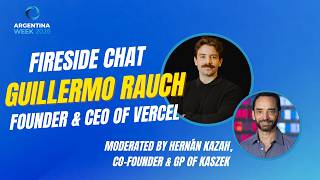
Argentina Week 2026 | Argentine Talent Powering Global AI | Guillermo Rauch & Hernán Kazah


Guillermo Rauch on Building Vercel With Purpose in an AI-First World | 2026 Upfront Summit