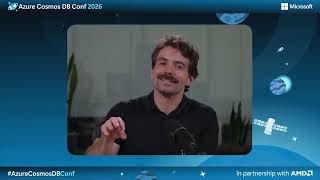
In a keynote interview at Azure Cosmos DB Conf 2026, Vercel CEO and founder Guillermo Rauch discusses the principles behind Vercel’s success, the explosive expansion of the software creator market driven by AI agents, and the strategic role of Azure Cosmos DB in supporting Vercel’s serverless architecture. Rauch explains that Vercel’s original focus on "ease of use for humans" has evolved into "agent ergonomics," enabling developers and AI agents alike to quickly bring ideas online. He highlights how agents dramatically increase the addressable market—potentially 100× the traditional developer base—by allowing non‑programmers to request solutions that agents then code, deploy, and run on Vercel. The conversation turns to Cosmos DB, which Vercel selected for its serverless compute model, fault isolation, and transparent request‑unit (RU) cost metrics that align with the token‑based economics of AI agents. This cost visibility helped Vercel scale from a garage‑stage team to handling billions of requests and a three‑fold increase in weekly deployments without a dedicated DBA. Finally, Rauch offers career advice to early‑stage developers, urging them to treat the AI‑augmented agent as the new computer, continuously update their priors, and become truly full‑stack—understanding business problems, performance, and cost, not just writing code or prompts. He stresses openness, adaptability, and ownership as the antidote to staying relevant in the rapidly evolving AI‑driven software landscape.
Chapters
Friends, it's an honor to have with us CEO and founder of Vercel, Guillermo Rauch. Guillermo, you've built libraries like Socket.IO and Next.js that form the modern web as we know it today. On top of it, you've built a highly successful company Vercel that has seen a really good growth of developers that provides developer cloud. What do you credit Vercel's success?
I think if I look back on the principles that we created Vercel on, it was really about the ease of use. At the time it was ease of use for humans. Now lately I've been calling it agent ergonomics or ease of use for agents. It's about, you have an idea and you need to bring it online and you actually wanted to scale and work really well and be a really high quality product. So if it could be summarized as something simple, it would be the focus of ease of use, but in the service of quality, not just getting slop, as we call it these days online, that crashes and pages you at midnight.
Makes sense. As you transition to agents as your customers, what surprised you is what's happening in the industry?
It's really the scale. You know, as an entrepreneur, as a founder, you start doing like market sizing estimates when you're preparing your early decks for your investors and would-be investors. And the common wisdom was that, you even being generous, maybe there were 30 million people that could deploy applications because we targeted the easiest programming language that we could think of, JavaScript, TypeScript, trying to make the cloud super accessible. But it was still tens of millions of people. And Next.js also lowered a barrier to entry to React and to this universe. But when you think about agents, they're empowering everyone on the planet to create software. They might not even be realizing that they're creating software. They might just ask for a solution to a problem. And in the process, the agent writes an application and deploys it on our cloud. So a lot of the growth that we're seeing these days is literally, by the way, happened yesterday. A high school friend of mine came to visit me. He'd never written a line of code in his life. And he's like, oh, by the way, I know what Vercel does now because Cloud Code deployed a Vercel and told me the application was now online. So I could have never imagined that we would see an increase in, let's call it 100 times the addressable market of creators of software, maybe even higher. I think we'll be soon in a future where software is like water. Like, it's just a normal thing to create, consume, sell, and it's everywhere.
That's amazing. And as the platform that is so frequently used by the agents, what do you expect of the modern database? How can we help you?
Well, I'm very thankful. I always tell the team, because part of growing up as a company is telling the stories and scars of the early days. We started out using a database that was very managed by me in the early team. And it was a horrifying experience. And I reached out to you, and I'm very thankful, Kirill, through an introduction from Nat Friedman, because I was looking for a solution that would help me focus on growing Vercel and not being a DBA. We had very few people on staff. This is literally the garage story. And one of the convictions that I had that helped me choose Cosmos and be savvy about this, because I'll tell you, some of the less familiar developers look at query languages and they might have a little bit of culture shock sometimes. But one of the things that convinced me is that compute was becoming serverless. The value of Vercel was you deploy, it scales to zero, it scales to billions of people. I literally am supporting applications these days that were vibe-coded and go viral all over the internet and have traffic that even teams of engineers would have never dreamed of and can now be sustained by someone that barely knows how to prompt. And the magic there is that it was that bet on serverless because I also tell you the reality is that a lot of this software is quite ephemeral that's being written by the agents. Maybe it's useful for a day. Maybe it's useful for a presentation. We're seeing a lot of sales engineers, including people at Microsoft, use v0 to vibe code an app for a sales pitch, for a demo for pre and post sales to demonstrate an integration of a product. And so if software is ephemeral, serverless scale to zero and flexibility there is extremely useful. So I'm very thankful that we made the right bet. The other thing that I wanted to be super mindful of that serverless compute helps a lot with is fault isolation. So I didn't want to get a machine hot that could create noisy neighbor problems. Imagine if the misbehavior of one tenant could impact the reliability, uptime, availability of other customers. But what I just described is the everyday database. It's kind of nuts that we still, that there's so many people that kind of live in the shadows I think, because they put systems online whose behavior they cannot predict. They might become a wave of queries or users or whatnot that just ruins the day for everybody. And people start citing slow query logs and all that junk. And so I wanted a system that gave me an economical thinking where the developer writes a query and they understand its cost. We can project out its cost. A lot of what I think has made Cosmos successful is that it kind of makes sense in the token world, right? Like when I use a coding agent, I know that certain traces of reasoning cost more compute. When I make a cross-partition query in Cosmos, I get back an RU count of how much I spent on that query. And so it allowed me to scale Vercel from a few developers that didn't want to have a DBA on staff And to actually hundreds of engineers that are supporting a growth in usage that we'd have never imagined with deployments, which is one of the key collections that we host on Cosmos, having grown our weekly deployment count has 3x'd in a few months. And I think there's probably no database system in the world that I could have homegrown, for example, that could have absorbed that kind of growth that agents have gotten us.
Thank you. Well, we are very grateful for you to be our customer. We have many developers online right now watching this that are early in career. What would be your advice to them?
Well, one of the things is that the agent is like the new computer. And this is advice that I give myself every day is that I really have to update my priors every day. I give a presentation to the whole company saying, look, these are the things that I used to believe AI couldn't do, and I was wrong. I'm coming out and saying it like, I thought AI couldn't, you know, contribute to large code bases. I was wrong. I thought AI couldn't have, couldn't do good designs. I was wrong. And so it's very important to realize that the things that you've learned, you have to hold on Of course, you have to appreciate the skills that you've developed and be proud, but also just be very light on your feet is my advice. I like to think of the engineer of the future as someone that is very full stack in their understanding of the business. When I hire an engineer, I don't expect them to just be typing code or even prompts for that matter. I want them to understand the full problem. Again, it's a little bit like I mentioned that economy system that Cosmos has given us where I was able to shift the burden of understanding what our database performance and cost is going to be to the everyday developer. They didn't toss the problem out to, oh, some other team will worry about scaling my database, right? No, you are participating in that process. I think the original ethos of DevOps was very much in that direction. I think The difference now is that everyone is super full stack. I do design, I generate videos, I generate SVGs, I create front-end code bases, I create back-end code bases, I write CLIs. During the holiday break, I vibe-coded my own Swift menu bar app. And so I think the antidote here, or like the way to really stay relevant is to be super open-minded and super full-stack.
Thank you, Guillermo. Really grateful for us to have you here. Appreciate everything what you're doing. Love your posts. Love everything that Vercel company is doing.
Likewise. It's been a great journey and excited to continue collaborating with you all and do more with Vercel in the future.