Architecting for model step-changes: A fireside with Vercel's Guillermo Rauch
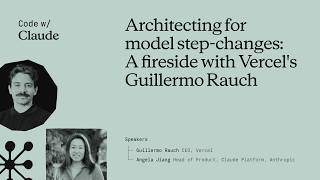
In this fireside conversation, Vercel CEO Guillermo Rauch and Anthropic’s Head of Product Cloud Platform Angela Jiang discuss how Vercel has evolved from a pure developer‑experience platform to an "agentic infrastructure" provider. Rauch explains Vercel’s original mission to eliminate friction between ideas and production, and how the rise of AI agents has become a new super‑power that expands the pool of people who can ship to the cloud. He describes the internal "AI software factory" – a culture where engineers, designers, and security teams build their own agents (e.g., Leap, DeepSec, internal security factory) to automate workflows, using tools like Cloud Code, v0, Claude Code, and the Vercel AI Gateway. The conversation dives into the technical and economic impact of upgrading to Anthropic’s Opus 4.5 model, noting that Opus tokens dominate usage and that smarter models enable simpler architectures, higher credit spend, and richer product completeness. Rauch outlines the importance of sandboxes, tool‑approval guardrails, and the Agent Browser CLI that lets agents use a computer‑like environment to generate and debug code autonomously. He contrasts synchronous, UI‑driven agent interactions with emerging asynchronous, less‑supervised workflows (e.g., Slack‑triggered tasks, autonomous security scanning with DeepSec) and speculates about future autonomous organizations where agents not only build software but also market and support it. Finally, he shares how Vercel prepares for future model releases by empowering every employee to deploy, sharing knowledge via internal channels, and treating tokens as a new kind of infrastructure resource.
Chapters
Please welcome to the stage CEO of Vercel, Guillermo Rauch, and Head of Product Cloud Platform at Anthropic, Angela Jiang. Gee, thanks for joining us.
It's great to be here, IRL.
Yes, Gee has sent me many requests for things over text, so now we can do this in person in front of a bunch of people. All right, folks, so I'm Angela. I'm from Anthropic, and, you know, everyone knows Gee. Incredible, incredible, I think, thinker, builder, creator of some of the most popular technologies, and I think been really incredible to actually see Vercel become, I think, a place and a provider of technology that almost so many startups and so many creators and builders have come to to actually build their agents, build their products, experience a lot of the more, I think, AGI-pilled types of experiences out there. I actually would love to maybe kick us off with your point of view on how you've seen Vercel transform And I know you've kind of publicly talked a little bit about, or actually a lot about, how AI is super transformative to technology, super transformative to the way that we build these things. And maybe give your perspective on how Vercel sees that, um, and how you kind of take that in internally as well.
Yeah, it's, it's interesting because when, when Vercel was born, the idea was to remove any friction between an idea and bring it online.
Love that.
And the tools that we had to do that were— I mean, maybe to summarize it, it was developer experience. Many people credit us with introducing the developer experience obsession to cloud infrastructure. And the, and the mission was to just make it more generally available. Like, if you only knew frontend, for example, React was the bet that we placed for the most part at the time. If you, if you could only learn JavaScript and React, Now maybe you can wield infrastructure that before that was only available to the massive mega manga or FANG or whatever you call them these days, those kind of massive corporations. And fast forward to today, I think we're still focused on this idea of bridging idea to reality. But we have these new amazing superpowers. It's like you've been playing an RPG game and like super weapons dropped and that's agents and AI. So I spend a lot of my time these days thinking about agent ergonomics and the developer experience for agents. And we're now living in a reality where that group of people that could deploy to the cloud is infinitely bigger, right? With tools like v0 and Cloud Code, you know, you hear every single day of your life now that everybody can ship. So it's been an accelerant of our mission. But it's really changed how we think about building. And the thing that we're narrowly focused on building now is what we call agentic infrastructure. So being the best partner infrastructure to tools like Cloud Code, helping you deploy agents, and then also turning the infra itself into an agent. Meaning, think of, imagine if the cloud itself can self-heal, self-optimize, self-configure, and so on.
That's incredible. I think one of the things that really stuck with me when, you know, some of the concepts that you've described publicly has been the idea of an AI software factory. I know Vercel has been— I think many of us know you for incredible products that you put out there for builders, but also even internally, I think you guys are incredibly agent-pilled and very, very fast-paced and very innovative in that space and would love to kind of hear how do you guys create agents internally even for yourselves and your own workflows?
Yeah, we are very agent-filled because we lived through the experience of using agents and becoming more productive ourselves, right? One of the core thesis of our product development philosophy is, you know, we try things, we try a lot of things internally at Vercel. And whenever something works, we become big advocates, we build around it. So I remember, for example, when I first got access to Cloud Code preview release, Mikey invited me to it and I grew very strong conviction that it wasn't just going to be, for example, frontend engineering. It wasn't just going to be, you know, autocompletion on a code editor, that this was fundamentally a new way of even automating your computer and your operating system, that the CLI was a very beautiful layer of abstraction to sort of agentify everything. What I did is I told the entire company, "Unlimited token budget. Go and use all of these tools." One of the things that's happened since then that I think has surprised me and has formed and crystallized this idea of the AI software factory is that people have used tools like Claude Code and v0 to build their own tools. For example, when Ralph Wiggum became a thing, I remember walking past one of our engineers at our office and I was like, "What is that? What is that sound?" What software do you have running? I was like, oh, I created my own sort of like little like AI coding environment. So I experienced that this idea that if software development costs go down, people are gonna reassemble all of these blocks and give birth to new tools and new ways of scaling their own productivity. And then I saw that with our design team. I've made this public on X, which has been kind of astonishing. We have an internal tool called Leap. Where designers at Vercel decided, you know, I'm gonna stop just reacting to Slack requests for design. I'm gonna instead put out a tool, an internal tool, um, that automates a lot of their work and produces beautiful artifacts of work. So we, we kind of have now a design factory of sorts. And earlier this week, we kind of open sourced our security engineering factory, or I call it the QA and security check of the production line of software. And so we're now firmly in this world in which not only are you— you can just ship software, but now you can also create the most ergonomic tools possible for your own team. And I call this sort of the software factory.
That's incredible. And I'm really curious, you know, just to kind of follow up on that, if you see a lot of, you know, this kind of creativity internally as a byproduct of the culture that you've created, or do you see it as, you know, just the fact that all these tools are so easy to reach for And so really just the imagination of all these folks is what's driving it.
Yeah, I think part of it is cultural because we're all, everyone that comes to Vercel is highly motivated by this mission of creating the best possible tools in the world.
That's awesome.
And I can't see a world where the best possible tools in the world today are not involving agents in some way, shape, or form, right? For example, for DeepSec, the idea that, you know, is not even just a tool where you are making your own code review faster, but the fact that you can spin up sandboxes in the cloud and automate your work to a degree that you never would have been able to do by hand, right? Like we're talking about running thousands of sandboxes in parallel, testing out different hypotheses. So I think there is the intersection between developer experience and the fact that Vercel builds agentic infrastructure. So I think people are finding creative ways to use this infra. We're talking about sandbox workflows, AI Gateway. We encourage people to test out multiple models. Uh, and so I, I think if I were to share the recipe, I think a big part of this is creating a safe sandbox environment where people can create and deploy their own tools. Uh, and, and obviously this is the perfect partnership between, for example, Cloud Code, uh, and the Vercel plugin. Yeah. You know, if I just gave you an amazing agentic engineering tool, but the code lives and dies in your own computer and there's no mechanism to share it with your colleagues, there's no mechanism to deploy it securely, to scale it, then you're just kind of like dying at the prototype stage. But anyone that touches these tools wants to see their ideas come to life and hit production.
Yeah, completely agree with that. And super big fan of Vercel Sandboxes. All right, well, maybe we can take a step back in time a little bit. And I'm curious if you can take us back to the day Opus 4.5 dropped. v0, I think known for incredible speed, beautiful production experiences. And you guys built in support like the same day. Yeah. Really wanted to kind of get a sense for you of like, you know, what does ready really mean for you as you kind of build in the months ahead to make that like day one experience? So possible, so quick for users.
Yeah, I have a lot of lessons learned from the astonishing success of just upgrading the model, which obviously just upgrading the model, I'll go into detail, is not as easy as it sounds. But to give you some context, Vercel AI Gateway is sort of this, I call it the CDN for tokens, and it aggregates a lot of the token usage of the millions and millions and millions of Vercel customers. And Opus tokens represent something like 20-something percent of usage on AI Gateway, but they're actually upwards of 70-something percent of all spent on the AI Gateway. By looking at the data that I have from so many different customers, the lesson that strikes out to me is people really chase the best intelligence they can find. When Opus came out, we had this question, right, of like, what is going to be the v0 default model? How quickly do we upgrade? Do we give it to everybody? And so it was a combination of one, running the evals to understand, you know, the product is getting better. One of the surprises with Opus was actually that we could simplify the codebase. We had added and documented a pretty extensive pipeline that did a lot to enhance the intelligence of previous versions of models, including, for example, we had a step of looking at the output and performing autofixes because earlier versions of models were making a lot of syntactical mistakes. They would produce errors in the application or they would slow down the agentic loop. One of the things that was striking to us is because this model is smarter, we could simplify the architecture of the product. The other thing was just superior taste. Okay, so I remember giving a talk to the company of like, look, anytime I see AI get better, I update priors. Yeah. And one of the priors that I had to update was, can models actually produce tasteful outputs? And I think it was probably, you know, a fix in the model from like purple outputs to darker Vercel-style outputs. But we also found that the model was very malleable. So one of the value adds that we found with v0 is that we can really infuse a lot of the best practices that we've learned over the last 10 years of design, of our own aesthetics, of what makes for a better product. And so we kind of added that onto the model. And then, you know, we do a lot of A/B testing. So one of the capabilities of Vercel's infrastructure is we make flags and experiments a first-class citizen of the platform. So we're always testing things out. And so I remember ramping up Opus really fast because the results were astonishing. I believe that since the beginning of the year, since our most recent Anthropic model upgrade, this is actually kind of an astonishing fact, our credit spend on the product is up by 2x. Wow. And this is a signal of not just like, oh, the outputs are amazing or it's more beautiful outputs, et cetera. It's also that you can go a lot further. With more intelligent models, meaning that the ambition of every creator is to make their product as complete as possible, production-ready, secure, high-quality, bug-free, but also full-stack. As we've been collaborating with you all on rolling out model upgrades, we've seen that the products that we create can become more complete and more ambitious.
That's awesome. My team loves v0. They actually actively go to v0 first to get a beautiful experience. They'll iterate there before they bring it down.
One-third of— signups have— total signups have now come from v0 because it's really opened and widened the aperture to who can build, or at least who can get started building. And nowadays we find that at any tech organization, the developer-adjacent personas have seen a ton of upside because in the past they really weren't able to contribute directly to software. Now it's everybody in the company can say, you know, here's my proposal, or here's my improvement, or here's the tool that I'm building.
Yeah. You mentioned this a little bit about the models with more intelligence, you're able to go a bit further, have this kind of completeness in your product. And you even talked about sort of cleaning up your code a bit to allow the model to sort of almost like breathe a bit. I'm curious from maybe the v0 perspective or alternatively other agents that you've built, where have you kind of over-engineered for maybe current generation of models, maybe with some examples in that area and how you kind of see that that may be changing or improving as future generations of models come forward in order for you to get more completeness to the end user?
I think there's been a number of things. One is how many tools we would give the model. We're trying to maybe at times overengineer a little bit in terms of building very specific subagents or building very specific tools when in reality, I think this has also been a thing that surprised me about Claude Code. The model in combination with the sandbox can get so creative. Sometimes it gets almost like too creative. You read the commands that it generates and you're like, what did it just do, right? But that idea that the model can, or the agent can produce its own code to creatively solve a problem, So it's kind of crazy, right? Like, it's not just producing the end result code of the application that the user wants to write. The model and the agent can write these intermediate steps to arrive to the right solution or to debug the output. And so one of the big leaps in capability for us has been just embracing this idea of giving each agent its own computer.
Mm-hmm.
So the importance of the sandbox. And why is it sandbox, right? It's because if the model is writing code, you know, it can get kind of nutty. Like it could be any code. And so I think where we're now engineering more is around tool approvals. It's around creating the right security guardrails. I think there's a lot to be said about finding that sweet spot between security and operator oversight and also not annoying the end user with like, approve, approve, approve, sometimes even asking the user to approve commands that they don't understand. Here's a Perl inline script, please approve it, right?
Yeah.
And so I think finding that balance. So the sandbox and the computer for every agent has given us a tremendous leap in capability because we're able to reduce the number of fixed tools and just let those tools emerge as part of the agentic process. This is also true about problem solving. I think in the early versions of these products, I was very much of the mindset that the human engineer was the one that needed to be prepared to map out and confront all of the error scenarios that your AI and agent tool can get into instead of, again, let it emerge with novel solutions. So a good example here would be we gave— we created this little CLI called Agent Browser. And so now v0 has the ability to write code. It knows really well how to use Next.js. And then if it finds that something is broken, it can use the browser to take a look at the output. It can take screenshots of it. It can read the developer logs. So it's a little bit like arming the agent with the same tools that a human would have and not being too much of a micromanager. Like it's maybe a lesson in like engineering management in general. Like you don't want to be the manager that's like, Hey, did you check this? Just let the model breathe, to your point. These are high-level things. The other one is embracing the CLIs. So I mentioned Agent Browser is a CLI. It's amazing to see the agent learn new tools that are not in the training data. So Agent Browser, which is this sort of partner program that we give the agent, it didn't really know how to use it. We now have since complemented it with skills. Obviously at Vercel, we're very skill-pilled. We found that it helps models get faster to their intended results and so on. But yeah, seeing that emergence of, hey, there's a— the agent has a sense of how these tools click together and it can embark in very creative problem solving.
Yeah, absolutely. All right, well, I'm curious for maybe some views that you might have on maybe where you have opinions on what the models are doing that maybe some of your peers might potentially disagree with you on. I know you kind of have some spicy takes every now and then, so curious for one here.
Okay, yeah, so I think this is probably a consensus that clearly agents need less and less and less supervision. Mm-hmm. So we're experimenting with Slack integration that launches v0 tasks directly from Slack. We've seen a lot of our colleagues and peers build their own agents that they invoke themselves kind of asynchronously. So maybe we're seeing this shift from more synchronous to asynchronous. Broadly speaking, I think all of the interaction modes with humans and agents will continue to exist in some way, shape, or form. For example, I personally really like CLIs when I'm doing something that's very specific. I'm problem solving. I need to get a debug log. I need to look at it. I need to use a bunch of tools that I already know exist in my machine. I use a CLI. Then there's this other interaction model that v0 is really good at, which is you're working on the interface of your product, or like it's almost like UI-driven development where you need really fast back and forth between the frontend output and your prompts. And the human operator is really engaged almost in a creative process. That can, that was almost instead of going longer, I feel like it's shrinking. For example, I'm kind of addicted to, V0 Max Fast, which is backed by Cloud Code Fast Mode. It's kind of nuts. It's really expensive. So good news for Anthropic. But it's kind of like the focus state that you fall into is pretty amazing. And this is because that kind of interaction model with agents requires these really fast loops. And I feel that— and a lot of customers tell me it's replaced their design tool. This is perhaps a little spicy because Even at Vercel, there's a lot of designers that love their, you know, more like drag and drop artboardy tools and whatnot. And by the way, I also love those tools. I always tell people, it's kind of shocking, but when I created the Vercel deployment CLI and the first version of Next.js, I didn't start with code. I designed it in Sketch.
Really?
The predecessor of Figma. I designed all the states of the CLI, like deployment failure, this and that. Like, so I've always been very design tool pilled. But I've seen how— and customers tell me that v0 kind of replaces those. Then the last one is where the one I think will see the most growth in the future is this more asynchronous, less human-supervised model where you launch your task and you're like, "Agent, come back to me with the solution." Obviously, we know this as Ralph with the exit criteria. For example, our CTO created this awesome tool, DeepSec, where we throw Claude Code and Codex at massive codebases in parallel using sandboxes, and the exit criteria is come back to me with a reproducible security bug. And it's— and the results of it have been shocking. We've now collaborated with nearly a dozen open-source projects where we've surfaced critical vulnerabilities. And this process is just kind of magical. Like, it's kind of funny because I sit in front of my CTO at the office, and he's kind of like, you know, fidgeting around, kind of semi-distracted because these agents are running in the background, right? And so this is a new, entirely new mode of, I think, like human-computer interaction, and I think it's gonna grow a lot. The other one that is maybe even more spicy is you can take, I mean, the goal of that unsupervised agent is to build you software, but it doesn't have to stop there. It could be promoting your software. It could be running ad campaigns. It could be responding to support requests. I do think there is a future ahead of this where instead of just building software, we take it a step further. It's like we're building autonomous companies and we're building autonomous organizations. Again, it's less supervised. I think when you see the excitement around things like OpenClaw and the text message -driven agent development, you're just using your text messenger as a way of sort of delegating tasks to your agent. And you're kind of expecting that they're going to take a while. And again, this is a completely different paradigm from, I think, how we've all used computers in the past, which is like we expect that instant gratification. Absolutely. But instead, we're just sending off these agents to work. I used the metaphor the other day because there's a bunch of these autonomous companies that are growing really fast on Vercel. Or autonomous companies builders. And it's a little bit like you're the board member. Like, think about being a board member of a company, right? You get your quarterly board meeting, you give feedback to the CEO, you give them resources, maybe you're an investor, you give them capital, and they run off and do amazing things in the world, hopefully, and then come back and give you a status report. So you're kind of like looking at the world one quarter at a time, and I think one could extrapolate that kind of engagement model with agents. Like, agents, I'm going to give you some resources. I'm going to give you a virtual credit card. I'm going to give you this. Check back with me. Let's see what you did in a week, month, quarter time.
Yeah, absolutely. I'm curious, you know, like on some of these kind of like takes that you have and clearly you're kind of seeing where some of these things will— these interaction models will kind of change. How are you at Vercel sort of architecting for that kind of change? You've obviously talked a lot about sandboxes and a lot of your perspective there. But as you kind of project forward and what you would maybe anticipate from you know, next couple of releases of models? How do you prepare for that?
Yeah, one is continuing to empower people, you know. Every time you join Vercel, we would have you deploy something, whether— it doesn't matter whether your role was going to be engineer or not, we'd have you deploy something, you know, get a taste. Like, we would even have people sign up for a GitHub account, and like, maybe this is the first and last Git commit that they ever make for some roles. And so I think it's always been about empowering people and like helping them realize that they have no ceiling, that they can use these tools. And, you know, I try to lead by example. I have a Slack channel where it's like my brain dump. I literally call it Brain Rauch G, and I try to show the company all the time how I'm using different tools, you know, image models, video models, how I vibe-coded my own little productivity tools, how I use operating system level AI. So Trying to be really dynamic about knowledge sharing on best practices. Obviously empowering people from even a capital perspective. You know, I don't like the idea of a token leaderboard, you know, who burns the most tokens the fastest. But I do like the idea of like, and by the way, there's a parallel between the consumption model of Claude tokens and what the cloud did for us. Like when Vercel started, it's pretty magical that I could just sign up for an AWS account and then do magic with it. And I think there's something to be said about tokens being almost like the new infrastructure because you tell people, all right, you know, you have all these tokens. Some are super smart, maybe super smart and super fast like FastMode. Be a little bit more careful with those. Some are really inexpensive like open models by certain inference providers. And so knowing that these are your new raw materials, your new clay to shape up new solutions. I think realizing that everybody at the company, not just the CTO, can do these things has gotten us a long way.
That's incredible. Well, I think Vercel is an incredible company, and it's really wonderful to have you here and to hear your perspective on how these teams can get better and how you're building agents and empowering so many builders to do this.
It's been great to partner with you guys.
Thank you so much.
More from Guillermo
Guillermo Rauch at Founders in Arms Live: Simplicity, Focus, and the Bet That Built Vercel
The Man Who Built a $9B Dev Platform Thinks You're Overcomplicating AI | Guillermo Rauch


Inside v0: How Guillermo Rauch Is Building 100 Million Engineers | Lenny's Podcast - EP.89
Keynote Interview: Vercel's Guillermo Rauch on the Agent Era | Azure Cosmos DB Conf 2026
Vercel CEO: 70% of Our Traffic Is Now AI Agents "Nobody Was Prepared" | Anthropic, OpenClaw, OpenAI
Why being "terminally online" is more important than ever, with Vercel CEO Guillermo Rauch
Argentina Week 2026 | Argentine Talent Powering Global AI | Guillermo Rauch & Hernán Kazah


Guillermo Rauch on Building Vercel With Purpose in an AI-First World | 2026 Upfront Summit