Is San Francisco Still Worth It in 2026? | Guillermo Rauch, CEO of Vercel

In a March 2026 fireside chat, Guillermo Rauch, founder and CEO of Vercel and creator of Next.js, shares his personal journey from a small town in Argentina to Silicon Valley, explains why San Francisco still adds a measurable edge to a startup’s odds of success, and reflects on the lessons learned from his first company that was sold to Automattic. He discusses the strategic role of open source as a rapid path to product‑market fit, how to decide what to open source versus monetize, and why he would still choose an open‑source model today, especially with AI‑driven agents. Rauch outlines the importance of ruthless focus—balancing boundless ambition with narrow, high‑quality execution—and introduces the concept of “taste” in product and communication design. He stresses the need for clean, distraction‑free landing pages and concise messaging to cut through the noise of an AI‑saturated market. Hiring is framed around “proof of work” from open‑source contributions and the ability to communicate ideas effectively. Throughout, he emphasizes building for agents first, leveraging APIs, CLIs, and server‑side performance improvements, while maintaining a long‑term personal legacy that balances founder responsibilities with family life.
Chapters
This really grinds my gears. I sometimes see slop landing pages from startups, which is this recording of the entire desktop of the entrepreneur. It's just so busy. I see his dock with 200 applications, I see his entire browsing history, I see 200 plugins, and I'm like, "Dude, I'm busy doomscrolling through different social networks. I only have this amount of brain cells dedicated to your landing page?" So you have to like remove all possible noise and distraction from how you communicate because they're an excuse for people to get distracted.
That's Guillermo Rauch, founder and CEO of the web development platform Vercel and the creator of Next.js, one of the most widely used frameworks on the internet. In this fireside chat, Guillermo explains how open source can accelerate product-market fit and why ruthless focus matters more than ever in the age of AI.
Thank you everybody for today and thank you so much Guillermo for being with us this morning. You know, we've known each other for a couple of years now and one of the most impressive things about you is not only what you've built at Vercel but your story of how you came to Silicon Valley. You were born in Argentina in not even the capital, it was like a small town, but It would be amazing if you can share with the audience a little bit about your story and how you got into tech and eventually how that guided you to Silicon Valley.
Yeah, funny enough, we're only a few blocks away from the first office that I had in SF. It was on the Embarcadero. There was this coworking space where I first got to SF not knowing much about it. I'm from Argentina. I grew up tinkering and hacking and speaking speedrunning things, funny enough. One of my hobbies was I would install Linux and I would try to get emulators to run in Linux, which back in the day was kind of a feat. Nothing worked, everything was like a manual compilation, et cetera. So I grew up with open source and then contributing to open source. I built a bit of a global resume off of open source, which is still a legit and amazing personal growth strategy. I just got in touch this week with a bunch of entrepreneurs that I like their work or I might invest in their companies and whatever, and it's because they're putting stuff out into the world. I think open source continues to be that thing. And so for me, even while I was in Argentina, I was able to sort of build this awesome resume as early as 13, 14 years old. I was sort of making these contributions to projects. And then a company noticed it. They invited me to like fly out of their office. Then they rented out this coworking space on the Embarcadero in SF. I came here and then very quickly I noticed that this was the best place to build a company. And I think there was a really good personality-city fit for me because I was all about exploring and trying to do it my own way and gaining independence. Putting my ideas out into the world. And so I started a startup with 2 other co-founders. We sold that startup to the company behind WordPress, Automattic. And then when I left Automattic, I started Vercel. And so also this is a great place to perpetually start companies and launch them and sell them even. 'Cause funny enough, we're also a few blocks away from, I remember I sent a cold email to the founder of WordPress saying, "Hey, I've been working on this thing. We're about to launch it. I would love for you guys to try it out." And he's like, "Do you wanna come to our office to show it to me?" And it was a Sunday. And it's like, this is the important thing about locking in and working every day of the week. Just kidding, but yes. And that weekend we met and another beautiful thing about SF is just, this amazing serendipity and connections you can make here. And I think you should all take advantage of that. So in this 5-block radius, I have all these stories that have been super formative and led to creating and shipping amazing things.
Just double-clicking a little bit, we were in London last year and you gotta ask this question because we have a lot of teams that are internationally based and are moving to Silicon Valley or trying to make that decision right now. How are you thinking about SF right now and would you start Vercel again here versus somewhere else in the world?
Yeah, I always say this is one of the hardest— I love the speedrun name, by the way. This is one of the hardest games, video games in the world, building a startup in hyper-crowded markets, competing against the most intelligent and motivated people in the world. We're all hyper-connected, ideas flow at the speed of thought. And so how do you differentiate and how do you accrue a competitive advantage in a situation like this? For me, SF accrues some percentage points of likelihood of success to my endeavor. So maybe I have a 5% chance of success. How can I add every possible point percentage of success to my odds? And I think SF provides that for me because of the things that I mentioned, like even the readiness and availability for you to meet people that could be trajectory-changing for your companies, businesses, et cetera, customers, et cetera. I also think in SF you have the most demanding customers. That's a beautiful thing if you lean into it, which is you're gonna get people that try out multiple things, know about multiple things. If they select you as a vendor or as a partner, on average, I think they tend to move faster. They tend to have a higher bar. There's the sort of the endless, or eternal I would say, advice or wisdom of, you know, sell to startups, sell to other startups, because when you sell to other startups, they have very little time, they have less resources, they're more discerning, they need to move really fast. And so it really takes a village to create a successful company, and so I find that this is sort of that ideal village of early beta testers, buyers, partners, that improve your odds of success.
Just double-clicking, before starting Vercel, you started a company and you sold to WordPress. For the founders in the audience, what was the biggest mistake that you made while you were building that company?
Biggest mistake was, I think, I stuck around with an idea that I wasn't passionate about in the beginning for a little too long. I wanted to build products that were widely available and used by as many people as they could. And had narrowed in on a market that was, I think, too narrow for me. So I think it's very important that there's market founder fit, idea founder fit. I actually think there's no shortage of incredible ideas to work on today. And some of them might just not be the things that each individual you should be working on. And so I think my biggest mistake was, 'cause, I really looked at it, I was CTO of the company, and I looked at it as a technology problem. And I actually think I can solve such a wide range of technology problems. But building a company is way more than just the technology. If I was starting, if I was in your position today, I would try to start with the mission. What problem, what big problem am I gonna go out and solve? So I don't start with tech, I start with the mission and a vision for what I want to accomplish. Maybe in the beginning I was too narrowly focused on tech. And by the way, the fun thing is we were actually really successful with just technology. We were building an edtech platform and we had hundreds of thousands of schools and teachers using our platform, but my heart wasn't in it. I just wanted to create something that was more widely successful.
So then you move into Vercel. Open source. I think one of the big questions that founders always have when they're building open source is like what to open source versus what to monetize. And it'll be great if you can share your perspective on how you make those decisions.
Yeah, my framework for open source has always been that because the hardest challenge for your startup is a couple things. One, people to know you exist. We're in a hyper-crowded and competitive market. How does a potential buyer know that you have a solution for their problem? So that's one. And the other one is also just building the right thing. Insanely difficult, right? Having genuine product-market fit. So I've always thought of open source as a speed run to product-market fit because if people don't use it when it's free, when it's easy to consume, when the code is available. Because building in open source actually has all of this super cool second-order effects. For example, typically documentation needs to be excellent. It's all in the open. It's very easy to modify, et cetera, et cetera. Agents will probably really appreciate an open source project that they can clone and work with. So it's like a super, transparent tool to be picked up. I actually think with AI, we're going to see a deepening of open-source advantages. And so if someone doesn't use it and doesn't find it valuable when it's in that shape and presentation and at the price of $0, then you probably should be working on something else. So it's actually a super awesome way of cycling through ideas and trying out different things. It does come with the disadvantage that because it's open, well, now it's easier to replicate and you can throw an agent at it and create a new permutation of it and whatever. But I actually think that the best open source projects have never been just about a singular piece and they've extended beyond into broader platforms. And so a good example would actually be OpenCloud, right? OpenCloud is open source, But if you wanted to deliver Open Claw safely and securely to a billion people, you would have to create a ton of infrastructure to actually make it scale, right? And so I could see how that project would be really attractive as an open source project. One, it builds this community and ecosystem, and people get a lot of value, inspiration from it. But also, because it's successful, there's emergence of all of these new interesting problems. And so I think what stops entrepreneurs on their tracks is that they worry too much about what's going to happen in the future. In reality, they don't even have product-market fit yet. And if you do get product-market fit, there's typically emergence of interesting new problems to solve. And so I'm using OpenClaw as an example, but it was definitely the case for us at Next, because Next in itself doesn't solve the whole problem that an enterprise has when they have to create an application and scale it and secure it in the cloud. It's only a small sliver of the bigger cloud problem. And so for us, open sourcing Next, I would do it again a million times because the world gets a lot of value. I get to test my product market fit and then I can create a lot of value around it.
If you were to start Vercel today, given the new distribution dynamics with AI, would you still pick open source?
Yes. Yes. And I will say Maybe the biggest difference would be that I would focus only on agents. So when you build a framework or a developer tool, there's an inclination to do a bunch of things that are more for human consumption. I think there is a lot that you can do today to just like— I wrote an article the other day about the value of APIs, which have always been super important. Actually, we just were having a great conversation on the side now talking about how AI's forcing a lot of great habits upon us. As an engineer, it's always been great to document things. And when you find the best practice, you write it down so that your whole team can learn from it. We now call that skills and we do it for the agents, but we should probably have been doing it all along for everybody, right? And so AI is kind of forcing a lot of good habits. Another great habit is whenever you created a SaaS or whatever kind of company, having an API is well known to be a huge accelerant. Enterprises tend to want different permutations of what you've built. They need to integrate it with their own systems. So APIs have always been great for enterprise sales motions. And now with AI, not having an API or an MCP or maybe even a CLI is almost a non-starter. If you look at what Pete built with OpenClaw, it's interesting. You look at the list of projects and it's basically he had to build a bunch of CLIs and APIs for projects that didn't have them. So I use one of his projects because I control my email through an agent. And I found that I couldn't control, I have two email Gmail accounts, my personal and my work one, and I needed a singular interface to all of my email. And I couldn't do it until I found that CLI that I could give to my agent. So this kind of gives you an example that you have to think about the agent ergonomics. What is the thing that an agent can pick up and use that you could sell or you could offer? And that's how I would start, which is basically what I'm doing at Vercel, but the hyperfocus on agents is definitely the way to approach the current market.
Okay, so let's talk a little bit more about Vercel in the early days when you were trying to find product-market fit. What was the most important focus decision that you had to make in the early days?
It was this really easy and excruciatingly difficult focus decision, which is I call it, you wanna have unbounded ambition, because when you go out, imagine you're gonna IPO, you're gonna ring the bell, you're gonna have to have a very bold mission statement. And there should be no shortage of dreams of what your company will be able to do in the future, and how big the markets will be, and how much money you'll be making, right? In contrast, when you're getting started and you're 3 people, If all you do every day is just like unbounded ambition and building everything and 200 million different features, then you've fucked up. And so you have to have this bicameral mind. Boundless ambition for the future and everything will be possible, but also we have no time, we have to create something truly excellent, we have to pick our battles, really, really, really, really hard. And so for me, so I knew that I wanted to give the world the easiest deployment platform, but the question was, what are you going to make deployable? And in the beginning, I was like, well, everything, of course. Every language, every runtime, every framework, even beyond frameworks, database. I wanted everything to be deployable into this thing. And then I realized, well, what is the differentiation in that? Like, where are you being truly excellent about? And that's when we started realizing, well, and this started happening before the enterprises actually started to do it, which is a really big market advantage. But the world is splitting into services, backend and frontend services. And so that would be an opportunity to create a new kind of managed service that didn't exist. The one that orchestrated your frontend, the one that automated your CDN, the one that automated your security. So focusing on the first layer of this super, super deep pie. And so instead of saying, well, I'll do everything overnight, which is actually what I started to do in the beginning, I started saying like, all right, chapter 1, we're going to knock this problem out of the park. And then chapter 2, we're going to knock this problem out of the park. And it's been fascinating to see in retrospect that I think if I had continued doing everything, I would've made a company that made $0. Like literally $0. No product-market fit. Really discerning buyers want the best of each class of problem. They don't settle for second best solution. They typically have 2 or 3 vendors that are doing a bake-off against that are hyper-focused on that problem space and they're offering excellent quality. And so I actually, it was the difference between making $0 and hundreds of millions of dollars, but with a narrow set of things. It's kind of, it's so unintuitive. And I think this is the challenge that every entrepreneur needs to figure out, 'cause you kind of want to do it all. And now you're actually, so the thing that's gonna make it even more difficult is that now you actually can do it all, because every problem with enough tokens is becoming shallow. And so the question is, what are you gonna throw your tokens at if you're generating a bunch of code? And so I think focus and taste has always been a huge differentiator. I think it's even more important, which is super ironic and exciting, that a bunch of you are probably already overbuilding massively because you notice that you can just prompt it and it'll do it. The discernment of what problems are worth solving is extremely, I guess, it could be one of your biggest differentiators.
Let's double-click on that because I think you have been very vocal on X about, okay, we're in this era where everybody can build anything, but that means that there's not a lot of specialized tools being built or there's a trade-off when you go after everything. But you also mentioned another thing that is you're also very vocal, which is taste. How do you define taste? Is this something that founders can acquire or is this something that—
Yeah, I'll give you some inside baseball of how this is playing out at Vercel. So we have agents, we have agent infrastructure, and we have a lot of people that are at the forefront of studying these agents, creating evals, et cetera. And so there is a bunch of paths that we can take on what do we throw our time, resources, and ultimately money because tokens have a price What do we throw them at, right? And so today we announced we're making an improvement to the way that we run JavaScript server-side that will basically make Vercel 20 to 40% faster for Node workloads. And we're open sourcing this, but it might take a while for Node and the world to get it. It's gonna launch in Node 26 and whatever. We don't have that kind of patience, so we're gonna roll it out to all of our customers as soon as it's ready. And it's really fun, we used the Ralph Wiggum technique, which is, we literally just blogged about it. So this is, I give a lot of kudos internally, by the way, as your company grows, one awesome definition that I've heard of what culture is, is that culture is what you celebrate and what you reward. And so, I was telling the team, this is such an awesome application of AI because it deepens a competitive advantage and it allows us to tell customers, look, Vercel has your back. We made all of your shit faster. In fact, when it's faster, we charge you less. The platform just got magically better for everybody. And I was saying, that's such a wonderful use of AI because Ralph worked overnight of this problem. We gave it the spec of web streams, we gave it 1,000 tests, and we just let it go. On the other hand, there's bad uses of AI. We could be using AI to, for example, and I've heard some companies doing this, to rewrite Workday, our HR platform. And that's not our business. I actually couldn't care less. In fact, one thing I do care about is does Workday have some kind of MCP or API so that I can extend it and whatever? But other than that, I genuinely don't care. And so we're at this time where, as a CEO, I'm going to have to basically help the company figure out if everything is possible, what are the problems that are actually worth investing in? And I suspect that a lot of them will have to deal with this deepening of a quality mode and not so much with quantity. Because the other challenge you can have is that, and perhaps this is not as big of a problem in the early days because you're competing for any attention. But when you do have something going, you also don't wanna flood the market with confusing news or updates. So the best example of this is, I actually think a really good email is still an incredible tool that you have in your toolbox. Somewhat controversial, right? Like, writing out an interesting, useful, and valuable email can open a lot of doors for you. But now imagine you have a newsletter, an email list, and you're vibe coding, and every day you're like, "Oh, I created this." Oh, and tomorrow it's a different thing. "I created this, another pivot, another thing." And so you run the risk of just diluting your signal so much that people just tune you off. And so this is why I think that what you deploy your tokens against and how you communicate out to the world is gonna be something you pay extra attention to.
How do you think about talent? Right now, obviously, the labs are throwing a lot of money. We have a lot of founders in the room that are trying to compete for the best talent. And your early strategy was kind of hiring people from open source. And we've seen that worked out. But how would you go about if you were to start all over again and maybe you didn't have, Guillermo wasn't the big brand that is right now, how would you go about it?
Because it's the current thing, I'll use this example again, but on the way to creating something like OpenClaw, I think there was a year worth of open source contributions by that guy. And I don't know if you could have hired that guy specifically, but there are a lot of people that are actually now shipping interesting and high-quality stuff that I would gravitate towards how can I select for people that have proof of work, people that can ship, especially with these new AI tools that can actually understand how LLMs work and how to use them for really high-quality outputs. And so if you can somehow detect What are the people that are on the rise? 'Cause it's very easy to go after the people that are like, you know, have like a million followers on Twitter, have already made their entire career. But if you can actually see, what are the points across like this contribution axis? And start noticing that someone is like inflecting. And the other one is, I pay a lot of attention to how people communicate their work. So sometimes the reason I reach out to people is not just what they built, but how they communicated. So a good example is I slid into the DMs of someone I was building. By the way, this is—
You need to share the name now.
No, you can actually find it because it went viral on X. But like, so it's really interesting is there's this problem in design engineering of like, and it's been, this horse has been beaten to death of, How do you make it such that when a person is hovering on a menu that has a submenu, how do you make it such that the submenu doesn't suddenly disappear? You have to map out the trajectory of your cursor such that it feels like, oh, the UI is responding accordingly, it's predicting my intention. This problem is actually, if you follow this super niche space of Twitter, this problem is well understood. This guy found a new twist on this problem that I'd never seen before. And also how he communicated the little twist was super interesting, which allowed him to get a bunch of likes and whatever, but what I appreciated about it is not the number of likes or going viral, etc., is that he found a novel way to communicate his contribution. And so I think this is where a lot of people fall short. You might create something that is objectively better for the world, faster, better technology, etc., but if you don't find that packaging of the idea, it's a little bit like, I really think that Apple nailed it with not just the iPhone, but the fact that the unboxing experience is beautiful. Everything around the experience of knowing about that technology and including it in your life has been carefully thought through. From the website to the purchasing to the physical store to literally the feeling of lifting. Have you lifted that second? It's addicting. I'll get every iPhone that comes out. I love sliding that upper part of the box. And so you have to think about what is the equivalent of that for your thing, that people feel good just to even pay attention to you and reading about your work and watching your work. I sometimes see slop landing pages from startups, which is this, this really grinds my gears. It's a recording of the entire desktop of the entrepreneur. And it's just so busy. I see his dock with 200 applications. I see his entire browsing history. I see 200 plugins. And I'm like, dude, I'm busy doomscrolling through different social networks. I only have, this amount of brain cells dedicated to your landing page. So you have to remove all possible noise and distraction from how you communicate. And so this is so simple, but people miss it, right? You're recording a video of your thing, so delete all the things that are not your thing, because they're an excuse for people to get distracted. This also happens with funnels. You give people 200 ways of getting started, and they get lost. Half of them don't even start. And so I care a lot about that last mile communication layer. I suspect it's gonna become even more important in this more competitive AI world.
Something that is interesting is that you mentioned that right now everybody can create a lot of different things. That kind of dilutes your signal. How would you go about, for the founders reaching out and crafting that message, how would you, What would be the framework that you give them right now?
I mean, there's a bunch of little tricks that I've accumulated over the years. One is, and I did this very successfully when I launched Socket.io, which is one of my open source projects. This may be more applicable to developer tools, but I really wanted people to get the idea without scrolling the page. So I still care a lot about this. The above the fold of a website, the thing that communicates your idea, if you really have to have people do all of these contortions and browse your entire ecosystem in order to understand what it is that you even do, you'll see a lot of flopped launches on Hacker News. People in the comments, pay attention to the comments of other launches, people say like, "I just navigated this website for like 5 hours and still don't know what it does," right? I start with, can you impose some constraints on what you're doing? And a good example is, for an early-stage startup, having a 20-50 page marketing website, definitely not a good idea. 'Cause you have to really convince people with fewer things, even fewer words. Another thing that I like about, for example, I was heavily involved in giving feedback on the launch of skills.sh. And there were a lot of things that the early revisions of that product that were massively distracting. A good example is the initial page didn't explain what a skill was. So my feedback to Andrew and our CTO was, you guys know what a skill is. So if you go to skills.assist, you're gonna see that we have a little explanation. I tune it out because I'm so terminally online, and I've been tracking this skill thing for so long that I literally don't register it. So you have to have this out-of-body experience your brain doesn't matter. Can you really empathize with people that know less about your specific problem domain? So we have the explanation there. The other thing I give them feedback on is like, all right, you have this registry, this ecosystem of skills, and people can navigate it, but what is the connection to the CLI? Because ultimately we want people to install these. So you're gonna notice there's an element there that if people don't even care about the list and whatever, We're actually giving them a concrete call to action that is one copy-to-clipboard button away. So if you only examine the first 200 pixels of that website, you understand what a skill is and you have a command that you can run. Now, one step further, most commands complain at you, like they look down and they're patronizing. They're like, if you don't run it the perfect way that the author thought about, it's like, ah, sorry, loser, error. You know what I mean? And so when you run NPX skills with no arguments, it teaches you everything that you need to learn, and it teaches agents everything they need to learn about this technology. So I'm always trying to think about what are the corner cases that empathize with people that have more fleeting knowledge of your technology, more fleeting attention, which is probably everybody, 'cause we're all super ADHD or whatever. And yeah, I think that's kind of to me the day-to-day of like product design. And then there's something about taste, like the initial design was good, but it didn't embody quite the signature style of what I would call like the zeitgeist. The zeitgeist right now is we're going back to fundamentals. We're peeling away layers of complexity. We're doing more focused and simpler interfaces. And so I wanted the website to speak almost like a terminal language, like a command line aesthetic language. It's not just because it's cute. It's because skills are almost like an infrastructure thing that you're going to add to Claude Code, and you're going to call from agents, and you're going to add as configuration. There has to be a symmetry between the aesthetics of your product and your market and the timing that you're trying to hit. And so there's no magic recipe for like good design for your product because it's so relative to the specific market, to the moment in time, to the audience, and even how you want the audience to think about your product. You can just with how the product is presented, you can you can send people in a certain direction of thought.
The pace of development, you know, every— I think we've seen each other for the last 2 months, but I feel like every time that we see each other is just your framework and what has happened in the market is, is just completely different. And, uh, you know, you talk about building for agents first, for— you've been talking for about a year about this. How is your current thinking about this? And then given the pace of development that we're having right now, I'm curious, you also on the personal side share a little bit about your legacy and what does that mean. And you have a new baby coming into the world and would love to see how you combine the two, especially as you continue to build, but also think about the long term of a founder.
I really think I love playing in markets where the rules are being defined as you go. I really think that if you, if you're entering a market where your piece of the puzzle fits in too neatly, you might be entering a mature market, maybe not a great market for disruptive innovation and startups. Agents are great because even the shape of them or what the word means is like, it's still so much we're all learning, we're all collectively learning. Also great for startups because it's very rare that a 2-person company, 3-person company could be a thought leader in something, right? Well, they just got started. But if you enter a market that is so unclear, that everything is still waiting to be discovered, it does give you an opportunity to be a thought leader. In fact, I'm always really impressed with startups that I use this heuristic of like, if I find myself putting a link into my clipboard of a blog post that a startup has written, it's like, holy shit, there's something interesting here. I think some people maybe mindlessly just share it away, and I'm thinking like, hmm, should we work more closer with this company? Should we acquire it? Should I invest? 'Cause it's like, this is the opportunity that you have. And so agents, the ways that we build them, the right interfaces for them, how they communicate with each other. All of this is still in very active collective research, I'll say, right? A good example is it turns out that what makes a successful coding agent that you use in your terminal to automate bits and pieces of your work, that architecture is also really good for a general-purpose assistant. If you take something that can use Bash, and use the file system and call commands and APIs, it turns out that that could be your personal assistant that books you a doctor appointment. But 2 weeks ago, we were using it for creating sad AWK bash incantations. And that's a radical insight, I think. And so what I'm doing with agents is, Number 1, building a lot of them. So internally at Vercel, we're building and automating our company with them. My aspiration is that a lot of what we do is just automated by agents that call to us to bring in our judgment and taste, right? And so a lot of experimentation. And then when we find something that is truly good, you should set a pretty high bar for what you consider to be good. 'Cause you can have endless experimentation, but you can say, like, all right, this is good. I'm gonna come to market with this. I'm gonna use all of those resources that I have available to myself. I'll post it everywhere, I'll email everyone, I'll tell people, I'll present it at Demo Day, whatever. And so there is that two-phase process of lots of experimentation, Building conviction. So this is another bit where just because people get excited or you heard someone talk on this stage and whatever, I think always deeply internalizing the ideas is important. Silicon Valley has this sharp edge of people just get so fucking excited about everything, right? And like some of those things are worth dismissing. And so choosing what you dismiss can also be a competitive advantage. And one of the ways that I choose what to dismiss is I really, and this is why I slide into people's DMs and like, I really try to grok the technology on a deep level. I use the products, I download them, I sign up, I like, I try not to outsource judgment to somebody else. All right, Gabe told me, and I trust Gabe, but Gabe told me This thing is fucking awesome. I need to build on it. I was like, well, but if I don't fully understand it myself, it's very hard for me to actually build conviction. And then on the other side is when I started Vercel, I decided to have a kid and now we're waiting for baby number 6. And I remember thinking there's never gonna be a good time in my life to do this. Part of life. And actually I was right, because it's not like now I can fully rest. We figured out all this AI stuff and it's not competitive at all. I have all the time in the world for a baby now. So that was actually super prescient and spot on. There's never a good time. And the other thing that I remember thinking is, because I used to box every day for an hour and a half at 6:00 AM to 7:30. And I remember I had a teacher, it was the founder of the gym, who was so fucking insane that, for example, we were an hour and 29 minutes in, and he would say like, "Okay, now run to the ballpark and back." Just for the, just like, there's always more that he could extract from us. And so I learned that if left to my own devices, my own judgment of how much pain I can tolerate and how much I can do, I'm not a good judge of that. And so I remember thinking like, I'll just push myself further here. I'll have a kid, I'll start a company, and I'll start investing and advising. And I found over the years that actually there's more capacity to you and to your life than you give yourself credit. Sometimes it's overwhelming and you say like, oh, I cannot deal with all that workload and I'm already so busy, I cannot take on that other thing. And then you realize that, I don't know, like how many high-quality hours of your day do you actually have that you're devoting to like productive and creative endeavors? I don't know if you're awake 18 hours, how many of those are actually high-quality hours you're devoting to your work? And so I try to be a little open-minded about how much I can take on, and it's served me well over the years.
Thank you so much, Guillermo. We really appreciate the time. Yeah, hope to have you next time here too.
Yes, I'll see you guys online.
More from Guillermo
Guillermo Rauch at Founders in Arms Live: Simplicity, Focus, and the Bet That Built Vercel
The Man Who Built a $9B Dev Platform Thinks You're Overcomplicating AI | Guillermo Rauch


Inside v0: How Guillermo Rauch Is Building 100 Million Engineers | Lenny's Podcast - EP.89
Architecting for model step-changes: A fireside with Vercel's Guillermo Rauch
Keynote Interview: Vercel's Guillermo Rauch on the Agent Era | Azure Cosmos DB Conf 2026
Vercel CEO: 70% of Our Traffic Is Now AI Agents "Nobody Was Prepared" | Anthropic, OpenClaw, OpenAI
Why being "terminally online" is more important than ever, with Vercel CEO Guillermo Rauch
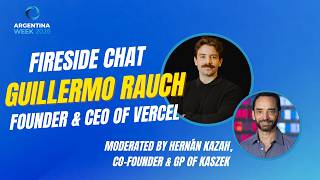
Argentina Week 2026 | Argentine Talent Powering Global AI | Guillermo Rauch & Hernán Kazah

Guillermo Rauch on Building Vercel With Purpose in an AI-First World | 2026 Upfront Summit