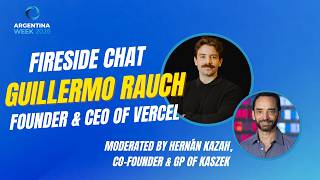
In this episode of Show Me Your Stack, host Jules interviews Guillermo Rauch, founder and CEO of Vercel, about how AI and agentic tools have reshaped his personal workflow and the company’s product strategy. Guillermo explains his "trust but verify" mindset, using autonomous agents to test and evaluate technologies from an end‑user perspective. He argues that the next generation of user interfaces will be natural‑language, messaging‑based agents and introduces Vercel’s new Chat SDK that lets developers deploy agents across platforms like WhatsApp and Telegram. Internally, Vercel runs AI agents named V0 (a coding assistant) and D0 (an analytics and operations assistant) that surface metrics, draft documentation, summarize emails, and even generate UI components. Guillermo demonstrates how he delegates tasks—writing Slack messages, creating progress‑bar designs, and producing comparative product analyses—to these agents, emphasizing the importance of good prompting, iterative refinement, and “ego death” when collaborating with AI. He shares productivity hacks such as keystroke‑counting tools, the Timeless bug‑capture app, and Raycast AI shortcuts. Looking ahead to 2026, he predicts a flood of collective software generation, the need to choose strategic battles, and the rise of AI‑native applications. He also reflects on the cognitive trade‑offs of heavy AI delegation, noting potential erosion of hard‑thinking skills while memory remains supported by tools. The conversation blends technical detail, product vision, and personal philosophy about AI‑augmented work.
Chapters
This is a clear instance of a CEO actually adding value, even though it's marginal.
Hi, I'm Jules, and this is Show Me Your Stack, a series where we're interviewing your favorite techies to understand what their day-to-day tech stack actually looks like. Today we're interviewing Guillermo, who is the founder and CEO of Vercel.
This is Show Me Your Stack.
One thing about Gui, he loves to hack. He loves to hack. Benevolently, only good hacks.
I actually love reverse engineering, taking things apart.
Is that to sort of identify the holes in that system as you take it apart?
Something that I focus on a lot is trying to understand what's true about the world.
Yeah.
If someone tells me like this framework or this tool is really successful, popular, etc., I try to understand like, is that so? Like, can I go out into the world and see how it's being used? I have an attitude of like trust but verify with what I hear.
So are you always first person verifying things?
I I try to, and because I have agents that can do the work for me, I can send my agents out.
IRL.
Into the world. And I do that not because I don't trust you, but because—
You can say it.
I actually don't trust her. I want to verify technology from an end-user perspective. I want to try it out like I'm the first person to ever use this technology, like where I pretend to be a novice. Yeah. I click things that are not meant to be clicked. People sometimes don't look forward to my product reviews. When I first came to San Francisco, mobile and cloud were like blowing up, much like AI is blowing up today.
Mm.
I don't know that we had so many billboards dedicated to them. It took a lot of reconfiguring of your priors and your mind of, "I now have to think more about mobile." And if you succeeded in doing that, this massive market opened up to your company. And so now people have to do that for agents. Yeah. So to me, there's a lot of elements of déjà vu, déjà vu, déjà vu.
One of the most magical parts of early Vercel days was the ease in which a developer could spin up a UI and create an interface, which is like so ironic that we're now here, scrapped interfaces.
I think we need to now think about what is the equivalent design philosophy, but for building agentic products. The new interface for agents is gonna be natural language and conversation. So WhatsApp.
Yeah.
Telegram. Vercel just announced the Chat SDK to help developers build agents that have interfaces in all of the messaging platforms. I think UI, this is still gonna be important that you can dive deep into the things that the agent looked into. Let me read those logs. The models continue to improve. More and more of the world will be the agentic interface. So I still think a lot about like more and more of our company runs on our internal agent. Right now it's called D0.
D0.
V0 and D0.
Unfortunately, a little too close.
It's going to get renamed soon.
What are the interfaces that are going to be most important to us in our day-to-day?
You were asking about like, what are some apps that I use? And I believe that in the fullness of time, and this is what Vercel is enabling, I'm gonna be able to go to any application. Yeah. And it's gonna be agentic and AI native. For applications that are not fully AI native yet, I can do Command+Shift+Space, brings up Raycast AI. I still use the terminal a lot, by the way. I use Cloud Code and— Okay. I, I use this for automating some things on the operating system side.
How are you actually operating as day-to-day?
D0 is a big part of it. I have a bunch of channels where I get periodic reports of company metrics. I also can ask D0 for bespoke questions. I also shared on X recently, every Monday I get the brain dump, the agent does basically like a business analysis. It looks at our metrics. This is what happened to total requests on the platform. This is what happened to total compute on the platform. This is what happens to all tokens on the platform. Yeah. Agents are really good at spotting trends.
Okay, so walk me through, this is how you're also reading your email?
Yeah.
How does that work? You, you no longer use a Gmail Superhuman interface?
I, I still use it from time to time. One of my predictions that is actually, I'm stealing it from Nikita X. He mentioned that the spam problem is gonna become more and more insurmountable. Surmountable because of things like Open Claw. It's very hard to notice if some post on social media is coming from a person or some agent.
So if you were to write me an email right now, how would you do that?
Writing doesn't happen that often, although I will say that, for example, I can say here, summarize these actions I just took and send them to Valerie on Slack. I have the Slack MCP wired up.
You are not in Slack writing these messages yourself.
Well, I am most of the time.
I am most of the time.
Every Vercel employee is gonna think twice when they receive a message It found my EA. Yeah. Right. And by the way, I think it discloses it. So let's open it.
She's going to be like, aren't you in an interview right now?
So perfect, right? So here's a summary of what I just knocked out.
So cool. It's so impressive how in the weeds you are still as a developer. Obviously you've always been a developer. Yeah. You love building side projects, but this still occupies a lot of your time.
Well, the funny thing is, is this developing? G from 10 years ago would be like, no, I don't know, man, it's an IDE or it's using Vim. Like I'm a huge Vim user and whatnot, but I haven't really had the need. I use 9x9 a lot and Groq to take an image of something and very quickly prompt to do something else or to give an idea to the teams. I think creation really replaces a lot of the more bespoke ways that we used to communicate. I really believe that a real link and a real product is worth not 1,000 words, it's worth 1 billion words. We've been talking about it and I always say like whenever we catch ourselves talking, we should be v0ing. Why are you chatting? Chatting on Slack.
Yeah, get busy building, get to V0.
Yeah, I love our documentation, but it's overwhelming. So let's actually open it. I was telling our designer of like, hey, like, let's actually make it real. And within two basically V0 shots, I now have a new version of documentation. This is a clear instance of a CEO actually adding value, even though it's marginal. I prefer to do this, which doesn't take me that much time, than give a bunch of unstructured feedback on Slack or meetings or whatever.
When you already have a clear idea of what you want. Yeah.
So it's like I asked v0, build me like 20 different progress bars that resemble classic video games.
Oh my gosh, I love this.
And by the way, it came up with the ideas too.
This is not an original G idea. This is an original G's agent idea.
I invited the agent to augment my idea, which is something that I also recommend. A little bit of like ego death. Don't try to overly complete the idea because you're not that smart.
How he starts the prompt: I am dumb. I am not that smart. Please fix my ideas.
It was really true. So this is where I was giving the agent a lot of feedback.
Mm. How far are you gonna go back with the agent in like tweaking these little by little changes?
It depends on how much time and how obsessed I am with the problem. I created tooling that allows me to count how many keystrokes I enter into a given day.
Is this a reflection of your productivity in a day?
I tend to think so. So let's look at the data.
The month of February.
It's all fake. Oh, what? It's all fake. So I actually have it charted by computer, so it only has the last few days of data.
Let it be known he was working in Q1.
May 26th, that was my hottest day.
Nice. The Coachella of coding. That's right.
I do think that prompting well is an art of sorts because sometimes I found success by saying, agent, let's both take a deep breath. Let's reset the approach altogether. It's not unlike managing humans. When I work with a junior engineer on something, one of the instincts that I always have from experience is I kind of know when something is doable. If you were to create a, a G soundboard, one of the—
I'm going to make an example now.
One of the key things is why is this so slow? Why? Because I know how fast it can be. This is why understanding systems, understanding the raw materials, understanding networking and like the bigger, like higher level concepts it's really good for the prompter because then you're not sending your agent into a dead end and you're not wasting tokens chasing something that's not fundamentally possible, right? Yeah. We launched Vercel Qs and I wanted to tell the world about how it's different. I cooked with the agent on a couple of things. One, I asked it to visit our documentation and compare it to the other products. I combined the research task, it created the dimensions for me, and then I also made it beautiful so I could screenshot it and post it on the X platform and everything else. Before I posted, I adversarially checked with a bunch of other AI tools. You can create like a consortium of agents to like judge your work. And then I also, uh, worked with the humans.
Worked with the humans on this one.
And then, yeah, and then sign off.
We're like, I'm optimistically trusting the AI. The agent to perform tasks on my behalf to do this research, but I will always, always, always check.
Yeah, the ultimate check that I've always loved to do— I check the final product. The final product has to be great.
This episode is brought to you by v0 by Vercel. v0 by Vercel is like your favorite coding agent but on the web and no setup required. Whether you're technical or not, take your ideas out of the group chat and into production. It's not just a vibe coder but an agent builder where you can prompt, build, and ship in minutes. Every prompt becomes real deployable code connected to your stack. It's never been easier to create a new landing page, deploy your next app, or build your first agent. Visit v0.app to go from idea to production in seconds.
One of my predictions for 2026 is that we're going to generate so much software as a collective. So you have to decide, all right, what are the battles that I'm going to pick? That's why we have a lot of really cool things that just meant to stay internal. They're highly custom to how we work at Vercel. We don't want to pollute the world with noise and like, hey, here is 20 other new things for you guys. There's also an app called Timeless. This is another app we built internally that allows me to— whenever I spot a bug, I can press a command and dump a few of the last few seconds of screen recording and document the bug for my teammates.
Oh, interesting.
So if something happened in the past that I wasn't happy with, you can go back. I can go back in time.
What is an essential part of your non-digital stack?
Due to being on a time crunch, I spend a lot of time on Peloton. Oh, I guess it's digital in some fashion.
It's not a physical thing, it's still a digital thing.
My non-digital thing is digital.
How do you handle task management?
I don't. I try to memorize the most important things. The reason I do this is if something is so important, how is it falling out of your top of mind. Why do you need a WriteBanit reminder?
I feel like my memory has deteriorated so dramatically because of AI use. Like, I rely so much on the tools to be my memory system.
For me, it's not so much memory. I think what's going to deteriorate first is the hard thinking cognitive skills, because you don't use those brain paths.
Do you feel like any of that has deteriorated for you yet?
I think so, actually. But I've leaned more into the massive diversification of tasks and delegation that I can do. It's been a good trade-off.