Argentina Week 2026 | Argentine Talent Powering Global AI | Guillermo Rauch & Hernán Kazah
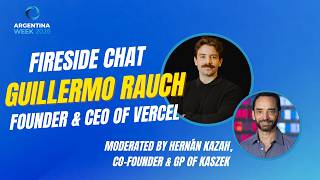
In this Argentina Week 2026 interview, Vercel founder and Next.js creator Guillermo Rauch discusses his upbringing in Lanús, Argentina, and how early limitations in tooling shaped his belief in open‑source as a pathway to success. He explains Vercel’s mission to automate infrastructure and democratize both development and AI, emphasizing a shift from developer‑centric code to AI‑generated software and agentic user experiences. Rauch outlines his hiring philosophy—prioritizing business acumen, grit, and integrity over formal credentials—and shares anecdotes about discovering a 21‑year‑old Argentine engineer who helped demo a product to Elon Musk. He highlights the extraordinary talent pool in Argentina, citing language fluency, time‑zone alignment, and cultural traits that foster innovation, and describes his extensive angel‑investment activity in Argentine‑based startups. The conversation moves to the broader AI landscape: the competitive dynamics among foundation model providers (Anthropic, OpenAI, xAI, Gemini), the “rich‑get‑richer” data loop, and his view of foundation models as the new silicon layer. Rauch predicts that by 2026 we will achieve “digital abundance”—generative music, video, and software available on demand—and that the next frontier will be physical AI (robots, healthcare, construction). He stresses the need for guardrails, alignment, and trust in AI agents, and ends with an optimistic message for Argentina’s next generation, who can leverage AI to create businesses and redistribute creative power globally.
Chapters
In Argentino or in English?
Hello everyone. Thank you for being here. Thank you, Guillermo. A pleasure to have you with us. I'm going to try to make this conversation a little bit about Argentina, and also a little bit about the future of humanity and what AI may do with us. Guillermo is one of the most prominent tech entrepreneurs. He has grown up in Argentina, then he moved to the US. He's the founder and CEO CEO of Vercel, a platform that developers use to build modern web applications and AI agents. He's also the creator of Next.js, a framework that is used by developers globally, more than 30 million downloads per week. It powers sites like OpenAI, Nike, and Walmart, but I will let you—
You studied it. Thank you.
I will let you tell us a bit about maybe your story from Argentina and also what you're doing with Vercel these days.
Well, thanks for having me. Thanks for the amazing intro. I grew up in Lanús, which is in the outskirts of Buenos Aires, for those that are not familiar with Argentina. We call it the conurbano. And my entire childhood, I obsessed over creating software. I found— and obviously I didn't know this as a kid— but my limiting factor to my prominence in the world was the quality of my tools. When I sat down to learn programming, to teach myself programming, I was limited by my tools. The tools at the time weren't open. So we had to figure out how to get compilers and software and CD-ROMs and whatever. The internet was just getting started. But what I realized is by betting on open source and creating amazing tools for developers, I made my own success. And then with Vercel, I wanted to democratize that creativity and creation power to everyone in the world. So I moved basically from Buenos Aires to San Francisco, Silicon Valley. Where I started Vercel. Vercel is an infrastructure automation company. So we sit behind the scenes of a lot of the great applications and great builders of our times. We run OpenAI, we run little startups, like anyone that has a dream and wants to make it a reality, like the next developer that's in Lanús. And increasingly what we're seeing is that we're going beyond developers. Everyone within your enterprises or your kids at home or your friends now have the ability to use AI to generate software. So we're at a special time in, I think, the history of technology, the history of humanity, where power that belonged to only a few people is now being democratized to the many.
Something that is quite interesting about your, your company is that when you got started, the web was, was static. Then it became dynamic and you had a big play in that evolution. Then cloud, afterwards it was mobile, now it's AI. How did you and the company evolve through all those phases and how could you succeed in all of them?
We always had this perspective. So when I grew up in Argentina, one of the things that I obsessed with was the customer experience side of engineering. I remember my dad, he was like, you need to learn C++, you need to learn Java. He would come up with ideas, cuz he didn't know how to program himself. But what I obsessed with was the interface layer between the human and the computer. And I built this thesis sort of intuitively, that if I could create technology that improves the customer experience, then that would improve your business. So when we started Vercel, we came to market saying, for example, one of our great clients is underarmor.com or McDonald's. When you order your next Big Mac or a Big Arch on the web, you're gonna be using Vercel. So we realized if we help companies like these create an amazing experience for their customers, then their businesses will improve. And so we've kind of transcended a lot of these eras of technology because When we started out, it was all about cloud. Now it's all about agents, but agents need to be deployed in the service of improving our lives and improving customers' lives. And so now we're helping customers like DoorDash, like McDonald's navigate this new transformation chapter for them. And we do that again by simplifying their tools, by automating their infrastructure, and by empowering their developers to create.
Great, terrific. I'll follow up in a minute on that, but before I go there, I want to connect with Argentina. So you have today your company in San Francisco, you have access to the best developers all over the world, but you do have some good developers in Argentina. You were telling me yesterday evening an interesting story. Yeah. So can you share what's your view on Argentine talent and And how are you using that?
Yeah, you know, something that's fairly unusual about me is that I went to Carlos Pellegrini School in Buenos Aires. I dropped out of high school and then I briefly moved to Switzerland and then Silicon Valley. I'm self-made in the sense of my resume became the things that I was creating. I was open-sourcing code, I was shipping software, and so I didn't need a resume like, I went to University so-and-so, I had an MBA program in so-and-so. And so I think that trend will continue to accelerate. The way that I hire today is by examining, working backwards from, you know, what are you shipping? What's your resume of the things that you've put into the hands of customers? I care less about your technical ability because AI is increasingly generating more of the code. I care actually more now than ever before about business acumen. Like we used to hire engineers in Silicon Valley that almost had this incredibly mathematical brain because we needed to sit them down in front of a terminal and just crank out code. Now we're focusing on people that can crank out entire products and think about the customer, revenue, cost, marketing. And so I have this funny anecdote because I spotted this gentleman on the X platform. Which is sort of the new public square. We have Miley, we have Elon, I'm there all the time. And I spotted this guy who seemed very promising. He was shipping stuff and he was posting about it. And I reached out to him, it turns out he's a 21-year-old from Rosario, Argentina. I've never been to Rosario, distant province. And he became one of my top engineers almost overnight. To the point that now as we continue our collaborations with AI Labs, the other day I had the privilege of demoing to Elon Musk. And so it was a Sunday. He works at the office. He's at the office 7 days a week. And I had to move really quick. I had this opportunity. Elon said, come over now. And so who's online? Esteban from Rosario. I was like, Esteban, we have to cook. Let's start cracking out code. We have to show this demo to the big guy. And so this is kind of the fluidity of the world that we live in today. I care less about college degree, and I care more about your integrity, your grind set, and ultimately your ability to ship.
Terrific, great story. What was Elon's feedback?
So Elon today is quite worried about this idea of we have this powerful AI, but In some cases, it might seem like it's increasingly misaligned from human interests and human incentives. And so, you know, our position, our official position at Vercel is I will help your enterprise not lock yourself into one particular model vendor. I help you create an abstraction between your applications and your agents and the model providers. I think that's really healthy for the future of capitalism because it encourages competition. But I think for the future of humanity, we have to worry about is this AI operating in a truth-seeking way? Is it operating upholding the values of liberty and Western civilization? Does it embed biases into its neural network? And so a lot of the conversation with Elon is about that. A lot of the conversation is also about Coding. Because coding is both the skill that was really sought after in Silicon Valley, but increasingly coding models are becoming the foundation of what I think will become AGI. Coding models like Claude Code are not just writing code, they're beginning to automate every aspect of every operation at your company. And I think this is a level of autonomy that these agents are, are getting that is somewhat unprecedented. I think most people outside of Silicon Valley cannot yet grasp what this little tool that when you look at it, it looks so innocent. Like you've seen Cloud Code, right? It looks like a black terminal from the 1960s, but that thing contains a level of autonomy that can be quite scary if we don't wrap our heads around it.
I'm double-clicking on that with the kind of visibility that you have, because you see what developers are building today that will be shipped tomorrow and, and eventually will reach us in a few days. What do you think we are somehow not grasping yet of what may come? And what do you think we are overrepresenting short term?
Yeah, I have a simple principle, which is that all software will become generative and will be generated. We're used to the idea that You go and you pay an engineer and they sit down and they crank out code. In the future, all software will be spontaneously generated. I was talking to Ari, the CEO of MercadoLibre. They have 20,000 engineers. Block just laid off 4,000 engineers. There are a lot of engineers that are operating in manual mode. They're operating, and again, things are changing so fast that I have empathy because 3 years ago, oh wow, that was the job to have. Like, you're cranking out code. 3 years later, no. Your job is to empower the machine that'll generate the code. So it's a little bit like you become the factory owner rather than the employee that was in the line of production. And so I don't think most companies have actualized to this insight. And the other part is that software will become generative. So you look at all these SaaS stocks, right? And what happens is those companies sat down in a room, typically in Palo Alto, and said, you know, I'm going to create an interface for operating your investment bank. And it's going to have this menu on the left. And when you log in, it's going to have this chart that says assets under management. Guess what? The user of tomorrow doesn't want to see that. They want to see something else. Because the world is changing really fast. And so the pressure that'll come upon the companies that created this rigid software will be that consumers will start going to agents instead. And those agents will be giving them more fluid responses. They'll get data and transform it into high-fidelity representations in real time. I think a lot of software will disappear because you'll be just talking to your assistant, right? Your assistant will tell you the answer. There will be some software running behind the scenes to get you the answer, of course. But you have to think that increasingly as a digital employee or a digital being that is sort of operating hopefully aligned with your incentives.
And what do you think will happen with the user interface, right? You started your career with the browser. You were a big kind of part of how it evolved in a better product. But now what will happen? How will we interact with this amazing technology we have available?
Yeah, I'm not a radical, you know, all UI will disappear guy. Why? Fundamentally, we're very visual beings, right? We have a lot of customers in fashion and retail, and they use Vercel because they want their customers to come in and see the beautiful fashion that they've designed and the products that they've created. But I believe that in order to survive, interfaces will have to become more agentic, which is another step in this transformation from static to dynamic to generative. When I go to Amazon, right, they're seeing that when you use their shopping assistant, their agent, Rufus, they increase conversion They increase customer retention. They help customers find the product that they actually wanted. Now, when I use your products or when I use your websites, most of the time I'm actually looking at static content. And so I think what will determine winners and losers is how quickly are you going to agentify your user interfaces.
But how are we going to connect with that agent? Will it be a— Through a screen or what do you guess?
So I think a lot of people will have a personal agent. So we saw this recently with the rise of OpenClaw. Just before this chat, Meta announced the acquisition of a social network for AI agents called Moldbook. That social network was built on Vercel. The social network is where the agents of the people are interacting sort of on your behalf. It's a little bit like if I want to tweet out a photo of this event, I can tell my agent, hey, collect some of the photos from today and send it over to my mom. So you're delegating to an agent to go and use the applications and protocols and networks that already exist today. The metaphor that I find really helpful is to think about self-driving cars. Because self-driving cars, in order to win, and I mean win because when you go to San Francisco you can take a Waymo and it's a pretty amazing experience, they had to play by the rules of the existing world. As an engineer, it would have been much easier for me to redesign San Francisco. Let's create this superhighway for high-speed magnet trains to sort of take me autonomously from point A to point B. The reality is that agents navigate the worlds that exist. For example, they might have to go to IRS.gov, the old version. I learned the other day IRS.gov is in a mainframe managed by Accenture. So it's going to be hard for IRS to agentify themselves. All right, National Design Studio, they're trying, they're doing amazing work. But I think what's most likely going to happen is that I'm going to ask my agent, go and file in my tax, return. And obviously, you might be thinking, well, are we at the level of trust where I can delegate that kind of sensitive information? But I'll say, that's our job right now. We're figuring out the guardrails, the frameworks, the verification loops to get you to that promised land where you really have this— it's a bit like an exoskeleton, an exo-intelligence that kind of follows you everywhere.
Going a minute into Argentina, you are a very active angel investor. You have like, I think you said like 100—
100 plus, yeah.
100 plus investments.
With a good track record.
But you have more than a fair share of companies that are somehow related to Argentina. Is that because of your heritage? Is that because you find some kind of talent that you like to work?
Yeah, I mean, there's extraordinary talent in Argentina. I think we've named some of the reasons, right? Everyone, I guess everyone I talk to speaks English. Great time zone. And there's 3 things that I look at when I hire somebody. Intelligence, grind set, like grit, grind set, and integrity. And so I think especially with the cultural revolution that's happening with Millae, that the Argentinian culture is incredibly compatible with innovation, with trust networks. Because honestly, when I give you my angel check, it's a little bit like Jesus, take the wheel. You know how it is in Silicon Valley, you trust people. And you have to find great innovators that are motivated by powerful missions. And so I tend to happen to find a lot of great people like this in Argentina. So my journey started when I arrived in Silicon Valley in 2008. And the revolution that was happening was Instagram, cloud, mobile. In fact, I had the luck that I was in the same coworking space where Instagram was born. And now fast forward to today, you have the same platform shift. It's no longer cloud and mobile, It's AI, it's agents. And so there's never been a better time for an entrepreneur to start a new company because you'll be able to go up against SAP and Workday and Salesforce. You'll be able to change the rules of the game. They're trying to refactor themselves, retool into agentic. You'll be able to start from a blank slate. And so I've organically invested in a lot of entrepreneurs from Argentina that some have moved to Silicon Valley. For example, an entrepreneur is working on agentic commerce, Cervana. An entrepreneur is working on an agentic hardware piece for the elderly to get a companion, like a digital companion. They moved to SF, but some that are still in Argentina. My canonical example of success is Auth0. Matías is not here, he's too successful, he's skiing somewhere, no joke. He grinded and grinded for 10, 20 years. I met him in 2008 in Silicon Valley. He came to visit, and he started a company that was primarily based in Argentina. The entire engineering team was in Argentina. I invested in a company actually based in San Francisco recently called Profound. Very interesting company. They're helping businesses navigate what does ChatGPT think of your business. Like a big question that you'll have to confront yourself with in the future is Gen Z will go to ChatGPT and say like, should I open a bank account in Citibank or should I use a neobank? And so you have to, Worry about what the AIs think about you. So there's this company, most of their engineering team is in Buenos Aires, trying to disrupt this world of, think of it as like the Gallup for AIs. Like, can you survey AIs? So every day I'm getting like an exciting new pitch, or I'm learning about amazing engineering talent in Argentina, like this guy in Rosario. The world's becoming increasingly distributed, right? Like, you don't have to be in Silicon Valley It helps, obviously, but yeah, exciting times.
So a couple of questions. One is, we are investors and we invest in technology, and as you've been saying, technology somehow has been spreading throughout the world up until now when it went back to significant concentration around San Francisco. And yeah, so why do you think that's happening? Will that change? And then a more provocative question. There is, in a gentle way, let's say, competition between the LLMs. What's your view on those? There's a Boca River thing going on with Anthropic and OpenAI. Maybe you can include xAI and Gemini. So what's your view there?
Yeah, you know, we've been talking about economic principles, we've been talking about natural monopolies, we've been talking about rich get richer dynamics. There's certainly a rich get richer dynamic for the accumulation of data. The easy way to understand AI is that it's a recipe with 3 ingredients, or, and I'll add a 4th. On one hand, you have the algorithms. Algorithms have been fairly stable since Google published their transformer paper. We have a simple set of rules that the GPU runs in order to train these models. Then you have compute. You have to buy a lot of hardware and you have to power it with low-cost clean energy from Argentina. Just kidding, from everywhere, but check it out. And third, you need data. Data is what can create rich get richer dynamics. Who in the world has data? Google has data. Elon with X has data. Anthropic has been accumulating especially coding data for many years, and so has OpenAI. And so they have an advantage, right? What I think— I think investing in the foundational model layer is going to be extremely capital intensive, and it's going to be the game of a few. But between the model, you have to think of the model as a new silicon, right? Just because Intel was the winner of the personal computer revolution from a hardware perspective, like most of the value ended up accruing from the, for the layers that we put on top of that foundation. So I increasingly think of the foundation models as the new hyperscaler clouds. So Anthropic is a little bit like AWS, and obviously OpenAI has their partnership with Azure. And so on. I think entrepreneurs now have the opportunity to create immense value on top of these models. For example, MercadoLibre will be able to massively improve their efficiency. They'll be able to put a financial expert and wealth advisor in the hands of— in every pocket of every user of Mercado Pago. And so they'll be using foundation models. I don't think they'll be training foundation models. Now, what is very interesting to pay attention to is the recursive improvement of models. And right now, the narrative on X, if you pay attention to the experts in AI, they're talking about the fact that AI can improve itself. And so today there is an indirect way in which AI improves itself. Anthropic has the best coding model. Their engineers who are training the models use that model. So there is a— there's an indirect improvement loop. When I met with Elon recently, he was telling me Anthropic cut off access to Claude code to xAI. Why? Because they're noticing that their own coding intelligence will improve the next generation of the model. The thing that we should be thinking about is how can we activate an entire recursive loop where, you know, maybe at some point in the future we won't even need the humans supervising the training process. We won't need the mathematicians. Most of whom, by the way, come from China. So you should be— it's worth paying attention to the names on the papers of that first ingredient, the algorithms. Most of them actually Chinese nationals or Chinese people that have moved to the United States. And so today it's obvious that Anthropic has a tremendous lead in coding AI. OpenAI is sort of catching up. One thing Vercel pays a lot of attention to is when the model writes software, where does it choose to deploy it? And so today we're very privileged because the models have been trained to deploy to our platform. But again, it's a very fluid and dynamic world. You know, Gal Perin, CEO of MercadoLibre, recently talked about this. Like, today you're used to going to mercadolibre.com and then you search for your products. Increasingly, you're going to be going to assistants. So it's very important to pay attention to the relationship between the model and you.
At a more high level, obviously, you've said somehow that coding will be something basically done by agents, not by us. Absolutely.
It's already the case. It's just that it hasn't fully permeated to the entirety of society.
And then from what we discussed yesterday, you think that SGI, you know, this super intelligent AI, will happen somehow in the next couple of years?
My argument is even more nuanced, is that super intelligent AI will be a coding AI, because what we do as humans is we solve novel problems all the time. One of the key researchers at Google believes that the key to human intelligence is our ability to synthesize programs. As we go. We incorporate new knowledge, new wisdom, new ideas, and we churn out new pro— we are writing programs in our head. So I think this is the clear path to superintelligence.
So what's the outcome of that process? Will we have augmented humans, or will we be diminished into a corner of existence?
My prediction is that in 2026, we will have solved what I call digital abundance. Here in this room is the manager of Bizarrap. You know Bizarrap? Yeah. Famous rapper. Bizarrap wrote and created his music himself. But now there exist models that can generate music spontaneously. Good and beautiful music. There's a company based in Boston called Suno. It's hosted on Vercel. You should check it out. suno.com. You can go in and generate music for your partners, for your kids, for your friends. You can say, make me a song of the style of Carlos Gardel, but talking about artificial intelligence. It's going to be amazing. That's a form of digital abundance. Because we weren't able to create— I wasn't able to create music. I failed pretty hard on music. I was good at computers. Now I can create music. I can create sitcoms. There's a model that just came out of China that can produce a novel episode of Seinfeld, like a good episode of Seinfeld. Obviously, copyright infringement, a lot of other problems, but there's video AI abundance. There's music AI abundance. There's software abundance. You can go to Vercel and generate any kind of software. And so the digital problem will be solved. My prediction is 2026. Now, physical AI will be the next frontier. This is why I'm bullish on Elon, because now that we created this incredible brain, some of which will run at the edge, some of which will run in the data center, we'll be able to equip robots. Physical AI will give us physical abundance. We'll be able to accelerate construction, mining, agriculture, Healthcare. Healthcare will see a tremendous disruption from agents. My wife recently had appendicitis. Grok took her to the ER. I thought she had gas, to be honest. That was my non-expert diagnosis. And it kept getting worse, and we ended up at the ER in San Francisco. So healthcare will be massively— but also physical AI and physical healthcare. But that needs the software takeoff in order to fully land. You see a lot of demos from robots, but if the robot is not intelligent like we are in terms of computer vision and in terms of movement and dexterity and program synthesis, it's not going to be very good physical AI.
Terrific. So last request, we're done with time. One message to the audience about AI and one message About Argentina?
I think, you know, I had a tough time and had to work extremely hard to teach myself programming. I actually taught myself English in order to read the programming manuals because they were only written in English. There was one guy who translated Java books to Spanish and put them online. I think you guys had the same challenge with MercadoLibre. Who's writing and teaching how to create servers and networks and in dynamically generating pages? No one. And so what I'm excited about is that the new generation of young people in Argentina are gonna— their IQ baseline has now improved by 100 points. They can use all of this AI to create businesses. I see examples on the Vercel platform where one— I know this guy in Sweden who makes $35,000 a month with a very simple website that he generated on Vercel. $35,000 a month. That'd be life-changing money for a lot of people in Argentina. I think as companies get smaller, there'll be a redistribution of creativity. Like, the individual will be able to go so much further. And so it's not just obviously bright for Argentina, it's bright for the entire world. But I think we're going to see a, a new generation of of— I mean, I was— I and Matías were like some cases in Argentina. I think it's going to be millions of us. It's going to be very exciting to watch.
Amazing. So allow me to thank Guillermo Rauch. Thank you so much.
Muchas gracias. Bueno.
More from Guillermo
Guillermo Rauch at Founders in Arms Live: Simplicity, Focus, and the Bet That Built Vercel
The Man Who Built a $9B Dev Platform Thinks You're Overcomplicating AI | Guillermo Rauch


Inside v0: How Guillermo Rauch Is Building 100 Million Engineers | Lenny's Podcast - EP.89
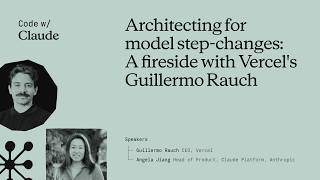
Architecting for model step-changes: A fireside with Vercel's Guillermo Rauch
Keynote Interview: Vercel's Guillermo Rauch on the Agent Era | Azure Cosmos DB Conf 2026
Vercel CEO: 70% of Our Traffic Is Now AI Agents "Nobody Was Prepared" | Anthropic, OpenClaw, OpenAI
Why being "terminally online" is more important than ever, with Vercel CEO Guillermo Rauch


Guillermo Rauch on Building Vercel With Purpose in an AI-First World | 2026 Upfront Summit