In this third installment of his introductory series, Harlow Reseburg III explains who he is as a coach and who his ideal clients are. He distinguishes the superficial marketing language used to attract clients from the deeper, experiential communication that occurs in coaching. Drawing on his personal journey—extensive martial‑arts training, study of Western and Eastern philosophy, and Taoist energetic practices—he presents a diagnostic framework that views the person through an eight‑energy‑body model, offering higher resolution than the typical Western mind‑body‑spirit split. He clarifies that he is not a therapist, career, or relationship coach, but a performance coach focused on impact‑driven entrepreneurs seeking greater satisfaction, productivity, and meaningful impact. He describes the target client as someone who wants to create value, scale impact, and live a “meaningful life” aligned with a transformative purpose. Finally, he outlines his fit‑assessment approach: if a prospect isn’t a good match, he will refer them to a more suitable practitioner, emphasizing meaningful relationships and maximal impact.
Chapters
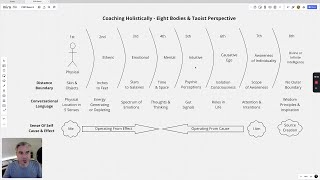
All right, last of the 3 little videos here that I'm making to describe coaching and working with me. The who of coaching. So that'd be me as a coach and you as the client. So who's my ideal client and all that kind of thing. And I want to make the distinction here again about like you can only get to the page you're on and take action through a means of communicating in words and you see marketing positioning And that, you know, all the great titles and subtitles is what you get through in order to start this whole process. But understand that at a deeper level, every coach that you're going to interact with, when, when and if you decide to interact with coaches, is going to be different how they communicate with you and how well they market. And a lot of people don't know marketing really well, which is why on social media you see everybody trying to convince you how to make 6 figures a year through their marketing tactics. The way I coach is based upon my life's journey. I have a deep background in martial arts and have read a lot of philosophy, grew up in a Western tradition, really, you know, fought against that and explored Eastern tradition. So I say that I deal with the whole person, and what that goes back to is a deeper understanding of the energetic practices of the Taoists, if you will, and martial arts and breathing exercises and all these crazy things. But you can actually diagnose, or troubleshoot is maybe a better way of saying it. If I were to speak to a Western tradition, it'd be mind, body, and spirit, right?. And we like to make those separate containers, and it's easier to work with them independently. But we do know the subcontext is they're all happening at the same time. From an Eastern perspective, we can actually— or I, again, working at a higher resolution— we can break that into 8 different segments. This is the 8 energy bodies of energetic anatomy, if you're into traditional Chinese medicine and all those types of things. If you understand those things as separate containers, similarly, but occurring all at the same time, you have a little bit more resolution, granularity if you will, of the distinctions. And so, as an example, there's a separation between your thinking and your emotions and your energy, right. And your intuition, say, that would be 4. When you decide, you have an insight, and you say, "Oh, this is the way the world is," because it's a deep insight of seeing truth in something, we can then check on each of those 4. There's 8 of them. I don't want to get into it. That's not really the point here, and this is not all about me. My point is to make more of the distinction and give you an inkling to the difference of me as a coach versus another person as a coach. It also speaks to the fact that I'm not a career coach or a relationship coach. I'm certainly not a therapist, so I'm not here to do remedial work. I like to work with performers. So about you, this would be where I start to speak specifically to who I'm a best fit for. So you'll see in my languaging of things that I'm essentially a performance coach and I work with impact-driven entrepreneurs. That's nothing fancy and it doesn't necessarily speak to anything particular, but what I do mean is something very specific. So a performance coach is, you know, somebody who wants to optimize for more satisfaction and more productivity in life. And that goes across all areas. An entrepreneur is somebody who wants to make things of value and get them into the marketplace and do stuff. An impact-driven person is a person who recognizes that, you know, here— and I'm in America, so in America we got 5% of the population in the world and 80% of the wealth. So if If we're going to do those things and we want to have a meaningful life, again, the 3 layers of happiness scale and positive psychology, having just a pleasant life, having an engaged life, having a meaningful life. In the meaningful life aspect of things, you're working beyond yourself to bigger and better things, the massively transformative purpose, if you will. And so that's really who I speak to. That's who I ideally work with. If that's you, and now you have a little bit of a taste of who I am, that would be the idea. If I'm not a good fit for you, or if that— or if you have a specific thing that you want to work with, um, I would be the person to first recommend you, if you will, to somebody else who's better suited for those particular things. It's really okay. I just want to have meaningful relationships and I want to do my valuable work and have the biggest impact possible. If you're a person who wants to make a bigger impact and perform better and that kind of thing, we may be a good match. So there you go. I hope that answers the question of who.