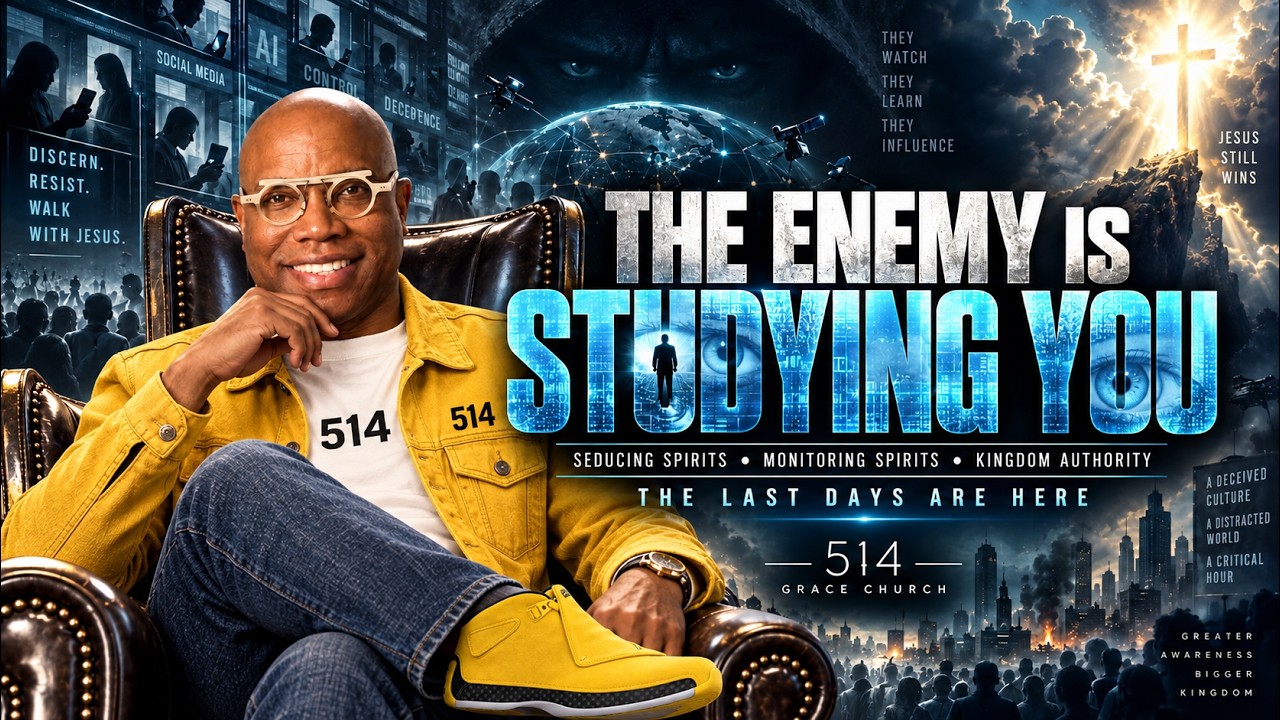
This content was created by Harry Pitts. This content was uploaded by Harry Pitts. This is a YouTube video titled "WHEN THE CHURCH FORGETS WHO IT BELONGS TO" (posted 2026-10-22) containing a recorded church sermon/service from 514 Grace Church. A pastor (speaking with reference to his wife Tracey/Tracy) addresses the in-person congregation and online viewers, interweaving Scripture exegesis (notably Ephesians 2:11–22 and 1 Corinthians 11:17–29), worship/music interludes, and pastoral exhortation. The message focuses on church unity, the dangers of letting race, politics, money, or personality divide believers, the meaning of the Lord’s Supper, a call to repentance and holiness, and an invitation to join/support 514 Grace Church.
Chapters
This program is brought to you in part by the friends and partners of 514 Grace Ministries.
Coming up next. And that is incorrect. Jesus does not belong to one group. There is no Black Jesus who saves only Black people. There's no white Jesus who saves only There's no Republican Jesus and Democratic Jesus competing for control of the kingdom of God. There's only one Lord, Jesus Christ himself. And when we surrender our lives to him, our allegiance— listen to me, family— our allegiance to Christ must govern every other allegiance that we have in our lives. Amen. Jesus said, "I will build my."
One name, one sound who we call Jesus, Jesus, Jesus, who still reigns. Jesus, Jesus. We shout one name, Jesus, Jesus. Chains snap when we call that name. We live one name, Jesus, Jesus. Hell backs up when we praise. We shout. We lift one name. Jesus, Jesus. Walls fall, giants hit the ground. We lift one name. Jesus, Jesus. King of glory, wear your crown. Light hit the dark, now the night gotta move. Fire in my chest, got my faith in the groove. Storm tried to talk, but it don't run the room. Grave lost the fight when he stepped from the tomb. Name got weight, name got power. Strong, strong tower in the midnight hour. Devil tried smoke, but he lost that flame. We came alive when we called that name. One voice, one King. Cry hands up.
Good morning, 514 Grace Church. I want to say thank you to every single one of you. Uh, Tracey and I, we get to pastor one of the most wonderful churches on the planet, and we're so humble and grateful for you allowing us to be your pastors. And we love you and want to say thank you this morning to every single one of you. But I want to say something this morning Because it is not my intention to trigger anyone. There is a word that the Lord has given me that I have to preach. I am under mandate by God to preach his word, and it is going to be a word that will provoke you to think. We have to look at the condition of the church, and it is vitally important that we do this. As a leader in the Lord's church, I must obey what God has given me. On this biblical mandate. So God bless every single one of you guys. Put your straps on, strap into your seat. We're going to go on a fantastic voyage this morning. And God bless you to those that are watching us online, those that are watching us from YouTube, social media, etc. God bless you and lock in this morning. Pull out your iPads, your phones, your Bibles, your notepads, and your pencils and take notes. Because this morning I have a message that I want to preach, and I want to title this message, uh, When the Church Forgets Who It Belongs To. Because there's only one Lord, one gospel, one church. And this morning the primary scripture is going to come from Ephesians chapter 2, verse 11 through 22, and the climactic scripture is going to come from 1 Corinthians 11:17-29. But the central thought this morning, or the central truth this morning, family, is very simple. The central truth is Jesus Christ has reconciled us to God and brought us into one body through his cross. We must not rebuild the walls of hostility he has broken down. And the question is this morning is, how did we get here? Because church, I want to ask you, ask you something this morning. How's it possible for 2 people to confess the same Jesus, read the same Bible, sing about the same Savior and come to the same Lord's table, yet allow skin color, political affiliation, money, or religious tradition to determine whether they will love one another based off of the word of God. And the question is, how did we reach a place where somebody's political affiliation, whether you're Democrat or Republican, a Libertarian or Independent, how does somebody's political affiliation can become more important to us than humanity itself? Where are the people of God that say they love God? Because where a wealthy person can receive special treatment, While somebody with nothing to give feels invisible. How do we arrive at this? Where we can preach reconciliation on Sunday and practice division throughout the week. How did we get here? And here's the question that troubles me. When did we start treating Christ's church as though it belongs to us? Amen. Somewhere along the way, we've allowed people to confuse Christianity with cultural identity or Christian nationalism for the sake of the word. We've allowed political preferences to become measures of spiritual loyalty or spiritual piety. We've sometimes elevated religious personalities until their opinions carry more influence than the scriptures they are supposed to teach from. And we've, we've allowed labels to become walls or partitions that separate every single one of us. There's no such thing as a black church or a white church or a rich church or a poor church. Or a conservative church or a liberal church. Now understand me, there are real histories behind some of those descriptions that I just gave. The historic Black church, for example, has a profound history of faith, endurance, community leadership, and resistance to racial injustice. And we should never erase that history. But descriptions of our congregation— congregations must never become claims that Jesus belongs exclusively to one group. And that is incorrect. Jesus does not belong to one group. There is no Black Jesus who saves only Black people. There's no white Jesus who saves only white people. There is no Republican Jesus and Democratic Jesus competing for control of the kingdom of God. There's only one Lord, Jesus Christ himself. And when we surrender our lives to him, our allegiance, Listen to me, family. Our allegiance to Christ must govern every other allegiance that we have in our lives. Jesus said, I will build my church. Notice that he says my church. He didn't say your church. He didn't say the pastor's church. He didn't say the politician's church. He didn't say the wealthy donor's church. He said my church. My church. Church, and that should settle the question of ultimate authority in his church, because the church doesn't belong to the loudest person in the room or the most emotional person in the room. It belongs to the one who gave his life. Oh my goodness. Who gave his life. Now, I'm not asking anybody Ah, I'm sorry, I'm a little excited this morning. I'm not asking anybody to surrender their culture or abandon responsible political participation or pretend that differences don't exist. I'm asking us to examine, to examine what happens when those differences become more important than our relationship with Jesus. Jesus Christ. And to understand this, I want to take us to Ephesians chapter 2, because Paul is addressing something the church still needs to understand. People who had been separated were being brought together through Jesus Christ. And the question wasn't simply whether they could occupy the same room. The question still stands, the question, was whether they understood what Christ had accomplished. Christ broke down the wall we keep trying to rebuild. Ephesians 2:11-16, Paul is writing to Gentile Christians to understand his message. We need to understand something about the world in which They lived— the Jewish people possess a distinct covenant history with God, and Gentiles were outside that covenantal position. And there were major religious and cultural differences between the Gentiles and the Jews because circumcision, the covenant, the commandments, and Israel's history all contributed to distinctions between Jews and Gentiles. These differences were not merely personal disagreements. They affected how people understood belonging and how worship was to go forth and their relationship with God. But Paul announces something extraordinary. In Ephesians chapter 2, 2:13, he tells the Gentile believers— are you listening to me? He tells the Gentile believers that those who were once far away have now been brought near through the blood of Christ. And then in verse 14, Paul declares that Christ himself is our peace, not merely that Jesus gives us peace or gives us peaceful feelings. Paul is saying something far greater. Through his death, Christ has acted to reconcile those who were separated from him. Paul says Christ has broken down the dividing wall of hostility, the middle wall of partition, Paul says it has been broken down. Now listen to me carefully, because the wall Paul describes is rooted in the historical relationships between Jews and Gentiles, including the divisive role of the laws, the commandments, and the ordinances. We must understand that original context before applying the passage to modern-day modern divisions. Paul is not describing political parties in America. No, he's not. He is describing what Christ has accomplished in creating one reconciled people regardless of race, regardless of gender. But the implications are profound because if Christ has made peace through his cross, How should those who belong to him treat one another? Let me bring that into everyday life. Suppose 2 people serve in the same congregation and they worship together, they receive communion together, they confess that Jesus died for their sins. But when one discovers that the other supports a different political party, Their entire attitude changes. Some people will not give to ministries because they don't support the party that they favor. What is this? And then suddenly that brother or sister becomes suspicious of the other. Their words are interpreted differently and their character is judged through assumptions about their political affiliation. And you don't give to the ministry because you don't like the position that your pastor takes or some of the leaders take. Now tell me something, please tell me something. What changed? What changed? Did Jesus stop being Lord? Did the cross lose its power? Did the other person cease being made in God's image? Or did political allegiance become more important than Christian fellowship and the gospel of Jesus Christ? Church, we have to be careful. We have to be careful. We cannot allow political loyalty to determine which biblical truths we are willing to obey or disobey. If dishonesty is wrong, it remains wrong regardless of whoever practices it. And I know you're quiet, so I know that means you're thinking. Because if corruption is wrong, it does not become acceptable because the person involved agrees with our political opinions. If racial bias, if racial hatred is wrong, it is wrong regardless of who is expressing it or who is being targeted. And if we condemn cruelty in one person, we cannot celebrate the same cruelty in another simply because that person represents our preferred political position. The church must not practice selective morality. Now let me address another issue, the issue of race. We must never pretend that racism hasn't damaged human relationships, religious institutions, and entire generations. It has, it has. We have to be honest about this. And the church has not always responded faithfully. There have been times even when people use religion to justify racial separation, discrimination, or abuse and the mistreatment of others just because they don't look like them, they don't talk like them, they don't sound like them, they don't dress like them, they don't come from the same social status or stratification as them. But here is what we must understand. The gospel, the gospel cannot become the property of the very prejudices it calls us to confront. We have different histories, different experiences, different traditions, but those differences must never become a license to deny someone else's dignity and humanity. God did not create humanity so that one race could claim a superior right to his love because of the color of their skin. And Christ did not bring people together through his cross so that the— his followers could invent new reasons to despise one another publicly and even privately. And sometimes privately, in our hearts. Now let's speak about something else that makes this serious— manipulation. Throughout history, people pursuing power have exploited human differences, and it is happening today, even here in this beautiful country we call America. They've used racial fear or racial slurs. They've stoked the fires of race difference or economic insecurity, religious suspicion, political misinformation, and repeated false accusation after false accusation after false accusation. Why? Because frightened and divided people are sometimes easier To manipulate and control. If I can convince you that your neighbor is your enemy, I may persuade you to stop examining my misconduct to control you. If I can convince you that everyone who disagrees with me is wicked, I may discourage you from asking whether I'm telling you the truth. And if I can attach God's name to my personal agenda, I may persuade you that questioning me is the same as questioning God. Beloved, that's dangerous philosophy. That's dangerous rhetoric. A lie does not become truth because a politician repeats it. A lie does not become truth because a preacher says it loudly. And a lie does not become biblical because somebody puts a scripture beside it. Now, now, we should never assume that everyone who disagrees with us, everyone that disagrees with us is deliberately deceptive. People can sincerely disagree about complicated public questions, but where there's a deliberate falsehood, prejudice, exploitation, or hatred, Christians must be willing to recognize and reject it because those things are contrary to the truth and love of Christ commandments. And scripture does reveal an enemy who works through deception and opposition to God's purpose. Yet we must not use spiritual warfare language to excuse human responsibility or make accusations against everyone who thinks differently than we do. People remain accountable for what they say and do, and they must always remain accountable and be held accountable. Church, I need you to hear me this morning. Jesus did not reconcile us through his cross so that we could continue allowing hostility to govern his household or to be separated from a people because that person is Black or Latino or white. And now Paul's argument takes us somewhere even deeper because he doesn't stop by telling us what Christ removed. He tells us what Christ has made us. If Christ is the cornerstone, who is shaping our beliefs? And when we look at Ephesians 2:17-20, look at verse 18, Paul explains that through Jesus Christ, both Jews and Gentiles have access to the Father by one Spirit, one Christ, one Father, one Spirit. Then verse 19 tells these same believers that they are no longer strangers and foreigners. They are fellow citizens with the saints and members of God's household. Now think about that. Think about that. People who once stood outside are being told that through Christ they belong, not because of the color of their skin, but through Christ, not because of the political party that they are a part of, but through Christ, not because they become wealthy, not because they have gained political influence, not because a religious leader decided they were useful, but because God, hallelujah, because God has brought them near Through Jesus. And church, this is why we must understand the foundational truths of our faith, because if we don't understand what brought us into God's household, we may begin believing something else that gives us the right to belong or to be affiliated with. Let's make this plain. We needed grace. Grace is God's undeserved favor and saving generosity toward us. We didn't earn his mercy. We couldn't purchase our salvation. We needed redemption. Redemption tells us that Christ accomplished our deliverance through his sacrifice. We needed reconciliation because reconciliation means Christ has acted to bring sinners into a place, a place where they're at peace with God. And through that same reconciliation, the work of Christ begins. He has created us as one people. And now that we belong to him, we are Called to repentance, sanctification, and holiness. Repentance means turning from sin toward God. Sanctification describes God's continuing work of setting us apart and transforming our lives into his image. Holiness means belonging to God and living in a manner that reflects his character. Now understand how these truths fit together, because grace is not permission to remain unchanged, and holiness is not the price we pay to purchase grace. We receive salvation through God's gracious work in Christ, and that relationship begins changing how we live publicly and privately. We become people who learn to love each other, even with the differences. People who practice honesty. People who confront prejudice. People who seek reconciliation. People who stop treating others as though their worth depends on money or popularity or social standing or a political party that they are affiliated with. Now I need you to look at verse 20 of the same book, same chapter. Paul says, God's household is built upon the foundation of the apostles and prophets with Jesus Christ himself as the chief cornerstone. In the building, when you look in the building, the imagery Paul uses, he says the cornerstone A cornerstone establishes the structural alignment. Ah, my goodness! And Christ is the central reference point. Now here is where I want to speak directly to the modern church, because there are Gen Z, there are Gen Alphas that want to hear expository preaching. Exegetical preaching, not eisegesis, not your personal opinion. Jesus is the cornerstone. Why are we allowing personal opinions to determine the meaning of scripture? Why are we allowing political preferences to shape our theology before we've even examined the text? Why are we allowing popularity of a preacher to become evidence that everything they teach must be correct? And why do we, some, why do some of us become offended when biblical teaching challenges something that we've believed for years? Church, the responsibility of a preacher is not to invent what scripture means. Our responsibility is to study it, to steward it faithfully and explain it clearly, not with opinions, but what the Bible actually means. And that's why exegesis, exegesis matters. Exegesis means drawing out the meaning of the biblical text through careful attention to its words, its context, and its purpose. Eisegesis happens when we impose our own ideas upon scripture, and it's happening all across this country in pulpits, particularly right around the election time. And let me give you an example, because some people are doing this and you need to understand the difference. Suppose I hold a strong political opinion. I search the Bible for a verse that sounds similar to what I believe. I remove it from its original setting, and then I declare God supports my position, but I never investigated what the biblical author was actually teaching. Church, I haven't demonstrated biblical truth. I've demonstrated my ability to find a sentence that sounds useful to my argument, and that is dangerous. And that danger isn't limited to politics. It happens with money, it happens with marriage, it happens with spiritual gifts, it happens when we make promises God never made, and it happens when we use scripture to defend personal traditions that we've never examined. The word must have the final authority over the preacher. The preacher must never claim or exclaim authority over the Word of God, and that includes me. Being a pastor doesn't make make my interpretation infallible. Having a title doesn't eliminate the need for careful study. Being passionate doesn't guarantee that I'm. That I'm correct. There's a place for passionate preaching. There's a place for raising our voices in praise. But intensity cannot substitute accuracy, biblical accuracy. It cannot. People need to understand what the Bible means. They need to know why they believe. They need to be equipped to recognize when somebody is using scripture carelessly. Because if we are going to be God's household, we must remain aligned with the cornerstone who is Jesus, not with whatever makes us popular, not with whatever protects our influence, but with Jesus Christ. And Paul is not finished. He has shown us how Christ reconciled us. He has shown us that belonging to God's household is of great value. Now he tells us what God is doing with the household. God is forming a people, not building competing religious empires. When you look at Ephesians 2:21-22, Paul says the whole building being joined together and grows into a holy temple in the Lord. And then he says something, listen to me, he says something Extraordinary. We are being built together into a dwelling place for God by the Holy Spirit. Now understand what Paul is describing. He's not talking primarily about a physical sanctuary. He's talking about God's people. People who previously experienced separation are now being joined together Through Christ Jesus, and God is at work among them through his Spirit. That means the church is more than a religious organization. It's more than the building where we gather. It is more than personalities and standing behind the pulpit. The church is a people God is forming for himself. That is why the active presence of the Holy Spirit matters for every single one of us, not simply because we want powerful moments during worship. I believe in the power of the Holy Spirit. I believe in prayer. I believe in spiritual gifts. I believe in worship that moves our hearts. But I also believe the Holy Spirit works to transform our character, our tongue, and our thinking. And sometimes we become so focused on what happens during worship that we stop examining what happens after worship. We shout about love, but do we practice love? We celebrate forgiveness, but are we willing to forgive? We sing about holiness, but do we pursue integrity when nobody is watching? We talk about unity, But yet we're divided during the elections. But do we treat people with dignity when their opinions or backgrounds differ from ours? The Holy Spirit does not exist to make our religious personalities famous. He glorifies Jesus Christ. He informs God's people into a holy dwelling place. What? Church, what if the greatest evidence of our spirituality, our spiritual maturity, our spirituality isn't how loudly we worship, but what if it is how faithfully we live after worship? I'm not dismissing emotional expression of faith. I'm not. I'm not dismissing those expressions. I'm asking us to recognize that transformation must reach beyond an emotional moment. And here is the beautiful part: God is building us together, not into competing political camps, not into rival racial communities claiming exclusive ownership of Christ because of the color of our skin, not into spiritual hierarchies based upon financial influence, but into a people who belong solely to Jesus Christ and him alone. And now, Now, now, now, I want to bring this entire message to the place where its meaning becomes visible, and that's the Lord's table, the Eucharist, the Eucharist, the table where our contradictions are exposed. 1 Corinthians chapter 11, verse 17 through 29. Church, hear me. I want to— I want you to think about something. What does it mean when We gather to receive communion. What are we saying when we take the bread and the cup? Some call it Holy Communion. Some call it the Lord's Supper. Others call it the Eucharist. The word Eucharist is associated with thanksgiving. But what are we thanking God for? Are we thanking God for Jesus Christ? For his life, for his body given for every single one of us on the cross of Calvary, for his blood establishing the new covenant, for the salvation we could never purchase for ourselves. Now listen, listen to me, listen. Jesus gave his disciples bread and the cup and instructed them to remember him. And the bread directs us to his body. That was given for every single one of us. The cup directs us to the new covenant in his blood. And every time we observe this sacred meal, we remember what Christ has done. Now let me explain, let me explain everything I said so that even our children can understand it in simplistic form. When we take the bread, we remember that Jesus gave himself for us. When we take the cup, we remember his sacrifice and the forgiveness made possible through him. We thank him for loving us. We remember that we belong to him, and we remember that the people who belong to Jesus are called to love one another. But church, there is something even deeper here that we cannot overlook. In 1 Corinthians chapter 10, Paul speaks of the bread and the cup as participation in Christ. Christians have historically understood the manner of his presence in the Eucharist differently, but this must— this is much clearer than many of us think it is. The Lord's Supper is not meant to become an empty religious routine. It is a sacred act that directs us to Christ, his sacrifice, and our fellowship as his people. Now let's examine what happened in Corinth. Paul tells the congregation that their gathering— their gatherings are doing more harm than they're good. Why? Because division have entered their fellowship. Some people are eating while others remain hungry. Some have plenty while others have little. Their gatherings are exposing economic and social differences. Doesn't this sound familiar? So much so in a way that humiliates members of the same church. That everyone attends. Now pause right there. I need you to pause right there. They're gathering for a meal associated with the sacrifice of Jesus Christ, yet their behavior contradicts what Christ has accomplished. They are remembering the Savior who gave himself for others while refusing to care properly For the people sitting amongst them, sitting on the same pews, just because they don't look like them. What is this nonsense about women don't have a place, women can't preach? Stop it! What are we doing? I know I kind of got detoured, but we can't allow divisions amongst us. And Paul will not ignore any of those contradictions that's taking place in Corinth. Church, this is where the word must confront every single one of us. In Ephesians 2, Paul teaches that Christ broke down the wall that divides us, the middle wall of hostility. He broke it down. But in Corinth, believers are allowing division visions to shape the way they gather around the Lord's table. Do you see the problem? Christ has brought them into one body, one body, yet they're behaving as though wealth and social standing determine whose presence matters. Now let's bring that home. What does What does it mean to celebrate the blood that reconciles us to God while harboring hatred toward people made in his image just because of the color of their skin? What does it mean to proclaim one Lord while allowing a political party to determine whom we're willing to respect or disrespect? How do we thank Jesus for his mercy While repeatedly spreading lies, stories designed to turn people against one another? And how can we gather at the Lord's table while treating people who possess less money as though they possess less dignity? Beloved, the Lord's table confronts every one of those contradictions. Now, there's nothing inherently wrong with having money. And there's nothing wrong with giving generously to support ministry. Generosity is good, but generosity does not purchase spiritual authority in God's church. You cannot buy a higher position at the foot of the cross of Jesus. The person with a substantial bank account needs the same grace that the person standing beside them needs. The person struggling to pay their bills needs the same grace that the wealthy person has. The person with an advanced degree needs the same grace as a person that has a high school diploma. Uh, the person with this advanced degree should help the other. The person who never had any opportunity to complete their education. And the needs of the grace of Jesus Christ is for everyone because our circumstances are not identical, our responsibilities are not identical, our experiences are not identical, but none of us purchases redemption and none of us become more valuable before God because of our political connections or our economic influence. Christ is the Savior and the church belongs to Jesus, not a political affiliation, not a people of color. The church is the Lord's. And now consider something about the world in which we live. There will always be people who recognize the power of fear and division, people who exploit racial hostility, people who manipulate financial insecurity, people who use religion to protect their own biases or influence, and people who spread deliberate falsehoods because they understand that suspicion and anger can be used to control a populace. But the church of the Lord Jesus Christ should not become an instrument or a tool of that manipulation. be people who examine claims carefully, people who refuse to participate in racial hatred, people who recognize that truth does not depend upon political convenience, and people who understand our ultimate allegiance is to Jesus Christ and Jesus alone. The world can divide people according to wealth, influence, race, and political affiliation. But the Lord's table reminds us that none of those things purchased our salvation. None of them. Now understand the distinction. I need you to understand this. Are you listening? Communion doesn't mean biblical truth no longer matters. It doesn't mean every moral decision becomes acceptable. It doesn't mean there is no need for repentance. It does not mean everyone automatically belongs to Christ without responding to the gospel. The New Testament calls people to repentance and faith in Jesus. But among those who belong to Jesus, we must never allow personal prejudice or institutional pride to replace the unity Christ has established in his church. That's why Paul calls the believers to examine themselves. He isn't demanding that only sinless people approach the table. If that were the requirement, none of us could come. His warning concerns the manner in which the meals— the meal is received. Their conduct is dishonoring Christ. and disregarding fellow believers. So let us examine ourselves, not merely whether we know the words of the ceremony, not merely whether we understand when to take the bread, but whether our lives reflect the Lord whom this meal proclaims. Church, the Eucharist points us in 3 directions. We look backward to the cross, we remember Christ's saving sacrifice. We look at our lives today, we examine our hearts and our treatment of others, and we look forward to his return. Paul says, we proclaim the Lord's death until he comes. So the Lord's table is not about our accomplishments. It is about his sacrifice, not our superiority or our pride or our piety. but his mercy, not our ability to save ourselves, his power to redeem. And this is not the pastor's table. This is not the political party's table. This is not the black church's table. This is not the white church's table. This is not the wealthy person's table. This is the Lord's table, and we need to observe that and respect that and honor that. And when we remember who table it is. We must also remember whose people we are. What wall are you still building? Church, I want to close where we began. We started by asking how people who confess this same Jesus can become so divided because of the color of a person's skin. Because you don't like that there's a female preacher that may be leading a congregation. What is wrong? What is sickening about that? That's a sin sickness that the Lord wants to extract and remove. And Paul has given us the answer to what Christ accomplished. Jesus brought separated people near him. Through his blood. He broke down the dividing wall of hostility. He made peace through his cross. He brought believers into God's household, and through the Holy Spirit, he is building his people together. Now I want you to consider one question: if Jesus tore down the wall What wall are you still helping to build? Maybe it's a wall of prejudice. You've allowed somebody's skin color or background to determine what you believe about their character before you know them. Maybe it's a wall of political hostility. You've become so committed to defending your political opinions that you no longer listen honestly to people who disagree. Maybe it's a wall of economic pride. You've been— you've begun measuring people's worth by what they earn, what they own, or what they contribute. Maybe it's a wall of religious arrogance. You become convinced that your denomination, your preacher, or your interpretation is above correction. Or maybe it's a wall of unforgiveness. You've allowed bitterness to remain in your heart while continuing to profess the love of Christ. Beloved, the sermon is— this sermon is not about correcting the world. It's about allowing Jesus to confront us because the church must not demand repentance from everybody else while refusing to repent itself. And I want to tell you something. There is a grace for the person who repents. There's forgiveness in Christ. There's redemption through his blood. And there is continuing a continuing work of the Holy Spirit for every single one of us and for those of us that belong to him. But we must be willing to surrender what contradicts his word. We cannot keep placing human loyalties above Jesus Christ. We cannot keep depending— excuse me, defending hatred while proclaiming reconciliation. We cannot keep celebrating holiness while refusing to confront the dishonesty that we possess. We cannot keep approaching the Lord's table as though its meaning ends with the service when the service is over, or start saying we love God when we hate a person just because of the color of their skin. Because the same Jesus we remember at the table is the same Jesus we are called to follow throughout the week and every day of our lives, even when we're at home, when we're at work, when we're speaking about people who disagree with us, when we are deciding whether to repeat a story we haven't verified, when we are treating someone who has less influence than we do. Father, thank you. Thank you for your word. I thank you, God, for Jesus Christ. I pray that this word has touched someone somewhere, Father. Bless your people. In Jesus' name I pray. And thank you for watching. Thank you for watching us. Thank you for those of those that are following us on social media. And I would be a terrible pastor, and I pray that this message bless you. I would be a terrible pastor if I did not offer This gift of salvation that Jesus freely gives. If you're here this morning and you know that you're not born again, if you're watching me right now wherever you are, if you're in Kansas, if you're in California, if you're in Tokyo, if you're in Atlanta, if you're in Villarica or Rootville, pray this prayer with me. Say, Father, come into my heart. Jesus saved me. I repent of all my sins. I believe that you died, rose, and you were buried. You First descended and you ascended and you're now seated in heavenly places. And because of this, I can now be saved through and by the blood of Jesus. Father, I denounce Satan and any sin that will try to control my life. Thank you, Jesus, for saving me. And I want to say this, if you prayed that prayer, welcome to the family of God. You are now born again. And thank you so much for giving your life to Jesus. And if you're looking for a church home, consider 514 Grace Church. We're a loving church. My wife and I, Tracy and I, we love families, we love children. I was a former youth pastor some time ago, and I still have that passion. And we love kids. We celebrate your victories, and sometimes even when you're going through things, we celebrate The periods when there are lows, we want to be there for you. Tracy and I, along with the leaders and the other members of our church, God bless you. Thank you for considering 514. Come meet us, shake our hands, come experience the presence of God. We are a church that is now just being planted, and God is doing great and marvelous things. This is an opportunity for you to grow and grow with us as we do the work of God. And do me a favor, go to our website, www.514gracechurch.org, and click on the Give button. And, and whatever God lays upon your heart to give— $5, $10, $20, $50, $100, $1,000— thank you for supporting us as 2020 Partners, because we have a vision that God has given us to, to reach the nations and to reach our community and to clothe And to feed people. We need your support. This money is stewarded correctly. We're a 501 ministry, and we're under covering, and we have stewardship as well. God bless every single one of you. Thank you for watching. Thank you for listening, and I pray that this message has touched your heart. Go and share with someone about 514 Grace Church and consider becoming a member, becoming a part of what God is doing. God bless you, and I hope that this word has blessed you, and look forward to seeing you again. And pray for us, pray for us. God bless you, Tracy and I, we love you in Jesus' name. You have a great week and be blessed in Jesus' name.
Oh yeah, I came to reclaim what the darkness stole. Every piece of my mind, every part of my soul. Not by my power, not by my might, by the blood of the Lamb. I step into light. The fire did not break me. God carried me through. Every lie fell silent when he spoke what was true. He restored my peace and commanded the sea. All glory to Jesus, the one who set me free.